The California Homestead Exemption in 2026: $373,175 to $746,350 of Protected Equity, Automatic vs. Declared Homestead, What It Does Not Stop, and Why It Is Not the $7,000 Property-Tax Break

California's homestead exemption protects a slice of the equity in the home you live in from judgment creditors: for 2026, the greater of $373,175 or your county's median single-family sale price, capped at $746,350. Those are the figures the Legislature wrote into AB 2782 this fall (Statutes of 2026, chapter 640) to settle years of argument over how the inflation adjustment in Code of Civil Procedure §704.730 should be computed. In most coastal counties the median is above the cap, so the protection is $746,350 of equity; in lower-priced counties it is the floor or the county median. The exemption is automatic if you live there, it does nothing against your mortgage, and it is not the $7,000 property-tax break with a similar name.
How much equity does the homestead exemption protect in 2026?
Since AB 1885 took effect on January 1, 2021, CCP §704.730 has set the exemption at "the greater of" two numbers: "the countywide median sale price for a single-family home in the calendar year prior to the calendar year in which the judgment debtor claims the exemption, not to exceed six hundred thousand dollars ($600,000)," or $300,000, with both amounts adjusting "annually for inflation, beginning on January 1, 2022," using the California Consumer Price Index. The statute never said who publishes the adjusted figures. The Judicial Council's exemption list (form EJ-156) carries no §704.730 number, and the Council's 2022 report declined to compute one, so bankruptcy trustees and lawyers published their own, which differed by a few hundred dollars.
AB 2782, the Assembly Judiciary Committee's 2026 omnibus bill, ends that. The Senate Judiciary analysis states that under the bill "the homestead exemption ceiling amount is $746,350 for the 2026 calendar year" and "the floor amount is $373,175," with both "to be adjusted annually for inflation, beginning on January 1, 2027," under a formula the bill spells out. The bill was chaptered September 27, 2026 and takes effect January 1, 2027, but it names the 2026 amounts by their terms. Figures still circulating online ($371,547 and $743,459 are the common ones) are pre-AB 2782 estimates; use the statutory numbers.
How the formula lands in practice: C.A.R.'s September 2026 county medians put San Diego at $1,050,000, Los Angeles at $994,670 and Orange at $1,480,000, all above the cap, so a homeowner in those counties has $746,350 of protected equity. Butte County's median was $450,000, so a Chico or Oroville owner's exemption is the county median for the prior calendar year, somewhere between the floor and the cap. A debtor in a county whose median is below $373,175 gets the floor.
What does the exemption actually do?
It applies when a creditor with a money judgment tries to collect it from your home. California law does not let a judgment creditor simply foreclose on a residence. CCP §704.740 says the interest of a natural person in a dwelling "may not be sold under this division to enforce a money judgment except pursuant to a court order for sale." At that hearing the court determines the exemption and the fair market value (§704.780), and under §704.800 the home cannot be sold unless a bid "exceeds the amount of the homestead exemption plus any additional amount necessary to satisfy all liens and encumbrances on the property." If no such bid comes in, the home is released and the same creditor cannot try again for a year. A bid below 90% of the court-found value is also refused unless the court, on the creditor's motion, allows it.
Run the numbers. A San Diego home worth $900,000 with a $500,000 first mortgage has $400,000 of equity. The exemption is $746,350. No bid can clear $500,000 plus $746,350 on a $900,000 house, so the creditor cannot force a sale; the judgment lien sits on the property and waits. If the same home were owned free and clear, a bid above $746,350 would be possible and the sale could go forward, with the owner receiving the first $746,350 of the proceeds. Those proceeds stay exempt for six months after a forced sale (§704.720(b)).
Automatic homestead vs. declared homestead: what is the difference?
The automatic homestead needs no paperwork. Under §704.710, a "homestead" is the principal dwelling where the debtor or spouse lived when the creditor's lien attached and has lived continuously since. The Ninth Circuit's In re Gilman (2018) read the statute to require "continuous residency, rather than continuous ownership," with the intent to live there. A house, condo, mobilehome or boat all qualify.
A declared homestead is a one-page document, notarized and recorded with the county recorder (§704.920, §704.930). It adds two things. Under §704.950, a judgment lien recorded after the declaration attaches only to equity above the exemption and senior liens, instead of to the whole property. And under §704.960, if you sell voluntarily, the proceeds up to the exemption are protected for six months, and reinvesting them in a new home within that window carries the declared-homestead date forward. The automatic homestead protects proceeds only after a forced sale, a casualty or a public taking, not a sale you choose, so an owner with a judgment against them who plans to sell and move should record the declaration first.
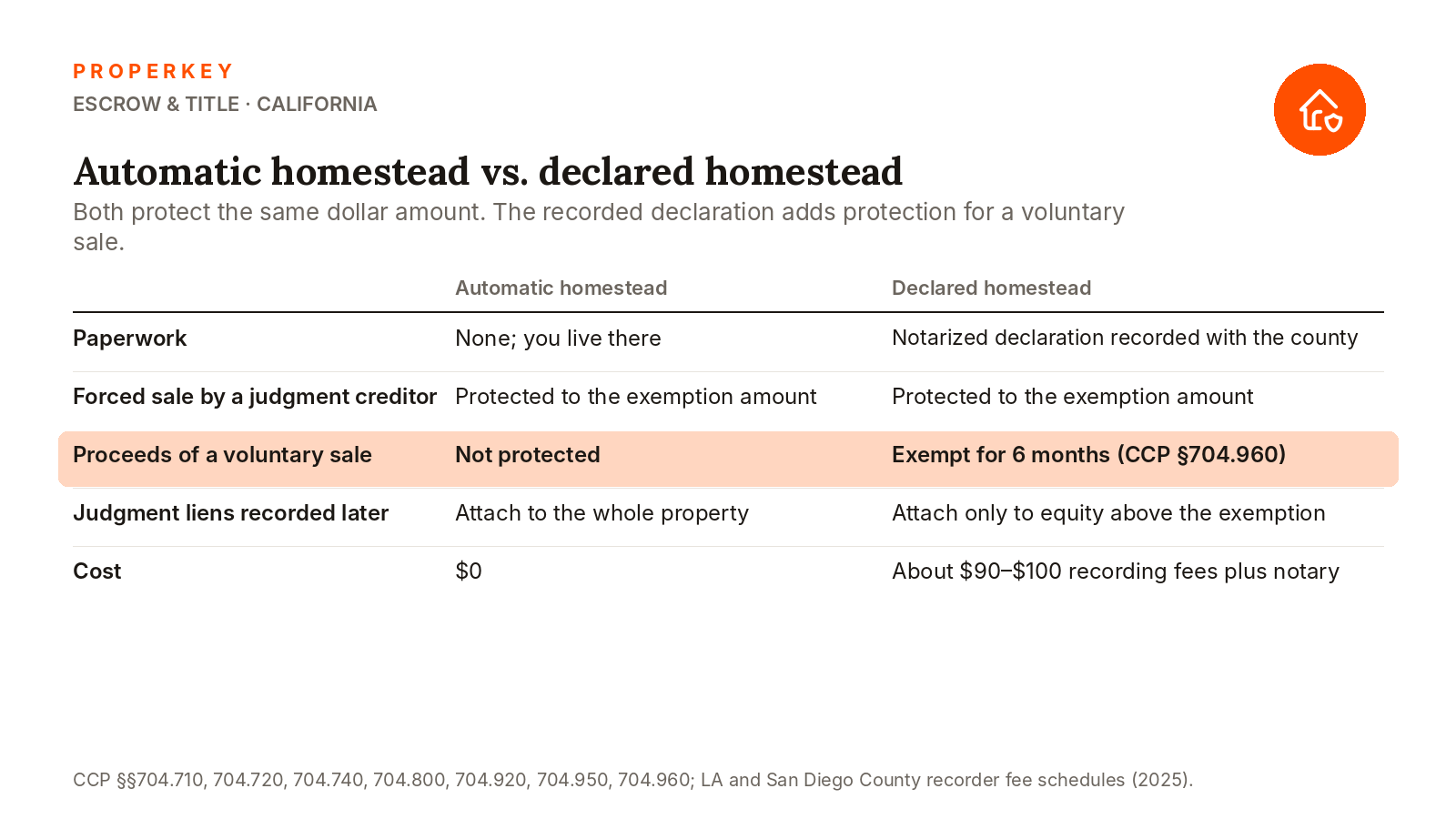
Recording is cheap. Los Angeles County charges $15 for the first page and $3 for each additional page plus the $75 state Building Homes and Jobs Act fee unless an exemption applies (LA Registrar-Recorder fee schedule); San Diego's first page is $14 (fee schedule effective July 1, 2025). San Diego County publishes a free Declaration of Homestead form, and the Sacramento County Public Law Library has a step-by-step guide with templates. Companies that mail "homestead filing" offers are regulated by Business and Professions Code §17537.6, which caps their total charge, including notary and recording, at $25 and requires the mailer to say in bold that "YOU DO NOT HAVE TO RECORD A HOMESTEAD DECLARATION" and that it "DOES NOT PROTECT YOUR HOME AGAINST FORCED SALE BY A CREDITOR." A $100 mailer is a sign to do it yourself.
What does the homestead exemption not protect against?
Quite a lot, and this is the part people get wrong.
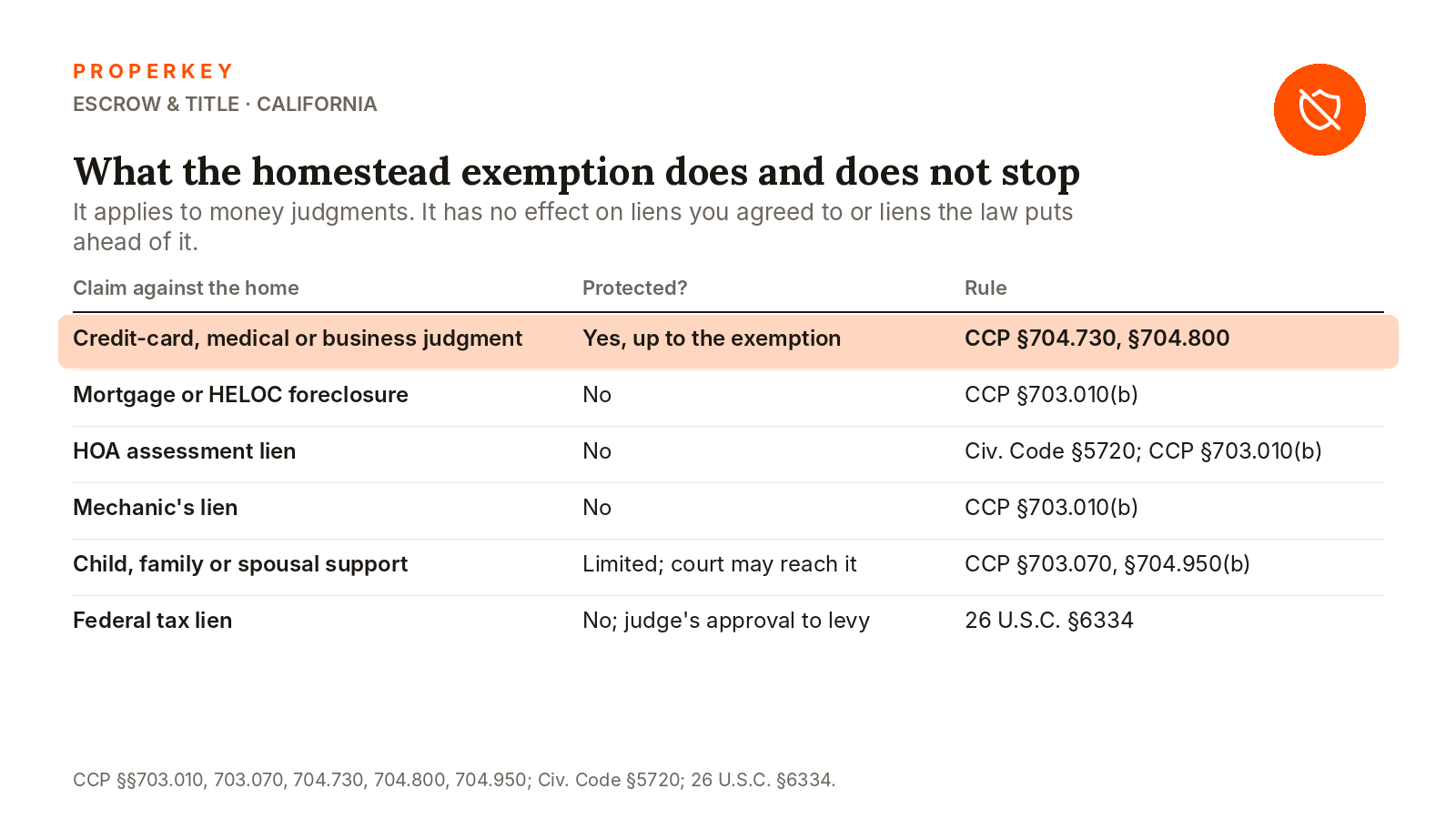
Your mortgage or HELOC. CCP §703.010(b) says the exemptions "do not apply if the judgment to be enforced is for the foreclosure of a mortgage, deed of trust, or other lien or encumbrance on the property." A lender forecloses on the whole home.
Mechanic's liens and HOA assessment liens. Both are enforced by foreclosing the lien, so the same subsection applies. An HOA may foreclose once assessments are $1,800 or more than 12 months delinquent (Civil Code §5720).
Child, family and spousal support. The exemption applies, but §703.070 lets the court order exempt property applied to a support judgment after weighing both sides' needs, and a recorded support judgment attaches to a declared homestead (§704.950(b)).
Federal tax liens. 26 U.S.C. §6334 overrides state exemptions; the IRS needs a federal judge's written approval to levy a principal residence, but the homestead amount does not bind it.
Voluntary sales, under the automatic homestead. Record a declaration if you intend to sell.
What it does reach is the ordinary money judgment: a credit-card or medical collection, a car-accident verdict above insurance, a business debt you guaranteed. A judgment lien lasts 10 years from the date the judgment was entered (§697.310) and can be renewed for another 10, though since 2023 a judgment under $50,000 for personal debt (or under $200,000 for medical debt) can be renewed once, for five years, and accrues interest at 5% instead of 10% (§683.110, §685.010). The lien does not disappear when a sale is impossible; it is paid from escrow when you eventually sell or refinance, after the exemption and senior liens if the sale is forced, and in full if the sale is voluntary and no declaration protected the proceeds. Properkey's escrow pulls every recorded lien in the preliminary title report, which is where most owners first learn one exists.
Does the exemption apply in bankruptcy?
Yes, and bankruptcy is where it is used most. California opted out of the federal exemption list (§703.130), so a California debtor chooses between two state sets: the §704 exemptions, with the full homestead above, or the §703.140(b) set, with a small $36,750 residence exemption and a wildcard (figures effective April 1, 2025, per form EJ-156). Owners with meaningful equity pick §704. Federal law adds two limits: you must have lived in California for 730 days before filing to use its exemptions, and equity acquired within 1,215 days before filing is capped at $214,000 (11 U.S.C. §522(b)(3) and (p), adjusted April 1, 2025). The Ninth Circuit held in Barclay v. Boskoski (2022) that the exemption amount is the one in effect on the bankruptcy filing date, not when the lien was recorded, which is how a lien recorded in 2014 against a $100,000 exemption was avoided in full against the $600,000 one. The home may be held in a revocable living trust and still qualify; the Court of Appeal said so in Fisch, Spiegler, Ginsburg & Ladner v. Appel (1992).
Is this the same as the homeowners' property-tax exemption?
No. California has no homestead property-tax exemption of the Florida or Texas kind. Its only general owner-occupant tax break is the homeowners' exemption in Revenue and Taxation Code §218: $7,000 off the assessed value of your principal residence, worth about $70 a year at the 1% basic rate. You claim it once with form BOE-266, in full if filed by February 15 and at 80% if filed by December 10 (§255, §275), and it stays on until you move. The creditor-protection homestead in CCP §704.730 has no effect on your tax bill, and the tax exemption has no effect on creditors, though a recorded homeowners' exemption does shift the burden of proof to the creditor at a §704.780 hearing. Properkey's guide to California property-tax deadlines covers the dates.
Questions people ask
What is the California homestead exemption amount for 2026? The greater of $373,175 or the countywide median sale price of a single-family home in the prior calendar year, capped at $746,350, under CCP §704.730 as clarified by AB 2782 (Stats. 2026, ch. 640). Both numbers adjust for inflation each January 1 starting in 2027.
Do I need to file anything to get it? No. The automatic homestead applies to the principal dwelling you live in. Recording a Declaration of Homestead adds protection for the proceeds of a voluntary sale for six months and limits later judgment liens to the equity above the exemption. The county forms are free and recording costs under $100.
Can a creditor take my house if my equity is below the exemption? Not through a judgment sale. Under CCP §704.800 the home cannot be sold unless a bid exceeds the exemption plus all liens. The judgment lien remains on title and is paid when you sell or refinance.
Does the homestead exemption stop a foreclosure? No. CCP §703.010(b) excludes the foreclosure of a mortgage, deed of trust or other lien on the property. It protects against unsecured judgment creditors, not against the lender who holds your deed of trust.
This article summarizes California and federal law for general information and is not legal advice. Anyone facing a judgment, a lien or a bankruptcy decision should talk to an attorney about the exemption that fits their situation.
Sources: CCP §704.730; AB 2782 (2026); Senate Judiciary Committee analysis; Judicial Council 2022 report; Form EJ-156; CCP §703.010; §703.070; §703.130; §703.140; §704.710; §704.720; §704.740; §704.780; §704.800; §704.920; §704.950; §704.960; §697.310; §683.110; §685.010; Civ. Code §5720; B&P Code §17537.6; R&T Code §218; §255; §275; BOE-266; 11 U.S.C. §522; Federal Register, Feb. 4, 2025; 26 U.S.C. §6334; In re Gilman (9th Cir. 2018); Barclay v. Boskoski (9th Cir. 2022); Fisch, Spiegler, Ginsburg & Ladner v. Appel (1992); LA County recording fees; San Diego County recording fees; San Diego Declaration of Homestead form; Sacramento County Public Law Library guide; C.A.R. September 2026 sales report.
Written by Keyro, Properkey's AI. Properkey, DRE #01979718.



