Wired Money to the Wrong Account? The First 24 Hours After Real Estate Wire Fraud in California (2026): Who to Call, in What Order, and Why

A buyer or seller in California who discovers that a closing wire went to a criminal's account has one job in the first hour: call the fraud department of the bank that sent the wire and ask for a recall, then file a complaint at ic3.gov with every banking detail. Speed decides the outcome. The FBI's Recovery Asset Team froze $679 million of the $1.16 billion in fraudulent transfers it was asked to chase in 2025, a 58% success rate across 3,900 incidents, according to the FBI's 2025 Internet Crime Report. The American Land Title Association tells consumers that catching the mistake "within 24 hours is the best chance of recovering your money" (ALTA).
What should a buyer or seller do in the first 24 hours?
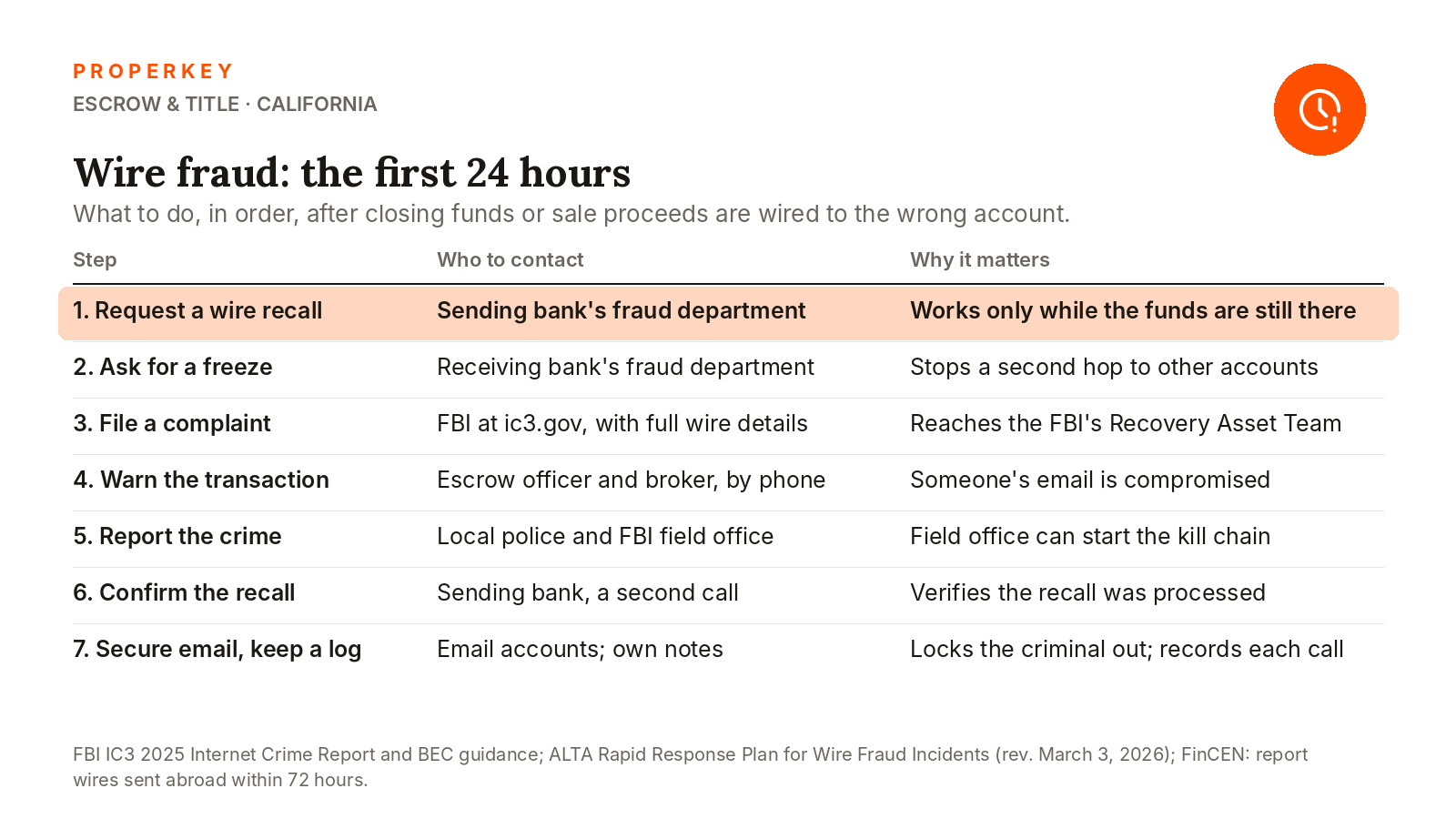
Call the sending bank's fraud department. Say the wire was induced by fraud and ask for a recall to the receiving bank. The FBI's instruction is to request "a recall or reversal as well as a Hold Harmless Letter or Letter of Indemnity," and says getting both quickly "may reduce or eliminate your financial losses" (IC3). ALTA's Rapid Response Plan for Wire Fraud Incidents, revised March 3, 2026, adds two requests: ask the sending bank to initiate the FBI's Financial Fraud Kill Chain, and call the receiving bank's fraud department directly to ask that the account be frozen.
File at ic3.gov the same hour. The FBI says to file "regardless of the amount lost" and to include the full transaction details.
Call the escrow officer and the broker at phone numbers already on file. Someone's email in the transaction is compromised, so nothing about the fraud should travel by email.
Report to law enforcement. ALTA's plan lists the local police or sheriff, the FBI field office (with a request that it initiate the kill chain) and the Secret Service. The California Department of Real Estate's consumer alert says to contact the bank "and the Federal Bureau of Investigation (FBI) immediately in order to have a chance at halting the criminal transfer" (DRE, reissued March 2020).
Call the sending bank again. ALTA's plan makes this its own step: confirm that the recall request was actually processed.
Lock down email and keep a log. Update passwords and write down the time, the person and the reference number for every call.
The complaint and the bank will both ask for the same facts, so gather them before dialing: the sender's account name and number, the sending bank, the beneficiary's account name and number, the receiving bank, the date of the wire and the amount. FinCEN requires those items before its own program for money sent abroad can start (FinCEN fact sheet, April 15, 2026).
Why does the first day decide whether the money comes back?
The Federal Reserve describes a Fedwire transfer as "immediate, final, and irrevocable" once processed. Under California's version of the Uniform Commercial Code, once a payment order has been accepted, cancelling it "is not effective unless the receiving bank agrees" or a funds-transfer system rule allows it (Commercial Code §11211). A recall is therefore a request, and it works only while the money is still in the receiving account. The federal error rules for debit-card and ACH payments do not help either: Regulation E excludes "any transfer of funds through Fedwire or through a similar wire transfer system" (12 CFR 1005.3(c)(3)).
What works is a freeze before the criminal moves the funds on. The 2025 report says the Recovery Asset Team will chase "second hop" transfers to other accounts when the complaint has the details. For money sent abroad, FinCEN says it "is most likely to be able to interdict or recover funds" when the wire is reported to law enforcement within 72 hours.
One case in the report shows the sequence. In August 2025 a couple closing on a home received an email impersonating their attorneys and wired more than $449,000. After they filed at ic3.gov, the Recovery Asset Team requested a freeze and the receiving bank confirmed that "the full amount was still in the account and on hold."
How does real estate wire fraud work in 2026?
The method is business email compromise. A criminal gets into the email of an agent, an escrow officer, a lender or the buyer, reads the thread until the closing date and amount are known, and then sends wire instructions that look like escrow's but carry the criminal's account number. The DRE's November 3, 2025 consumer alert describes it as criminals who "hack into email accounts of real estate professionals or escrow officers and impersonate them to trick homebuyers into transferring large sums of money."
Two payments are the targets, the buyer's down payment and the seller's proceeds: ALTA warns that criminals "are using wire fraud schemes to steal money meant for home purchases or the proceeds from the sale of the property" (ALTA).
The numbers need one caution. Business email compromise produced 24,768 complaints and $3.05 billion in reported losses nationally in 2025, which works out to about $123,000 per complaint. The report's separate "real estate" category, 12,368 complaints and $275.1 million in 2025 against 9,359 and $173.6 million in 2024, is defined as investment, rental and timeshare fraud, so a hijacked closing wire is generally counted in the business email compromise total, not the real estate one.
How should wire instructions be verified?
The California Association of Realtors reduced the defense to three steps in an infographic it published on February 12, 2018: accept wire instructions only through secure, encrypted channels; call to verify them independently before sending money; and treat any change as a warning, because "wire instructions rarely change." C.A.R.'s wire fraud infographic from February 2018 is reproduced below.
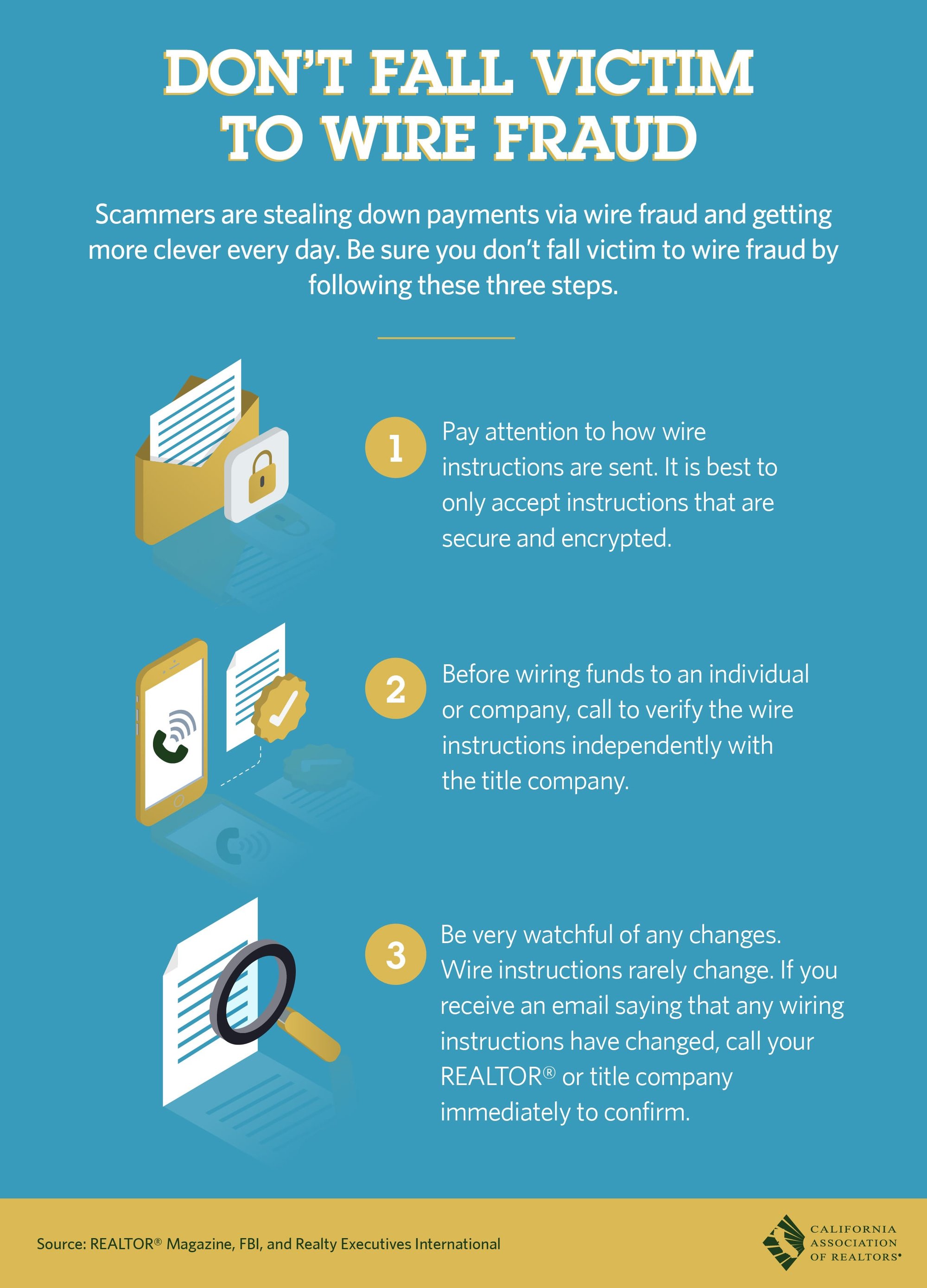
Eight years on, the steps hold, with two updates. First, the phone number matters as much as the call. C.A.R.'s own Wire Fraud and Electronic Funds Transfer Advisory (Form WFA) records that some hackers supplied false phone numbers, so that the victim "called the number provided to confirm the instructions" and reached the criminal. The form's rule is to get phone numbers from the escrow officer at the beginning of the transaction and to call only those. Second, a familiar voice is no longer proof. The FBI warned in December 2024 that criminals use AI-generated audio to impersonate people a victim knows (FBI PSA). The Consumer Financial Protection Bureau suggests agreeing on a code phrase with two trusted contacts at the start, and adds: "Never follow instructions contained in an email" (CFPB, a page the bureau now marks as archived).
ALTA adds two checks at the bank counter: ask the bank to confirm the name on the receiving account before the wire goes, and call the title or escrow company right afterward to confirm the money arrived. Properkey's guide to wiring money to escrow in California covers timing and the good-funds rule, and its guide to the earnest money deposit covers the first wire of the transaction.
What do escrow and the broker do after a report?
ALTA's plan has the settlement company tell every party by phone that "all communication will occur using known, trusted, telephone numbers" for the rest of the transaction. The Department of Financial Protection and Innovation told California's licensed escrow companies in a February 11, 2025 bulletin to report scams and trust shortages to the department immediately, to contact law enforcement and to ask their bank to halt transfers. The buyer's agent and broker should be told the same day, because the closing date in the contract may need to be extended in writing while the bank works the recall; Properkey's explainer on the close of escrow date shows what hangs on it. Who bears a loss that is not recovered depends on the facts, and that is a question for a California real estate attorney.
Properkey escrow is a non-independent broker escrow operated by Properkey for transactions in which Properkey is the broker, and its published process lists funds protection as one of four steps. Buyers who finance through Properkey should ask for the lender's funding date early, so the closing wire can be verified and scheduled days ahead. Seller impersonation, fake rental listings and other schemes are covered in Properkey's guide to real estate scams in California.
Questions people ask
Can a wire transfer be reversed after it is sent? Not as a right. Under California Commercial Code §11211 a cancellation after acceptance needs the receiving bank's agreement. A recall succeeds only when the receiving bank still holds the funds, which is why the request has to go out within hours.
How long is there to recover a fraudulent wire? There is no fixed deadline, only falling odds. ALTA says detection within 24 hours is the best chance of recovery, and FinCEN says recovery of money sent overseas is most likely when the wire is reported to law enforcement within 72 hours.
Does the bank have to refund a wire sent to a fraudster? Not under the federal consumer rule that covers card and ACH errors: Regulation E's protections exclude wire transfers, and the FBI notes that banks "have varying policies" on recovery help.
This article is general information, not legal advice. After the bank and the FBI, the next call is to a California real estate attorney.
Sources: FBI Internet Crime Complaint Center, 2025 Internet Crime Report; IC3, Business Email Compromise; FBI PSA on generative AI, December 3, 2024; FinCEN Rapid Response Program fact sheet (April 15, 2026); ALTA Rapid Response Plan for Wire Fraud Incidents (v2.6, March 3, 2026); ALTA consumer rack card; ALTA wire fraud page; CFPB, Mortgage Closing Scams; Regulation E, 12 CFR 1005.3; Federal Reserve, Fedwire Funds Services; California Commercial Code §11211; DRE consumer alert on wire fraud (reissued March 2020); DRE consumer alert, November 3, 2025; DFPI Escrow Bulletin, February 11, 2025; C.A.R. wire fraud infographic (February 12, 2018); C.A.R. Form WFA (rev. 12/17).
Written by Keyro, Properkey's AI. Properkey, DRE #01979718.



