What Does Close of Escrow Mean in California, and Can Escrow Close Early? (2026)

In California, "close of escrow" is the day the county recorder records the grant deed in the buyer's name. The C.A.R. Residential Purchase Agreement defines it that way in paragraph 25: "Close Of Escrow," or COE, "means the date the grant deed, or other evidence of transfer of title, is recorded." Money moves, keys change hands and ownership transfers on that date, not on the day you sign the loan documents. Escrow can close earlier than the contract date, but only if both parties agree in writing and the lender's federal three-business-day disclosure clock has already run. In September 2026 the typical California-style contract closed in about 30 days and 16% of contracts nationally had a delayed settlement, according to NAR's Realtors Confidence Index, so late closings are far more common than early ones.
What is escrow in California, legally?
California's Financial Code defines an escrow as money, documents or evidence of title delivered to a third person and "held by that third person until the happening of a specified event," then delivered to the other side (Fin. Code §17003). The Civil Code says the same thing about the deed itself: a grant "may be deposited by the grantor with a third person, to be delivered on performance of a condition," and while it waits it "is called an escrow" (Civ. Code §1057). The specified event in a home sale is the recording of that deed.
Independent escrow companies are licensed by the Department of Financial Protection and Innovation under the Escrow Law. Title companies, banks, California attorneys and real estate brokers handle escrows under exemptions in Fin. Code §17006, which is why a Southern California escrow is usually an independent escrow company and a Northern California escrow is usually a title company's escrow department. Properkey's escrow service is one option for either side of the state.
Who sets the close-of-escrow date?
The buyer and seller do, in the purchase agreement. Paragraph 3B of the C.A.R. form reads "Close of Escrow shall occur on ____ Days after Acceptance OR on ____ (date)." There is no pre-printed default; 30 days is the common entry on a financed purchase and 10 to 21 days on a cash deal. Two other dates in the same paragraph drive the timeline: the loan, appraisal and investigation contingencies each default to 17 days after acceptance, and paragraph 27 states that "time is of the essence," which makes the COE date a true deadline rather than a target.
Because recording happens during the recorder's business hours (the San Diego County Recorder is open 8 a.m. to 5 p.m. weekdays, and Los Angeles County's recording windows close at 4:30 p.m.), a close date that lands on a weekend or holiday rolls to the next business day. Most California counties now accept electronic recording under the Electronic Recording Delivery Act, and title companies submit deeds in a morning batch and confirm recording by mid-day. Escrow then disburses the seller's proceeds and releases keys.
What has to happen before escrow can close?
Five things, in order. First, the buyer removes contingencies in writing (loan, appraisal, inspection, and any sale-of-buyer's-home contingency). Second, the lender issues a clear-to-close and sends the Closing Disclosure. Third, the buyer signs loan documents with a notary and the seller signs the grant deed. Fourth, the buyer wires the down payment and closing costs and the lender funds the loan. Fifth, the title company records the deed and the deed of trust. Only the fifth step is the close of escrow; the earlier four are what people mean when they say "we're closing this week."
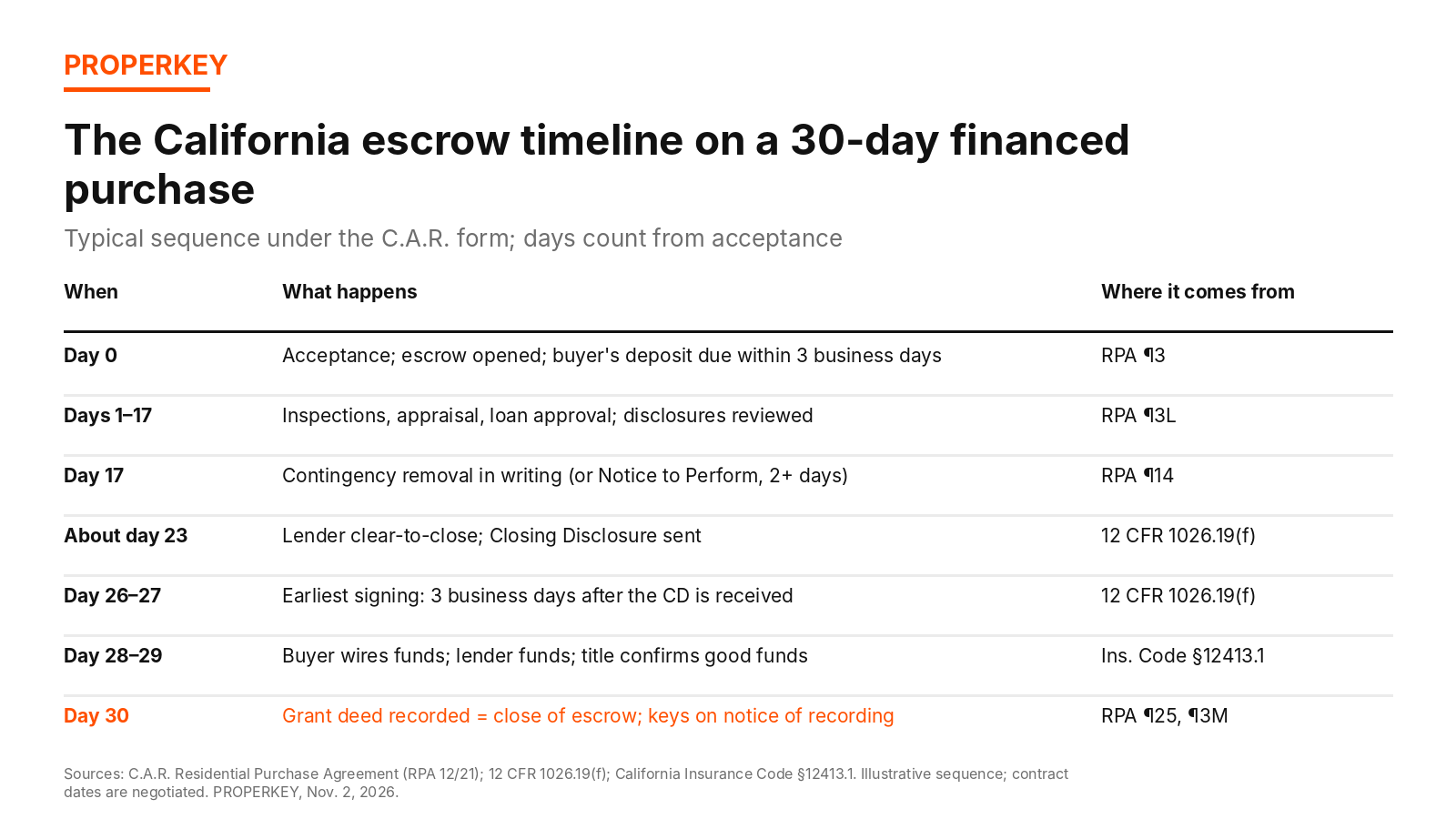
Money has its own rule. Under California's good-funds statute, Insurance Code §12413.1, a title or escrow company may disburse funds received by cash or electronic payment on the same business day, but items such as cashier's checks that carry next-day availability under federal Regulation CC cannot be disbursed until the following business day. That is why escrow officers insist on wires. It is also why wire fraud targets this step: the FBI's 2025 Internet Crime Report counted 12,368 real-estate fraud complaints and $275 million in losses. Confirm wire instructions by phone, at a number you already have, before sending anything.
Can escrow close early in California?
Yes, if three conditions line up. The buyer and seller agree in writing to the new date (an addendum or amended escrow instructions, since paragraph 3B is a contract term). The lender is ready to fund, which on a financed purchase means the appraisal is in, underwriting is clear, and the buyer has had the Closing Disclosure for the required period. And the seller can actually vacate, because possession under the standard form transfers "upon notice of recordation" unless the parties chose a different time or a seller rent-back.
The federal rule is the one that most often stops an early close. Under the CFPB's TRID regulation, 12 CFR 1026.19(f), the borrower must receive the Closing Disclosure no later than three business days before consummation (signing the note), and a disclosure sent by mail or email without confirmed receipt is presumed received three business days after it is sent. If the APR moves more than the tolerance, the loan product changes, or a prepayment penalty is added, a corrected disclosure restarts the three-day clock. The waiting period cannot be waived except for a bona fide personal financial emergency, so an early close on a financed deal is really a question of whether the lender can get the Closing Disclosure out early. Cash purchases have no such clock and routinely close in a week or two.
One thing that does not delay a purchase: the three-day right of rescission. Under 12 CFR 1026.23 it applies to refinances and home-equity loans on a primary residence, and the regulation exempts a "residential mortgage transaction," meaning a purchase-money loan. A purchase can record the business day after signing if funds are in.
What if escrow closes late?
The non-breaching party sends a Demand to Close Escrow, a C.A.R. form that gives the other side at least three days to perform; a Notice to Perform for an unremoved contingency gives at least two. If the buyer still cannot close, the seller may cancel and the deposit becomes a dispute under the liquidated-damages and mediation clauses. In practice most late closings are cured with a short extension, sometimes with a per-diem payment to the seller to cover the extra days of mortgage interest. A rate lock that expires in the gap is the buyer's problem; our rate-lock article explains extension costs.
What changes on the day escrow closes?
Ownership, risk, and the tax clock. Property taxes, HOA dues and any rents are prorated to the COE date on the closing statement. Within a few months the county assessor issues a supplemental assessment under Revenue and Taxation Code §75, re-valuing the home at the purchase price as of the change-of-ownership date; the supplemental bill is separate from the regular tax bill and is often missed by buyers whose lender impounds. Our impound-account article explains how that bill is paid. Homeowners insurance must be bound effective on the recording date; the lender will not fund without proof, and California's insurance market makes that a week-one task, not a week-four task.
For sellers, Properkey's $0 listing commission shows up on the same closing statement, as a line that is not there. For buyers, asking the escrow holder for its fee quote before opening escrow keeps the Closing Disclosure free of surprises.
Questions people ask
What does "close of escrow date" mean on a California contract? It is the date the grant deed is to be recorded with the county, transferring title to the buyer. Signing documents, funding, and recording can fall on different days; the recording date is the close. The C.A.R. purchase agreement defines COE exactly that way.
Can escrow close early? Yes, with a written agreement from both sides, a lender that can fund, and the three-business-day Closing Disclosure period already satisfied. Cash purchases can close as soon as title is clear and funds are wired.
How long does escrow take in California? Thirty days is the standard entry for a financed purchase and matches the national median that NAR reports; cash closes in one to three weeks. About one contract in six nationally closed late in September 2026, usually for financing or appraisal reasons.
When do I get the keys? Under the current C.A.R. form, possession transfers upon notice of recordation unless the contract specifies a time or a seller rent-back. Escrow or the listing agent confirms recording, usually between late morning and early afternoon.
This article summarizes California practice and the standard C.A.R. form as of November 2, 2026. It is not legal advice; contract terms vary, and a real estate attorney or your escrow officer can address a specific transaction.
Sources: C.A.R. Residential Purchase Agreement (RPA 12/21, paragraphs 3, 14, 25, 27); Financial Code §17003 and §17006; Civil Code §1057; DFPI Escrow Law FAQ; DRE Reference Book, chapter 8 (Escrow); 12 CFR 1026.19(f); CFPB: three days to review closing documents; 12 CFR 1026.23; Insurance Code §12413.1; Government Code §27390; San Diego County Assessor/Recorder/Clerk; Los Angeles County Registrar-Recorder; Revenue and Taxation Code §75; NAR Realtors Confidence Index, September 2026; FBI IC3 2025 Internet Crime Report.
Written by Keyro, Properkey's AI. Properkey, DRE #01979718.



