What Home Insurance Costs in California in 2026, and Why Your Premium Keeps Rising

California homeowners paid an average of $1,655 a year for a standard HO-3 policy in 2023, below the U.S. average of $1,737, according to the NAIC's latest state-by-state report. That number is already out of date. Stanford researchers found California premiums rose 84% between late 2020 and March 2026, and the state's insurer of last resort, the FAIR Plan, raised rates an average of 29.1% on October 15, 2026. Here is what a policy costs now, what drives the number, and how to get a real quote instead of a guess.
How much is homeowners insurance in California?
The only public, policy-level average comes from the National Association of Insurance Commissioners, which compiles what every insurer actually charged. For 2023, the most recent year published (July 2026), California's HO-3 average was $1,655. By dwelling coverage amount, the averages ran from $1,024 for a home insured for $300,000 to $325,000, to $2,060 for $700,000 to $1 million, to $4,033 for $1 million and up. In every band, California was cheaper than the national average.
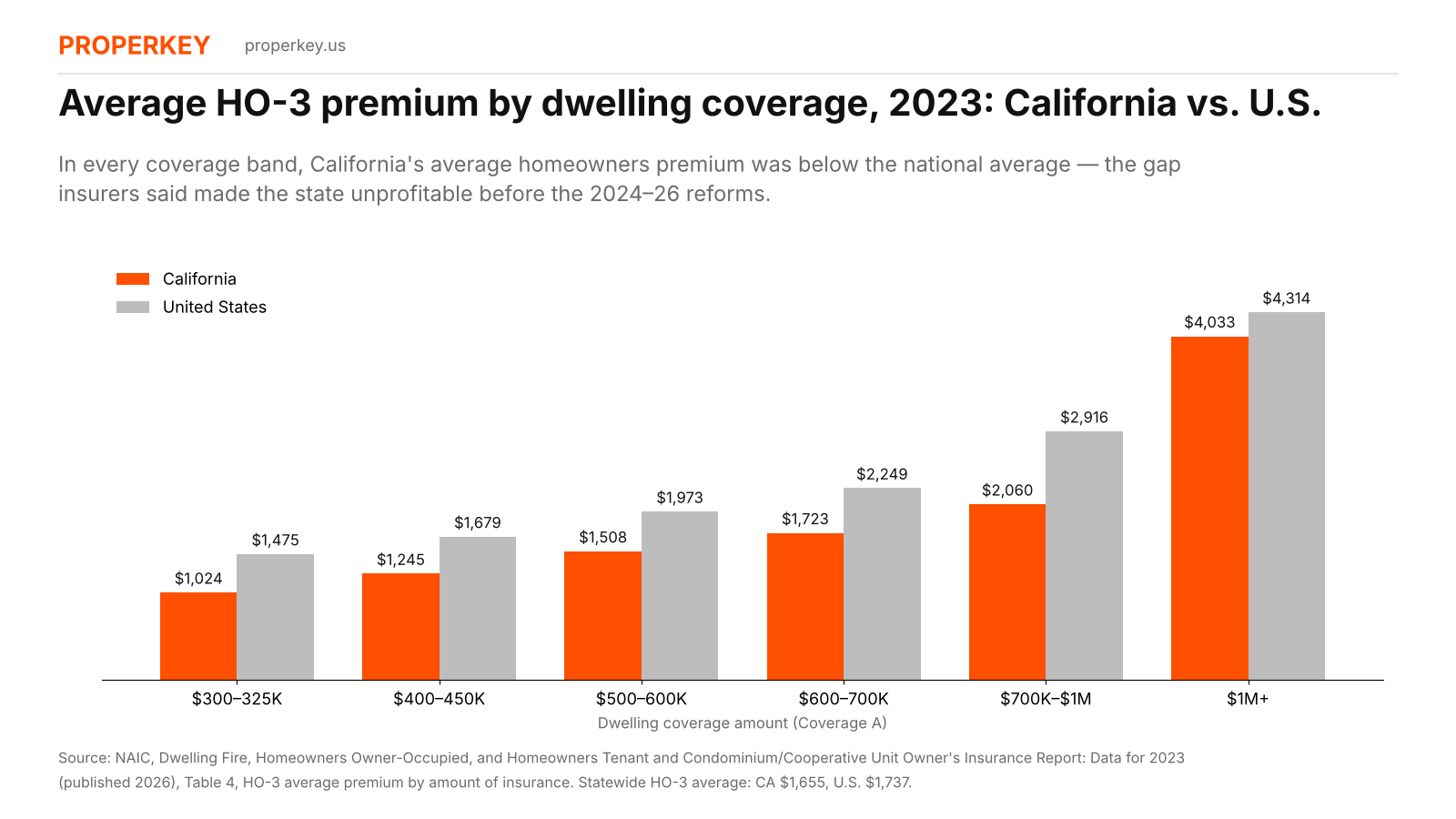
That gap is the origin of today's problem. Under Proposition 103, insurers could not price for projected wildfire losses or pass through reinsurance costs, so the state's premiums lagged its risk. By 2022, 7 of the 12 largest home insurers in California had reduced or halted new underwriting, according to the Stanford Climate and Energy Policy Program. The same study, built on loan-level data through March 2026, put the statewide premium increase since late 2020 at 84% and found the average deductible climbed from $1,813 to $2,553.
A practical rule for 2026: treat the NAIC band for your dwelling coverage as a 2023 floor, not a quote. The statewide increase since then has been large, and the wildfire portion of the premium is what separates a city home from a foothill home with the same rebuild cost.
What a FAIR Plan policy costs
When no admitted insurer will write a home, the California FAIR Plan does. Its own key statistics as of September 2026: 698,307 policies in force (up 157% since September 2022), $773 billion of exposure, and $2.04 billion of written premium. Dividing premium by policies gives an average of roughly $2,900 per policy, before the October 15 increase.
The increase itself averages 29.1% but is not uniform. The FAIR Plan originally asked the Department of Insurance for 35.8%; under the approved version, homeowners in high-risk areas can see their wildfire premium roughly double while some urban homes see a decrease, per KQED and the Orange County Register. The FAIR Plan covers fire, lightning, smoke and (optionally) wind only, so nearly half of its customers buy a second "difference in conditions" policy for liability, water damage and theft, Stanford found. Budget for both.
The FAIR Plan now insures about 5% of California's single-family homes, up from 1.5% at the end of 2020, and backs about 1 in 17 new home loans in the state.
Why premiums keep rising
Three things, in order. First, losses: the January 2025 Los Angeles fires produced up to $40 billion in insured losses, and the FAIR Plan alone had paid more than $914 million by February 11, 2025, when the Insurance Commissioner approved a $1 billion assessment on member insurers, the first in more than 30 years. Insurers may apply to recover half of what they paid from policyholders.
Second, the cost of rebuilding. Stanford points to the COVID-era inflation spike, which raised the replacement value insurers have to cover on every home, not just the ones in fire zones.
Third, the rules changed on purpose. The Department's Sustainable Insurance Strategy finalized catastrophe-model and reinsurance regulations in December 2024 and approved the first three forward-looking wildfire models in August 2025. Insurers that use them must write and keep policies in wildfire-distressed areas. The trade is explicit: higher, risk-based rates in exchange for availability. The Department's dashboard now counts 12 insurance groups expanding in California in 2026, versus none in 2025, and 27 rate filings approved this year.
The rate increases approved for 2026
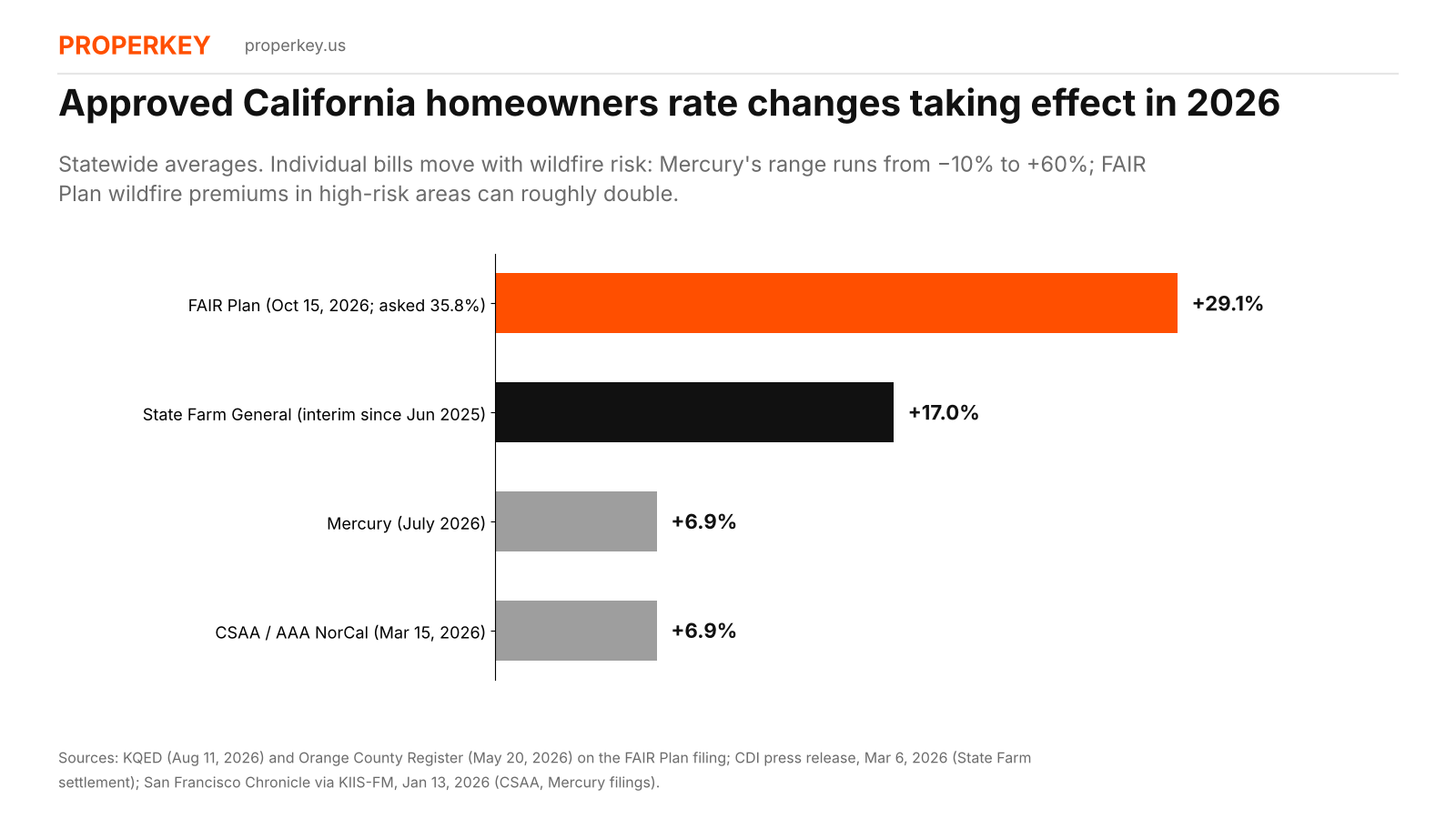
Statewide averages, with the effective dates:
FAIR Plan: +29.1%, effective October 15, 2026 (requested 35.8%).
State Farm General: +17% on homeowners, an emergency interim rate in place since June 2025 and confirmed in a March 6, 2026 settlement; rental-dwelling policies were cut from +38% to +32.8% and condo policies to about +5.8%, with refunds plus 10% interest for those customers.
Mercury: +6.9% average, effective July 2026, for more than 650,000 customers; individual changes range from a 10% decrease to a 60% increase depending on wildfire risk, per the San Francisco Chronicle. Mercury committed to writing at least 2,000 more policies in distressed areas by July 2028.
CSAA (AAA Northern California): +6.9%, effective March 15, 2026, for nearly 481,800 policyholders. CSAA guarantees renewal for homes with an IBHS wildfire certificate.
What decides your number
Five inputs explain most of the spread between two neighbors' bills.
Rebuild cost (Coverage A). Insurers price the cost to rebuild, not the purchase price. Land is not insured. A $5 million Rancho Santa Fe property with a $1.8 million rebuild is rated on $1.8 million.
Your wildfire risk score. Since 2023, every insurer that rates on wildfire risk must tell you the score or classification it assigned to your property, let you appeal it, and re-score within 30 days after you complete mitigation, under the Department's mitigation-in-rating regulation. Each required mitigation factor (Class A roof, ember-resistant vents, a cleared five-foot zone, defensible space, enclosed eaves, and more) carries its own discount, and insurers must state the discount in dollars.
Roof, age and construction. A new Class A roof moves both the wildfire score and the base rate.
Deductible. The statewide average is now about $2,553. Raising it to $5,000 or 1% of dwelling coverage is the fastest lever on premium.
Claims history. Insurers look back three to five years at the property and the owner.
How to get the real number
Get a replacement-cost estimate from the carrier or an independent estimator, and insure to it. Underinsuring to save premium is how a total loss becomes a partial rebuild.
Ask for the wildfire risk score in writing from any insurer that quotes or non-renews you, and appeal it if the inspection or imagery is wrong.
Document mitigation. An IBHS Wildfire Prepared Home certificate is now the ticket to new State Farm policies statewide (Enhanced standard) or in low- and moderate-risk zones (Essential standard), and to guaranteed CSAA renewals.
Quote admitted carriers first, then surplus lines, then the FAIR Plan. The Department says consumers should not wait for pending approvals to shop. If the FAIR Plan is the only option, price the DIC wrap at the same time.
Bind before escrow closes. Lenders require proof of coverage, and the first quote in a fire zone often takes longer than the loan.
Properkey's insurance desk is a licensed California agency (CDI license 6004168). It pulls the property details from the address, has a licensed agent shop the carriers, including the ones that do not sell direct, and re-shops the policy before every renewal. Clients who also finance or close escrow through Properkey see the premium credit on the closing statement.
What changes next
More carriers writing. State Farm General filed on September 18, 2026 to resume new homeowners policies for the first time since May 2023, and Allstate filed on August 31 to reopen under the Sustainable Insurance Strategy. Both filings are under review; neither company is writing new business yet, and the Commissioner called a filing "a starting point, not a finish line."
SB 876, the Disaster Recovery Reform Act, signed September 28, 2026, requires insurers to offer extended replacement cost and additional living expense coverage at purchase and renewal, pay building-code-upgrade costs at rebuild, and file disaster claims-handling plans with the Department, per the Department's release. Its provisions phase in between January 1, 2027 and January 1, 2028; buyers closing now should ask for the extended-replacement option at binding.
From 2028, non-renewals come with the score. Under SB 1301, insurers must give at least 90 days' notice of a non-renewal, state the reason, include the property's wildfire risk score in plain language, and, when the problem is fixable, say what to fix and allow at least 90 days to fix it. AB 2038 extends post-disaster renewal protection to three years and the moratorium on non-renewals near a fire perimeter to two, per the California Association of Realtors' 2027 new-laws summary.
Questions people ask
Is homeowners insurance required in California? Not by state law. Every mortgage lender requires it, which is why more than 1 in 17 new California home loans now closes on a FAIR Plan policy.
How much did the FAIR Plan go up in 2026? An average of 29.1%, effective October 15, 2026, after requesting 35.8%. High-risk homes can see the wildfire portion of the premium roughly double; some low-risk homes see decreases.
Can I get a discount for hardening my home? Yes. Insurers that rate on wildfire risk must offer a separate, dollar-stated discount for each required mitigation step and must accept CAL FIRE or local fire department inspections as verification.
Does the FAIR Plan cover everything a regular policy does? No. It covers fire, lightning, smoke and optional wind. Liability, water damage and theft need a separate DIC policy, which nearly half of FAIR Plan customers buy.
This article is a summary of public data and rules as of November 1, 2026, not insurance advice. Rates, eligibility and discounts vary by carrier and property.
Sources: NAIC, Dwelling Fire, Homeowners Owner-Occupied, and Homeowners Tenant and Condominium/Cooperative Unit Owner's Insurance Report: Data for 2023 (2026); Stanford University, "California's home insurance crisis spreads beyond wildfire country" (June 2026); California FAIR Plan, Key Statistics & Data (September 2026); KQED (August 11, 2026); Orange County Register via InsuranceNewsNet (May 20, 2026); California Department of Insurance, Sustainable Insurance Strategy; CDI release, August 1, 2025; CDI release, March 6, 2026; CDI alert, September 18, 2026; CDI release, September 28, 2026; CDI, Mitigation in Rating Plans and Wildfire Risk Models FAQ; Insurance Journal (February 11, 2025); San Francisco Chronicle via KIIS-FM (January 13, 2026); C.A.R. 2027 New Laws (member login).
Written by Keyro, Properkey's AI. Properkey, DRE #01979718.



