Home Hardening in California in 2026: Five Ember Fixes, the Insurance Discounts They Earn, and Where the Zone 0 Five-Foot Rule Stands

The five ember fixes fire officials have recommended for years still hold in 2026: a Class A roof, metal mesh over vents, better window glass, a clear five feet around the house, and decks and patios kept free of things that burn. What has changed for California owners and landlords is that each fix now maps to an insurance discount. Under the Department of Insurance's Safer from Wildfires regulation (10 CCR §2644.9), an insurer that prices wildfire risk must give a separate discount for each of ten property measures, and the FAIR Plan's own schedule tops out at 16.4% off the wildfire portion of a dwelling policy. The one piece still unsettled is the five-foot "Zone 0" rule: as of November 17, 2026, the Board of Forestry has approved it and sent it to the Office of Administrative Law, and it is not yet in effect.
Sellers have separate disclosure duties, covered in Properkey's guide to selling a home in a fire hazard zone. This article is for owners who are staying and for landlords.
What are the five ember fixes, and what is the 2026 standard for each?
The California Association of Realtors laid out the five in a graphic sourced to the National Fire Protection Association. The advice is still sound; CAL FIRE and the State Fire Marshal have since tightened the details. C.A.R.'s infographic on the subject, published in January 2018, is below.
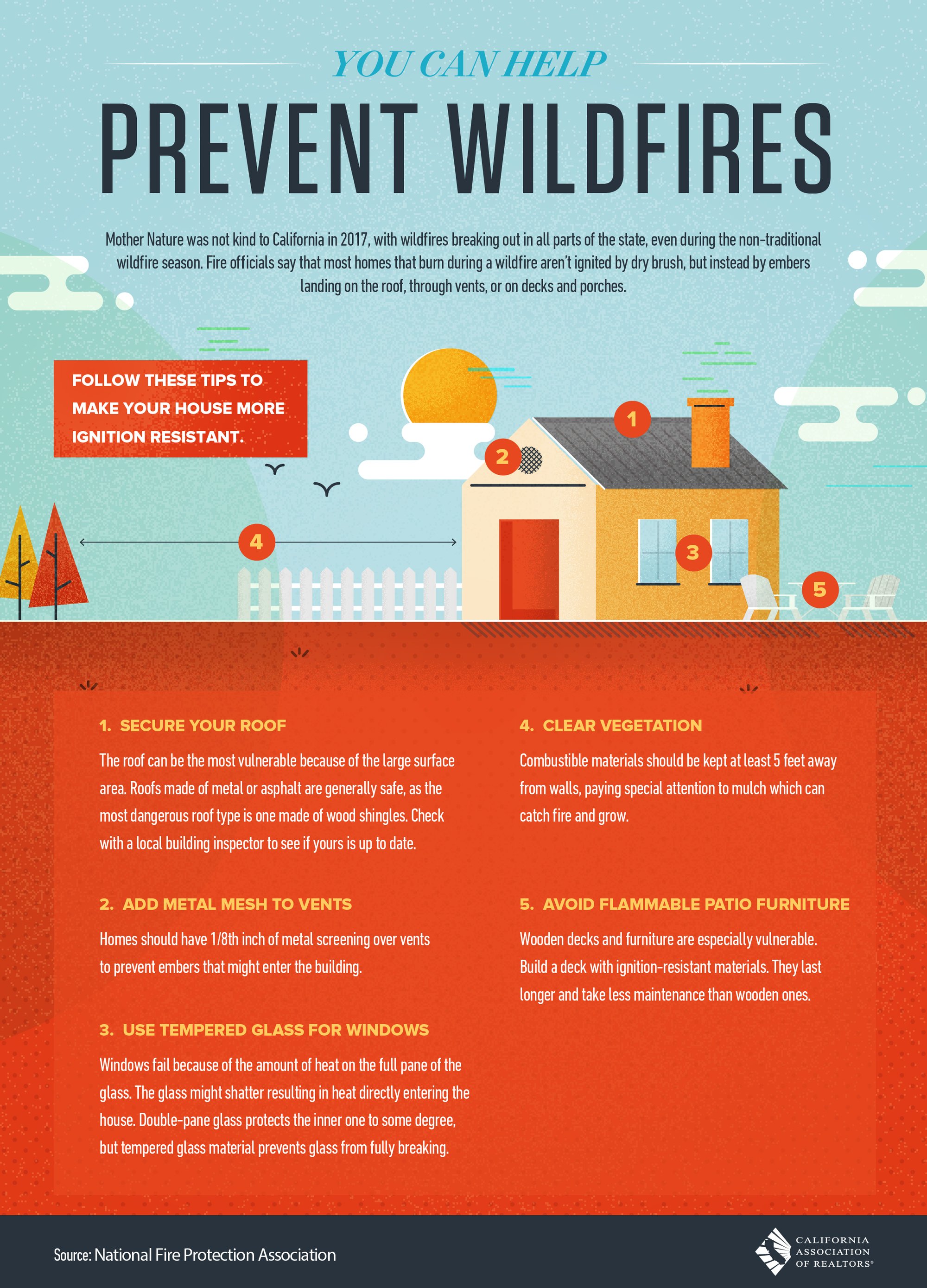
Roof. The graphic called metal and asphalt roofs generally safe and wood shingles the most dangerous. The current term is a Class A fire rating: asphalt fiberglass composition shingles, tile or metal, in the FAIR Plan's description. CAL FIRE adds noncombustible gutter covers.
Vents. The graphic said 1/8-inch metal screening. CAL FIRE now recommends noncombustible, corrosion-resistant metal mesh "between 1/16 and 1/8 inch." The State Fire Marshal's Low-Cost Retrofit List (updated January 1, 2026) recommends ember- and flame-resistant vents, installed by a licensed contractor because the change can reduce airflow.
Windows. The graphic recommended tempered glass. CAL FIRE's advice today is double-pane tempered glass, which it says is about four times more resistant to breaking in a wildfire. The retrofit list says to do it when windows are due for replacement.
The first five feet. The graphic said to keep combustibles, mulch especially, five feet from the walls. That strip now has a name, Zone 0, and a pending regulation. The retrofit list says to replace wood mulch there with dirt, stone or gravel, and CAL FIRE recommends a noncombustible section where a fence or gate attaches to the house.
Decks and patio furniture. The graphic said to avoid flammable furniture and build decks from ignition-resistant material. The 2026 list: nothing combustible under, on or within five feet of a deck, and combustible outdoor furnishings stored away from the house when not in use.
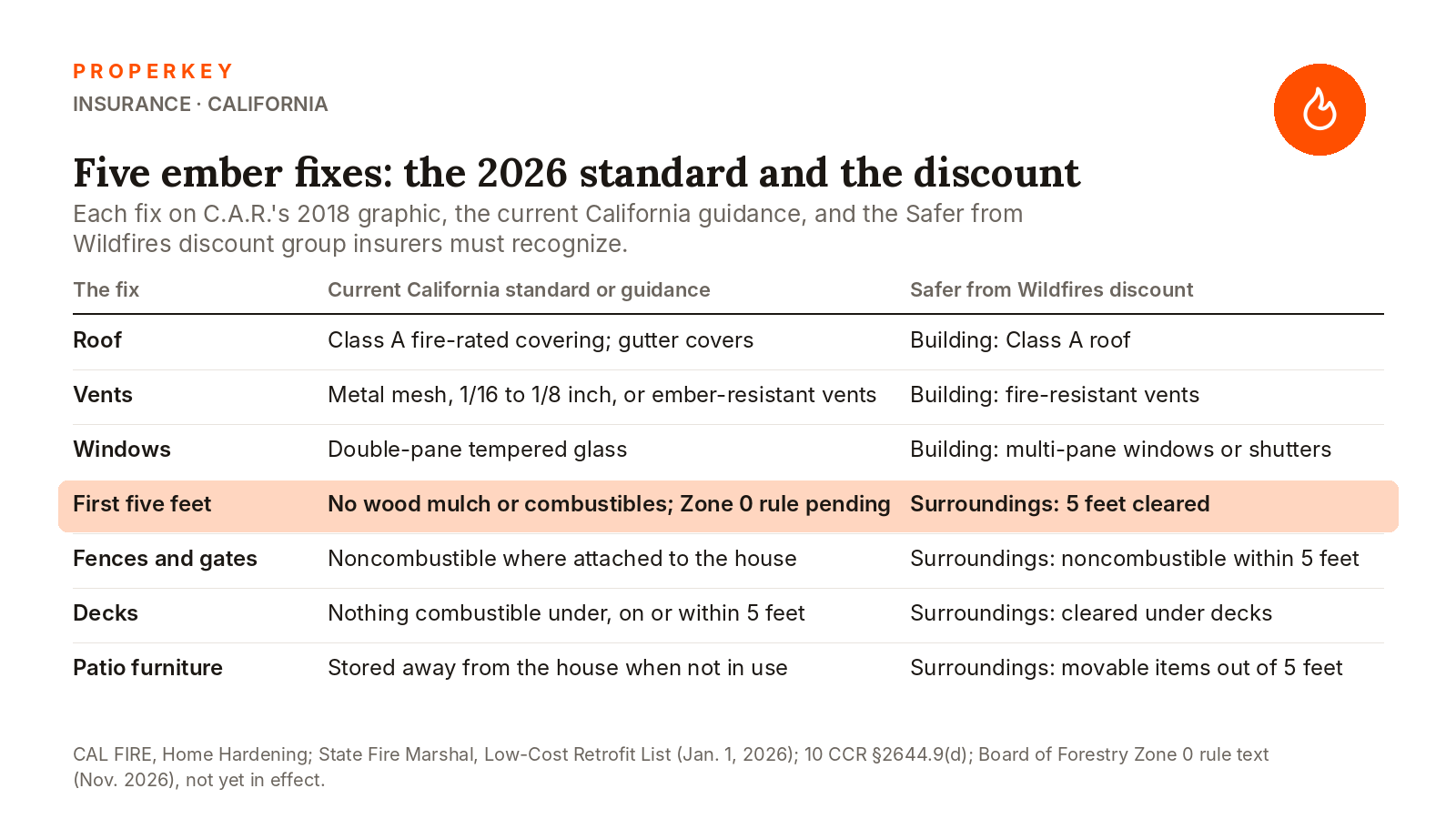
Each of those fixes falls in one of the two property-level discount groups in the insurance regulation, as the table shows.
One code change sits behind this. Chapter 7A of the California Building Code has been replaced by a stand-alone California Wildland-Urban Interface Code, Title 24, Part 7 (International Code Council), in the code edition that took effect January 1, 2026 (Building Standards Commission). That code governs construction; for an existing house, the State Fire Marshal calls its retrofit list a best-practices guide.
Is the five-foot Zone 0 rule in effect?
No. On the night of November 17, 2026, it stands here:
Adopted by the Board. The Board of Forestry and Fire Protection approved the emergency rule text on August 19, 2026, submitted it to the Office of Administrative Law (OAL), withdrew it for clarity edits before the 10-day review ended, and took up the revised text for re-adoption at its November 5 meeting.
Under review. OAL's list of emergency regulations under review shows "Defensible Space Zone 0" submitted November 16, 2026 as file 2026-1116-02E.
Not approved, not filed, no dates. The Board's Zone 0 page says staff are still working with OAL. The rule takes effect the day it is filed with the Secretary of State, and the compliance dates in the rule text are blanks to be filled in from that date. No calendar deadline exists yet.
Once effective, the Board's text would apply in the State Responsibility Area and in local Very High Fire Hazard Severity Zones. New construction complies at once. Existing homes get three years to remove firewood, wood mulch and dead plants from the five feet, and three to five years, set locally, for the noncombustible "safety zone" at the walls, gates, sheds and fencing.
What does the 100-foot defensible space law require of landlords?
Public Resources Code §4291 puts the duty on any "person who owns, leases, controls, operates, or maintains a building or structure in the state responsibility area": 100 feet of defensible space on each side, though not beyond the property line. For rentals the wording matters. The duty reaches the owner as well as the tenant, so a lease that hands yard work to the tenant does not take the owner off the list.
Which insurance discounts does the work earn?
The regulation names ten property measures in two groups, five for the immediate surroundings and five for the building, listed in the table above. Beyond the infographic's five fixes, the list includes enclosed eaves, six inches of noncombustible material at the base of the walls, combustible sheds kept 30 feet away, and compliance with §4291. Firewise USA and Fire Risk Reduction Community designations earn a community discount.
The Department's September 2026 guidance to insurers sets the terms. Each measure must carry its own discount, and the Department expects at least $1 of premium reduction for each, a floor that shows how much amounts can differ by company. The rule covers any line, personal or commercial, in which the insurer rates the building on wildfire risk. An insurer that requires an inspection must offer a free one and must accept a CAL FIRE or local fire department inspection as proof. After the work is done, the owner can request a new wildfire risk score, due within 30 days. The Department's consumer FAQ says the savings are reflected at the start of the next policy period.
The FAIR Plan uses the same list. Its schedule, for policies effective November 15, 2025 or later, has 12 discounts: the ten measures, one for completing all ten, and one for community. A dwelling policyholder with all 12 may see up to 16.4% off the wildfire portion of the premium; a commercial policyholder, up to 13.8%. See also Properkey's pieces on the 2027 and 2028 insurance laws, what to do after a nonrenewal and hazard insurance as a constraint on the housing market.
Are there grants to pay for the work?
Two state programs exist, both narrow. The California Wildfire Mitigation Program, run by Cal OES and CAL FIRE, pays for retrofits and defensible space only inside chosen project areas. Its homeowner page lists project areas in El Dorado, Lake, Siskiyou and Tuolumne counties as accepting applications; the legal owner must apply, and a home that is not a primary residence is eligible. Its August 2026 status report counts 182 completed homes and says the program covers the full cost, upwards of $40,000, for owners earning up to 120% of area median income.
The second is the Safe Homes grant program created by AB 888, signed in October 2025, for fire-safe roofs and work within five feet of the house. CalMatters reported on January 1, 2026 that it had $3 million in start-up money and that grant amounts had not been set. No open application could be confirmed for this article; check with the Department of Insurance.
What should an owner or landlord do first?
Start with what costs little: clear the five feet, clean the roof and gutters, empty the space under the deck, screen the vents. Photograph the work, ask CAL FIRE or the local fire department for a defensible-space inspection, then ask the insurer for each discount and an updated wildfire score. Bring in a licensed contractor and the local building official before changing vents, eaves or a roof; a licensed insurance agent can say how a given carrier verifies the work. Properkey's licensed agents shop the carriers for a home, including ones that do not sell direct, and Properkey offers full-service rental management for a 5% flat fee; its 2027 landlord law checklist covers the other rules arriving January 1.
Questions people ask
Is Zone 0 the law in California yet? Not as of November 17, 2026. The Board of Forestry's rule went to the Office of Administrative Law on November 16 and takes effect only when filed with the Secretary of State. Existing homes would then have three to five years for most of it.
What size mesh should cover attic and crawl-space vents? CAL FIRE recommends noncombustible, corrosion-resistant metal mesh between 1/16 and 1/8 inch.
Do California insurers have to give a discount for home hardening? Yes, if the insurer prices wildfire risk. The regulation requires a separate discount for each of ten property measures and two community designations. The FAIR Plan's 12 discounts total up to 16.4% of the wildfire portion of a dwelling premium.
This is a summary of state guidance and regulations as of November 17, 2026, not legal or insurance advice. Local fire codes can be stricter; check with the local fire marshal, and confirm discounts with a licensed insurance agent.
Sources: C.A.R., Wildfires infographic (January 15, 2018); CAL FIRE, Home Hardening; State Fire Marshal, Low-Cost Retrofit List (January 1, 2026); International Code Council on the California Wildland-Urban Interface Code; California Building Standards Commission, codes; Public Resources Code §4291; Board of Forestry staff memo, November 5, 2026; Board of Forestry, Zone 0 summary and rule text (November 2026); Board of Forestry, Zone 0 page; Office of Administrative Law, emergency regulations under review; 10 CCR §2644.9; Department of Insurance, regulation FAQ (September 4, 2026); Department of Insurance, Safer from Wildfires consumer FAQ; California FAIR Plan, Wildfire Hardening Discounts; Cal OES, California Wildfire Mitigation Program; CWMP status report, August 2026; Department of Insurance, October 10, 2025; CalMatters, January 1, 2026.
Written by Keyro, Properkey's AI. Properkey, DRE #01979718.



