Selling a Home in a California Fire Hazard Zone (2026): The Defensible-Space Documentation Rule, the Pre-2010 Hardening Disclosure, the New Maps, and Zone 0

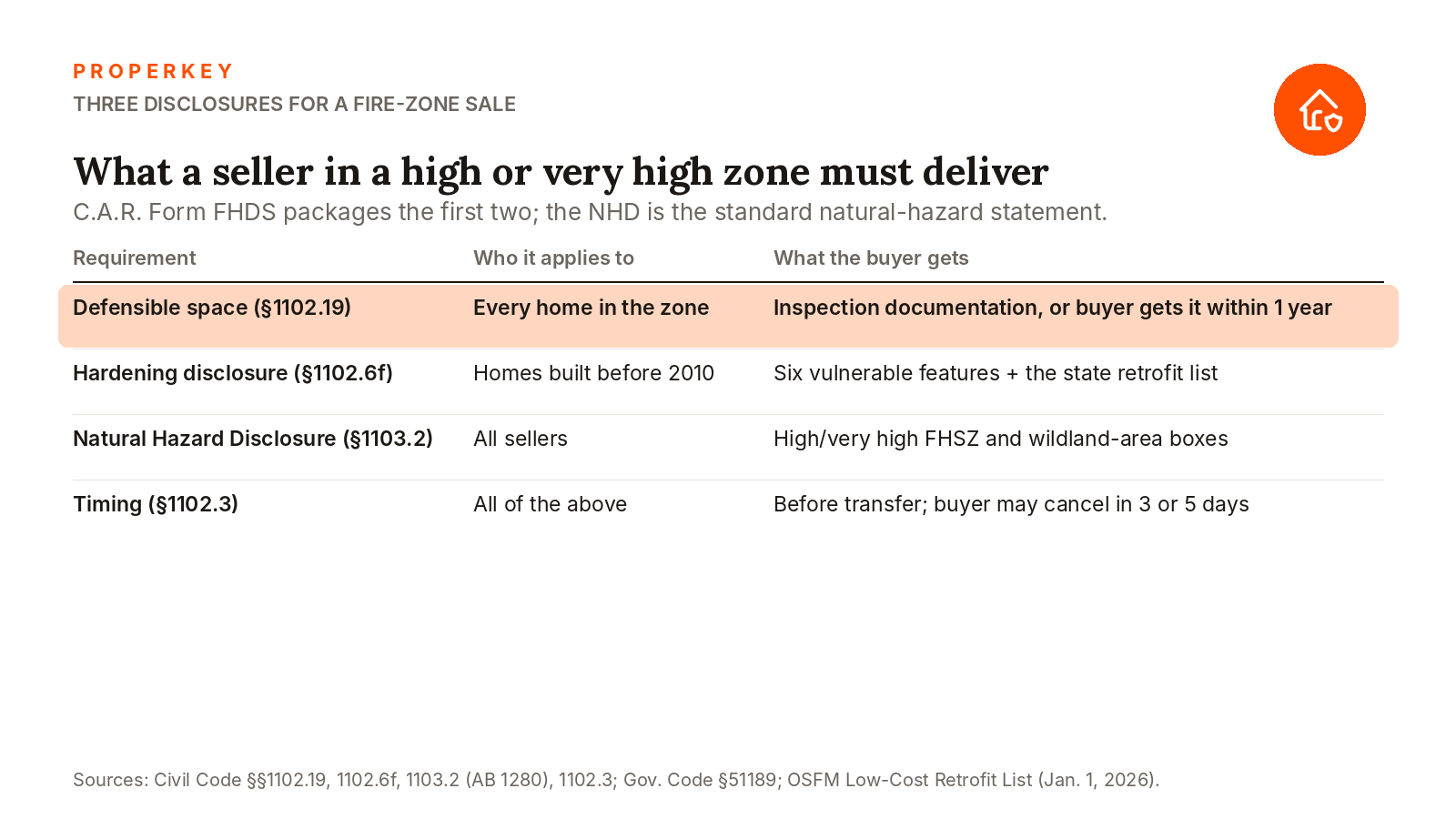
If your California home sits in a high or very high fire hazard severity zone, selling it now carries three extra legal steps: documentation that the property meets the 100-foot defensible-space law, or a written agreement that the buyer will get it within a year of closing (Civil Code §1102.19); for homes built before 2010, a disclosure of six specific fire-vulnerable features plus the state's low-cost retrofit list and which items you completed (§1102.6f); and the fire-zone boxes on the Natural Hazard Disclosure (§1103.2). Far more homes are in those zones than two years ago: CAL FIRE's 2025 local maps added about 1.4 million acres to the high and very high tiers. And a fourth item is weeks away. The Board of Forestry re-adopted the "Zone 0" ember-resistant-zone rule on November 5, 2026; it is not yet in force, but once filed it gives existing homes three years to clear the five feet around the house. Here is what each requirement says, and what buyers in these zones ask about insurance.
Which zone is the house in?
Two map systems decide it. In the State Responsibility Area, the 31 million acres where CAL FIRE is the fire department (home to an estimated 800,000 homes), the maps adopted January 31, 2024 took effect April 1, 2024 and class every acre as moderate, high or very high (Office of the State Fire Marshal). In Local Responsibility Areas, cities and counties with their own fire departments, the State Fire Marshal released new recommended maps in four phases between February 10 and March 24, 2025, and for the first time they include moderate and high zones, not just very high (SB 63, 2021). Local agencies had to adopt them by ordinance within 120 days and may not downgrade a zone (Gov. Code §51179). The Governor's office put the statewide change at roughly 1.16 million acres added to "high" and 247,000 acres added to "very high" (CalMatters). Look up any address on the OSFM map viewer before you list; the zone drives everything below.
What is the defensible-space documentation rule?
Since July 1, 2021, a seller in a high or very high zone must give the buyer documentation that the property complies with the defensible-space requirements of Public Resources Code §4291 or the local vegetation-management ordinance (§1102.19(a)). Where a local ordinance requires an inspection, the seller provides that agency's documentation; otherwise the seller provides an inspection report obtained from a state or local agency or a qualified nonprofit within the six months before entering the contract. If the seller has no documentation, buyer and seller sign an agreement that the buyer will obtain it, under the local ordinance or, where an inspection program exists, within one year of close of escrow (§1102.19(b)). The rule applies to every home in the zone regardless of age.
In the State Responsibility Area, CAL FIRE performs the inspection on request through the "Request an Inspection" form at fire.ca.gov/dspace and issues a Notice of Defensible Space Inspection (form LE-100a) as the documentation. In a local very-high zone, the local fire agency does it, and some charge a fee. What they check is the 100 feet around the structure (or to the property line): Zone 1, from 5 to 30 feet, "lean, clean and green," and Zone 2, from 30 to 100 feet, reduced fuel, plus tree limbs cleared 10 feet from chimney outlets. C.A.R.'s Fire Hardening and Defensible Space Disclosure and Addendum (Form FHDS) packages the §1102.19 and §1102.6f items for the file.
What must a pre-2010 home disclose?
For homes built before January 1, 2010 in a high or very high zone, §1102.6f requires a notice stating that the home predates the Wildland-Urban Interface building codes, pointing the buyer to readyforwildfire.org, and listing which of six features the seller is aware of: roof or eave vents with openings larger than 1/8 inch that are not flame- and ember-resistant; untreated wood shingle or shake roofing; combustible landscaping or materials within five feet of the home or under an attached deck; single-pane or non-tempered windows; loose or missing bird stops or roof flashing; and rain gutters without metal or noncombustible covers. Since July 1, 2025 the notice must also attach the State Fire Marshal's Low-Cost Retrofit List (12 items in the January 1, 2026 version, from ember-resistant vents and gutter covers to 1/8-inch mesh over skylights) and state which of those retrofits the seller completed during ownership. A final defensible-space inspection report, if the seller has one, is provided or its source identified (§1102.6f(b)).
The Natural Hazard Disclosure Statement changed on January 1, 2024 (AB 1280). Its fire item now reads "a high or very high fire hazard severity zone," with separate boxes for a high or very high zone in the State Responsibility Area and a very high zone in a local area, and it notes that the owner is subject to the maintenance requirements of Gov. Code §51182. A second box covers wildland areas where the state is not responsible for structure protection (PRC §4125). These disclosures are delivered as soon as practicable before title transfers; a buyer who gets them after the offer may cancel within three days if delivered in person or five days by mail or electronically (§1102.3).
What is Zone 0, and is it in effect?
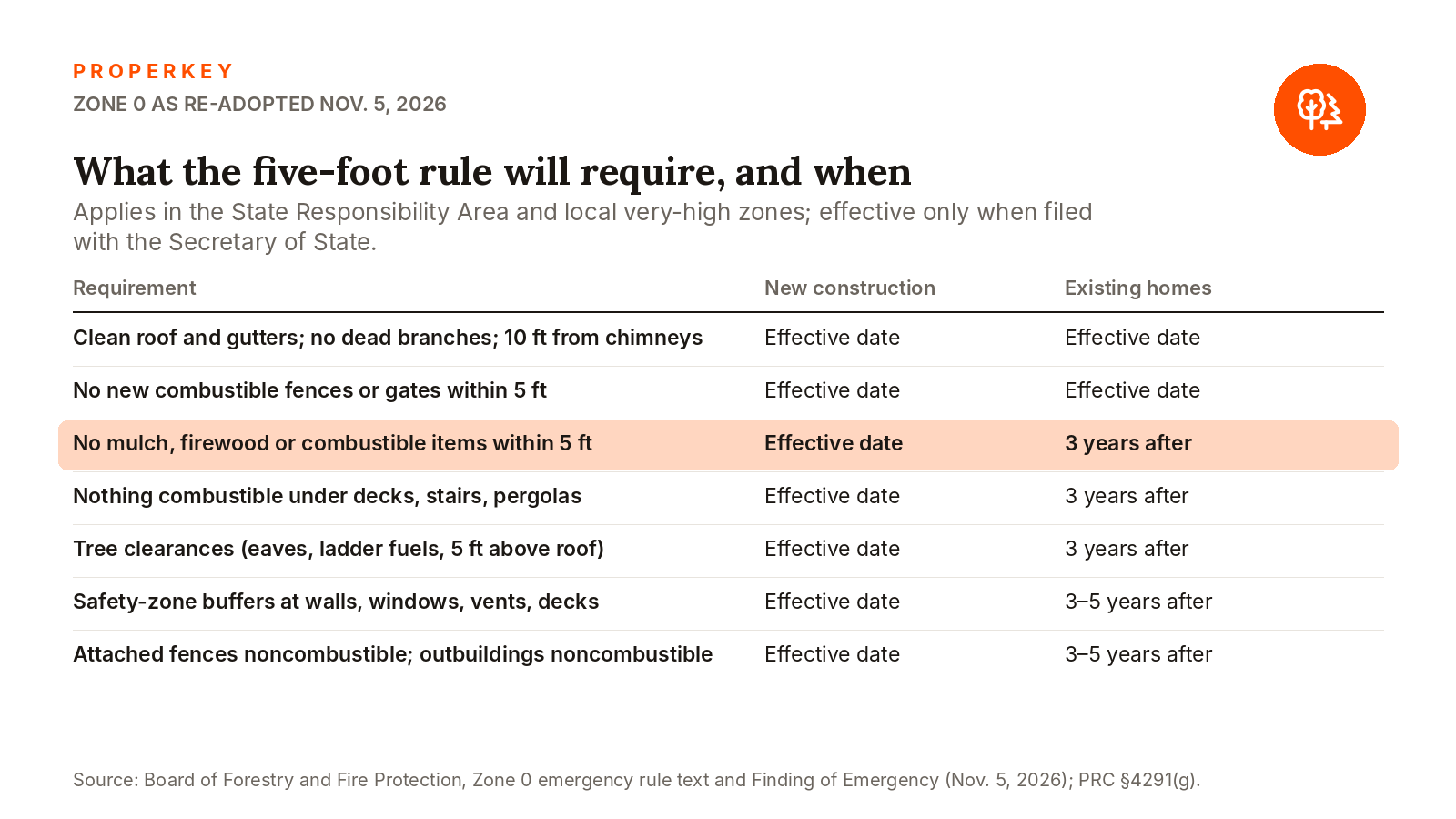
Zone 0 is the five feet right around the house, the ember-resistant zone that AB 3074 (2020) added to PRC §4291 and that cannot take effect until the Board of Forestry and Fire Protection adopts regulations. The Board missed the December 31, 2025 deadline in Executive Order N-18-25, adopted an emergency rule on August 19, 2026, withdrew it from the Office of Administrative Law on September 8 for revisions, and re-adopted the revised text on November 5, 2026. Its notice said the Board planned to submit the package to OAL on or after November 13, and OAL's list of emergency regulations under review shows "Defensible Space Zone 0" submitted on November 16, 2026; it is under review, not yet approved, and the rule takes effect only when filed with the Secretary of State. As of November 17, 2026 it is adopted and submitted, not effective.
What it will require, when it does: no combustible material in the five feet (bark or wood-chip mulch, firewood, plastic or wood items), roofs and gutters clear of leaves and needles, nothing combustible under decks and stairs, no new trees, no new combustible fences or gates attached to or within five feet of the house, outbuildings in the zone only if entirely noncombustible, and plantings limited to low non-woody plants in small spaced groupings or noncombustible pots outside a one-to-five-foot "safety zone" at the walls, deck edges, windows and vents. It applies to every structure in the State Responsibility Area and to very-high zones in local areas, not to local high or moderate zones. New construction complies from the effective date; existing homes get three years for most items and three to five years for the safety-zone, fence and outbuilding rules, with a few existing-law items (clean roofs and gutters, dead branches, 10 feet from chimneys) applying at once. Some cities have moved first with their own ordinances; check the local fire code as well.
What will buyers in a fire zone ask about insurance?
Whether the home can be insured, and at what price. The FAIR Plan, the state's insurer of last resort, covered 698,307 policies at the end of September 2026, up 157% from September 2022, and its average dwelling rates rose 29.1% for renewals from October 15, 2026 (KQED). The residential limit is $3 million. Admitted carriers are starting back: State Farm General filed on September 18, 2026 to resume new policies, but only for homes meeting the IBHS Wildfire Prepared Home standard (the Enhanced tier statewide, the Essential tier in low and moderate zones), and the filing is still under review, so it is not writing yet. Allstate filed August 31.
Hardening pays twice. Under the Department of Insurance's Safer from Wildfires regulation (10 CCR §2644.9), every insurer's rating plan must give a dollar-stated discount for each listed mitigation: a Class A roof, a five-foot ember-resistant zone, six inches of noncombustible material at the base of walls, ember-resistant vents, multi-pane windows, enclosed eaves, cleared decks, outbuildings moved 30 feet away, compliant defensible space, and a Firewise USA or Fire Risk Reduction Community. Policyholders can see their wildfire risk score, appeal it, and get a re-score within 30 days of completing work. A seller who finishes these items, documents them and keeps the inspection report has answered the buyer's hardest question before it is asked, and Properkey's insurance desk can shop the carriers for the buyer, including ones that do not sell direct. Note that the hazard maps measure hazard, not insurance risk; CDI has said the maps themselves do not set rates or availability.
The stakes are the reason for all of it. CAL FIRE's counts: 18,804 structures destroyed in the 2018 Camp Fire in Butte County; 9,419 in the Eaton Fire and 6,845 in the Palisades Fire in January 2025 (Eaton, Palisades). Nonrenewal notices currently must arrive 75 days before expiration (Insurance Code §678); from January 1, 2028, SB 1301 makes it 90 days with the insurer's reasons and the home's wildfire score attached (see the 2027–28 insurance laws).
Questions people ask
Do I need a defensible-space inspection to sell my house in California? If the home is in a high or very high fire hazard severity zone, you must give the buyer compliance documentation from the past six months or sign an agreement that the buyer will obtain it within a year of closing. Request a CAL FIRE inspection in the State Responsibility Area, or your local fire agency's in a local zone.
Is the Zone 0 five-foot rule the law yet? No. The Board of Forestry re-adopted the emergency regulation on November 5, 2026 and submitted it to the Office of Administrative Law on November 16, 2026, where it is under review; it takes effect when filed with the Secretary of State. Existing homes then have three years for most requirements.
What fire features must a seller disclose on an older home? For homes built before 2010 in a high or very high zone: non-ember-resistant vents, wood shake roofing, combustibles within five feet or under decks, single-pane windows, loose bird stops or flashing, and uncovered gutters, plus the state's low-cost retrofit list and which items you completed.
Will the new fire maps raise my insurance? The maps rate hazard for building and defensible-space rules, not insurance; insurers use their own models. What does lower premiums is documented mitigation: insurers must give dollar discounts for each Safer from Wildfires measure and re-score the home within 30 days.
This is a summary of the statutes, maps and regulations as of November 11, 2026, not legal advice. Local ordinances add requirements; check the city or county fire marshal for the property's zone and inspection program.
Sources: Civil Code §1102.19; §1102.6f; §1103.2; §1102.3; Gov. Code §51189; Gov. Code §51179; Public Resources Code §4291; OSFM Fire Hazard Severity Zones; CalMatters, February 2025; CAL FIRE defensible space; OSFM Low-Cost Retrofit List (Jan. 1, 2026); Board of Forestry, November 2026 meeting materials; Board of Forestry, Zone 0; Executive Order N-18-25; CDI, Mitigation in Rating Plans FAQ (Sept. 2026); CDI Safer from Wildfires consumer FAQ; CDI consumer alert, Sept. 18, 2026; IBHS Wildfire Prepared Home checklist; California FAIR Plan key statistics; KQED, FAIR Plan rate increase; Insurance Code §678; SB 1301 (2026); CAL FIRE Top 20 most destructive fires; CAL FIRE Eaton Fire; CAL FIRE Palisades Fire. Related: what home insurance costs in California; the disclosure checklist for sellers; Properkey's $0 listing.
Written by Keyro, Properkey's AI. Properkey, DRE #01979718.



