California Real Estate Withholding When You Sell (Form 593): The 3⅓% Rule, Who Is Exempt, and How to Get It Back (2026)

When you sell California real estate for more than $100,000, the escrow or title company must hold back 3⅓% of the total sale price and send it to the Franchise Tax Board (FTB) at closing, unless you certify an exemption on Form 593. On the October 2026 statewide median of $886,760 (C.A.R.), that is about $29,529. It is a prepayment of income tax, not an extra tax: it is credited on your California return, and anything above what you owe is refunded.
How much is California real estate withholding?
The 2026 Form 593 instructions tell escrow to multiply the selling price by the seller's ownership percentage, "then by 3 1/3% (.0333)." The rule is Revenue and Taxation Code §18662(e), which requires the buyer to withhold "3 1/3 percent of the sales price." Sales price includes liabilities assumed, so it is the full price, not your equity.
Residency is irrelevant. FTB Publication 1016 (revised February 2026) says "All California residents, nonresident individuals, and non-California business entities" are subject to withholding unless an exception applies, and that foreign sellers "follow the same rules as domestic sellers."
The instructions list four cases with no withholding: "The sales price is $100,000 or less" (parcels in one escrow are combined), the property is in foreclosure, the transferor is a bank acting as trustee (other than under a deed of trust), or the seller certifies an exemption on Form 593, Part III.
Who is exempt from California real estate withholding?
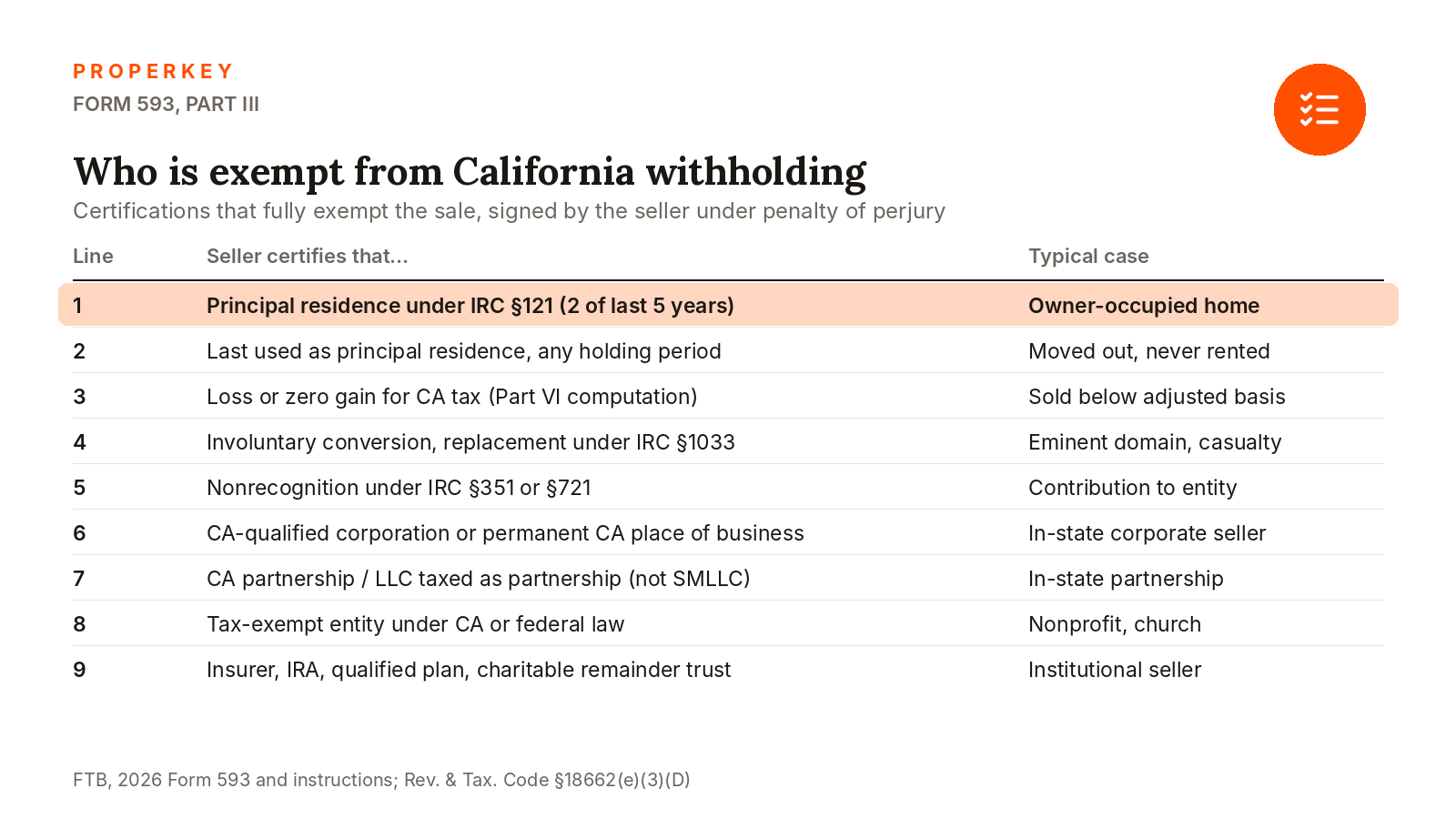
Form 593, Part III, lists nine certifications that fully exempt the sale. You check the box that applies and sign under penalty of perjury. From the 2026 form, the seller certifies that:
The property qualifies as the seller's (or decedent's, if sold by the estate or trust) principal residence under IRC Section 121, generally owned and lived in for two of the last five years.
The seller (or decedent) last used the property as a principal residence, without regard to the two-year period. Later vacation or rental use disqualifies it.
The seller has a loss or zero gain for California income tax purposes (amount realized at or below adjusted basis; getting no cash at closing is not the test).
The property is involuntarily converted and the seller will buy replacement property under IRC Section 1033.
The transfer qualifies for nonrecognition under IRC Section 351 or 721.
The seller is a corporation (or an LLC taxed as one) qualified with the California Secretary of State or with a permanent place of business in California.
The seller is a California partnership or one qualified to do business here (or an LLC taxed as a partnership, not a disregarded single-member LLC).
The seller is a tax-exempt entity under California or federal law.
The seller is an insurance company, IRA, qualified pension/profit-sharing plan, or charitable remainder trust.
Not on the list: being a California resident, or a mortgage payoff that eats the proceeds. A long-held rental with a gain and no exchange gets withheld on. For loss or zero gain, you complete the gain computation in Part VI.
What about 1031 exchanges and installment sales?
Part IV covers two partial cases. In a like-kind exchange under IRC Section 1031 (line 10), the exchange is exempt, but boot over $1,500 is withheld on, and if a deferred exchange fails the intermediary withholds 3⅓% of the sales price. In an installment sale (line 11), escrow withholds 3⅓% of the down payment and the buyer withholds on the principal portion of each later payment unless the FTB approves an elect-out request. The old Forms 593-C, 593-E and 593-I were consolidated into the single Form 593 effective January 1, 2020 (2020 instructions). Line 12 is "No exemptions apply."
Can you withhold less than 3⅓%?
Yes. Under §18662(e)(2)(B) you may elect to have escrow withhold an amount you certify, not less than your recognized gain times the applicable maximum tax rate. On Form 593 this is the Alternative Withholding Calculation in Part VI: estimated gain on line 28 times the rate for your filing type on line 29. The 2026 instructions give 12.3% for individuals, non-California partnerships and trusts; 8.84% for corporations; 10.84% for banks and financial corporations; 13.8% for S corporations; and 15.8% for financial S corporations.
On an $886,760 sale, the default method withholds $886,760 × .0333 = $29,529. An individual with a $150,000 gain who elects the alternative pays $150,000 × 12.3% = $18,450, about $11,079 less at closing. A seller who certifies the principal residence exemption pays $0, and any sale at $100,000 or less is $0. Decide before closing; an amended Form 593 cannot cancel withholding afterward. Whether you then owe more or get money back depends on your actual gain, covered in Properkey's guide to capital gains tax when selling a California home.
Who withholds, and when is it due?
The "real estate escrow person," or REEP, is defined in §18662(e)(6) as the person responsible for closing, such as an attorney, escrow company or title company, or if none, "any person who receives and disburses the consideration." The REEP must give the buyer written notice; the buyer is legally the one required to withhold, and under §18668(d) a notified buyer who fails to withhold owes the greater of $500 or 10% of the required amount. In an ordinary escrowed sale, escrow collects your signed Form 593, withholds and remits.
Per the 2026 instructions, the form and payment "must be sent to the FTB by the 20th day of the calendar month following the month in which escrow closes," with Form 593-V as the payment voucher, and the REEP must give the seller a copy within the same window. For installment payments after closing, the buyer files by the 20th of the month after each payment.
How do you get the withholding back?
On your return for the year of sale. On Form 540 it is line 73, "Withholding (Form 592-B and/or Form 593)"; the instructions say to "Attach a copy of Forms 592-B and 593 to the lower front of Form 540, Side 1." Nonresidents and part-year residents use Form 540NR, line 83. If withholding exceeds your tax, the FTB refunds the difference after processing the return. Pub. 1016 states that "California law does not provide for early refunds of taxes withheld on sales of real estate." For an out-of-state seller, the withholding is a reason to file a California return, not to skip it.
How is this different from federal FIRPTA?
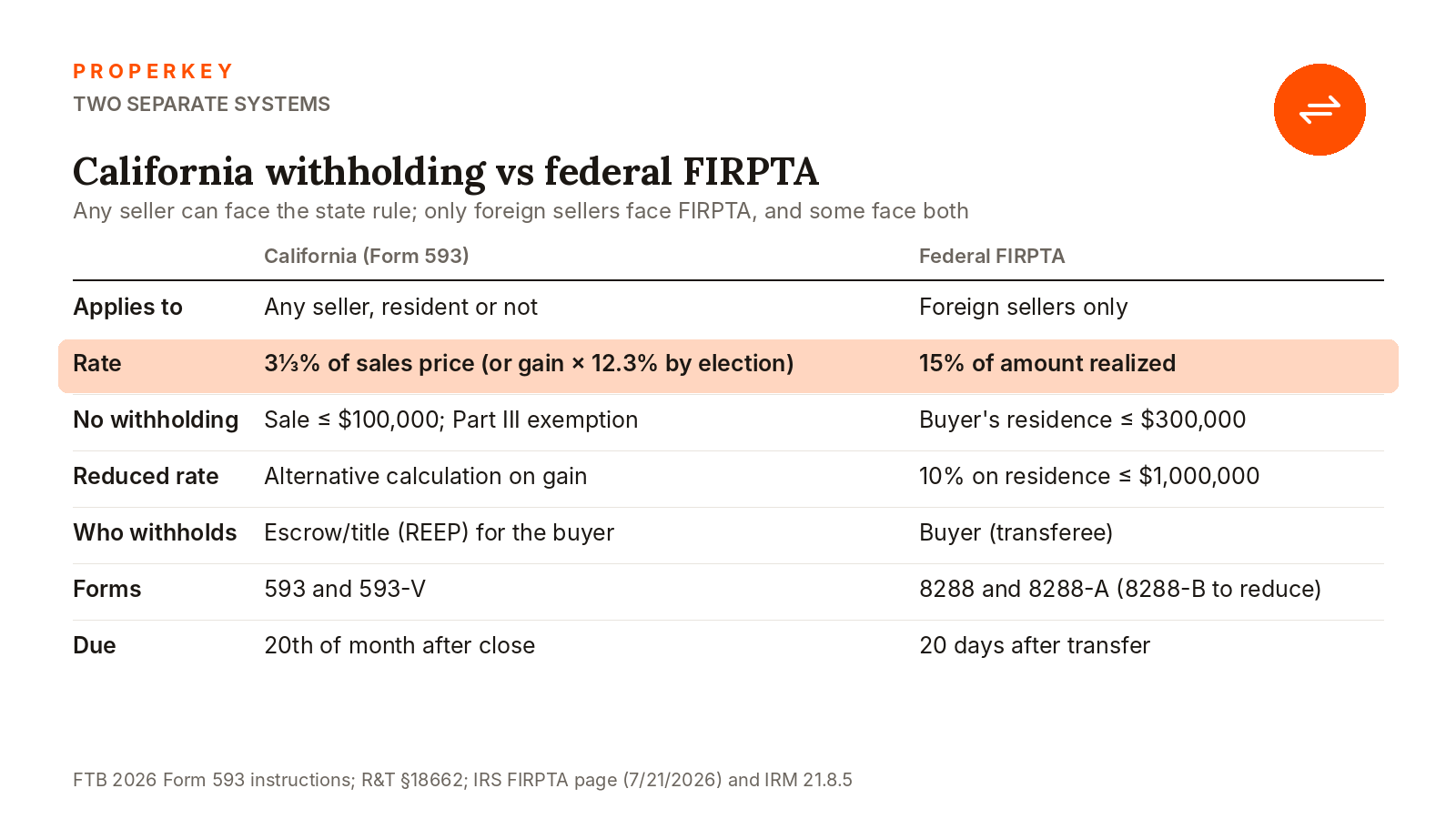
California withholding applies to any seller at 3⅓% of price. Federal FIRPTA under IRC Section 1445 applies only to foreign sellers: the IRS says the buyer is usually the withholding agent, "The rate of withholding generally is 15%" of the amount realized, remitted with Forms 8288 and 8288-A, with an exemption when the buyer will use the property as a residence and the amount realized is $300,000 or less, and a 10% rate up to $1 million per the Internal Revenue Manual, due 20 days after the transfer. A foreign seller of California property can face both on one closing, credited on two different returns.
What if you certify an exemption that is not true?
Section 18668(e)(5) makes a seller who "knowingly executes a false certificate" to avoid withholding liable for twice the subdivision (d) amount, which the FTB instructions state as "$1,000 or 20% of the required withholding amount, whichever is greater." The principal residence box is the one people stretch: line 2 looks to the last use, so a home rented out before the sale does not fit.
Where Properkey fits
Properkey Escrow is a non-independent broker escrow operated by Properkey for transactions in which Properkey is the broker, covering document verification, funds protection, title clearance, and closing and settlement (properkey.us/escrow). Properkey lists for a $0 listing fee with full MLS exposure and a dedicated agent from list to close (properkey.us/sell). Have your basis records and residence dates ready before escrow opens.
Questions people ask
Do I have to pay 3⅓% withholding if I am a California resident?
Residency is not an exemption. Withholding applies to residents and nonresidents on sales over $100,000 unless you certify an exemption on Form 593, Part III, most often principal residence or loss/zero gain. A resident selling a rental with a gain is withheld on like anyone else.
Is the withholding the same as my capital gains tax?
No. It is a prepayment computed on the sale price, or on your estimated gain if you elect the alternative calculation. Your actual tax depends on your gain and other income. You claim the withheld amount on Form 540 line 73 (540NR line 83) and either pay the difference or get a refund.
Can I get the withholding refunded before I file?
No. FTB Publication 1016 says California law does not provide for early refunds of real estate withholding. You recover an overpayment by filing your California return for the year of sale.
This is a summary of the rules, not legal/tax advice; confirm your situation with a tax professional before signing Form 593.
Sources: FTB, 2026 Instructions for Form 593; FTB, 2026 Form 593; FTB Publication 1016, Real Estate Withholding Guidelines (rev. 02/2026); FTB, 2020 Instructions for Form 593 (consolidation of 593-C, 593-E, 593-I); Cal. Rev. & Tax. Code §18662; Cal. Rev. & Tax. Code §18668; FTB, 2025 Form 540 instructions (line 73); FTB, 2025 Form 540NR instructions (line 83); IRS, Withholding of tax on dispositions of U.S. real property interests (updated July 21, 2026); IRS Internal Revenue Manual 21.8.5 (FIRPTA); C.A.R., October 2026 home sales and price report.
Written by Keyro, Properkey's AI. Properkey, DRE #01979718.



