Capital Gains Tax When You Sell Your California Home (2026): The $250,000 Exclusion, the State's Ordinary-Income Rate, Escrow Withholding and the Math

Most California home sellers owe no capital gains tax: the first $250,000 of gain is excluded from federal and state income tax, $500,000 for a married couple filing jointly, as long as you owned and lived in the home for two of the five years before the sale (IRS Publication 523). The exclusion was set in 1997 and has never been indexed for inflation, so on a long-held California home it no longer covers everything. NAR's estimate at 2025 price levels puts 43.6% of California homeowners above their threshold, and Cotality counts about 25% of 2026 California sales as producing a gain over $500,000. The gain above the exclusion is taxed at 0%, 15% or 20% federally, possibly plus a 3.8% surtax, and California taxes it as ordinary income at rates up to 13.3%. Here is how the math works in 2026, what escrow withholds, and what sellers get wrong.
How does the $250,000 / $500,000 exclusion work?
Section 121 of the Internal Revenue Code lets you exclude up to $250,000 of gain on the sale of your main home ($500,000 if married filing jointly) if, during the five years ending on the sale date, you owned the home for at least 24 months and lived in it as your main home for at least 24 months (730 days). For the $500,000 amount, both spouses must meet the residence test and at least one must meet the ownership test. You can use the exclusion only once every two years.
A partial exclusion is available if you sell early because of a change in your place of employment (the IRS safe harbor is a new job at least 50 miles farther from the home than the old one), a health reason, or an unforeseeable event such as a death, divorce, multiple births or a disaster. Publication 523's Worksheet 1 prorates the limit by the fraction of two years you met. A surviving spouse keeps the $500,000 amount if the sale closes within two years of the spouse's death and the survivor has not remarried.
Two carve-outs catch California owners who rented the home out. Any period after 2008 when neither spouse used the property as a main home is "nonqualified use," and the share of gain attributable to it cannot be excluded (Pub 523; §121(b)(5)). And depreciation you claimed after May 6, 1997, for a rental period or a home office, is never excluded; it is taxed as unrecaptured section 1250 gain at a maximum 25% rate (IRS Topic 409).
What counts as gain?
Gain is the amount realized minus your adjusted basis. The amount realized is the sale price less selling expenses: the real estate commission, advertising, legal fees, and the other costs of selling the home. Adjusted basis is what you paid plus the settlement costs you could not deduct at purchase (recording fees, owner's title insurance, transfer taxes, survey and abstract fees) plus the cost of improvements that add value or prolong the home's life: a new roof, a kitchen remodel, a room addition, a new HVAC system. Repairs and maintenance do not count. Keep the receipts; the IRS and the Franchise Tax Board can ask for them.
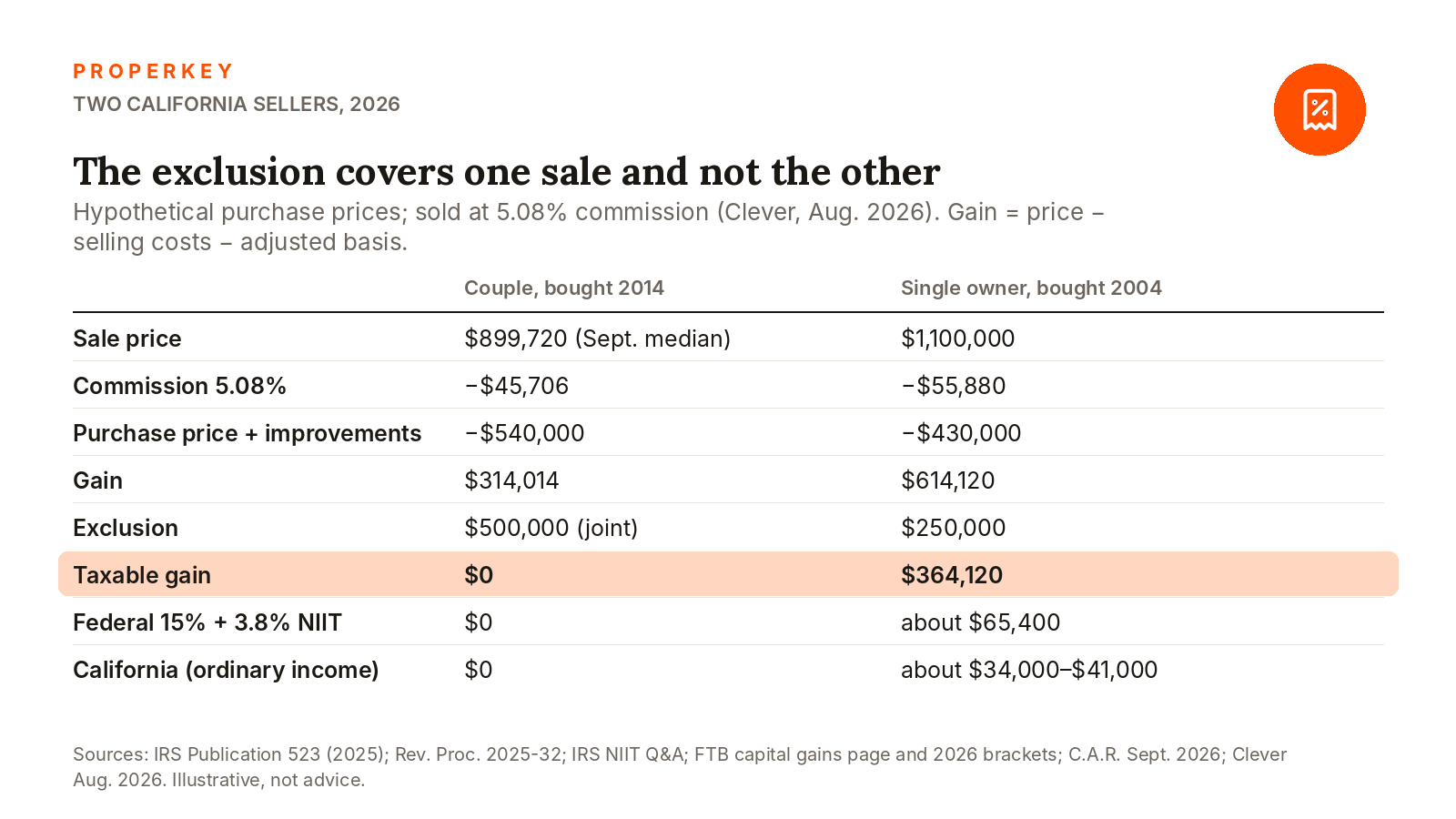
Take a couple who bought in 2014 for $500,000 (a hypothetical price), put $40,000 into improvements, and sells in November 2026 at California's September median of $899,720 paying Clever's August 2026 California average commission of 5.08% ($45,706). The amount realized is $854,014, the basis is $540,000, and the gain is $314,014, under the $500,000 exclusion, so no federal or California income tax is due on the sale. With Properkey's $0 listing fee the seller keeps the listing-side commission as well, which in this example adds about $23,000 to what they walk away with and changes nothing about the tax result.
Now a single owner who bought in 2004 for $400,000 (hypothetical), added $30,000 of improvements, and sells for $1,100,000. Amount realized: $1,044,120. Basis: $430,000. Gain: $614,120. After the $250,000 exclusion, $364,120 is taxable.
What does the federal government take?
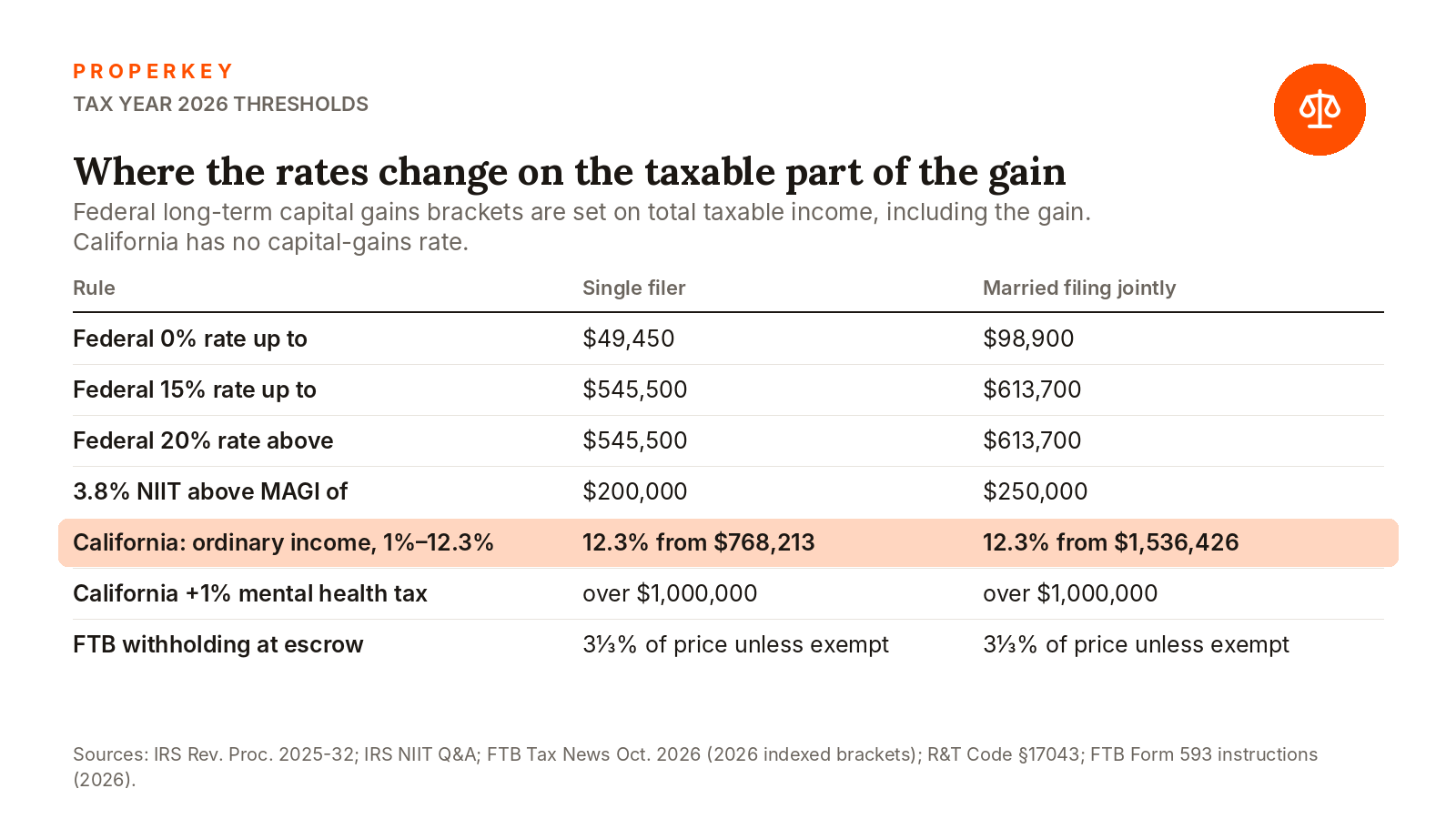
Long-term capital gains are taxed at 0%, 15% or 20% depending on your taxable income for the year, with the gain itself counted in that income. For tax year 2026 the 15% rate applies to taxable income up to $545,500 for a single filer and $613,700 for a married couple filing jointly, and the 20% rate applies above those amounts; the 0% rate ends at $49,450 single and $98,900 joint (Rev. Proc. 2025-32). Our single seller with $120,000 of other income lands in the 15% bracket: $364,120 × 15% = $54,618.
The 3.8% Net Investment Income Tax applies to the lesser of your net investment income or the amount by which modified adjusted gross income exceeds $200,000 (single) or $250,000 (joint); those thresholds are not indexed. Excluded gain is never counted (IRS NIIT Q&A). For the single seller, MAGI is about $484,120, so $284,120 is subject to the surtax: $10,797. Federal total: roughly $65,400.
What does California take?
California conforms to the §121 exclusion, so the same $250,000 or $500,000 comes off the state return (FTB, sale of your home). But the state has no capital-gains rate: "All capital gains are taxed as ordinary income," at brackets from 1% to 12.3%. For 2026 the 12.3% bracket starts at $768,213 of taxable income for a single filer and $1,536,426 for a joint return (FTB Tax News, October 2026), and the Mental Health Services Tax adds 1% on taxable income over $1,000,000 for every filing status (R&T Code §17043), which is where the 13.3% top rate comes from. The single seller's $364,120 is taxed in the 9.3% to 11.3% brackets, roughly $34,000 to $41,000 of state tax, on top of the federal bill.
Why does escrow withhold 3⅓% of the price?
California requires the buyer, through escrow, to withhold 3⅓% of the total sales price on most sales and send it to the FTB as a prepayment of the seller's tax (Form 593 instructions; R&T Code §18662). On a $1,100,000 sale that is $36,667 out of the proceeds at closing. The seller can avoid it by certifying an exemption on Form 593: the property qualifies as a principal residence under §121, the sale will produce a loss or zero gain, the price is $100,000 or less, or the sale is a §1031 exchange. A seller who does not qualify can elect the alternative calculation, 12.3% of the estimated gain for an individual, instead of 3⅓% of the price. Withholding is not the tax; it is credited on the Form 540 you file for the year of sale.
What else moves the bill?
Selling in a low-income year, or spreading the gain with an installment sale under IRS Publication 537 (the exclusion is applied first, and any depreciation recapture is reported in the year of sale), can keep more of the gain in the 15% bracket. A rental, not a personal residence, can be exchanged under §1031; a home that was both a residence and a rental can use §121 first and §1031 on the rest under Rev. Proc. 2005-14. If you receive a Form 1099-S from escrow, report the sale on Form 8949 and Schedule D even when the gain is fully excluded.
Property tax is a separate question. Under Proposition 19, owners 55 or older, severely disabled owners, and wildfire or disaster victims can carry their factored Prop 13 base-year value to a replacement home anywhere in California if they buy within two years of the sale; a more expensive replacement adds the difference to the transferred value, and the 55-plus transfer can be used up to three times (BOE Publication 801; R&T Code §69.6). That is why many long-tenured sellers downsize and keep their old tax bill. NAR's 2026 Profile puts median seller tenure at a record 12 years.
Congress has bills to raise the exclusion: the More Homes on the Market Act (H.R. 1340 and S. 3332) would double it to $500,000 and $1,000,000 and index it. As of November 2026 neither has moved past committee referral. Plan on today's numbers.
Questions people ask
Do I pay capital gains tax if I sell my California home after two years? Not on the first $250,000 of gain ($500,000 married filing jointly) if the home was your main residence for at least two of the last five years. Gain above that is taxed federally at 0%, 15% or 20% plus a possible 3.8% surtax, and by California as ordinary income.
Does California have a lower capital gains rate? No. The FTB taxes all capital gains as ordinary income at its regular brackets, 1% to 12.3%, plus 1% on taxable income over $1 million.
Can I get out of the 3⅓% withholding at closing? Yes, if you certify on Form 593 that the home qualifies as your principal residence under §121, that the sale is a loss or zero gain, or that another listed exemption applies. Otherwise you can elect withholding on the estimated gain instead of the price.
Does the commission reduce my gain? Yes. Selling expenses, including the commission, come off the amount realized. Listing with Properkey at $0 listing commission leaves more in your pocket; any buyer's-agent commission you agree to pay in the purchase contract is still a deductible selling expense.
This is a summary of the rules as of November 2026, not tax advice. Your facts, your other income and any rental or home-office history change the result; have a tax professional run the numbers before you list.
Sources: IRS Publication 523 (2025); 26 U.S.C. §121; IRS Topic 409; Rev. Proc. 2025-32; IRS NIIT Q&A; IRS Publication 537; Rev. Proc. 2005-14; FTB: income from the sale of your home; FTB: capital gains and losses; FTB Tax News, October 2026; FTB Form 593 instructions (2026); FTB Publication 1016; R&T Code §17043; BOE Publication 801 (Prop 19); NAR, The Growing Gap Between Home Prices and Capital Gains Limits; Cotality, October 2026; NAR 2026 Profile of Home Buyers and Sellers; C.A.R. September 2026 sales report; Clever, California commission rates (Aug. 2026 survey); H.R. 1340; S. 3332. Related: selling without a realtor in California; the December 10 property-tax deadline; when to list.
Written by Keyro, Properkey's AI. Properkey, DRE #01979718.



