When Is the Best Time to Sell a House in California? What Two Years of Monthly Data Say, and Whether to List in December 2026

The best month to sell a house in California is April, with May a close second. In both 2025 and 2026 the statewide median price set its record for the year in April or May ($910,160 in April 2025; $914,810 in April and $930,260 in May 2026), homes sold in 21–22 days at 100% of asking, and both years' lowest prices and slowest sales came in January, 9% to 11% below the spring peak, according to the California Association of Realtors' monthly reports. National studies agree on the season and disagree on the week: Zillow's best listing window for Los Angeles is the last two weeks of April, for San Diego the last two weeks of March, for San Francisco late May. The harder question in November 2026 is whether to list now or wait for spring, with pending sales at record lows, 21% of listings carrying a price cut and Freddie Mac's rate at 7.18%. Here is what the data say about each month, what it is worth, and how to decide.
California's year, month by month
C.A.R.'s monthly releases track three things a seller cares about: the median price, the median days a home takes to sell, and the sale-to-list ratio. Across 2025 they looked like this (median price / median days on market / sale-to-list):
January: $838,850 / 35 days / 98.6% (the release)
February: $829,060 / 26 / 99.9%
March: $884,350 / 22 / 100%
April: $910,160, the year's high / 21 / 100% (release)
May: $900,170 / 21 / 100%
June: $899,560 / 24 / 99.3%
July: $884,050 / 28 / 98.5%
August: $899,140 / 31 / 98.3%
September: $883,640 / 32 / 98.2%
October: $886,960 / 32 / 98.3%
November: $852,680 / 32 / 98.3% (release)
December: $850,680 / 36 / 97.9% (release)
2026 followed the same arc on a higher track: $823,180 in January (a 23-month low, 39 days on market), $889,190 in March, a record $914,810 in April, a new record $930,260 in May with 22 days on market and 100% of list, then $904,640 in June, $887,680 in July, $901,420 in August and $899,720 in September at 29 days and 98.8%. From the May peak to the January trough is a swing of roughly 11% in the median and 17 days in time on market. Part of the price swing is mix, since larger family homes trade in spring, but the days-on-market and sale-to-list figures are not mix: in March through June buyers pay full asking inside a month, and in December and January they pay 2% under and take five weeks.
One number cuts the other way. C.A.R.'s unsold inventory index falls to its lowest point in December (2.7 months in December 2025) because sellers pull listings for the holidays faster than buyers leave. A home that stays on the market in December faces the fewest competitors of the year.
What the national studies say about the premium
Three large datasets put a number on the spring effect, and they are smaller than the folklore.
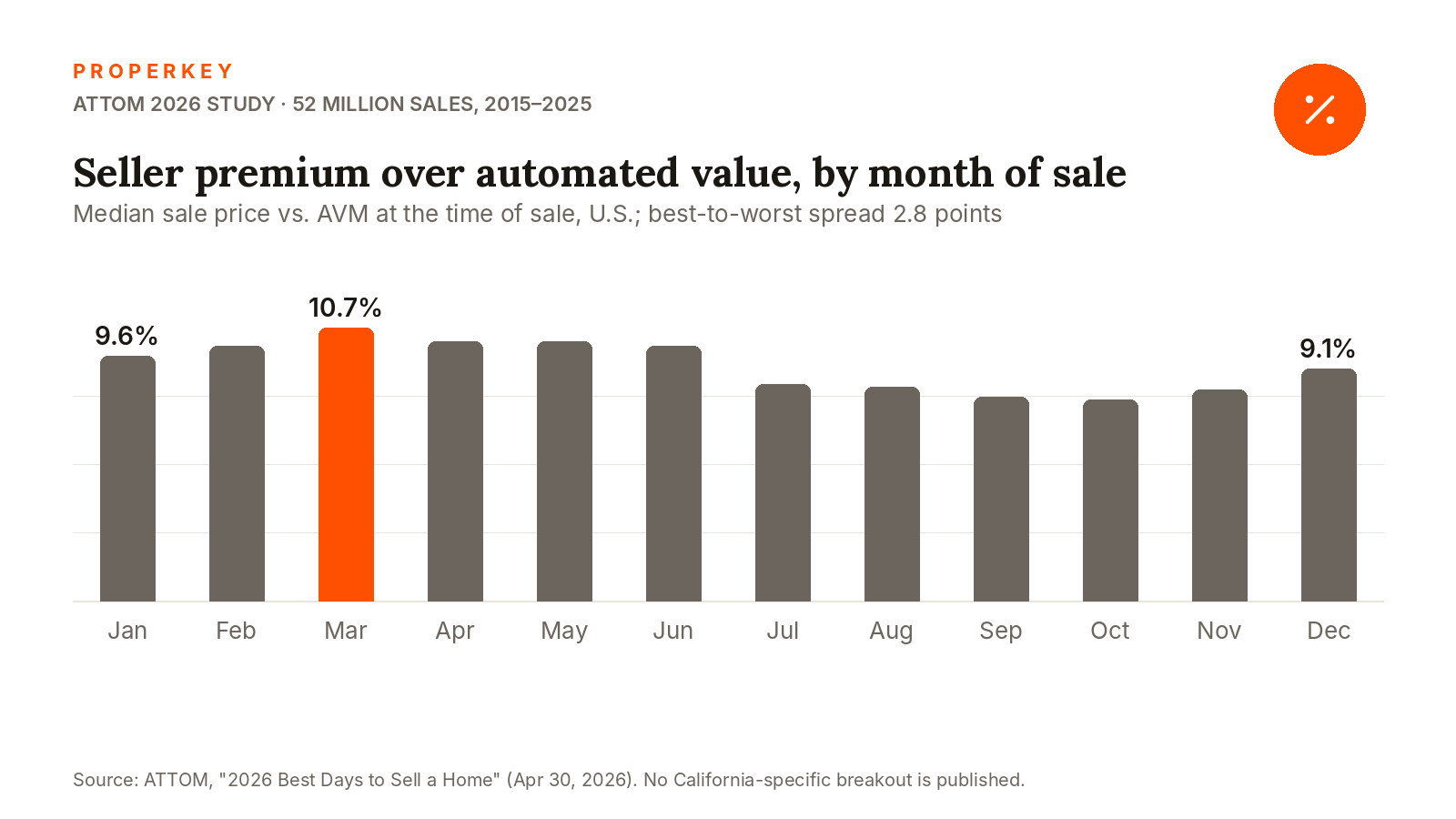
ATTOM's 2026 study of more than 52 million sales from 2015 to 2025 measures the seller premium as the median sale price over the home's automated valuation at the time of sale. By month: March 10.7%, May and April 10.2%, February 10.0%, June 10.0%, January 9.6%, December 9.1%, July 8.5%, August 8.4%, November 8.3%, September 8.0%, October 7.9%. The weakest stretch is September through November, not the holidays; December ranks seventh of twelve, ahead of every summer month. The gap between the best and worst month is 2.8 percentage points. The single best days cluster in late March and late May (May 26, 14.7%; March 31, 14.1%).
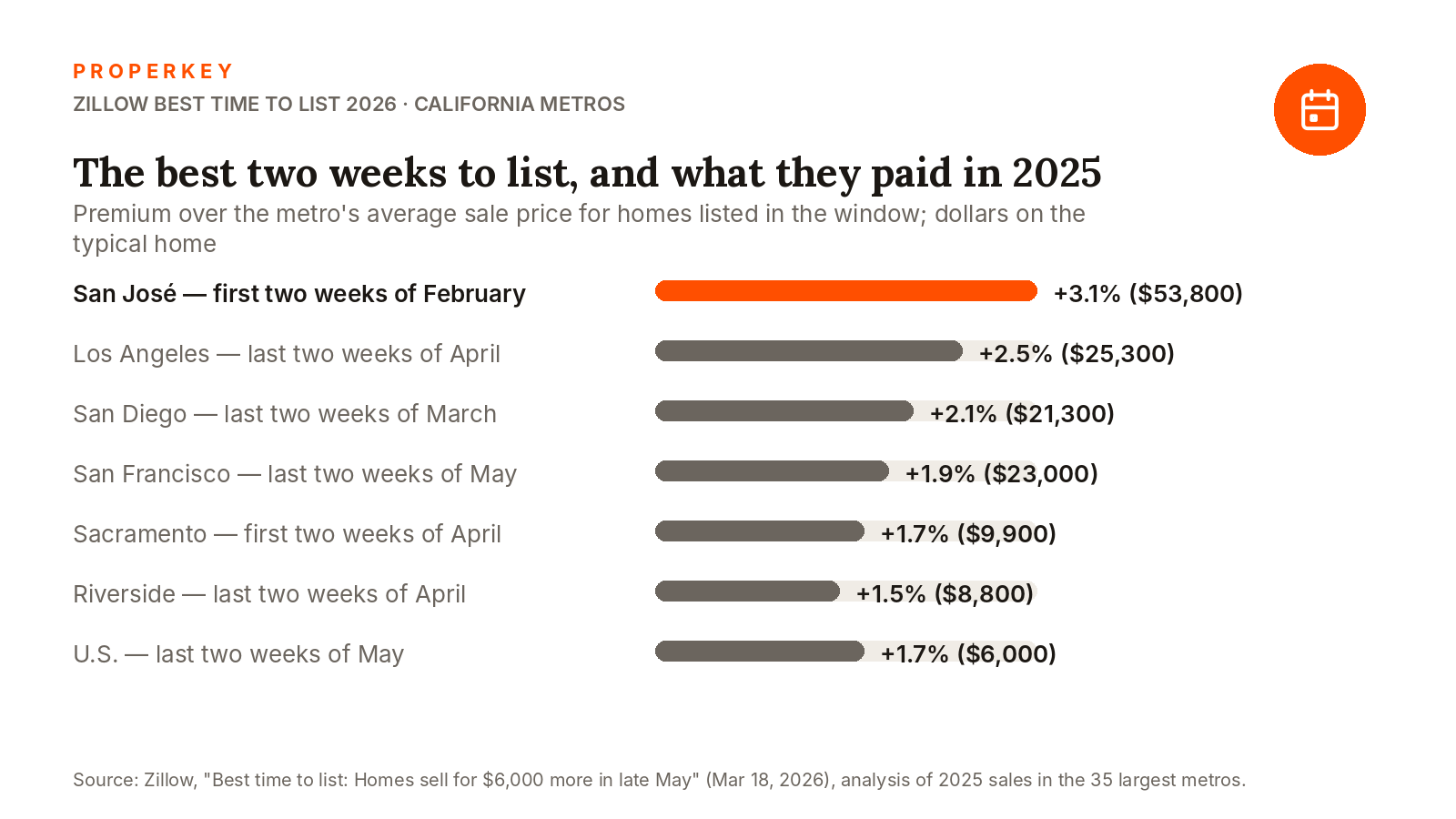
Zillow's 2026 analysis of 2025 sales in the 35 largest metros finds homes listed in the last two weeks of May sold for 1.7% more, about $6,000 nationally. California's windows come earlier and pay more: Los Angeles, last two weeks of April, +2.5% ($25,300); San Diego, last two weeks of March, +2.1% ($21,300); San Francisco, last two weeks of May, +1.9% ($23,000); Sacramento, first two weeks of April, +1.7% ($9,900); Riverside, last two weeks of April, +1.5% ($8,800); and San Jose, the first two weeks of February, +3.1% ($53,800), the largest dollar boost of any metro in the country. "Late spring is when motivation and momentum meet," said Zillow senior economist Kara Ng.
Realtor.com's "best week to list" for 2026 was April 12–18: prices 1.3% above the average week, 16.7% more views, 18.9% fewer price reductions, and homes sold about ten days faster than the annual average. Redfin's April 2026 study puts the national sweet spot in late April (18% more likely to sell above asking, median price 4% above the yearly average) and has San Diego, San Jose, San Francisco and Oakland peaking in mid-to-late March. The consistent lesson: California's spring starts in March, and the premium is 1.5% to 3%, not 10%.
Why spring works, and why it is weaker than it looks
Three forces line up in spring. Buyers with children want to close before the school year; tax refunds and bonuses arrive; and the inventory that will compete with you has not yet listed. Redfin's Asad Khan put it plainly in the April study: "seasonality isn't just about weather—it's also about supply." By June the competing listings are at their peak and the buyers who were going to buy have bought, which is why price and sale-to-list roll over in summer even as sales volume stays high.
The premium is smaller than sellers assume because the buyer pool and the seller pool move together. A spring seller gets more buyers but also more competition; a December seller gets fewer buyers but, as the inventory index shows, far fewer rivals, and the buyers who tour on a December weekend are not browsing. Nationally, NAR's Realtors Confidence Index shows the difference in days, not disaster: a median 27 days on market in May and June 2025 against 36 in November and 39 in December, with 28% of May sales going over list price against 16% in December (NAR, December 2025).
Should you list in November or December 2026?
This is not a normal fall. Pending sales nationally are at the lowest level in Redfin's records, down 16.4% from a year ago in the four weeks to November 1, with 21.2% of listings carrying a price cut and 4.6 months of supply (Redfin). Zillow's newly pending listings fell 16.8% in October, the biggest annual drop since 2023, and its chief economist Mischa Fisher said "November is shaping up to have an even larger contraction, but the silver lining is that next month is likely going to be the worst of it. I expect the pace of the slowdown to ease into the new year" (Zillow). Sellers are reacting by not listing: new listings were down 7.5% nationally in October and 28% in San Diego, per Realtor.com, with 20.5% of active listings price-reduced. Redfin counts 62.6% more sellers than buyers nationally, with Riverside (81% more sellers) and Los Angeles (73%) among the most lopsided metros and San Francisco the only California metro still favoring sellers. Mortgage rates eased to 7.18% on November 5 but Tuesday's hot inflation report put that at risk.
So the choice is between two imperfect windows. Listing now means fewer buyers but also the thinnest competition of the year and a chance to close before any spring rush of delayed listings; it suits a seller who needs certainty, has a vacant or well-presented home, and prices to the current comps rather than the spring ones. Waiting for March means more buyers and the seasonal 2% to 3% premium, but you will be joined by every seller who "paused" this fall, and nobody's forecast has rates meaningfully lower by then (Fannie Mae has 7.5% through 2027). A fair rule: if the home needs work or you are not ready, use the winter to prepare and list in the first half of March, before the Easter-to-Memorial-Day peak, when inventory is still low; if it is ready and you are priced to today, list now and set the price for the buyer who shows up in December, not the one who might in May.
Whichever you choose, exposure is not seasonal. Properkey lists for a $0 listing fee with full MLS exposure and professional photos with a 3D tour, and every listing goes on the MLS and the portals on day one; a winter listing with professional media and a correct price outsells a spring listing with neither. The guide to selling in California covers disclosures and the timeline.
Tax and timing details sellers ask about
The closing date, not the listing date, sets the tax year. IRS Publication 523 lets a seller exclude up to $250,000 of gain ($500,000 married filing jointly) if the home was owned and lived in for at least 24 months of the five years before the sale, once every two years; the date of sale is the Form 1099-S date or the earlier of title transfer and the shift of ownership burdens, which in practice is the day escrow records. A December 30 closing lands in 2026; a January 2 closing in 2027. Property taxes are prorated through the closing date in escrow (the first installment is delinquent after December 10), and a buyer's supplemental bill is handled outside escrow. Homeowners 55 or older moving their Proposition 19 tax base have two years from the sale to buy the replacement home, per the Board of Equalization.
Questions people ask
What is the best month to sell a house in California? April, with March and May close behind. California's median price peaked in April 2025 and May 2026, homes sold in 21–22 days at full asking in both springs, and Zillow's best listing windows for Los Angeles, San Diego and Riverside fall in late March and April. The spring premium is about 1.5% to 3% over the yearly average, not the double-digit figure often quoted.
Is December a bad time to sell a house? Slower, not bad. In December 2025 California homes took 36 days and sold at 97.9% of list, against 21 days and 100% in April, but December also had the fewest competing listings of the year (2.7 months of inventory). ATTOM's 2026 study ranks December seventh of twelve months for seller premium, ahead of July through November.
Should I wait until spring 2027 to sell in California? Waiting buys the seasonal premium and more buyers, but also the competition of every seller who paused this fall, and no major forecaster expects lower mortgage rates by spring. If the home is ready and priced to current comps, listing now avoids that crowd; if it needs work, prepare over the winter and list in early March, before the peak.
How much more does a home sell for in spring? Nationally about 1.7% ($6,000) for a late-May listing, per Zillow; 2.5% ($25,300) in Los Angeles, 2.1% ($21,300) in San Diego and 3.1% ($53,800) in San Jose for their best two-week windows. ATTOM's month-level premium ranges from 10.7% in March to 7.9% in October, a 2.8-point spread.
This is a summary of public market data as of November 10, 2026, not advice on your home. Local results vary; a pricing conversation starts with current comparable sales.
Sources: C.A.R. monthly sales and price reports, 2025–2026 · C.A.R. September 2026 sales · C.A.R. December 2025 sales · C.A.R. April 2025 sales · ATTOM, 2026 Best Days to Sell a Home · Zillow, Best Time to List 2026 · Realtor.com Best Week to List 2026 (Real Estate News) · Redfin, Best Time to Sell, April 2026 · NAR Realtors Confidence Index, December 2025 · Redfin, Nov 5, 2026 · Zillow October 2026 Market Report · Realtor.com October 2026 Housing Report · Redfin, buyers vs. sellers, Oct 14, 2026 · Freddie Mac PMMS · IRS Publication 523 · BOE, Introduction to Prop 19
Written by Keyro, Properkey's AI. Properkey, DRE #01979718.



