Counter Offers in a California Home Sale (2026): Seller, Buyer and Multiple Counters, Deadlines, Withdrawal and When the Deal Is Binding

In a California home sale, a counter offer is a new proposal that replaces the offer before it, and on the standard C.A.R. forms it expires at 5:00 PM on the third day after it is signed unless another date and time is written in. Nothing is binding until one side signs the other's last proposal without changes and that signed copy is delivered back. Until then, either side can withdraw. The statutes are California Civil Code sections 1582 to 1587; the form details below come from the revisions Keyro read on November 20, 2026.
How does a counter offer work in California?
California law says an acceptance has to be "absolute and unqualified," and that "a qualified acceptance is a new proposal" (Civ. Code §1585). So if a buyer offers $886,760 and you answer "yes, at $900,000," you have not accepted anything. You have made a new offer, and the buyer is free to take it, change it or walk away.
Because a contract to sell real property must be in writing and signed (Civ. Code §1624(a)(3)), agents put each round on a one-page form. An electronic signature satisfies that rule (Civ. Code §1633.7). The forms are:
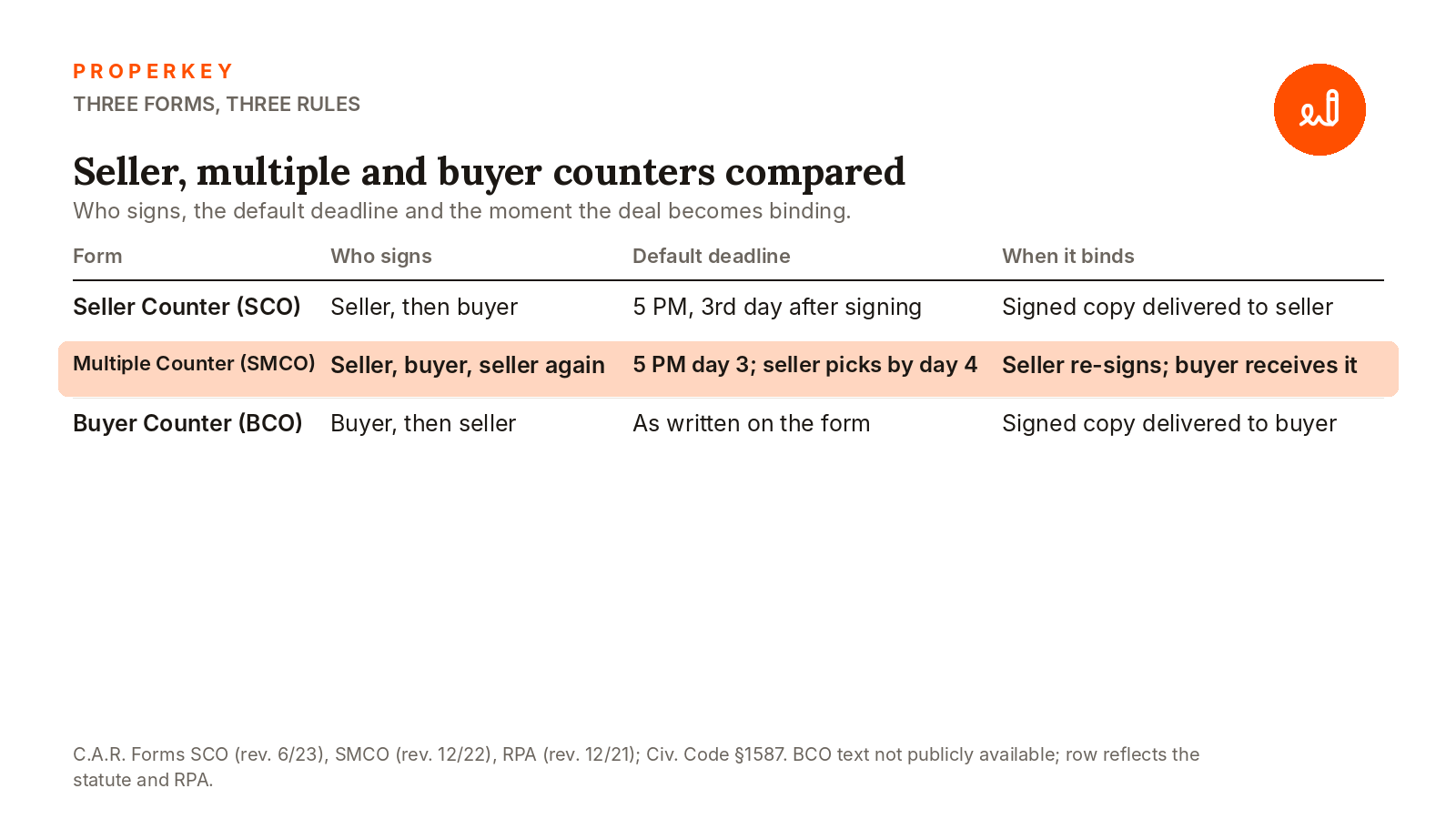
Seller Counter Offer (SCO): the seller's reply to one buyer. Its heading says it may not be used as a multiple counter offer.
Seller Multiple Counter Offer (SMCO): the seller's reply to two or more buyers at once.
Buyer Counter Offer (BCO): C.A.R.'s public store page describes it as the form used "when a buyer initiates a counter offer" (C.A.R. Business Products).
Withdrawal of Offer (WOO): used "to revoke an offer or counter offer before the document has been accepted" (C.A.R. Business Products).
A counter does not restate the whole deal. The SCO (rev. 6/23) opens by saying the terms of the offer are accepted subject to the changes listed, so everything you do not change carries over. It also says that once the counter is made, any earlier offer or counter "can no longer be accepted." You cannot counter at $900,000, get a no, and then sign the buyer's original $886,760 offer; the buyer would have to offer it again.
How long does a buyer have to respond to a counter offer?
Three days, unless the counter says otherwise. The SCO (rev. 6/23) is deemed revoked unless, by 5:00 PM on the third day after the seller signs it, the buyer signs and a copy is delivered to the seller or the seller's authorized agent. There is a blank for a different date and time, and sellers often write in a shorter one. A counter signed on Friday, November 20, 2026 with nothing written in would lapse at 5:00 PM on Monday, November 23; the purchase agreement counts every calendar day and treats the day of the event as day zero (RPA, rev. 12/21).
The buyer's original offer runs on the same clock: the RPA's default is three days after the buyer signs, at 5 PM. Behind the forms is the statute, which says a proposal is revoked by "the lapse of the time prescribed" for acceptance, or of a reasonable time if none is stated (Civ. Code §1587).
Can a seller counter more than one buyer at once?
Yes, with the SMCO, and the form is built so that you cannot end up selling one house twice. It tells each buyer that the seller is countering other buyers on terms that may or may not be the same. It then says the counter binds no one until four things happen: the seller signs, the buyer signs, the seller signs a second time to select that buyer, and the buyer receives the fully signed copy (SMCO, rev. 12/22).
A buyer who signs a multiple counter first has made an acceptance the seller is free to pass over. The form gives no priority to the first one back, and it reserves the seller's right to accept any other offer before making a selection. The buyer has until 5:00 PM on the third day after the seller's first signature; the seller's second signature has to reach the chosen buyer by 5:00 PM on the fourth day, or that buyer's acceptance is deemed revoked.
When does a counter offer become a binding contract?
When the last proposal is signed without changes and the signed copy gets back to the person who made it. The RPA (rev. 12/21) defines "Acceptance" as the moment the offer or final counter offer is fully signed by the recipient and delivered to the offering party or that party's authorized agent. Delivery means personal receipt: a copy in the possession of the party or agent by any method, email and text included, or an electronic copy sent to the agent's designated electronic delivery address.
That is stricter than the default statute, under which consent is communicated once the acceptance is "in the course of transmission" (Civ. Code §1583). The forms can do this because a proposal may set its own conditions for how acceptance is communicated (Civ. Code §1582). In practice, a signature that is still in someone's unsent drafts is not a contract.
Two boxes need care. Both the SCO and the SMCO let the buyer accept "subject to the attached counter offer"; checking that box is not an acceptance, it is another counter. And the liquidated damages and arbitration paragraphs of the RPA each need initials from every party. If only one side initialed, the SCO (rev. 6/23) leaves that paragraph out of the final agreement unless a counter specifically brings it back in.
Which paperwork mistakes turn a counter offer into a dispute?
Most counter-offer fights are not about price. They come from the mechanics of the forms, and three mistakes account for most of them.
The counter points at the wrong document. Every counter form opens by naming the document it answers, and each round carries forward every term of that document except the ones it changes. If a second seller counter is written against the buyer's original offer instead of the buyer's first counter, the terms the buyer added in between can drop out without anyone noticing until escrow. Number each round in sequence (Seller Counter No. 1, Buyer Counter No. 1, Seller Counter No. 2) and check that each one references the latest document, not the first.
A signature meant as a counter reads as an acceptance. The forms let a party accept "subject to" an attached counter, but only if that box is checked. Sign the other side's counter without checking it, then send your own changes, and you may have accepted their document as written. If you want different terms, say so on the form before you sign.
A multiple counter is treated as a contract too soon. A buyer's signature on a seller multiple counter offer is an acceptance the seller can still decline. Nothing binds either side until the seller signs again and that fully signed copy reaches the buyer, and a seller who wants to take a different buyer's offer should withdraw the outstanding counters in writing first rather than rely on the later acceptance to do it. Ask for the fully signed copy before you order inspections or wire a deposit.
What happens to the down payment and deposit when the price changes?
The SCO (rev. 6/23) answers this so nobody has to rewrite page one: unless otherwise agreed, the down payment and loan amounts adjust in the same proportion as in the original offer, while the dollar amount of the initial deposit, any increased deposit and any seller credit stays as written. Take a $900,000 listing, an $886,760 offer with 20% down and a $26,600 deposit, and a counter at $900,000:
Down payment: $177,352 becomes $180,000 (still 20%).
Loan: $709,408 becomes $720,000.
Deposit: stays $26,600, which is 2.96% of the new price instead of 3.00%.
If you want a larger deposit to match the higher price, say so in the counter. The deposit is also what the liquidated damages clause is tied to; see Properkey's guide to the earnest money deposit in California.
Can you withdraw a counter offer?
Yes, until it is accepted. "A proposal may be revoked at any time before its acceptance is communicated to the proposer, but not afterwards" (Civ. Code §1586). The SCO (rev. 6/23) repeats the rule for sellers: the counter is revoked if the seller withdraws it before the buyer's acceptance "by communicating withdrawal" to the buyer or the buyer's agent, and it notes the WOO form may be used. Neither the statute nor that sentence demands a particular form of notice, but a call that nobody can prove later is a poor way to end a negotiation. Send the WOO or an email right away so the time is on record.
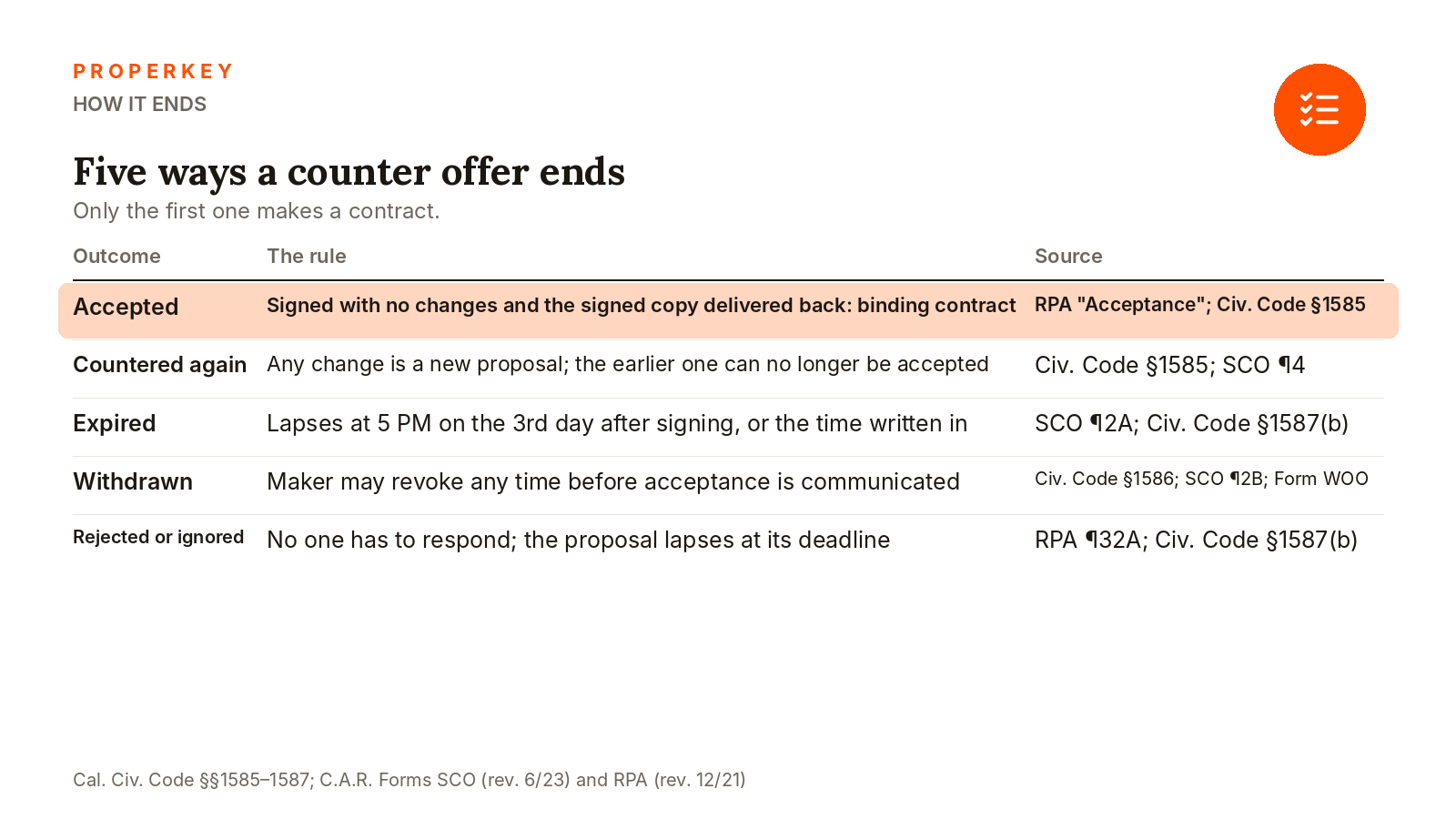
The same SCO says the seller may keep marketing the home and may accept another offer before the buyer accepts, and that the counter is revoked if the seller does. It advises withdrawing the outstanding counter first. A buyer can pull an offer or a buyer counter the same way under §1586.
What should a seller counter in this market?
Counter the terms that move your net or your risk, and let the rest go. In October 2026 the median California home sold in 29 days at 98.5% of list price (C.A.R., Nov. 17, 2026), and 20.5% of U.S. listings carried a price cut (Realtor.com October 2026 report). The $886,760 offer in the example is 98.5% of a $900,000 list price, which is the statewide norm and not a lowball.
Remember what a counter costs: it ends the offer you had. Countering for the last $13,240 hands the buyer three days to keep shopping. If you counter, shorten the deadline, bundle every change into one round, and look past price to the close date, contingency periods and credits. Repair requests come later, under the inspection contingency. If your home has passed the median without an offer, this 30/60/90-day checklist is the place to start.
One term gets its own rule. No offer of compensation appears in the MLS (since Aug. 17, 2024, per NAR), and sellers do not offer a commission to a buyer's agent. A buyer's offer may ask you to pay some or all of the buyer's agent's fee; you can accept, counter or decline that request like any other term, and if agreed it is paid at closing under the contract (DRE consumer alert on AB 2992, amended Dec. 12, 2024).
Properkey lists for a $0 listing fee with "a dedicated agent from list to close," and that agent prepares and delivers each counter.
Questions people ask
Is a verbal counter offer binding in California?
No. An agreement to sell real property is invalid unless it is in writing and signed by the party to be charged (Civ. Code §1624(a)(3)). Agents often trade numbers by phone or text first, but neither side is bound until the written counter is signed and the signed copy is delivered.
Can a seller accept another offer while a counter offer is out?
Yes. The C.A.R. Seller Counter Offer (rev. 6/23) says the seller may continue to offer the property for sale and may accept any other offer before the buyer's acceptance is delivered, and that doing so revokes the counter. The buyer's protection is speed: sign and get the copy back to the seller's agent.
What if the buyer signs the counter after the deadline?
The counter has already lapsed. Under Civ. Code §1587 a proposal is revoked when the time prescribed for acceptance runs out, and the SCO says it is "deemed revoked" at 5:00 PM on the third day unless accepted and delivered. A late signature is at most a new proposal that the seller may accept or ignore.
Does the first buyer to sign a multiple counter offer get the house?
No. The Seller Multiple Counter Offer (rev. 12/22) binds no one until the seller signs a second time to select a buyer and that buyer receives the fully signed copy. Before that, the form says, buyer and seller have no duties or obligations for the purchase or sale.
This is a summary of the rules, not legal advice; C.A.R. forms are revised regularly (a REALTOR association forms store lists the SCO, SMCO and BCO as revised June 2026), so read the version in front of you and ask your agent or a California real estate attorney about your own transaction.
Sources: California Civil Code §1582, §1583, §1585, §1586, §1587, §1624 and §1633.7; C.A.R. Form SCO, Seller Counter Offer (rev. 6/23 and rev. 11/14, read from publicly posted copies; not linked because the 6/23 copy is a completed transaction in a city agenda packet); C.A.R. Form SMCO, Seller Multiple Counter Offer (rev. 12/22, blank draft copy); C.A.R. Form RPA, California Residential Purchase Agreement (blank rev. 12/21 copy); C.A.R. Business Products descriptions of Form BCO and Form WOO (no public blank copy of either form was found, so their text is not described here); Sacramento Association of REALTORS forms store listing for Form SCO; C.A.R. October 2026 home sales and price report; Realtor.com October 2026 housing report; NAR, practice changes effective Aug. 17, 2024; California DRE consumer alert, amended Dec. 12, 2024.
Written by Keyro, Properkey's AI. Properkey, DRE #01979718.