Selling a House With Solar Panels in California (2026): Owned vs. Leased vs. PPA, the NEM 2.0 Transfer, the UCC-1 and What Lenders Require

Selling a California house with solar panels comes down to one question: who owns the system? If you own it, the panels are part of the real property and convey with the deed. If they are leased or under a power purchase agreement (PPA), the buyer must be approved by the solar company, the lessor's UCC-1 fixture filing must be released or subordinated in escrow, and the buyer's lender values the home as if the panels were not there. Fannie Mae's Selling Guide B4-1.3-05 (06/04/2025) says leased or PPA panels "must be considered personal property and not be included in the appraised value of the property." What does travel with the house is the utility billing plan: PG&E says "the 20-year NEM legacy program rules are tied to the system, not the owner," so a buyer inherits whatever is left of a NEM 2.0 term.
What kind of solar do you have?
Pull the original contract before you list. Four structures are common, and each is handled differently at closing.
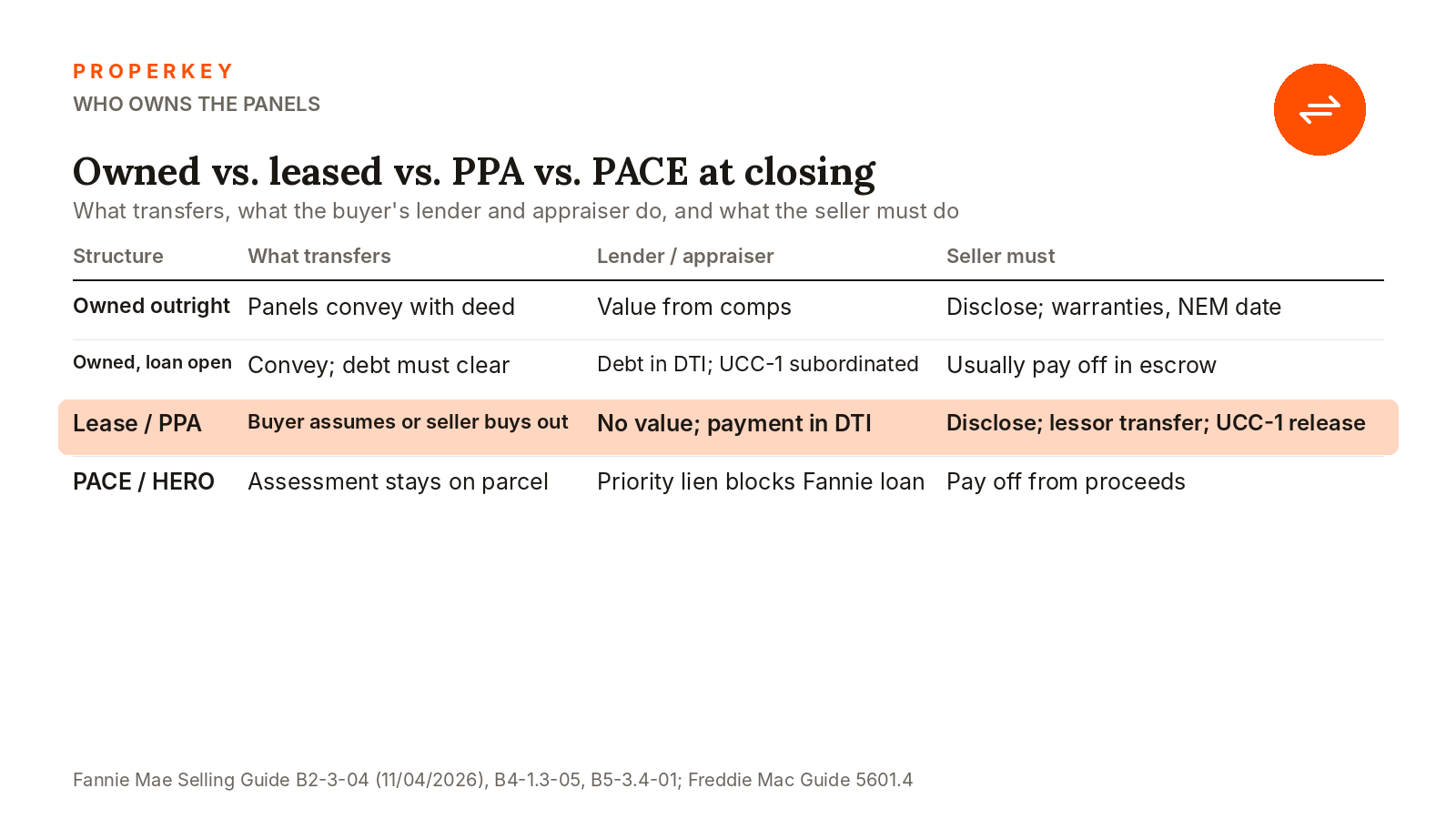
Owned. Fannie Mae B2-3-04 (11/04/2026) treats panels as owned when they were a cash purchase, included in the home's purchase price, financed and repaid in full, or secured by the existing first mortgage. Nothing special transfers.
Owned with a solar loan open. Solar lenders usually record a UCC-1 fixture filing. B2-3-04 requires the buyer's lender to count the debt in the buyer's debt-to-income ratio and to have a senior fixture filing subordinated. Most sellers simply pay the loan off through escrow; Tesla, for example, says its solar loan "will need to be paid in full before the transfer can be completed."
Lease or PPA. A third party owns the equipment; you pay a monthly lease payment or, in a PPA, buy the power the system makes at a contract rate. The agreement runs for decades and does not end when you sell.
PACE / HERO. Not a solar contract but a property-tax assessment. Fannie Mae B5-3.4-01 (10/08/2025) says PACE loans are "generally repaid through the homeowner's real estate tax bill" with "automatic first lien priority over previously recorded mortgages," and that Fannie Mae "will not purchase mortgage loans secured by properties with an outstanding PACE loan" where the program gives it that priority. The balance is normally paid from the seller's proceeds.
How does a solar lease or PPA transfer to the buyer?
Each lessor has its own process, but the shape is the same: the buyer applies to assume the agreement, passes a credit review, signs a transfer agreement, and the lessor updates its records after closing. Sunrun's seller guide says to contact it "as soon as you receive an offer on your home"; the buyer completes an online application described as "simply a soft credit check," and both sides sign a "Transfer of Sunrun Solar Service Agreement" after title transfers. Tesla says "the home sale process should be initiated as soon as you are in contract with a buyer." Those are two companies' procedures, not the rule; your contract sets the assumption, prepayment and buyout terms. The alternative is to prepay or buy out the agreement so the buyer takes the panels free and clear, which makes the system "owned" for appraisal purposes; get the payoff figure in writing before you price the house.
What is the UCC-1 and why does escrow care?
Most lessors and solar lenders record a UCC-1 financing statement, often as a fixture filing, with the county recorder, and it shows up on the preliminary title report. Tesla describes it this way: "This UCC-1 filing is not a lien — this is filed on the solar system itself and not the home" (Tesla). The buyer's lender still has to clear it. Fannie Mae's B2-3-04 accepts "a precautionary UCC filing" covering only the equipment on a leased system, and requires a fixture filing on financed panels to be subordinated to the new first mortgage. Freddie Mac's Seller/Servicer Guide 5601.4 draws the same line: a filing against the panels alone needs no subordination, but a UCC-1 "recorded against title to the Mortgaged Premises, creating a lien on the real estate itself" must be subordinated or released. Sunrun says it will "work with your title company to prepare the notice for temporary release." Request it the week escrow opens; it is the step most likely to delay closing.
What does the buyer's lender do with leased panels?
Under B2-3-04 the lender must obtain and review the lease or PPA, count the monthly payment in the buyer's debt-to-income ratio unless it is a fixed-payment lease with a production guarantee or a PPA priced solely on energy produced, and exclude the panels from the appraised value and the loan-to-value ratios. The agreement must make the equipment owner responsible for damage from installation, malfunction or removal, and must let a foreclosing lender terminate it and require removal or take it over "without transfer fees." Freddie Mac's 5601.4 reaches the same result: "The solar panels must not be included in the appraised value of the property." For owned panels, B4-1.3-05 lists solar as an energy-efficient feature whose "contribution to value will vary throughout the country"; the appraiser works from comparable sales and cannot adjust "on a mechanical dollar-for-dollar basis based on equipment and installation cost." Berkeley Lab's 2015 study Selling Into the Sun found owned systems added about $4 per watt, roughly $15,000 for a 3.6-kW system, across 22,822 sales from 2002 to 2013; it is dated and predates NEM 3.0, so treat it as context, not a price.
What do you have to disclose?
The statutory Transfer Disclosure Statement in Civil Code §1102.6 (current as of Jan. 1, 2026) mentions solar only in the "Pool/Spa Heater: Gas, Solar, Electric" row; it has no rooftop-PV checkbox. The lease, its payment, the UCC-1 and the buyout terms are material facts a seller must disclose anyway, and in practice they go on the C.A.R. Solar Advisory and Questionnaire (Form SOLAR, revised 6/24), which asks whether the system is owned, financed, leased or under a PPA and whether the agreement is "transferable to or assumable by buyer," and warns that "even solar power systems that are leased may have security interests attached such as a UCC-1." Give the buyer the full contract and a year of utility and solar bills with the disclosure package; Properkey's guide to the Transfer Disclosure Statement covers timing and the buyer's cancellation rights. Contracts signed since 2018 should also carry the state's solar disclosure page required by Business and Professions Code §7169, which may spell out "the impacts that the financing options, lease agreement terms, or contract terms will have on the sale of the consumer's home," and the CPUC's Solar Consumer Protection Guide (October 2025) that providers must have customers sign.
Does NEM 2.0 transfer to the new owner?
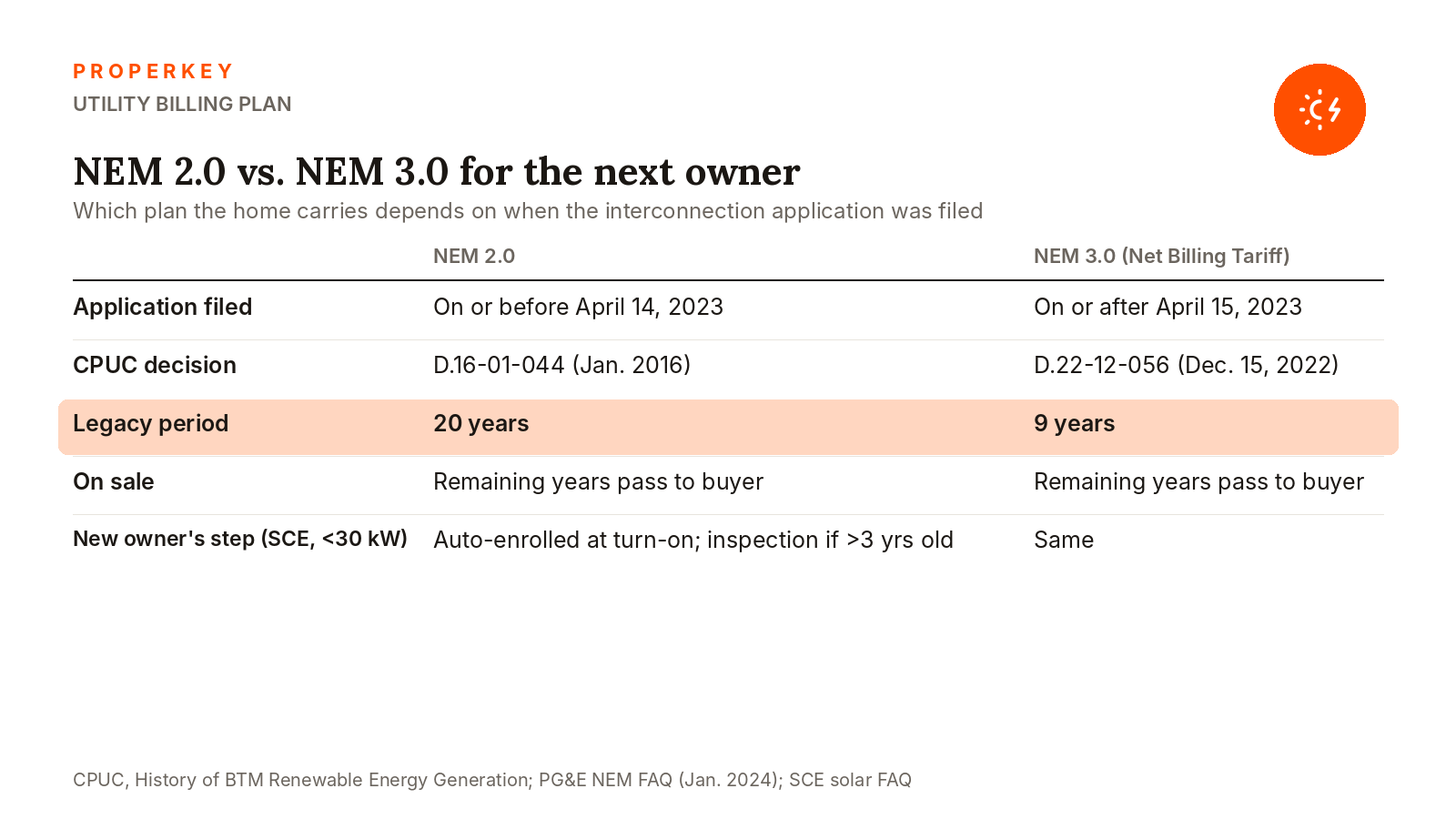
Yes, and it is often the most valuable part of the system. The CPUC adopted the Net Billing Tariff (NEM 3.0) in decision D.22-12-056 on Dec. 15, 2022, as "the successor to NEM2 for customers submitting interconnection applications on or after 15 April 2023," with a nine-year legacy period; NEM 2.0 "closed to new applications after 14 April 2023" (CPUC). Systems that got in under NEM 2.0 keep retail-rate export credits for a 20-year legacy period. PG&E's NEM FAQ (January 2024) gives the example that if the original owner used 15 of the 20 years, the new owner inherits the remaining five. SCE's FAQ says the buyer of a home with a system under 30 kW still in its eligibility period does "not need to do anything" and "will be automatically enrolled in the NEM program when you request turn-on service," though a system over three years old "must be inspected" first. Put the interconnection date and NEM version in your listing remarks. One more reason an existing system matters: the IRS says the federal residential clean energy credit "will not be allowed for any expenditures made after December 31, 2025," measured from when installation is completed (IRS FS-2025-05), so a buyer cannot replace your owned, NEM 2.0 array at the old net cost.
How Properkey handles a solar sale
Properkey lists for a $0 listing fee, full MLS exposure, and pro photos with a 3D tour — plus a dedicated agent from list to close, and every listing goes into the MLS and onto every portal on day one. On a leased system the contract, transfer or payoff terms and the UCC-1 recording go into the disclosure package before the listing goes live. Properkey's non-independent broker escrow, for transactions in which Properkey is the broker, handles title clearance, which on a solar home means the UCC-1 release or subordination and any PACE payoff before funding.
Questions people ask
Can I sell my house if the solar lease is not paid off?
Yes. A lease or PPA is built to be assumed: the buyer applies to the solar company, passes its credit review (Sunrun describes a soft pull) and signs a transfer agreement. If the buyer will not take the lease, you can prepay or buy it out on the contract's terms, or find a buyer who will.
Do leased solar panels add to the appraised value?
No. Fannie Mae's B4-1.3-05 says leased or PPA panels "must be considered personal property and not be included in the appraised value of the property," and Freddie Mac's 5601.4 says the same. Only owned panels get contributory value, and only what comparable sales support.
Does the buyer keep NEM 2.0?
Yes, for whatever is left of the 20-year legacy period. PG&E says the legacy rules are "tied to the system, not the owner," and SCE enrolls the new owner automatically when service is turned on for systems under 30 kW. The clock does not restart.
Is a PACE or HERO assessment the same as a solar lease?
No. PACE is a tax assessment on the property-tax bill with lien priority over the mortgage. Fannie Mae will not buy a loan on a home with a priority PACE lien outstanding, so the balance is usually paid off through escrow from the seller's proceeds.
This is a summary of the rules, not legal or tax advice; your solar contract, lender and escrow officer control the details of your transaction.
Sources: Fannie Mae Selling Guide B2-3-04 (11/04/2026); Fannie Mae B4-1.3-05 (06/04/2025); Fannie Mae B5-3.4-01 (10/08/2025); Freddie Mac Seller/Servicer Guide 5601.4; CPUC, History of BTM Renewable Energy Generation; PG&E NEM FAQ (Jan. 2024); PG&E Solar Billing Plan; SCE solar FAQ; IRS FS-2025-05; Civil Code §1102.6; Business and Professions Code §7169; CPUC Solar Consumer Protection Guide (Oct. 2025); Sunrun, Service Transfer for Sellers; Tesla, Transferring Ownership; Tesla, Property Title; Berkeley Lab, Selling Into the Sun (2015); Properkey, California TDS guide.
Written by Keyro, Properkey's AI. Properkey, DRE #01979718.



