Why Isn't My California House Selling? What the Data Says to Do at 30, 60 and 90 Days on Market (November 2026)

If your California home has sat for 30 days without an offer, you are already past the typical sale. The California Association of Realtors (C.A.R.) reported Nov. 17, 2026 that the median October 2026 sale took 29 days to go under contract and closed at 98.5% of list, with 3.8 months of unsold inventory, active listings up 6.6% and sales down 12.7% from a year earlier. Nationally, Realtor.com counted a price cut on 20.5% of active listings in October and Zillow on 26.5%. The fix at 30 days is usually price or exposure; at 60, condition, access or a concession; at 90, a decision about pausing or relisting.
Is 30 days on the market too long in California?
It is longer than half of October's sellers needed. C.A.R.'s median of 29 days is down from 32 a year ago, but fewer homes are selling at all: 246,830 at an annual rate, the lowest in nearly three years, with sales down year over year in 44 of 52 counties. The buyers still shopping have more to choose from, which is why "no offers in a month" now means something.
Every national tracker says the same thing with a different clock. The National Association of Realtors (NAR) put the median time on market at 35 days in October with 5.1 months' supply, up from 4.4 a year earlier. Zillow measured 31 days to pending, two slower than last year, with newly pending sales down 16.8%. Redfin's four weeks ending Nov. 8 showed 51 median days, 21% of listings with a price drop, 22.7% selling above list and a 98.2% sale-to-list ratio. Realtor.com's median was 63 days. The samples differ, but by any of them a California home with no offer at 30 days is in the slower half.
Rates explain most of it. Freddie Mac's Primary Mortgage Market Survey for Nov. 19, 2026 put the 30-year fixed at 7.28%, up from 6.26% a year ago. A buyer who could afford your home last fall is now shopping one price band down.
What do "days on market" numbers mean on the MLS?
Two counters follow your listing. Days on market (DOM) counts the current listing. A cumulative counter adds up every listing of the same property. On the California Regional MLS (CRMLS) that field is Cumulative Days Active in MLS (CDAM), and under the rule change effective Nov. 19, 2025 it resets to zero only after the property has been off the MLS for 30 days (down from 90) or has changed owners. Cancel and relist a week later and the portals still show the full history. Other MLSs keep their own rules; ask your agent how yours displays both numbers before any status change.
At 30 days: is it the price?
Ask one question first: has anyone made an offer, even a low one? No offers after 30 days of full exposure means the buyers who saw the listing decided it was not worth a conversation at that price. Showings without offers say the same thing more politely.
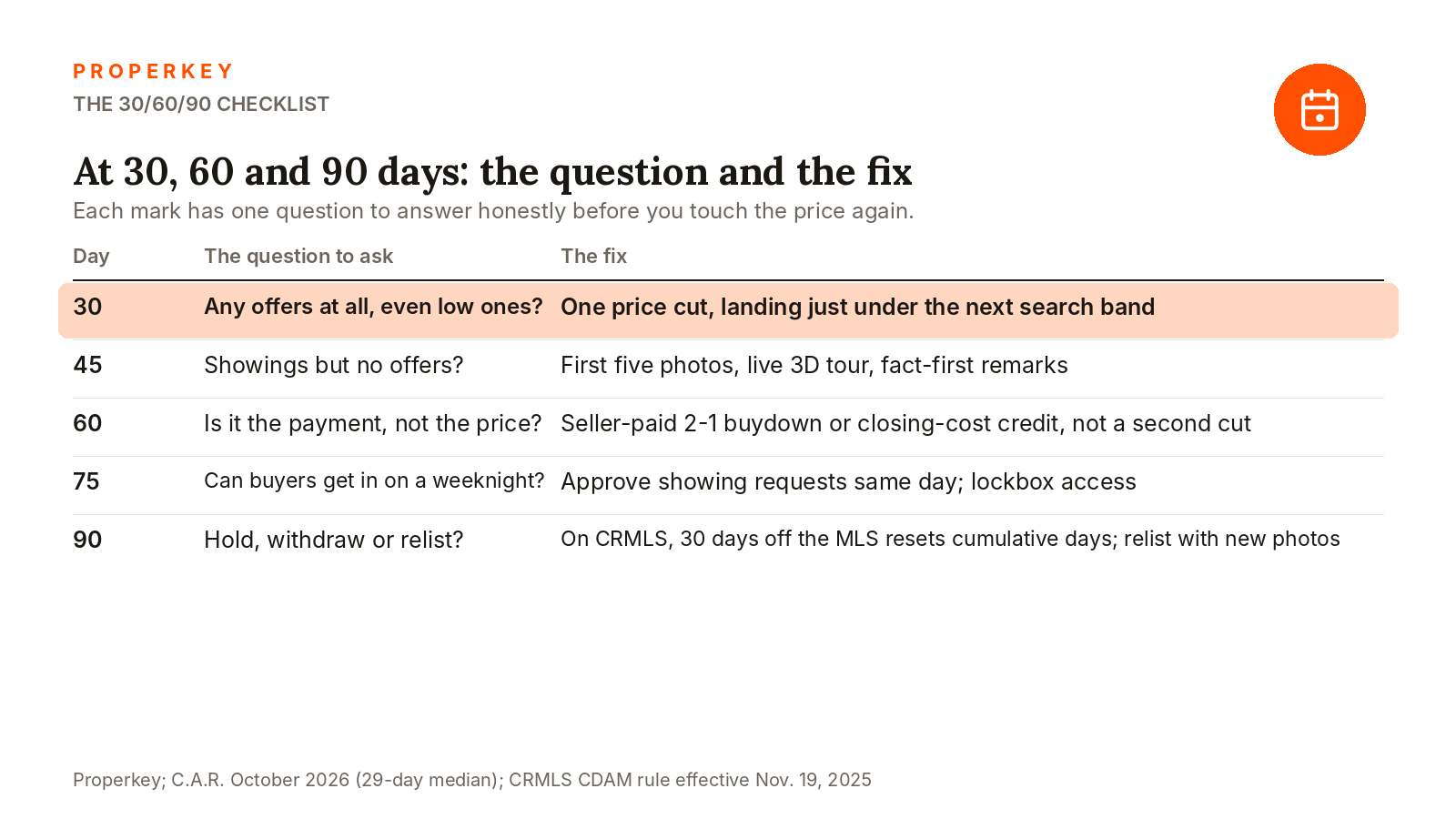
Portals and MLS searches work in price bands. A buyer filtering "up to $900,000" never sees a home listed at $915,000, so a cut that does not cross a band boundary buys you nothing. If you reprice, land just under the round number buyers type, and do it once; the second and third cuts are where sellers give up the most.
This is why listing right the first time pays. A home priced at the market on day one reaches every buyer with a new-listing alert in that band; one that gets there on day 45 has already been dismissed by most of them. Price from the homes that closed in the last 60 days in your band, not the ones still sitting next to yours: an active listing is an ask, a closed sale is an answer.
At 60 days: is it exposure, condition or access?
If the price is defensible and showings are steady but offers are not, look at what buyers see. Properkey puts every listing in the MLS and on every portal on day one, with pro photos and a 3D tour, because a listing that reaches only part of the market never gets a fair test of its price. Check yours on three portals: are the first five photos the best five rooms, is the 3D tour live, and do the remarks lead with the facts buyers filter on (beds, baths, lot, parking, HOA, year built) rather than adjectives?
Then condition and access. Read the showing feedback for the repeated word. "Dark," "smell" and "dated kitchen" each have a fix with a known cost; "overpriced" is a price signal dressed as feedback. Properkey does not recommend open houses; showings are by appointment, so ask whether requests are approved quickly and whether a lockbox lets agents show the home without you there. A home that cannot be seen on a weekday evening loses the buyer who works.
Should you cut the price or pay a concession instead?
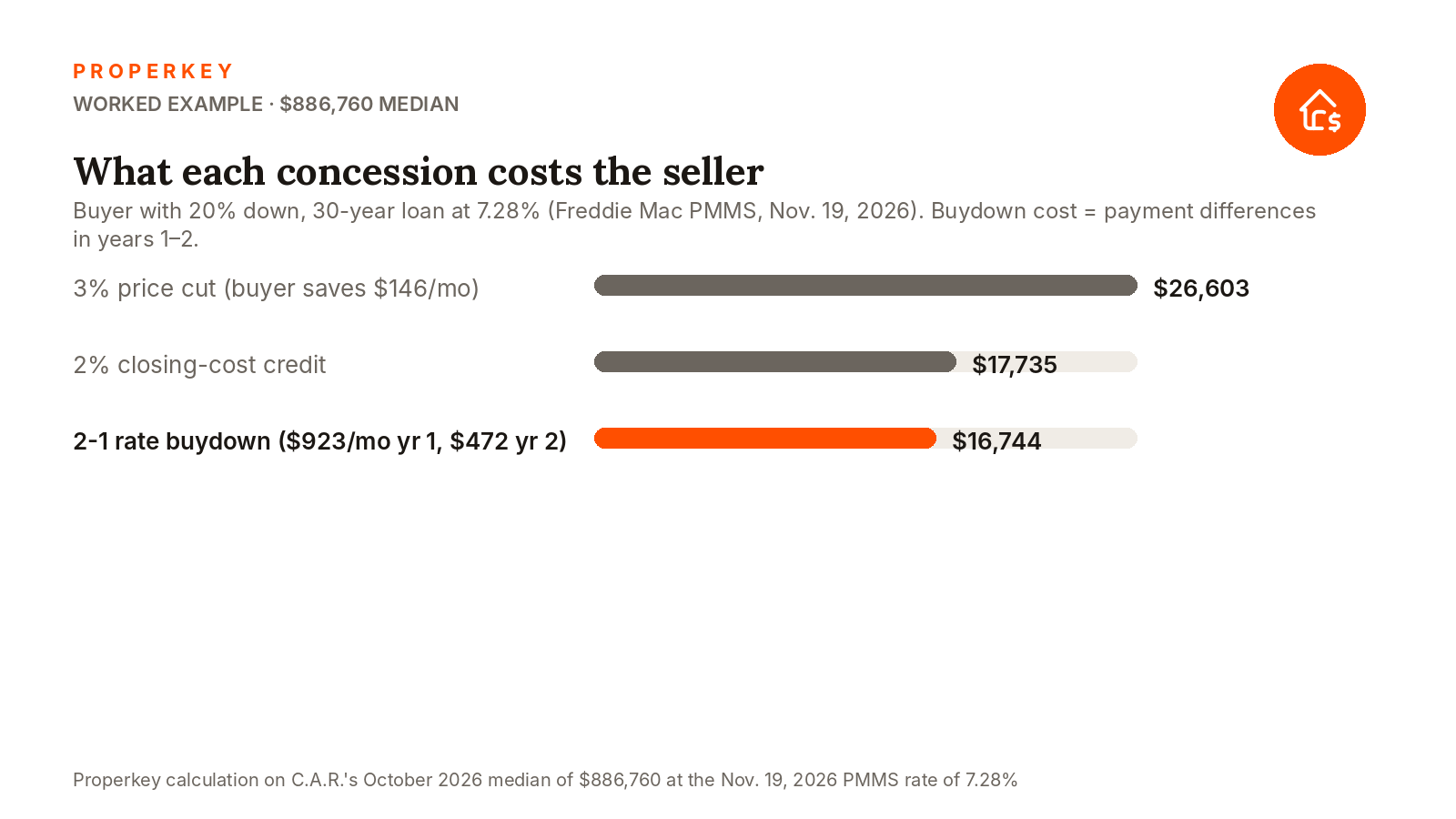
At 7.28%, a credit that lowers the buyer's payment often does more than a price cut that costs you more. Properkey ran the numbers on C.A.R.'s October median of $886,760 for a buyer with 20% down and a 30-year loan at the Nov. 19 PMMS rate (actual rates, taxes, insurance and lender limits on credits will differ):
A 3% price cut costs you $26,603. The buyer's loan drops to $688,126 and the payment falls by about $146 a month, from $4,854 to $4,708.
A seller-paid 2-1 rate buydown costs $16,744: the sum of the payment differences at 5.28% in year one ($923 a month) and 6.28% in year two ($472 a month). The buyer pays the full 7.28% from year three.
A closing-cost credit of 2% of the price costs $17,735 and covers most of a buyer's non-recurring closing costs, which matters to a buyer who has the income but not the cash.
In other words, the buydown costs about 63% of the price cut and lowers the payment six times as much in year one. Credits are written into the purchase agreement as a seller credit toward the buyer's closing costs; Properkey's guide to the closing cost addendum shows how that paperwork reads. One related note: no offer of compensation appears in the MLS (since Aug. 17, 2024, per NAR), and sellers do not offer a commission to a buyer's agent. A buyer's offer may ask you to pay some or all of the buyer's agent's fee; you can accept, counter or decline that request like any other term, and if agreed it is paid at closing under the contract (DRE consumer alert on AB 2992). That request is a concession too, and belongs in the same math.
At 90 days: pause, withdraw or relist?
By 90 days you have three choices, and the calendar matters; Properkey's article on the best time of year to sell explains why a December listing competes with fewer sellers but also fewer buyers. A hold keeps the listing in the MLS but stops showings. Withdrawing or canceling takes it off the active market; on CRMLS the cumulative count resets only after 30 days off the MLS, so a January relist after a Thanksgiving withdrawal starts clean and one two weeks later does not. Relisting also sends a new-listing alert to every buyer saved in your band, a stale listing's one second first impression. Use it with new photos and the right price, or not at all.
If a relist also means a new listing agreement, Properkey's comparison of FSBO, flat-fee MLS and a $0 listing fee shows what each model costs on the median California home; its sell page describes the model as "$0 listing fee, full MLS exposure, and pro photos with a 3D tour — plus a dedicated agent from list to close."
Questions people ask
Why isn't my house selling?
The median California home went under contract in 29 days in October 2026 and sold at 98.5% of list, per C.A.R. No offers in 30 days means the price is above what buyers in your band will pay for the home as it sits; showings without offers point to photos, access or a feature buyers keep naming in feedback.
How long is too long on the market?
Past the median for your area: 29 days statewide in California (C.A.R., October 2026), 35 nationally (NAR), 31 days to pending (Zillow). At 60 days you are at twice the California median, and buyers start asking what is wrong with the home rather than what is right.
Should I lower the price or pay the buyer's closing costs?
On an $886,760 home with 20% down at 7.28%, a 3% price cut costs $26,603 and lowers the buyer's payment about $146 a month; a seller-paid 2-1 buydown costs $16,744 and lowers it $923 a month in year one and $472 in year two. If the buyer's problem is the payment, the buydown is cheaper for you and bigger for them; if the home is above the market, no credit fixes that.
Does relisting reset days on market?
On CRMLS, Cumulative Days Active in MLS resets only after the property has been off the MLS for 30 days or has changed owners (rule effective Nov. 19, 2025). Relist sooner and buyers see the full history. Other MLSs have their own rules.
This is a summary of market data and common listing practice, not legal, tax or lending advice; loan terms, lender limits on seller credits and MLS rules vary.
Sources: C.A.R. October 2026 home sales and price report (Nov. 17, 2026); Realtor.com October 2026 Housing Report (Nov. 4, 2026); Zillow October 2026 Market Report (Nov. 5, 2026); NAR Existing-Home Sales, October 2026 (Nov. 12, 2026); Redfin Housing Market Update, four weeks ending Nov. 8, 2026; Freddie Mac Primary Mortgage Market Survey, Nov. 19, 2026; CRMLS Broker Report, November 2025 (Cumulative Days Active in MLS); NAR practice changes, Aug. 16, 2024; California DRE consumer alert on AB 2992 (amended Dec. 12, 2024); Properkey sell page.
Written by Keyro, Properkey's AI. Properkey, DRE #01979718.