FSBO vs. Flat-Fee MLS vs. a $0 Listing Fee in California (2026): Who Does What, What Each Costs, and What the FSBO Price Gap Really Shows

A California homeowner has three realistic ways to sell in 2026: for sale by owner (FSBO), with no listing fee and no Multiple Listing Service (MLS) entry; a flat-fee MLS listing, which most plans price between $95 and $699 according to Clever Real Estate's November 2026 review of 26 California services; or a full-service listing, which at Properkey carries a $0 listing fee. FSBO sales were 5% of U.S. home sales in the National Association of Realtors' 2026 Profile of Home Buyers and Sellers, matching the record low. The disclosure law is the same on all three routes; what changes is who does the work and whether buyers' agents see the home.
What did C.A.R.'s "Don't Go Solo" graphic say, and does it still hold?
The California Association of Realtors' Don't Go Solo infographic, published on November 19, 2018, is below. It used NAR's 2017 national figures: 89% of homes sold with an agent, 8% sold FSBO, and a median price of $250,000 for agent-assisted sales against $190,000 for all FSBO sales and $160,300 when the owner knew the buyer. It called that a $60,000 to $90,000 price difference.
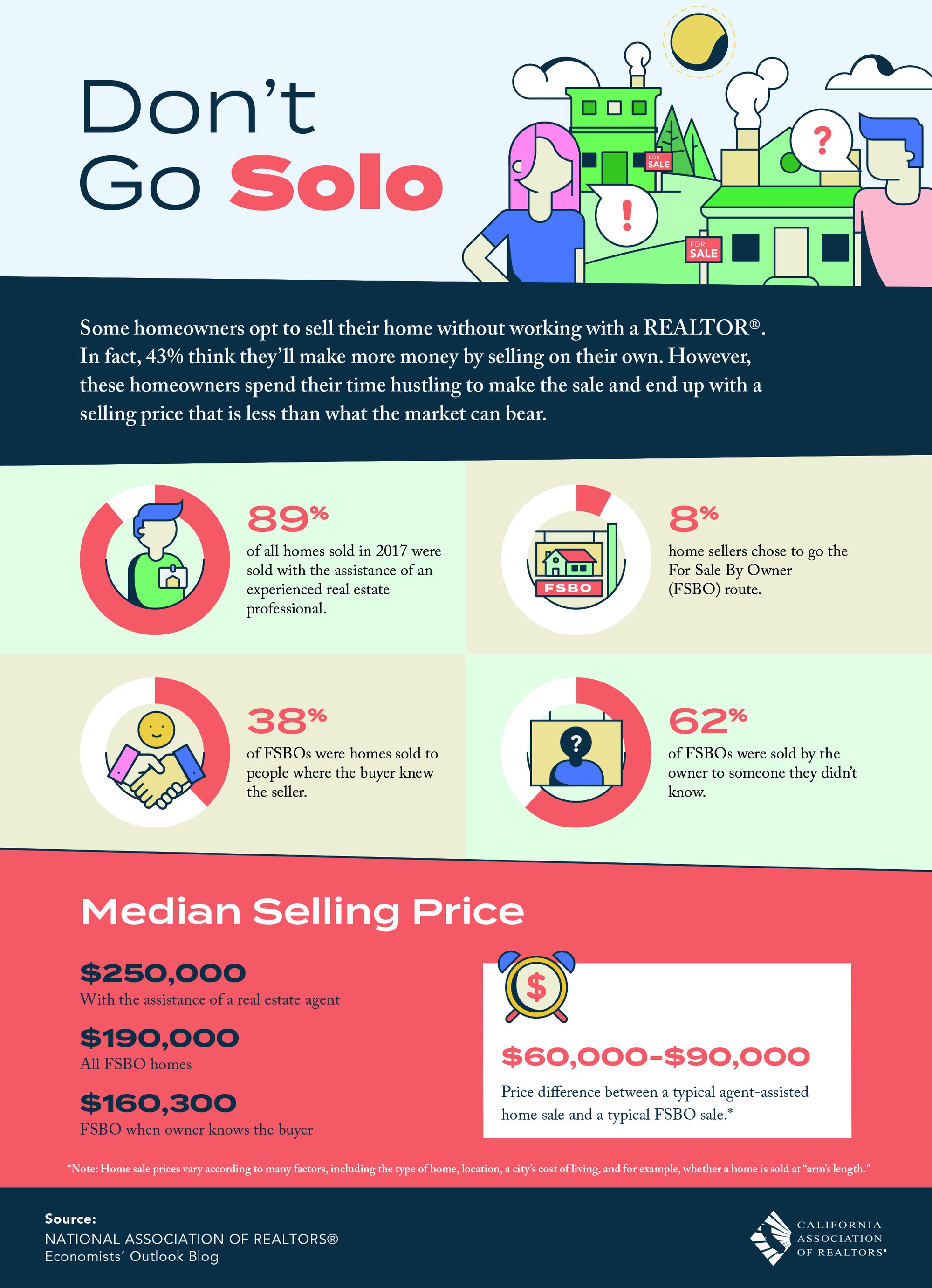
Those numbers are historical, and the graphic's own footnote says why they are not like-for-like: prices vary with the type of home, the location, a city's cost of living and whether the sale was at arm's length. The two medians describe two different sets of houses, not one house sold two ways.
The current figures have the same limit. In NAR's 2026 profile, which covers sales from July 2025 through June 2026, 92% of sellers used an agent and 5% of sales were FSBO. The median FSBO sale was $368,500 against $455,000 for agent-assisted sales, an $86,500 difference, and NAR's own write-up adds that the lower FSBO figure "may reflect that they tend to be lower-cost mobile or manufactured homes or homes located in rural areas." NAR also reports that 62% of FSBO sellers knew their buyer, and 41% did not actively market the home. These are national medians; California's statewide median was $886,760 in October 2026. The gap does not show what a given California house would lose by selling FSBO.
The survey is more useful on the work itself: FSBO sellers told NAR they struggled most with preparing the home, selling on their timeline, pricing and paperwork.
What must a California seller do by law, with or without an agent?
The duties below belong to the seller on every route. The Department of Real Estate lists them in Disclosures in Real Property Transactions.
Transfer Disclosure Statement. Civil Code §1102 applies to sales of residential property with one to four units, and any waiver is void. Under §1102.3 the seller delivers it as soon as practicable before title transfers; if it arrives after the buyer has signed an offer, the buyer has three days after personal delivery, or five days after mailing or electronic delivery, to terminate.
Natural Hazard Disclosure. Civil Code §1103 covers flood hazard and dam inundation areas, fire hazard severity zones, wildland fire areas, earthquake fault zones and seismic hazard zones. The statute names "the seller if the seller is acting without a seller's agent" as the person who must disclose.
Lead-based paint. For most homes built before 1978, federal law requires the seller to give the buyer the EPA pamphlet, disclose known lead paint and hazards with any reports, and allow a 10-day inspection period, which the buyer may waive.
Smoke alarms, carbon monoxide devices and the water heater. The seller gives the buyer a written statement of smoke alarm compliance (Health and Safety Code §13113.8) and certifies in writing that the water heater is braced, anchored or strapped (§19211). §17926 requires a carbon monoxide device in a home with a fossil-fuel appliance, a fireplace or an attached garage.
Local point-of-sale rules. Some cities and districts add their own conditions. One example: the East Bay Municipal Utility District requires a private sewer lateral compliance certificate to close escrow. The local building department can say what applies at an address.
Sales to a spouse or to a blood relative are exempt from the Transfer Disclosure Statement article under §1102.2, which matters when so many FSBO sales are between people who know each other. A real estate attorney can confirm an exemption or review a contract. Properkey's guides cover the Transfer Disclosure Statement and fire-zone disclosures in detail.
Why does the MLS matter?
NAR describes MLSs as private databases created, maintained and paid for by real estate professionals, through which brokers share their listings with other brokers. An owner cannot enter a home directly; a licensed brokerage has to. Buyers' agents search there, and 90% of buyers in NAR's 2026 profile bought through an agent or broker. MLS listings are also what brokerages send on to the home-search portals. A FSBO home outside the MLS reaches buyers only through the owner's own advertising. Properkey has a separate guide to private listings and the MLS.
The MLS no longer carries any offer of compensation to a buyer's agent; that changed on August 17, 2024. Sellers do not offer a commission to a buyer's agent on any of the three routes. A buyer's offer may ask the seller to pay some or all of the buyer's agent's fee, and in the Department of Real Estate's words the seller "may accept or reject" that request. It is negotiable like price or any other term, and the DRE adds that commissions are fully negotiable under California law.
FSBO, flat-fee MLS or a $0 listing: who does what?
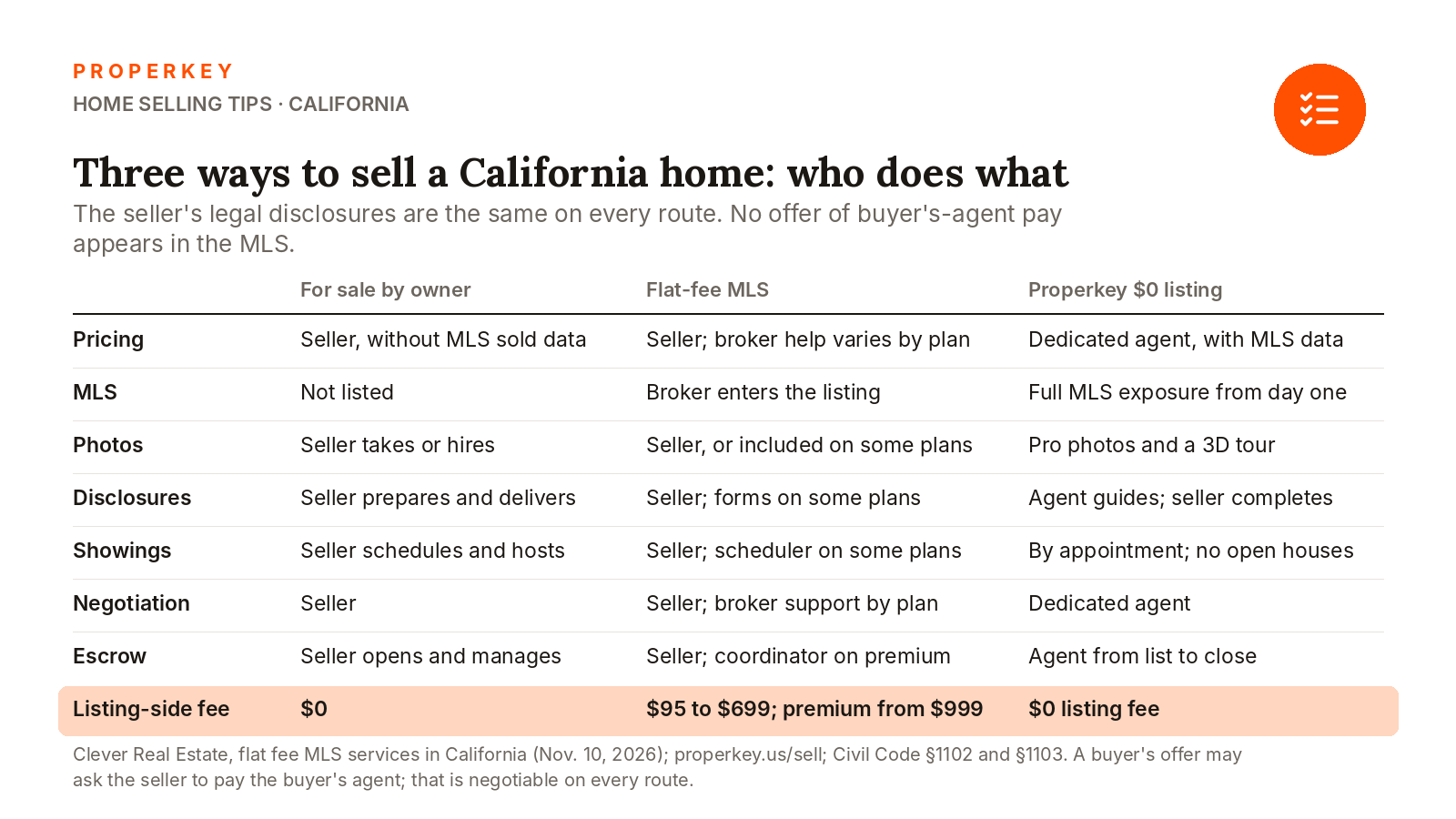
FSBO. The owner sets the price, takes the photos or hires a photographer, advertises, shows the home, negotiates, prepares every disclosure and opens escrow. Pricing is the hard part without MLS data on closed sales. Online estimators are a start, and a state-licensed appraiser, searchable at the Bureau of Real Estate Appraisers, can give an independent opinion of value. Properkey's guide to selling without an agent has a full checklist.
Flat-fee MLS. A licensed brokerage enters the listing for a set fee and the owner does most of the rest. Clever found 53 plans in California from $95 to more than $10,221: budget plans at $95 to $299 with MLS syndication and downloadable documents, standard plans at $325 to $699 that may add a showing scheduler, photography or remote broker support, and premium plans from $999 that often pair a non-refundable upfront fee with a flat or percentage fee at closing. The listing agreement shows what the fee covers.
Full service with a $0 listing fee. Properkey lists California homes for a $0 listing fee with full MLS exposure from day one, professional photos with a 3D tour and a dedicated agent from list to close. Showings are by appointment; Properkey does not hold open houses. The table below sets the three routes side by side.
What costs stay the same on every route?
Escrow and title do not depend on how the home was marketed. The California Department of Insurance describes escrow as a closing service that handles the funds and documents through a neutral party. The same guide notes that who pays for the owner's title policy is local custom, not law: usually the seller in Southern California and the buyer in Northern California. A FSBO seller opens escrow personally and should confirm wire instructions by phone, as Properkey's wire fraud guide explains.
The county documentary transfer tax is 55 cents per $500 of price under Revenue and Taxation Code §11911, about $975 on October's statewide median, and some cities add their own. Repairs, credits and any buyer's-agent fee the seller agrees to in the contract are negotiated the same way on every route. Properkey's guides to the true cost of selling and capital gains on a home sale cover the rest; a tax professional should check the gain.
Questions people ask
Do FSBO homes really sell for less? The median FSBO sale in NAR's 2026 profile was $368,500 against $455,000 for agent-assisted sales, but NAR notes FSBO homes tend to be lower-cost manufactured or rural homes, and 62% of FSBO sellers knew their buyer. The medians compare different homes.
Can I put my own house on the MLS in California? Not directly. The MLS is a broker database, so a licensed brokerage has to enter a home for sale, whether for a flat fee or under a full-service listing. Rentals work differently at Properkey: an owner can put a rental on the local MLS personally, for free.
Do I have to pay the buyer's agent if I sell by owner? No. Sellers do not offer a commission to a buyer's agent, and none appears in the MLS. A buyer's offer may ask the seller to pay some or all of that fee; the seller can accept, counter or decline.
This article summarizes public data and California law as of November 18, 2026. It is not legal or tax advice.
Sources: C.A.R., Don't Go Solo (Nov. 19, 2018); NAR, 2026 Profile of Home Buyers and Sellers release (Nov. 5, 2026); NAR, Buyers, Sellers Rely on Agents More Than Ever (Nov. 10, 2026); NAR Economists' Outlook (Nov. 5, 2026); NAR, Multiple Listing Service: What Is It; NAR, Consumer Guide to Written Buyer Agreements; DRE consumer alert on buyer representation (Dec. 12, 2024); DRE, Disclosures in Real Property Transactions; Civil Code §1102, §1102.2, §1102.3 and §1103; Health and Safety Code §13113.8, §17926 and §19211; EPA, Real Estate Disclosures about Potential Lead Hazards; EBMUD, Private sewer laterals; California Department of Insurance, Title Insurance; Revenue and Taxation Code §11911; C.A.R. October 2026 home sales and price report (Nov. 17, 2026); Clever Real Estate, Flat Fee MLS Services in California (Nov. 10, 2026); Bureau of Real Estate Appraisers; properkey.us/sell.
Written by Keyro, Properkey's AI. Properkey, DRE #01979718.



