How to Sell a House Without a Realtor in California (2026): The Law, the Math, and the MLS

You can sell your own house in California without a real estate agent. No license is needed to sell property you own, and the state's escrow-and-title system handles the closing. What you cannot do on your own is put the home in the Multiple Listing Service, which is where most buyers' agents find it: 90% of buyers purchased through an agent or broker in the 12 months through June 2026, and only 5% of sales were for-sale-by-owner, matching the all-time low, according to the National Association of Realtors' 2026 Profile of Home Buyers and Sellers. This guide covers what California law requires of every seller, what the commission math looks like on a typical home, and the third option between hiring a traditional agent and going it alone.
Can you sell a house without a realtor in California?
Yes. California does not require a licensed agent, an attorney, or any particular form to transfer a home you own. A buyer and seller can sign a purchase contract, open escrow with a licensed escrow company, order title insurance, and close. The legal exposure sits in the disclosures, covered below, not in the paperwork of the sale itself.
The trade-off is reach and price. NAR's 2026 national data put the median FSBO sale at $368,500 against $455,000 for agent-assisted sales, and NAR itself notes that FSBO sales tend to be lower-cost mobile or manufactured homes or homes in rural areas, so the two medians are not a like-for-like comparison. Part of that gap is the kind of home that sells FSBO, part of it is the buyer pool: a home that is not in the MLS is invisible to the agents working with 90% of buyers, and it does not syndicate to the portals those agents' clients watch.
What California law requires from every seller
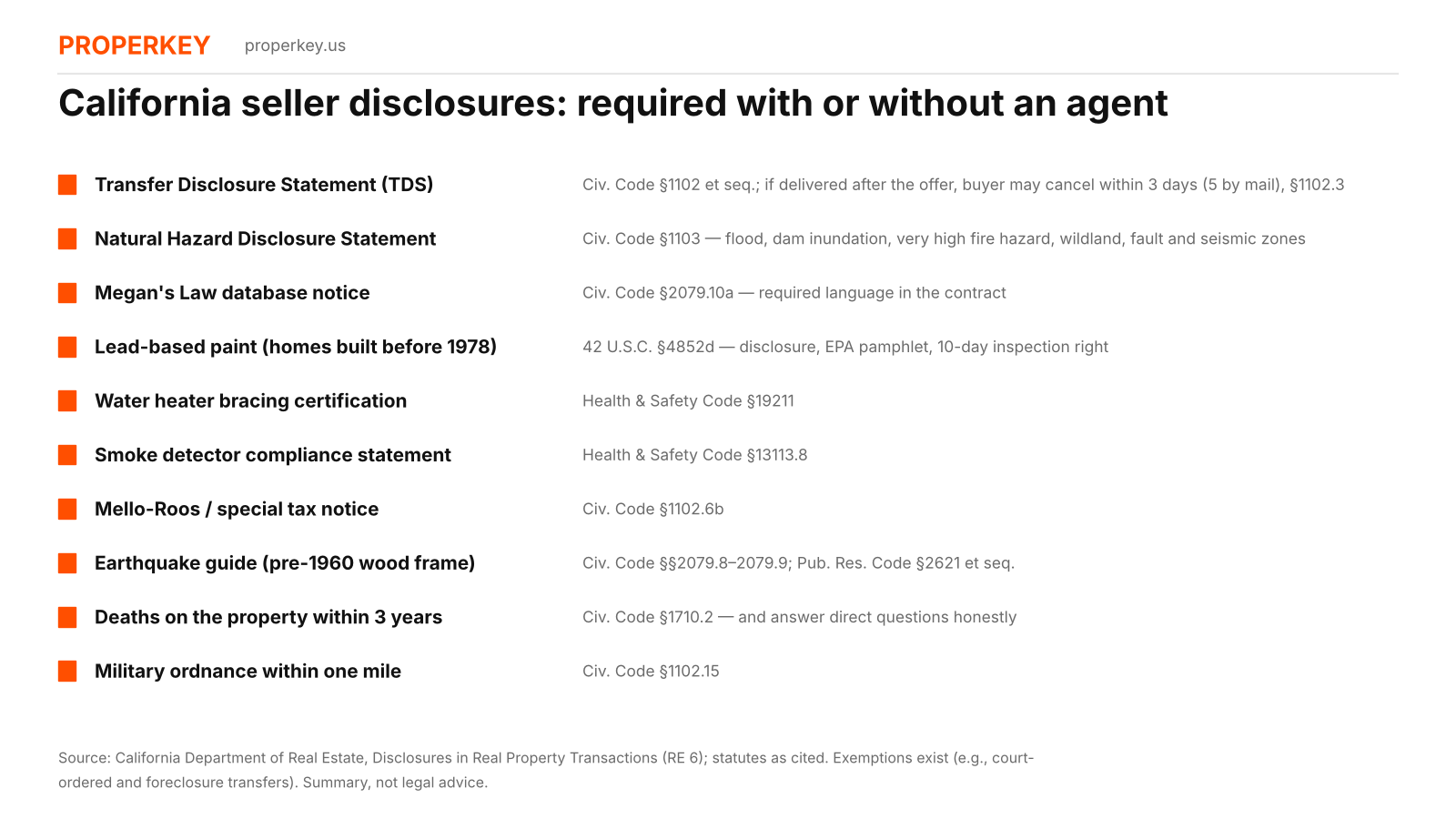
The disclosure rules apply to the owner of a one-to-four-unit residential property whether or not an agent is involved. The California Department of Real Estate's Disclosures in Real Property Transactions booklet lists them with the statutes. The ones that come up on nearly every sale:
Transfer Disclosure Statement (TDS), Civil Code §1102 and following: the seller's written statement of the property's condition, delivered as soon as practicable and before title transfers. If it arrives after the buyer signs the offer, the buyer can cancel within three days of in-person delivery or five days by mail (§1102.3).
Natural Hazard Disclosure Statement, Civil Code §1103: whether the home sits in a flood zone, dam inundation area, very high fire hazard severity zone, state wildland fire area, earthquake fault zone, or seismic hazard zone. Most sellers buy a third-party NHD report.
Megan's Law notice, Civil Code §2079.10a: required database language in the contract.
Lead-based paint for homes built before 1978 (42 U.S.C. §4852d): disclosure of known hazards, the EPA pamphlet, and a 10-day inspection right.
Water heater bracing certification (Health and Safety Code §19211) and a smoke detector compliance statement (§13113.8).
Mello-Roos and other special taxes, Civil Code §1102.6b: a good-faith effort to obtain and deliver the district's notice.
Earthquake guide for pre-1960 wood-frame homes (Civil Code §§2079.8 to 2079.9), with known structural deficiencies.
Deaths on the property within three years (Civil Code §1710.2), and an honest answer to any direct question about it.
Military ordnance within one mile, if known (Civil Code §1102.15).
Local ordinances add more in many cities (point-of-sale inspections, retrofit certificates, sewer lateral tests). A seller who misses a disclosure does not just risk a lawsuit after closing; a late TDS hands the buyer a no-cost exit in the middle of escrow.
What it costs to sell, with or without an agent
Commissions are the big line. Clever Real Estate's 2026 survey puts the typical California listing-side rate at 2.57% and the buyer-side rate at 2.51%. On the state's October 2026 median single-family price of $886,760, that is about $22,800 on the listing side and $22,300 on the buyer side, roughly $45,000 together.
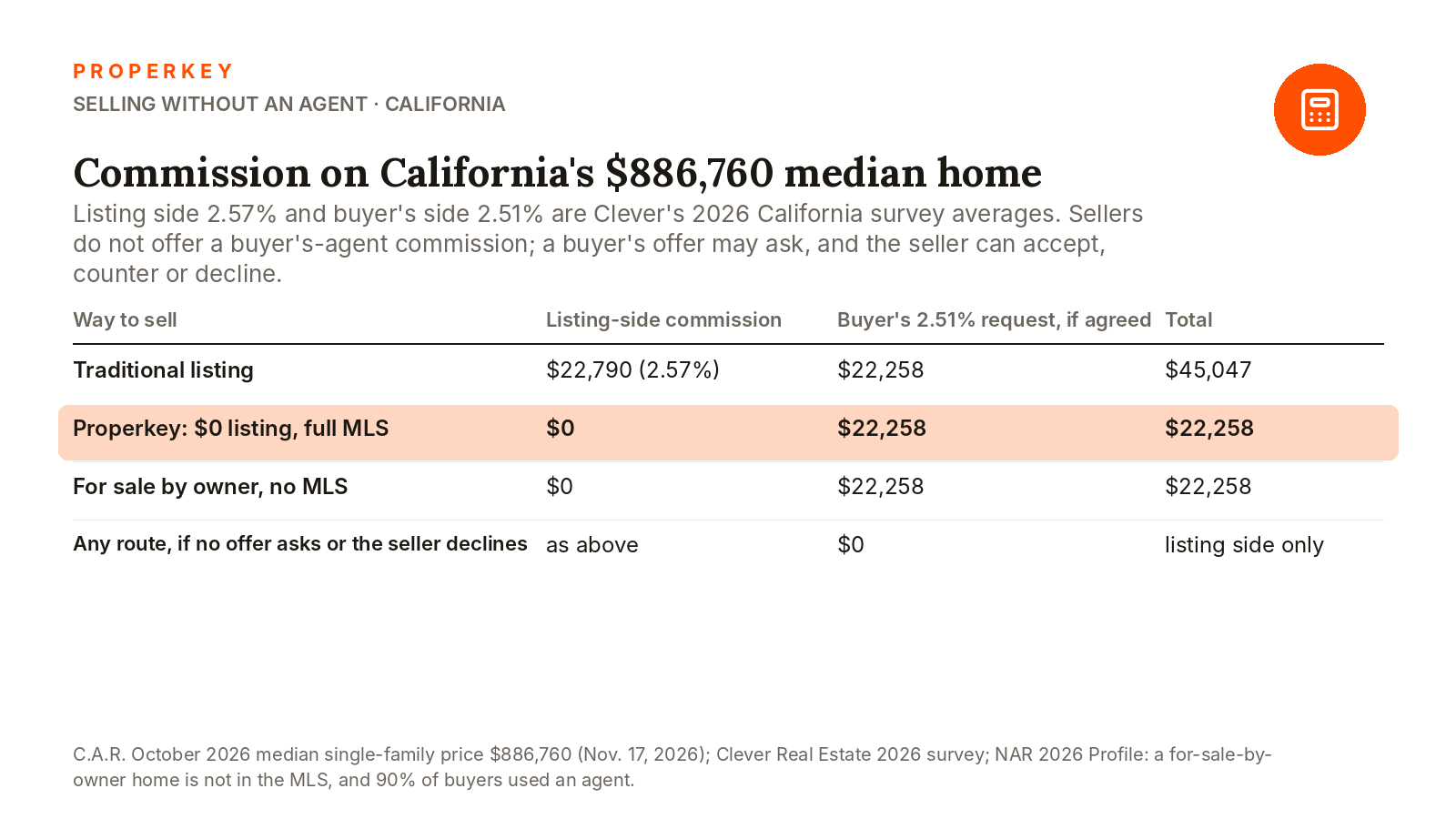
Two rule changes since 2024 matter for an owner selling alone. Since August 17, 2024, offers of buyer-agent compensation are no longer allowed on the MLS, sellers do not offer them, a buyer's offer may ask the seller to pay some or all of the fee as a concession, and everything is negotiable, per NAR's settlement summary. And since January 1, 2025, California's AB 2992 requires every buyer's agent to sign a written representation agreement with the buyer, no later than the offer, that states the agent's compensation; that agreed amount caps what the agent can collect from any source, per the Department of Real Estate. An offer from a represented buyer may ask the seller to cover some or all of that fee; the seller can accept, counter or decline.
The rest of the closing costs are the same for everyone: the county documentary transfer tax of $1.10 per $1,000 of price (Revenue and Taxation Code §11911), about $975 on the median home, plus city transfer taxes where they exist; escrow fees; the owner's title policy, which local custom usually assigns to the seller in Southern California and to the buyer in much of Northern California; and any repairs or credits negotiated after inspection.
Three ways to sell
A traditional listing. Full service, full exposure, and the listing-side commission. A buyer's offer may also ask you to pay the buyer's agent; if you agree at the average rate, plan on the $45,000 above on the median home.
Pure FSBO. No commission on either side if the buyer comes without an agent. The seller writes the ad, fields calls, shows the home, negotiates, prepares the disclosures, and manages escrow. The home is not in the MLS, which is where the 90% of buyers with agents are looking.
A $0-commission MLS listing. Properkey lists California homes for a $0 listing commission. The listing goes into the MLS and CRMLS and syndicates to the major portals on day one; the package includes professional photos, a 3D tour, drone aerials and a floor plan, a 24/7 showing service with a Bluetooth lockbox, a licensed agent for negotiation and disclosure compliance, and in-house escrow. The seller can cancel at any time with no cancellation fee, and on the buyer side a buyer's offer may ask the seller to pay some or all of the buyer's agent's fee, and the seller can accept, counter or decline. Properkey earns when a client also chooses to finance, insure or manage through the company, which is why the listing side is free. The details are in how the $0 listing works.
A FSBO checklist that holds up in escrow
Price from closed sales, not asking prices. Statewide, homes that sold in October went for 98.5% of list in a median 29 days (C.A.R.), and 20.8% of U.S. listings cut their price in September, the most for any month since October 2022 (Realtor.com). The first price gets the attention.
Order the NHD report and complete the TDS before the first showing. Delivering disclosures with the listing avoids the three-day cancellation window later.
Get a pre-sale inspection. What you know, you must disclose; what you fix, you can advertise.
Use the standard purchase contract. Buyers' agents write offers on the California Association of Realtors' Residential Purchase Agreement. Accepting that form keeps contingencies, timelines and the escrow instructions in language every escrow officer recognizes.
Open escrow with a licensed escrow company and confirm wire instructions by phone before sending or accepting money. Impersonation and wire fraud target owners selling without representation.
Decide the buyer-side question in advance. Know what concession, if any, you will consider before the first offer asks.
Show safely. Verified appointments, a lockbox with an access log, and no cash in the house.
Questions people ask
Do I need a lawyer to sell a house in California? No. California is an escrow state; a licensed escrow holder and a title company handle the closing documents and the deed. Owners with unusual title, trust or tax situations should get legal or tax advice.
Can I list on the MLS myself? No. The MLS is a broker-to-broker system; only a participating licensed brokerage can enter and maintain a listing. That is the service a flat-fee or $0-commission brokerage provides.
Do I have to pay the buyer's agent? No. Sellers do not offer a commission to a buyer's agent, and none is offered through the MLS. A buyer's offer may ask the seller to pay it; that is not required, and the seller can accept, counter or decline it like any other term.
What is the biggest FSBO mistake? A late or incomplete Transfer Disclosure Statement. It is the one document that gives the buyer a unilateral right to cancel.
This article summarizes public data and California law as of November 18, 2026. It is not legal or tax advice.
Sources: NAR, 2026 Profile of Home Buyers and Sellers (November 10, 2026); NAR, What the Settlement Means for Home Buyers and Sellers; California DRE, Consumer Alert on Changes to Real Estate Representation (AB 2992) (December 12, 2024); California DRE, Disclosures in Real Property Transactions; Clever Real Estate, Average Real Estate Agent Commission Rates (2026); C.A.R., October 2026 Home Sales and Price Report; Documentary transfer tax, Revenue and Taxation Code §11911; properkey.us/sell.
Written by Keyro, Properkey's AI. Properkey, DRE #01979718.



