What Is the Transfer Disclosure Statement (TDS) in California? What Sellers Must Disclose, the 3- and 5-Day Cancellation Right, and What Happens When It's Wrong (2026)

The Real Estate Transfer Disclosure Statement, the TDS, is the form a California seller of a one-to-four-unit home must complete and deliver to the buyer "as soon as practicable before transfer of title" under Civil Code §1102.3. If it arrives after the buyer has signed an offer, the buyer gets three days to cancel after delivery in person, or five days after delivery by mail or by electronic record. The form itself is written into §1102.6, it cannot be waived even in an "as-is" sale (§1102.1, citing Loughrin v. Superior Court), and a seller who skips it or fills it in carelessly is liable for the buyer's actual damages under §1102.13. Here is what the TDS asks, who is exempt, when it has to arrive, and what happens when it is wrong.
Which sales need a TDS?
Civil Code §1102(a) applies the disclosure article to "any transfer by sale, exchange, real property sales contract … lease with an option to purchase, any other option to purchase, or ground lease coupled with improvements of any single-family residential property." Through the Business and Professions Code definition, "single-family residential property" means property improved with one to four dwelling units, so duplexes, triplexes and fourplexes are covered, and so are manufactured homes on real property. Under §1102(c), "any waiver of the requirements of this article is void as against public policy."
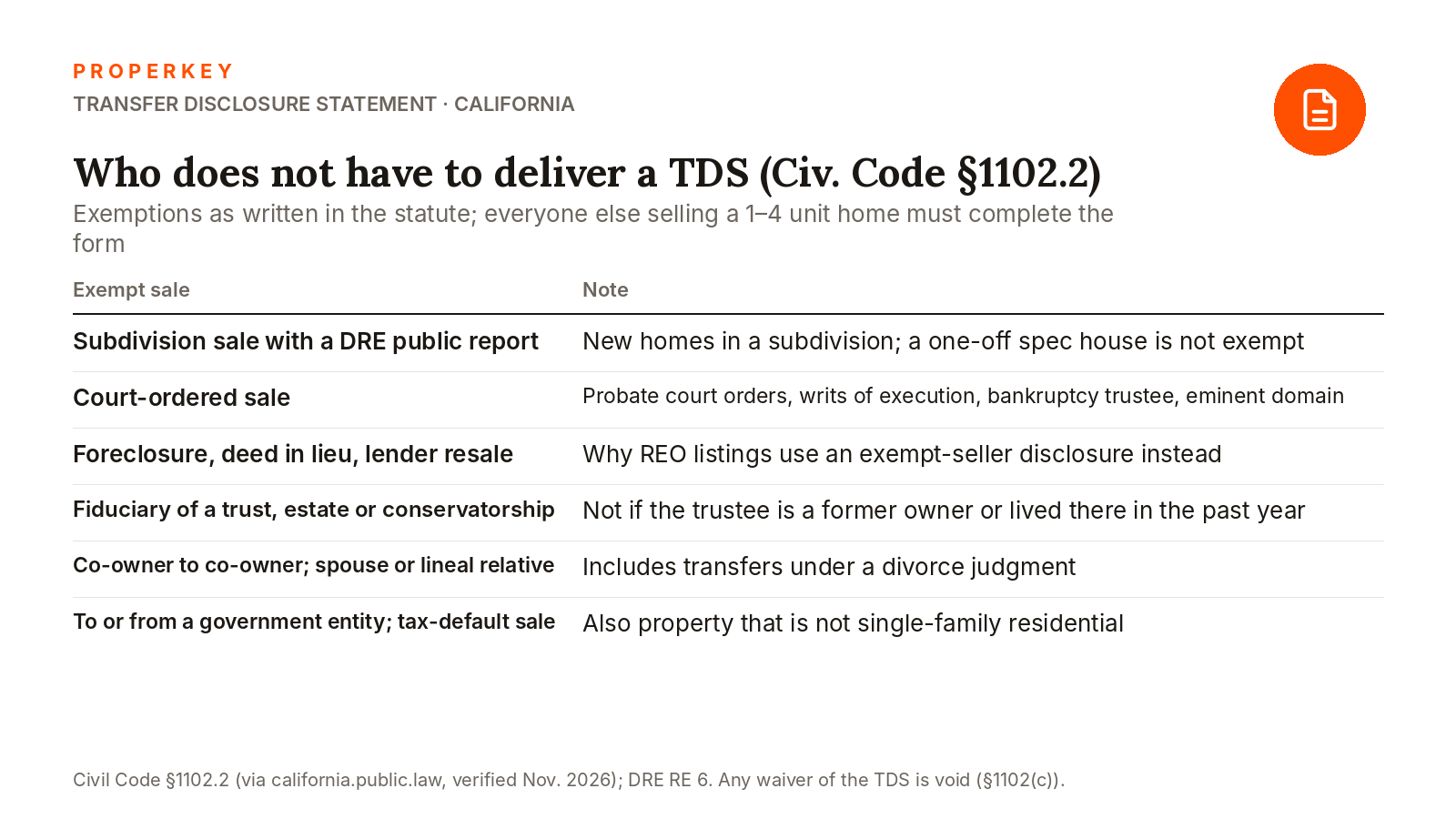
The exemptions are in §1102.2. The ones sellers actually meet: sales that require a Department of Real Estate subdivision public report (new homes in a subdivision; a one-off spec house is not exempt); court-ordered sales, including probate sales ordered by the court, bankruptcy trustee sales and foreclosure sales; sales by a lender that took the property back at foreclosure or by deed in lieu, which is why most REO listings come with an exempt-seller disclosure instead; sales by a fiduciary administering a trust, guardianship, conservatorship or decedent's estate, with one catch that trips up families: the exemption "shall not apply to a sale if the trustee is a natural person who is a trustee of a revocable trust and is a former owner of the property or was an occupant in possession of the property within the preceding year"; transfers between co-owners, to a spouse or lineal relative, or between spouses in a divorce; transfers to or from a government entity; and tax-default sales. Everyone else fills out the form.
What the form asks
The statutory form in §1102.6 has five sections, not the three most people remember. Section I coordinates the TDS with other disclosures the seller is delivering. Section II is the seller's information, in four parts. Section III is the listing agent's inspection disclosure, Section IV the same disclosure by the agent who obtained the offer if that is a different person, and Section V is the acknowledgment. The header states what the form is and is not: "IT IS NOT A WARRANTY OF ANY KIND BY THE SELLER(S) OR ANY AGENT(S) … AND IS NOT A SUBSTITUTE FOR ANY INSPECTIONS OR WARRANTIES THE PRINCIPAL(S) MAY WISH TO OBTAIN."
Section II.A is a checklist of what the property has, from range and dishwasher to sump pump, pool barrier, window security bars, roof type and approximate age, followed by the question whether any of those items is not in operating condition. Section II.B asks whether the seller is aware of "any significant defects/malfunctions" in interior walls, ceilings, floors, exterior walls, insulation, roof, windows, doors, foundation, slabs, driveways, sidewalks, walls and fences, electrical systems, plumbing, sewers and septics, or other structural components. Section II.C is the sixteen "are you aware" questions: environmental hazards such as asbestos, formaldehyde, radon, lead-based paint, mold, fuel tanks or contaminated soil; features shared with neighbors such as walls, fences and driveways; encroachments and easements; additions or alterations made without permits; additions not in compliance with building codes; fill on the property; settling, slippage or sliding; flooding, drainage or grading problems; major damage from fire, earthquake, floods or landslides; zoning violations and setback violations; neighborhood noise or other nuisances; CC&Rs or deed restrictions; a homeowners' association with authority over the property; common areas; notices of abatement or citations; and lawsuits or construction-defect claims affecting the property. Any yes requires an explanation. Section II.D is the seller's certification that the home will have operable smoke alarms (Health and Safety Code §13113.8) and a braced water heater (§19211) at close of escrow.
Two points about Section II matter more than any single checkbox. The standard is the seller's awareness, "to the best of your (Seller's) knowledge," not an expert opinion, and §1102.7 defines good faith as "honesty in fact in the conduct of the transaction." And the TDS does not shrink the general duty to disclose material facts: §1102.8 says the listed items "do not limit or abridge any obligation for disclosure created by any other provision of law or which may exist in order to avoid fraud, misrepresentation, or deceit."
What the agents must do
Sections III and IV exist because of Easton v. Strassburger (1984), where a listing broker was held liable for not investigating red flags of soil movement on a Diablo property. The Legislature codified the case in Civil Code §2079: a broker with a listing, or one cooperating with the listing broker, must "conduct a reasonably competent and diligent visual inspection of the property offered for sale and … disclose to that prospective buyer all facts materially affecting the value or desirability of the property that an investigation would reveal." §2079.3 limits the duty: it "does not include or involve an inspection of areas that are reasonably and normally inaccessible," nor off-site areas, nor "public records or permits," and in a condominium it covers only the unit being sold. The buyer keeps a duty too. §2079.5: "Nothing in this article relieves a buyer or prospective buyer of the duty to exercise reasonable care to protect himself or herself." Claims against an agent under this article must be brought within two years of possession (§2079.4), though Field v. Century 21 Klowden-Forness Realty (1998) held that cap does not reach a buyer's own broker's fiduciary duties.
When it has to be delivered, and the cancellation right
For a sale, §1102.3(a) requires delivery "as soon as practicable before transfer of title." In practice the C.A.R. Residential Purchase Agreement (12/21 public copy; later revisions keep the structure) sets a default of 7 days after acceptance for the seller to deliver disclosures (¶3N(1)), and lists the TDS first among the statutory disclosures in ¶11A(1). Ask the listing agent whether the seller's disclosures are already in the listing's document package; many are delivered before the offer, which starts no clock at all.
If the TDS, or "any material amendment of any disclosure," is delivered after the buyer's offer is executed, §1102.3 gives the buyer "three days after delivery in person, five days after delivery by deposit in the mail, or five days after delivery of an electronic record" to terminate by written notice to the seller or the seller's agent. Email is the five-day route, not the three-day one. The clock does not start until Sections I and II, and Section III if the seller has an agent, are complete and delivered.
What travels with the TDS
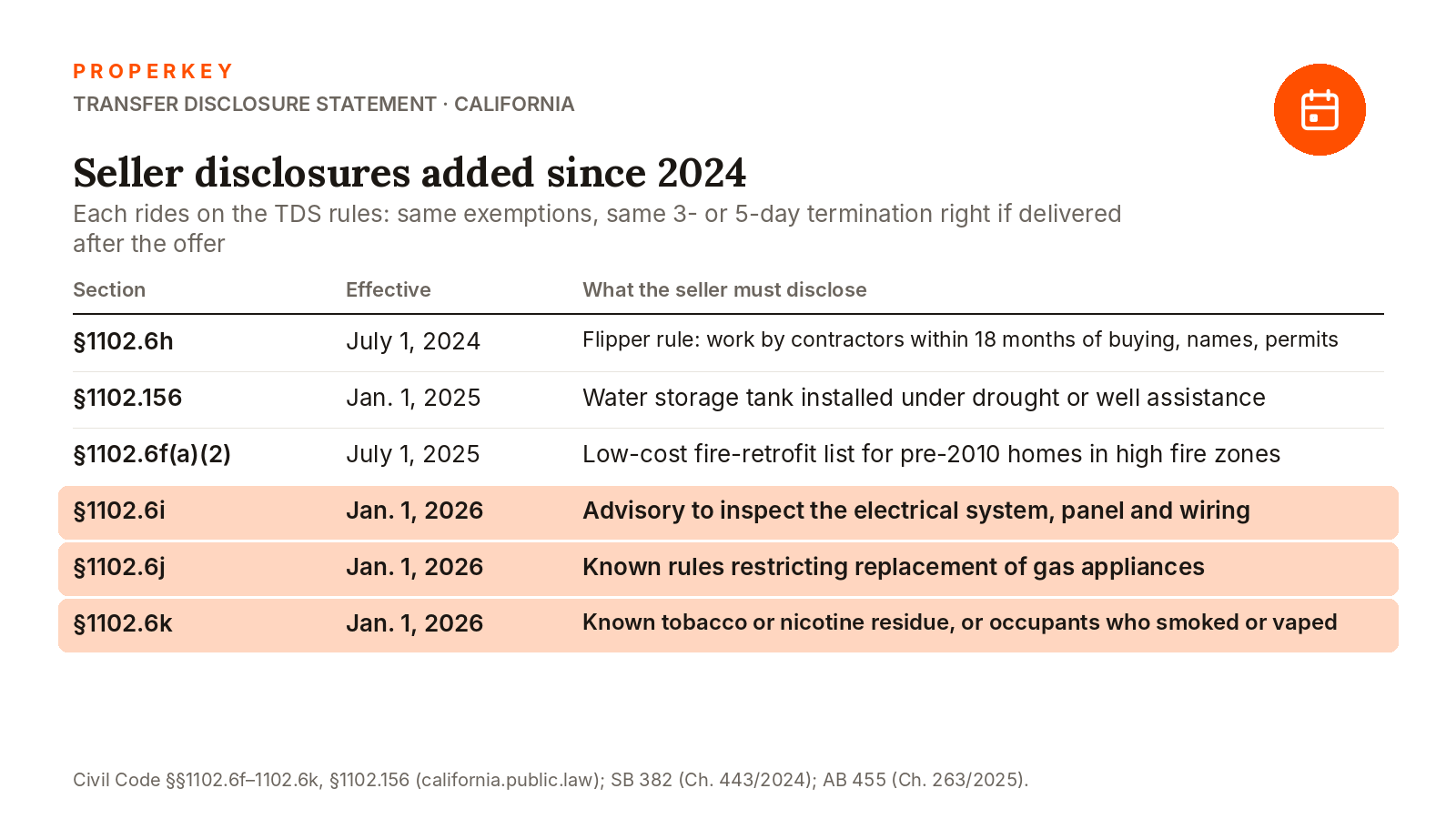
The TDS is the center of a stack of statutory disclosures, each with its own citation. The Natural Hazard Disclosure Statement (§1103 et seq.) covers six zones: a FEMA special flood hazard area, a dam-failure inundation area, a high or very high fire hazard severity zone (the "high" tier was added by AB 1280 in 2023), a state-responsibility wildland fire area, an earthquake fault zone and a seismic hazard zone. §1102.6b requires a good-faith effort to obtain a Notice of Special Tax for any Mello-Roos district or 1915 Act bond on the property. §1102.6c is the supplemental property tax notice. §1102.6f is the fire-hardening disclosure for pre-2010 homes in high or very high fire zones, and §1102.19 requires defensible-space documentation there (see Properkey's fire-zone selling guide). §1102.6h is the "flipper" rule: a seller who accepts an offer within 18 months of taking title must disclose contractor-performed work, the contractors' names and permits. Federal law (42 U.S.C. §4852d) adds the lead-paint pamphlet, disclosure and a 10-day inspection window for homes built before 1978. The Megan's Law notice is §2079.10a; the military ordnance notice is §1102.15; and sellers of pre-1960 light-frame homes must deliver the Homeowner's Guide to Earthquake Safety under Government Code §8897.1.
Three disclosures are new for 2026. §1102.6i adds an advisory that "it may be advisable to obtain an inspection by a qualified professional of the electrical system(s)," noting that faulty wiring "may make it difficult to obtain property insurance." §1102.6j requires sellers to disclose, to the extent they are aware, "any state or local requirements or restrictions relating to the future replacement of existing gas-powered appliances." And §1102.6k requires a seller with actual knowledge of tobacco or nicotine residue, or a history of occupants smoking on the property, including vaping, to disclose it in writing.
What a death on the property requires
Civil Code §1710.2 is narrower than its reputation. It says an owner or agent is not required to disclose a death that "occurred more than three years prior to the date the transferee offers to purchase," nor that an occupant had HIV or died of AIDS-related complications. It does not create a rule that every death within three years must be volunteered; that comes from the general duty to disclose material facts. What the statute does say plainly is that there is no protection for "an intentional misrepresentation in response to a direct inquiry … concerning deaths on the real property." Asked directly, the seller must answer truthfully.
What happens when the TDS is wrong or missing
Honest mistakes are protected. §1102.4: neither the seller nor an agent is liable for an error "if the error, inaccuracy, or omission was not within the personal knowledge of the seller or that listing or buyer's agent, was based on information timely provided by public agencies or by other persons … and ordinary care was exercised in obtaining and transmitting it." A seller may rely on an expert's report, from a pest inspector to a roofing contractor, and may give a clearly labeled approximation when a fact cannot be learned after reasonable effort (§1102.5).
Carelessness is not. §1102.13 says no transfer "shall be invalidated solely because of the failure of any person to comply," but "any person who willfully or negligently violates or fails to perform any duty prescribed by any provision of this article shall be liable in the amount of actual damages suffered by a transferee." There is no statutory cap. Fraud and negligent-misrepresentation claims run alongside, and under Code of Civil Procedure §338(d) a fraud claim's three-year clock does not start until the buyer discovers the facts. Two recent published decisions frame the edges. In Batta v. Hunt (2024) 106 Cal.App.5th 295, the court held a TDS is "merely informational" and a seller's signature "did not convert the TDS from a disclosure statement to a binding contract." In Nasey v. Fell Holdings LLC (First District, August 10, 2026, A174623), the court held that a seller's failure to deliver a TDS was not a condition precedent excusing the buyer from closing where the contract did not make it one; the remedy is damages, not a free exit after the §1102.3 window closes.
How a Properkey seller handles it
Fill the form out yourself, in your own words, before the home is listed, and err toward disclosing. A repaired roof leak, a permit you never closed out, a neighbor's barking dog and a settling crack that was patched all belong on the form; the buyer who learns of them later is the one who sues, and the buyer who learns of them up front usually just adjusts the price or moves on. Keep the paperwork: §1102.12 requires the broker to keep a record of compliance, and the expert reports you attach are what §1102.4 protects you with. Properkey's listing service, a $0 listing fee with full MLS exposure and a dedicated agent from list to close, comes with the agent's §2079 visual inspection, which the law attaches to every listing, and Properkey Escrow, the broker escrow for Properkey-brokered sales, starts its process with document verification. Buyers working with a Properkey agent should read the TDS against the inspection report, not instead of it.
Questions people ask
Can the buyer cancel over anything in the TDS? Within the §1102.3 window, yes, for any reason or none; the statute gives a right to "terminate the offer by delivery of a written notice." After the window closes, the buyer's leverage is the investigation contingency in the purchase agreement, and after that the remedy for a false or missing disclosure is damages.
Does the seller have to fix anything disclosed on the TDS? No. The form is a disclosure, not a repair list. Repairs are negotiated through the purchase agreement and the buyer's request for repair; the C.A.R. contract's "as-is" clause means the seller discloses known defects and performs only the repairs the contract specifies.
Is a trust sale exempt? Only when the trustee is acting as a fiduciary who did not own or live in the home. §1102.2(d) removes the exemption when the trustee is a natural person who is a former owner or occupied the property within the preceding year, which describes most parents and adult children selling a family home out of a living trust.
What if the seller learns something new after delivering the TDS? §1102.3 treats "any material amendment of any disclosure" like the original: deliver it in writing, and the buyer gets the same three- or five-day right to terminate from that delivery.
This article is a summary of California disclosure law for general information, not legal advice. For a specific transaction, consult a California real estate attorney.
Sources: Civ. Code §1102 · §1102.1 · §1102.2 · §1102.3 · §1102.4 · §1102.6 · §1102.6b · §1102.6f · §1102.6h · §1102.6i · §1102.6j · §1102.6k · §1102.13 · §1102.15 · §1102.19 · §1103.2 · §1710.2 · §2079 · §2079.3 · §2079.4 · §2079.5 · §2079.10a · CCP §338 · H&S §13113.8 · H&S §19211 · Gov. Code §8897.1 · 42 U.S.C. §4852d · Easton v. Strassburger · Nasey v. Fell Holdings (2026) · Batta v. Hunt (2024) · C.A.R. RPA 12/21 (public copy) · DRE RE 6 (2005)
Written by Keyro, Properkey's AI. Properkey, DRE #01979718.



