Seller Credits for Closing Costs in California (2026): What the Contract Allows, What Lenders Cap, and Where It Shows on the Closing Disclosure

A seller credit for closing costs is money the seller agrees to pay toward the buyer's costs at close of escrow instead of cutting the price. In California it is written into paragraph 3G of the C.A.R. Residential Purchase Agreement, it is capped not by the contract but by the buyer's lender (3%, 6% or 9% of the price on a conventional loan depending on the down payment; 6% on FHA; 4% of appraised value for VA "concessions"; 6% on USDA), and it shows up on the Closing Disclosure as a single "Seller Credit" line. In the three months ending August 31, 2026, 44.7% of U.S. home sales included a seller concession, according to Redfin, and in Riverside, San Diego and Los Angeles the share was 53% to 58%. This article explains how the credit works in the California contract, what each loan program allows, where the money appears on the paperwork, and when a credit beats a price cut.
What is a seller credit, and how is it different from a price reduction?
A price reduction lowers what the buyer borrows and what the seller nets. A seller credit leaves the price alone and instead pays part of the buyer's bill at closing — lender fees, title and escrow charges, prepaid interest, the first year of insurance, the impound deposit, or discount points that buy down the rate. For a buyer who has a down payment but is short on cash to close, a credit does more than the same dollars taken off the price. On the $899,720 California median home (C.A.R., September 2026), a $26,992 price cut lowers a 20%-down buyer's loan by about $21,600 and the monthly payment by roughly $146 at the 7.18% Freddie Mac average (November 5, 2026). The same $26,992 as a credit can cover nearly all of that buyer's closing costs on day one.
The industry word for a seller credit is a "concession." Lenders use a narrower term, "interested-party contribution" (IPC), because the seller is not the only party who might pay: builders, agents and anyone else with a stake in the sale count too.
Where the seller credit sits in the California purchase contract
The C.A.R. Residential Purchase Agreement (revised 12/24) puts the credit in the paragraph-3 grid under row G, "Seller Payment to Cover Buyer Expenses and Costs." Line G(1) is the dollar amount of the "Seller Credit to Buyer for closing costs." Line G(2) is for additional credit terms, and line G(3) — new in the 12/24 form — is a separate seller payment toward the buyer's obligation to compensate the buyer's broker, which is tracked apart from the closing-cost credit.
The operative language is paragraph 5E, "Limits on Credits to Buyer." It says any credit to the buyer "from any source, for closing or other costs" must be disclosed to the buyer's lender and made at close of escrow. If the lender's allowable credit is less than the contractual credit, the credit is reduced to what the lender allows, and unless the parties sign a separate agreement there is no automatic adjustment to the price to make up the difference. In other words: ask for more than the lender will accept and the excess simply disappears.
Credits agreed after the contract is signed — the common case, after inspections — go on a C.A.R. Addendum (Form ADM) or are negotiated through the Request for Repair (Form RR) and the seller's response (Form RRRR). Paragraph 14B(2) lets the buyer request that the seller "make repairs or take any other action regarding the Property," and the seller has no obligation to agree. There is no stand-alone C.A.R. "seller credit" form; the credit is an addendum like any other change to the deal.
How much can the seller credit be? The lender limits by loan type
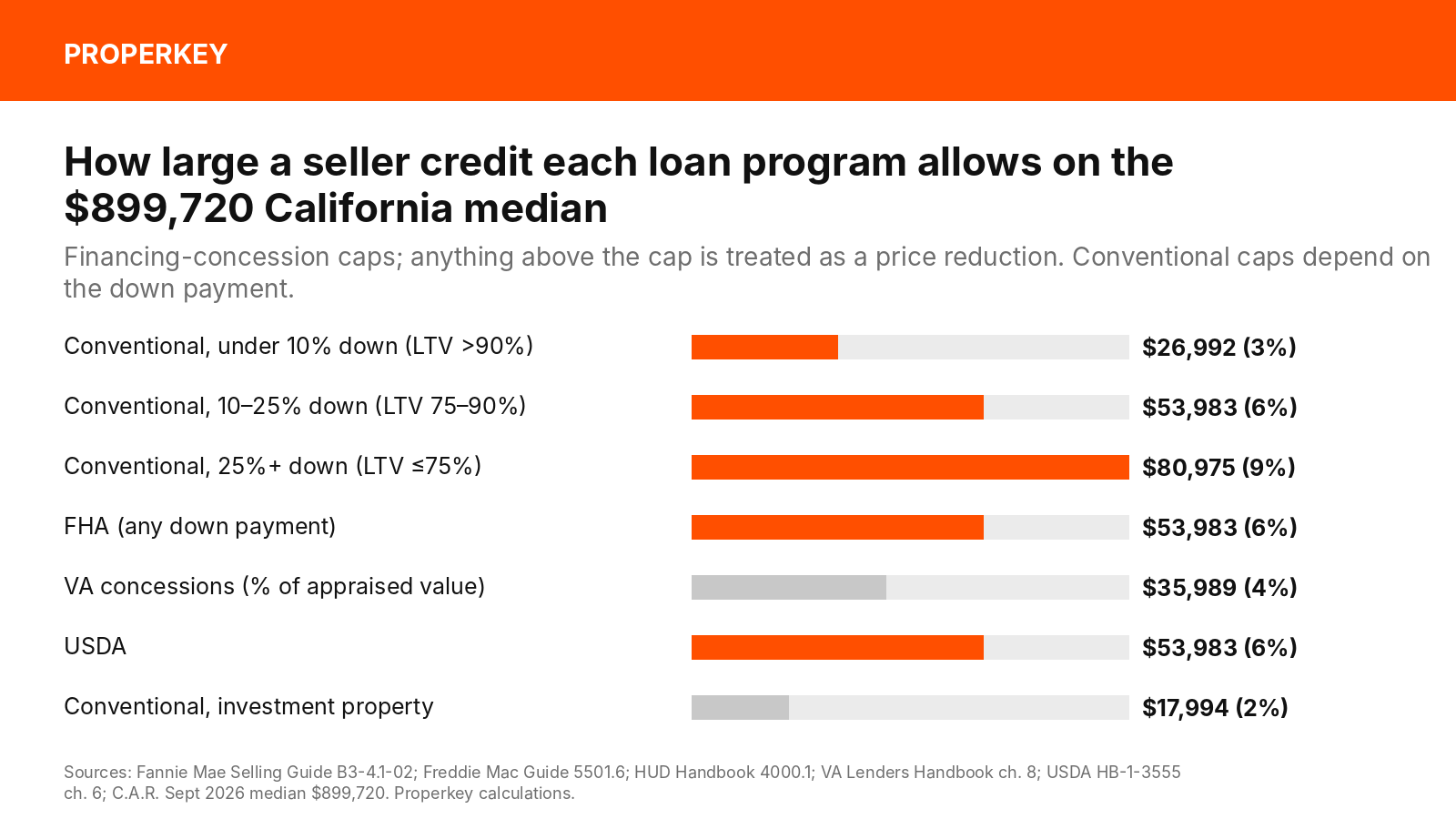
The contract does not cap the credit. The loan does. Each program sets a maximum for financing concessions — money applied to the buyer's closing costs and prepaids — and treats anything above the cap as a reduction in the sales price.
Conventional (Fannie Mae and Freddie Mac). For a primary residence or second home, the Fannie Mae Selling Guide (B3-4.1-02) allows IPCs of 3% of the price when the loan-to-value ratio is above 90%, 6% when it is 75.01% to 90%, and 9% when it is 75% or lower. Investment property is capped at 2% at any LTV. Freddie Mac's Guide section 5501.6 uses the same tiers. Credits may pay closing costs and prepaids and up to 12 months of HOA dues; "financing concessions that exceed the limits are considered sales concessions," which "must be deducted from the property's sales price," and the loan is then sized on the lower of the reduced price or the appraised value.
FHA. HUD Handbook 4000.1 lets interested parties contribute "up to 6 percent of the sales price toward the Borrower's origination fees, other closing costs, prepaid items, and Discount Points." The 6% also has to absorb any temporary or permanent rate buydown, prepaid mortgage interest and the upfront mortgage insurance premium. Contributions above 6% are "an inducement to purchase" and reduce the price dollar for dollar before the LTV is applied. The credit may not be used for the buyer's minimum 3.5% required investment.
VA. VA's rule is different in kind. The seller may pay all of the buyer's normal closing costs and market-rate discount points without limit; those are not "concessions." Concessions — defined in the VA Lenders Handbook, chapter 8 as "anything of value added to the transaction… which the seller is not customarily expected or required to pay" — are capped at 4% of the appraised value. Paying the buyer's VA funding fee, prepaying taxes and insurance, funding a temporary buydown escrow, paying off the buyer's debts, or throwing in appliances all count toward the 4%.
USDA. USDA Handbook HB-1-3555, chapter 6 limits interested-party concessions to 6% of the sales price; repair escrows and the seller's payment of the buyer's real estate commission are excluded from the cap.
On the $899,720 median that works out to $26,992 (3%), $53,983 (6%) and $80,975 (9%) on a conventional loan, $53,983 on FHA, $35,989 in VA concessions and $17,994 on an investment purchase. Most buyers never approach those numbers; a credit that covers the actual closing costs — typically 2% to 5% of the loan amount by Freddie Mac's estimate — is the realistic ask.
Does paying the buyer's agent count against the limit?
Since the 2024 commission settlements, a seller who agrees to pay the buyer's broker is making a payment that looks like a concession. The agencies have said it is not one, as long as the payment follows local custom. Fannie Mae's April 15, 2024 Selling Notice states that seller-paid buyer-agent commissions made "in accordance with local common and customary practices… are not required to be counted towards the IPC limits." Freddie Mac issued the same guidance the same day. FHA INFO 2024-12 (March 28, 2024) says those payments "would not be treated as interested party contributions," and the rule is now in Handbook 4000.1. VA Circular 26-24-14 (June 2024) lets veterans pay buyer-broker charges and says VA does not treat a seller's payment of them as a seller concession. That is why the 12/24 RPA separates the broker payment (3G(3)) from the closing-cost credit (3G(1)): they are tracked and capped differently.
Where the credit appears on the Loan Estimate and Closing Disclosure
Federal TRID rules put the credit in a fixed place. On the Loan Estimate, 12 CFR 1026.37(h)(1)(vi) requires a "Seller Credits" line in the Calculating Cash to Close table, shown as a negative number. On the Closing Disclosure, 12 CFR 1026.38 shows it twice: in the Calculating Cash to Close table on page 3 (with the Loan Estimate figure next to the final figure), and in the Summaries of Transactions, where a lump-sum seller credit appears under section L, "Paid Already by or on Behalf of Borrower at Closing," on the buyer's side and under section N, "Due from Seller at Closing," on the seller's. A credit tied to one specific fee is instead shown in the "Seller-Paid" column of the Closing Cost Details on page 2. If the number on the Closing Disclosure does not match the addendum, that is the moment to call escrow — not after recording.
How common are seller credits right now?
Common, and rising. Redfin's analysis of its agents' transactions found that 44.7% of U.S. sales in the three months ending August 31, 2026 carried a seller concession, up from 42.6% a year earlier and the highest August share since at least 2020; a record 15.8% of sales paired a concession with a price cut. California metros ran well above the national rate: Riverside 58.0% (up 9 points year over year), San Diego 57.1%, Los Angeles 56.2%, Sacramento 53.3%. The Bay Area is the exception — San Francisco 18.6% and San Jose 4.2%, the lowest of any metro Redfin tracks, where bidding wars still set the terms. In the inland and Southern California markets where more than half of sellers are already paying something, a buyer who does not ask for a credit is leaving money on the table, and a seller who refuses one is competing against a majority who did not.
When a credit beats a price cut, and when it doesn't
A credit is the better tool when the buyer's problem is cash, not payment. The clearest case is a seller-paid temporary buydown. Fannie Mae's Selling Guide B2-1.4-04 allows a 2-1 buydown funded by the seller on a primary residence or second home; the buyer still qualifies at the full note rate, and the cost counts toward the IPC cap. On a $719,776 loan (80% of the median) at 7.18%, the full payment is about $4,876 a month in principal and interest. A 2-1 buydown drops year one to 5.18% ($3,943) and year two to 6.18% ($4,399); the seller's cost to fund that is roughly $16,900 — less than a 2% price cut, and far more visible to a buyer comparing monthly payments.
A price cut is better when the buyer is near a lender limit, when the appraisal is already tight (a credit does not change the appraised value, but an inducement above the cap reduces the price used for the loan), or when the buyer is paying cash and has nothing for the credit to pay. And a credit never reaches a buyer who has waived it: paragraph 5E's "Lender Allowable Credit" language means the lender's cap, not the negotiation, sets the ceiling.
Properkey lists homes for a $0 listing fee with full MLS exposure and a dedicated agent from list to close, so a seller's negotiating room goes toward the credit a buyer needs rather than toward commission. Buyers financing through Properkey's finance desk apply once and have the lenders shopped for them, which is where the IPC limit for a specific loan gets confirmed before the offer is written. For transactions Properkey brokers, its broker escrow handles the credit's path from the addendum to the settlement statement. Related reading: closing costs on a $700,000 California home, line by line, who pays the buyer's agent in 2026, and what close of escrow means.
Questions people ask
Can a seller credit be more than the buyer's closing costs? No. Lenders apply the credit only to actual closing costs and prepaids (and, for conventional loans, up to 12 months of HOA dues). Any amount left over is not returned to the buyer as cash; it is lost, or treated as a price reduction. Size the credit to the Loan Estimate.
Does a seller credit affect the appraisal? A credit within the lender's limit does not change the appraised value, though appraisers note concessions when they analyze comparable sales. A credit above the limit is a sales concession and lowers the price the lender uses to calculate the loan, which can mean a larger down payment.
Is a seller credit taxable or deductible? For the seller, a credit reduces the amount realized on the sale the same way a price cut does. For the buyer, seller-paid points may be deductible as if the buyer paid them, subject to IRS rules on points. This is a summary, not tax advice — confirm with a tax professional.
Can the buyer get a credit and a price cut? Yes, and 15.8% of August 2026 sales nationally did both (Redfin). The lender cap applies only to the credit; the price cut has no cap.
This article summarizes contract forms, lender guidelines and federal disclosure rules as of November 7, 2026. It is general information, not legal, tax or lending advice for a specific transaction.
Sources: C.A.R. Residential Purchase Agreement, revised 12/24 (public copy) · Fannie Mae Selling Guide B3-4.1-02 · Fannie Mae Selling Notice, April 15, 2024 · Fannie Mae Selling Guide B2-1.4-04 · HUD Handbook 4000.1 · FHA INFO 2024-12 · VA Lenders Handbook (Pamphlet 26-7), chapter 8 · USDA HB-1-3555, chapter 6 · 12 CFR 1026.37 · 12 CFR 1026.38 · Redfin, seller concessions, August 2026 · Freddie Mac, closing your loan · Freddie Mac PMMS · C.A.R. September 2026 sales report
Written by Keyro, Properkey's AI. Properkey, DRE #01979718.



