Closing Costs on a California Condo in 2026: The HOA Fees, Who Pays Them, the Dues Proration and What the Lender Adds

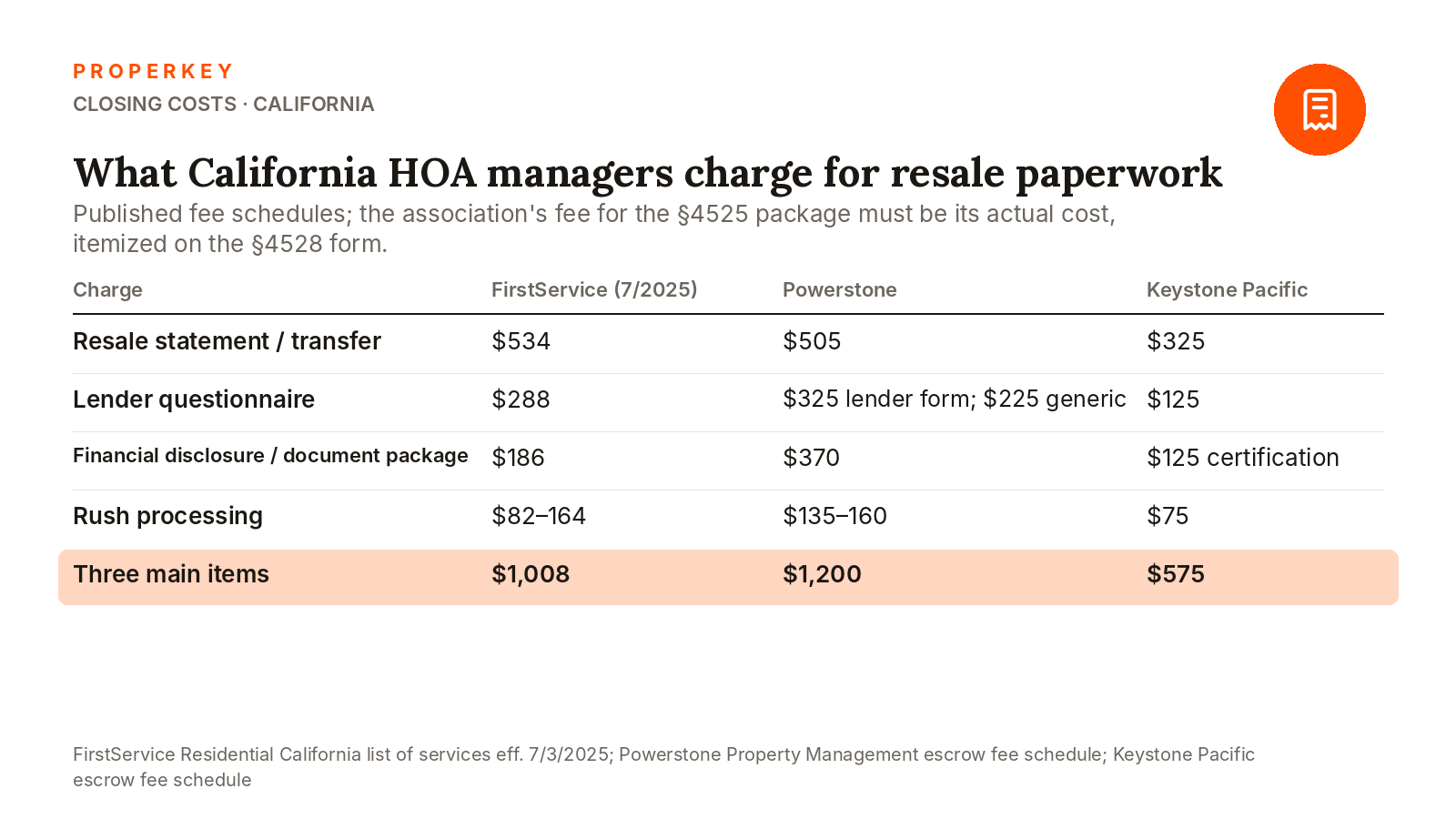
Closing costs on a California condo are the same escrow, title, lender and transfer-tax charges as on a house, plus an HOA layer that typically adds $575 to $1,200 in association paperwork fees, a prorated share of the monthly dues, and, in new construction, a capital contribution that is often several hundred dollars to more than $1,000. The Civil Code puts the cost of the seller's HOA disclosure package on the seller, the standard purchase contract puts the HOA certification fee on the buyer, and the transfer fee is a checkbox the parties negotiate. On a $700,000 condo, near the $640,000 statewide condo median (C.A.R., September 2026), the HOA items are a small fraction of the roughly $12,000–$18,000 a buyer with 20% down pays in total at the November 12 Freddie Mac rate of 7.11%. The lender adds its own condo-specific requirements, and the reserve standard changes on January 4, 2027.
What does the HOA charge, and who pays it?
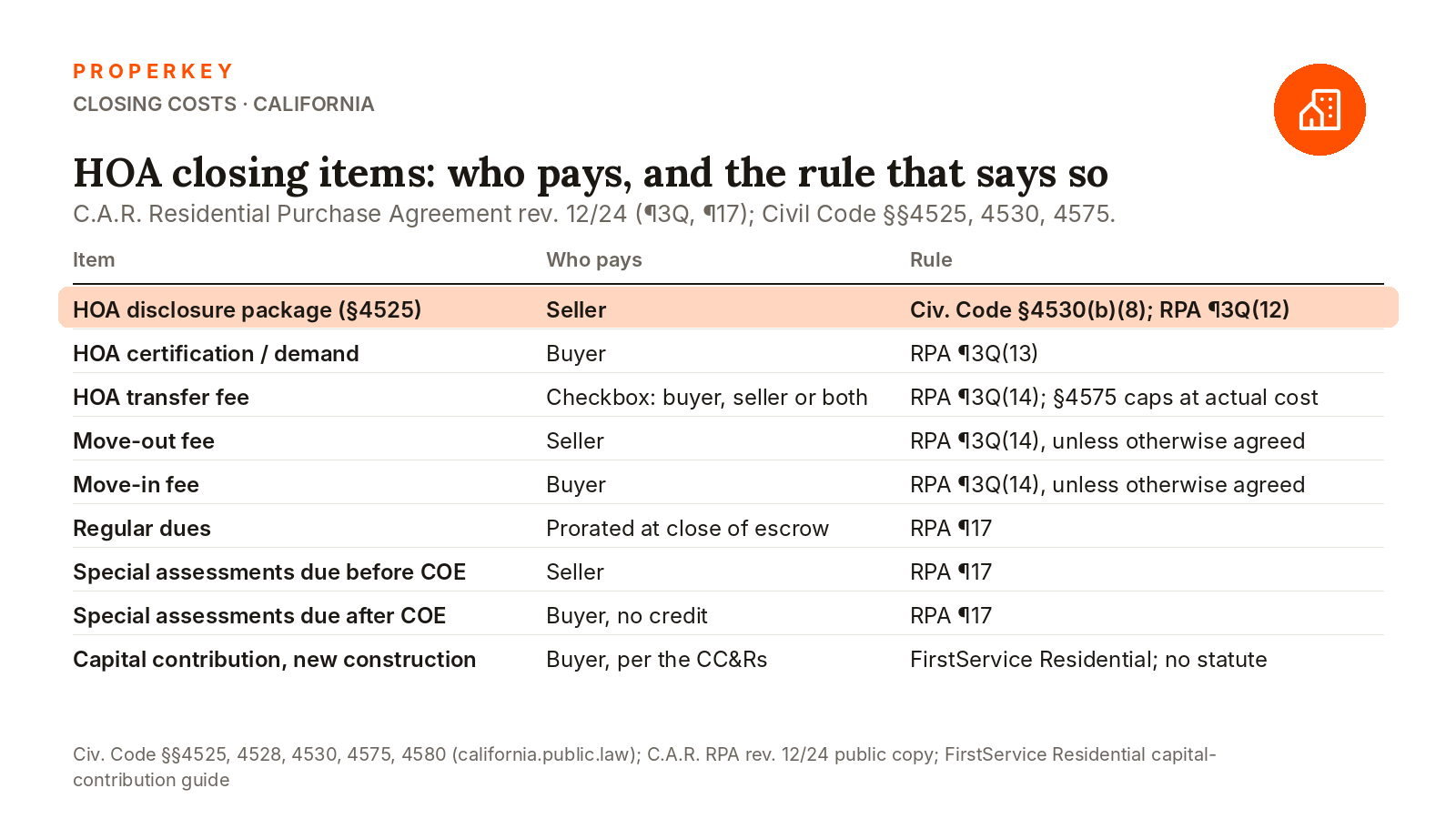
Three association charges show up on almost every California condo closing statement. The first is the seller's disclosure package. Civil Code §4525 lists eleven documents the seller must give a prospective buyer, from the governing documents and the annual budget report to the most recent balcony inspection report, and §4530 says the association must deliver them "within 10 days of the mailing or delivery of the request," may charge the seller only "a reasonable fee … based upon the association's actual cost," must itemize each document's fee on the statutory §4528 form, may not bundle required documents with anything else, and "it is the responsibility of the seller to compensate the association" (Civ. Code §4525; §4530). The purchase agreement follows the statute: paragraph 3Q(12) of the C.A.R. Residential Purchase Agreement assigns the "HOA fee for preparing disclosures" to the seller (C.A.R. RPA, 12/22 public copy; the 12/24 revision keeps the same paragraph numbers).
The second is the certification or resale statement, sometimes called a demand or estoppel, in which the association confirms the account balance, unpaid assessments and pending special assessments. The RPA's paragraph 3Q(13) assigns the "HOA certification fee" to the buyer. The third is the lender questionnaire: Fannie Mae publishes Form 1076 and says "this form is optional; however, lenders are encouraged to use and retain the form in the loan file" (Fannie Mae Selling Guide B4-2.1-01), and in practice nearly every lender orders one or an equivalent. Management companies charge for each. FirstService Residential's California price list effective July 3, 2025 bills $534 for a resale statement of account, $288 for a lender questionnaire and $186 for a financial disclosure statement, "to be remitted at closing" (FirstService Residential); Powerstone Property Management in Irvine lists $505 for the resale statement and transfer, $325 for a lender-specific questionnaire and $370 for the escrow document package (Powerstone); Keystone Pacific lists $325 for the resale transfer, $125 for the questionnaire and $125 for certification (Keystone Pacific). Rush fees of $75–$160 are common.
Can the HOA charge a transfer fee?
Only its actual cost. "Neither an association nor a community service organization or similar entity may impose or collect any assessment, penalty, or fee in connection with a transfer of title or any other interest except for the following: (a) An amount not to exceed the association's actual costs to change its records. (b) An amount authorized by Section 4530" (Civ. Code §4575). The exception in §4580 covers community service organizations and nonprofits under a declaration of trust that were collecting transfer fees before January 1, 2004 or funding environmental mitigation required as a condition of development; those must offer the buyer an installment plan of at least seven years (Civ. Code §4580). The RPA's paragraph 3Q(14) leaves "HOA transfer fees" as a buyer/seller/both checkbox with no default and adds that, unless otherwise agreed, the seller pays any separately billed move-out fee and the buyer any move-in fee.
How are the dues handled at closing?
Prorated to the day. Paragraph 17 of the RPA prorates "HOA regular assessments due prior to Close Of Escrow"; the seller pays "any HOA special or emergency assessments due prior to Close Of Escrow," and special or emergency assessments due afterward are assumed by the buyer "WITHOUT CREDIT toward the purchase price." On a $500-a-month association with a mid-month closing, the buyer reimburses the seller about $250. Associations are now raising dues fast: 91% of community associations reported insurance premium increases in the Foundation for Community Association Research's 2025 survey, 17% of them more than 100% (FCAR), and California has 51,700 associations housing 14.5 million residents (FCAR 2025 Statistical Review). The annual budget report the buyer receives under §4525 must show the reserve summary, planned special assessments and the insurance summary, and it is delivered "30 to 90 days before the end of its fiscal year" (Civ. Code §5300), so a buyer closing late in the association's year is reading a document almost twelve months old; see the HOA documents a condo seller must give you.
New construction adds one more line. A working-capital or capital contribution, paid by the buyer into the association's reserves at the first sale, has no statutory basis in the Davis-Stirling Act; FirstService Residential's guide says "the buyer is almost always responsible for paying the HOA capital contribution fee," that the amounts "range from a few hundred dollars to over $1,000," and that the figure is "typically outlined in the governing documents" (FirstService Residential). Fannie Mae's interested-party-contribution rules treat seller-paid HOA assessments covering a period after settlement as a financing concession, limited to 12 months, within the 3%, 6% or 9% caps (Fannie Mae Selling Guide B3-4.1-02).
What does the lender add on a condo?
Project review and insurance. Fannie Mae's Lender Letter LL-2026-03 of March 18, 2026 raises the required reserve contribution from 10% to 15% of the association's annual budgeted assessment income for loan applications on or after January 4, 2027, retires the Limited Review for applications on or after August 3, 2026, caps the master policy's per-unit deductible at $50,000, and retires the 50% investor-concentration limit (LL-2026-03, reproduction). The master policy "must equal at least 100% of the estimated replacement cost value of the project improvements," and when it has a per-unit deductible or excludes the unit interior the borrower must carry a unit-owner (HO-6) policy (Fannie Mae B7-3-03; B7-3-04). That HO-6 premium is a closing-cost prepaid the house buyer does not have. The lender's title policy on a condo is priced off the schedule like any loan, and the condominium endorsement, ALTA 4-06, is issued at no charge under Title Resources Guaranty's California manual (TRG California Rates and Rules Manual, eff. 1/9/2026).
FHA buyers face a project test too: the project must be on FHA's approved list or qualify for Single-Unit Approval, with owner-occupancy of at least 50% (35% for existing projects more than a year old that meet reserve and delinquency conditions), reserves of at least 10% of monthly assessments, and FHA concentration under Single-Unit Approval capped at 10% of units in projects of ten or more (24 CFR 203.43b; HUD, October 2019). The §5300 budget report must state whether the project is FHA- and VA-approved.
What does the whole closing cost on a $700,000 condo?
For the buyer with 20% down and a $560,000 loan: lender fees of roughly $2,800–$5,600 at the 0.5%–1% origination range Bankrate reports (Bankrate), a lender's title policy in the $1,000–$1,300 range on the filed schedules, the buyer's half of escrow at about $1,200–$2,700, prepaid interest of $109 a day, two to six months of property tax impounds at the statewide 1.151% average ($8,057 a year), the first year of the HO-6 policy, recording, the HOA certification and questionnaire fees of $400–$800, and the dues proration, together about $12,000–$18,000, or 1.7%–2.6% of the price. For the seller in a Southern California county: the owner's title policy ($1,950 for a standard CLTA policy at Old Republic's $700,000 row), half the escrow fee, the $770 county documentary transfer tax, $3,150 more inside the City of Los Angeles at $4.50 per $1,000 (LA Office of Finance), the HOA disclosure package, and the commission, which is negotiable. Properkey lists for a $0 listing fee, and its broker escrow handles the HOA demand and proration on transactions where Properkey is the broker. Properkey's closing-cost percentages for California buyers and sellers has the house version of the same math.
Questions people ask
Can the seller refuse to pay for the HOA documents?
Not under the Civil Code. §4530 places the association's document fee on the seller and bars the association from withholding the documents "for any reason" other than non-payment of that fee. The RPA allocation matches the statute. A seller can hand over documents already in their possession at no cost.
Is the HOA transfer fee negotiable?
Yes. It is one of the few closing items the RPA leaves blank by default; the association's charge itself is capped at its actual record-change cost unless a pre-2004 community service organization is involved.
Are condo closing costs tax deductible?
Prepaid mortgage interest and property taxes are, within the federal and California limits; HOA fees and dues on a personal residence are not. See whether mortgage interest is deductible in California.
Why does my lender want a questionnaire if Fannie Mae says the form is optional?
The form is optional; the information is not. The lender must document owner-occupancy, reserves, insurance, litigation and commercial space to sell the loan, and the questionnaire is how it does so. The fee is the association's, not the lender's.
This article summarizes statutes, agency guidelines, filed rate schedules and published fee lists as of November 13, 2026; it is not legal, tax or lending advice. Association fees vary by manager and by project.
Sources: Civ. Code §4525 · Civ. Code §4528 · Civ. Code §4530 · Civ. Code §4575 · Civ. Code §4580 · Civ. Code §5300 · C.A.R. Residential Purchase Agreement (12/22 public copy; 12/24 paragraph numbers unchanged) · Fannie Mae B4-2.1-01 · FirstService Residential California list of services (eff. 7/3/2025) · Powerstone Property Management escrow fee schedule · Keystone Pacific escrow fee schedule · FCAR insurance coverage trends survey (2025) · FCAR 2025 statistical review · FirstService Residential: HOA capital contributions · Fannie Mae B3-4.1-02 · Fannie Mae Lender Letter LL-2026-03 · Fannie Mae B7-3-03 · Fannie Mae B7-3-04 · TRG California Rates and Rules Manual · 24 CFR 203.43b · HUD condominium rule, Oct. 2019 · C.A.R. September 2026 report (condo median) · Freddie Mac PMMS, Nov. 12, 2026 · Bankrate: origination fees · Old Republic Title California rate schedule · LA Office of Finance: transfer tax
Written by Keyro, Properkey's AI. Properkey, DRE #01979718.



