Is Mortgage Interest Tax Deductible in California for 2026? The $750,000 Federal Cap, the New $40,400 SALT Limit, the Return of the Mortgage-Insurance Deduction and California’s $1 Million Rule

Yes, mortgage interest is still deductible for a California homeowner in 2026, on two different sets of rules. On the federal return the interest on up to $750,000 of home-acquisition debt ($375,000 married filing separately) is deductible if you itemize, a cap that Public Law 119-21, signed July 4, 2025, made permanent. On the California return the cap is $1,000,000 of acquisition debt plus $100,000 of home-equity debt used for any purpose, because California never adopted the 2017 federal change (Schedule CA (540) instructions). Two other changes matter for 2026 returns: the state-and-local-tax deduction cap rises to $40,400 for joint and single filers, and mortgage-insurance premiums (FHA MIP, private mortgage insurance, the VA funding fee and the USDA guarantee fee) become deductible again for the first time since 2021. Here is how the pieces fit for a buyer of the median California home, as the law stands on November 12, 2026.
What are the federal limits for 2026?
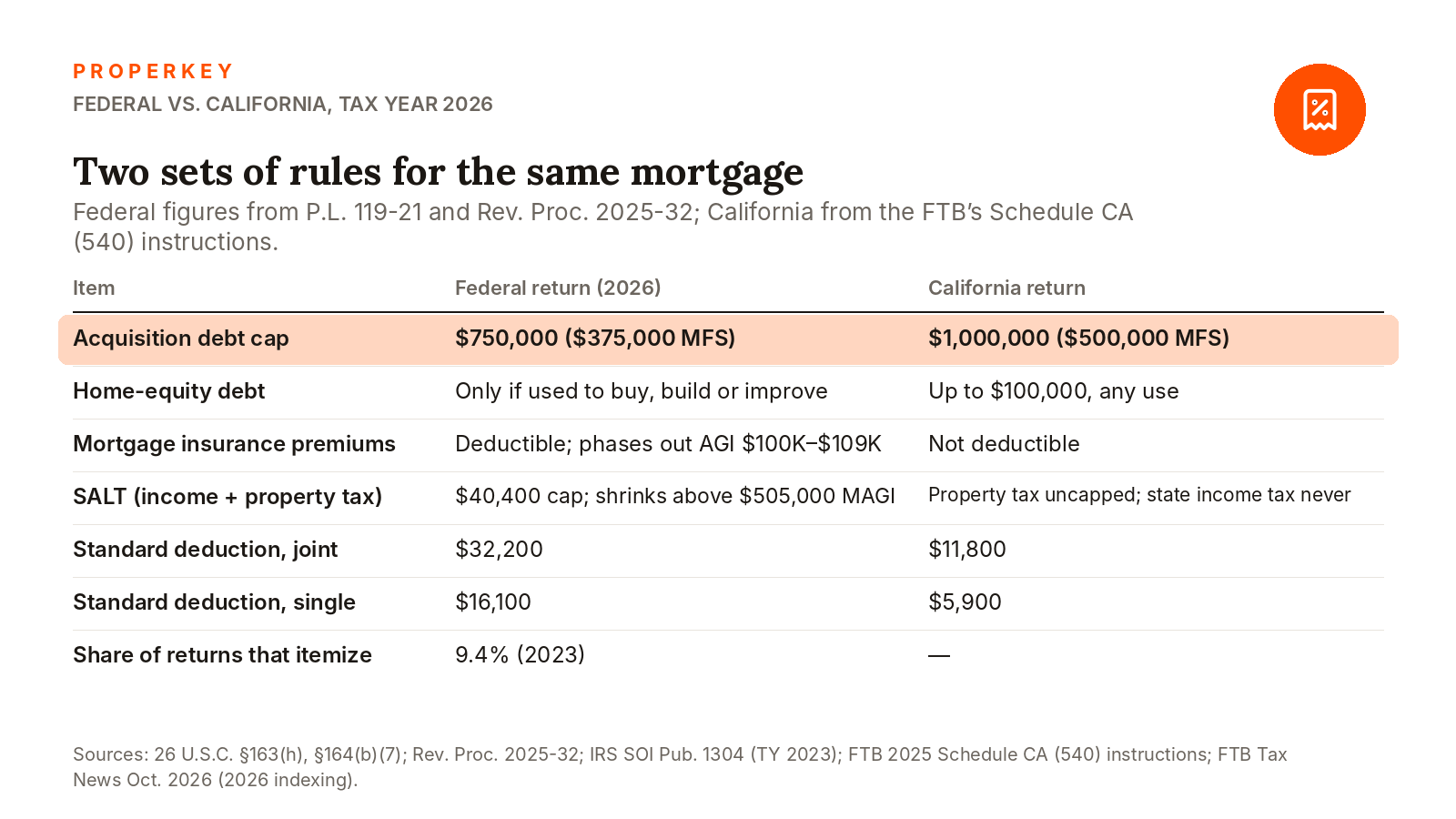
Internal Revenue Code §163(h)(3) allows interest on debt used to buy, build or substantially improve a main home or one second home. For loans taken out after December 15, 2017 the combined limit is $750,000 ($375,000 married filing separately); older loans keep the $1,000,000 limit, and a refinance of an old loan keeps the old status up to the balance refinanced (IRS Publication 936). Interest on a home-equity loan or HELOC counts only when the money went into the home that secures it. Section 70108 of Public Law 119-21 removed the 2025 sunset, so these rules no longer expire.
The same section restored the mortgage-insurance deduction for tax years beginning after December 31, 2025, with no end date. Premiums for FHA, VA, Rural Housing Service and private mortgage insurance on acquisition debt are treated as mortgage interest, but the deduction phases out by 10% for every $1,000 of adjusted gross income over $100,000 ($50,000 married filing separately) and is gone once AGI passes $109,000 ($54,500). Those thresholds were not indexed. An FHA buyer putting 3.5% down on a $600,000 home pays about $3,185 a year in annual MIP on a $579,000 loan at the 0.55% rate; the deduction is worth having only if the household's AGI is under $100,000, which rules out many California buyers at that price. Lenders will report the premiums in Box 5 of Form 1098, and the 2026 edition of Publication 936, expected at the turn of the year, will be the first to describe the restored deduction; the current 2025 edition still says it "has expired."
Why the $40,400 SALT cap changes the math
Most homeowners stopped itemizing after 2017 because the standard deduction doubled and the SALT deduction was capped at $10,000: only 9.4% of returns itemized in 2023, the latest IRS data, against 31% in 2017 (IRS Statistics of Income; Tax Policy Center). Section 70120 of Public Law 119-21 raised the cap to $40,000 for 2025 and $40,400 for 2026, with 1% increases through 2029 and a return to $10,000 in 2030. The cap shrinks by 30% of modified AGI above $505,000 in 2026 ($252,500 married filing separately), never below $10,000. Married-filing-separately filers get half of each figure. The IRS's own pages still show 2025's $40,000 (Topic 503); the $40,400 figure is in the statute.
For 2026 the standard deduction is $32,200 for joint filers, $16,100 for singles and $24,150 for heads of household (Rev. Proc. 2025-32). A California homeowner with a new mortgage clears that bar easily once property tax and state income tax count toward a $40,400 limit instead of $10,000, which is why itemizing is back on the table for buyers in this state.
The math on the median California home
Take a couple buying the September 2026 median-priced home at $899,720 with 20% down and a $719,776 loan at Freddie Mac's November 12 average of 7.11%. First-year interest is about $50,950, all of it deductible on both returns because the loan is under both caps. Property tax at Los Angeles County's average 1.18% rate is about $10,600. With the household income C.A.R. says the median home requires, $228,000, California income tax runs roughly $8,400, so state and local taxes total about $19,000, under the new cap. Federal itemized deductions come to about $69,900 against a $32,200 standard deduction: $37,700 more in deductions, worth about $8,300 at the couple's 22% federal bracket. On the state return the interest and property tax, $61,600, replace an $11,800 standard deduction and save about $4,600 at California's 9.3% rate. Together that is roughly $12,900 a year, about $1,075 a month off the true cost of a $4,842 payment. Those figures assume no other deductions and use the 2025 California rate schedule, the latest published; FTB posts the 2026 schedule in late December.
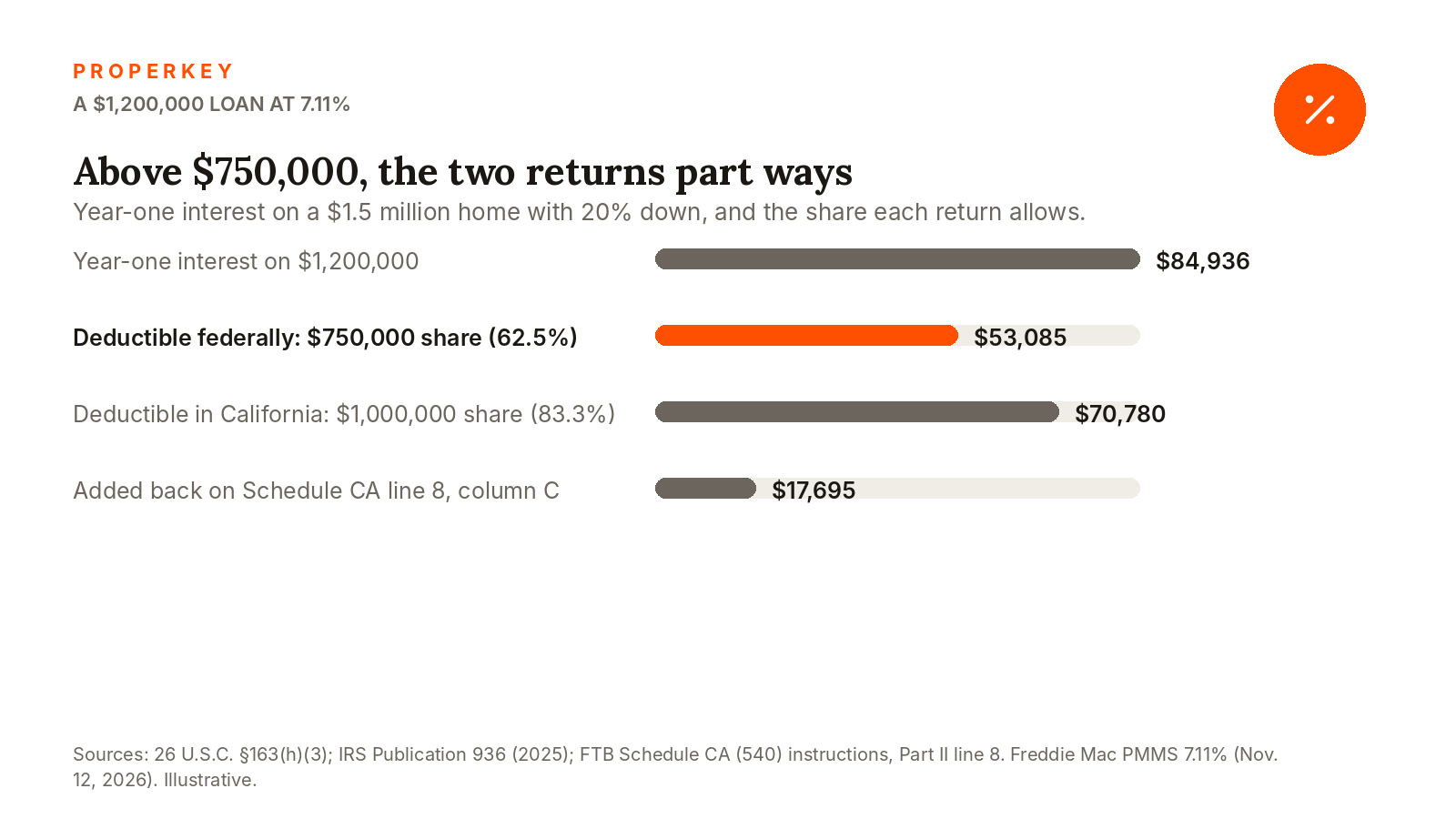
Above the federal cap the two returns diverge. On a $1,500,000 home with a $1,200,000 loan at 7.11%, first-year interest is about $84,900. The federal return allows the share attributable to $750,000 of debt, 62.5% or about $53,100; California allows the share attributable to $1,000,000, 83.3% or about $70,800. That difference is entered as an adjustment on Schedule CA (540), Part II, line 8, column C.
How California differs, line by line
California's conformity date is January 1, 2025, and the Franchise Tax Board's 2025 instructions say flatly that "California R&TC does not conform to the OBBBA." On Schedule CA (540), Part II: state and local income taxes come out on line 5a, column B, because California never allows a deduction for its own income tax; property tax above the federal cap goes back in on line 5e, column C, because California has no SALT cap; and mortgage interest the federal cap disallowed goes back in on line 8, column C, up to the $1,000,000 and $100,000 limits. California does not allow the mortgage-insurance deduction (the last time it existed, the 2021 instructions said so), and the 2026 instructions are not out yet. Two more California numbers: the state standard deduction is $11,412 for joint filers and $5,706 for singles on 2025 returns, rising to $11,800 and $5,900 for 2026 (FTB Tax News, October 2026), and California trims itemized deductions for joint filers with federal AGI above $504,411 (2025) by the lesser of 6% of the excess or 80% of the affected deductions.
Points, second homes and the paperwork
Points paid to buy or build your main home are generally deductible in full in the year paid; points paid on a refinance are deducted over the life of the loan, except the part spent on improvements (Publication 936). Seller-paid points are treated as paid by the buyer, which is one reason a seller-paid rate buydown can carry a tax benefit. Interest on one second home counts within the same $750,000 federal and $1,000,000 California limits. Your lender's Form 1098 reports interest of $600 or more per mortgage; keep it with the closing statement, which you will need again when you sell and compute capital gains.
None of this changes what the loan costs the lender charges; it changes what the loan costs you after April. Buyers comparing a larger down payment against a larger loan, or weighing a rate buydown, should run the after-tax payment, and a lender that shops the loan can show both. Properkey's lending service describes itself this way: "Purchase or refinance, you apply once. We shop the lenders, you pick the terms."
Questions people ask
Is mortgage interest deductible if I take the standard deduction? No. The deduction exists only on Schedule A for filers who itemize. With a $32,200 joint standard deduction and a $40,400 SALT cap, a new California mortgage usually makes itemizing worthwhile; an older low-balance loan often does not.
Is PMI tax deductible in 2026? Yes, on the federal return, for the first time since 2021, if your adjusted gross income is $100,000 or less ($50,000 married filing separately), with a phase-out that ends at $109,000 ($54,500). California does not allow the deduction.
Can I deduct the interest on a HELOC? Federally, only if the HELOC paid to buy, build or substantially improve the home that secures it, within the $750,000 total. California allows interest on up to $100,000 of home-equity debt regardless of use.
What is the mortgage interest deduction limit in California? $1,000,000 of acquisition debt ($500,000 married filing separately) plus $100,000 of home-equity debt ($50,000) on the state return, versus $750,000 ($375,000) federally for loans made after December 15, 2017. The difference is claimed as an adjustment on Schedule CA (540), Part II, line 8, column C.
This is a summary of the Internal Revenue Code, IRS publications and FTB instructions as of November 12, 2026, not tax advice. Consult a tax professional about your return.
Sources: Public Law 119-21, Sections 70108 and 70120; 26 U.S.C. §163(h); IRS Publication 936 (2025); Rev. Proc. 2025-32; IRS release IR-2025-103; IRS Topic 503; Schedule A instructions (2025); Form 1098 instructions; IRS Statistics of Income, Publication 1304, Table 1.2 (2023); Tax Policy Center Briefing Book; FTB, 2025 Schedule CA (540) instructions; FTB, 2021 Schedule CA (540) instructions; FTB, 2025 Form 540 booklet; FTB, 2025 tax rate schedules; FTB Tax News, October 2026; Freddie Mac PMMS, November 12, 2026; C.A.R. September 2026 sales report; BOE Annual Report 2024-25 (average tax rates). Related: capital gains when you sell; the December 10 property-tax deadline; impound accounts; rate buydowns and points; income needed to buy in California; Properkey Finance.
Written by Keyro, Properkey's AI. Properkey, DRE #01979718.



