California Property Taxes Are Late After December 10: The 10% Penalty, Supplemental Bills, Impounds and the Exemptions Worth Claiming (2026–27)

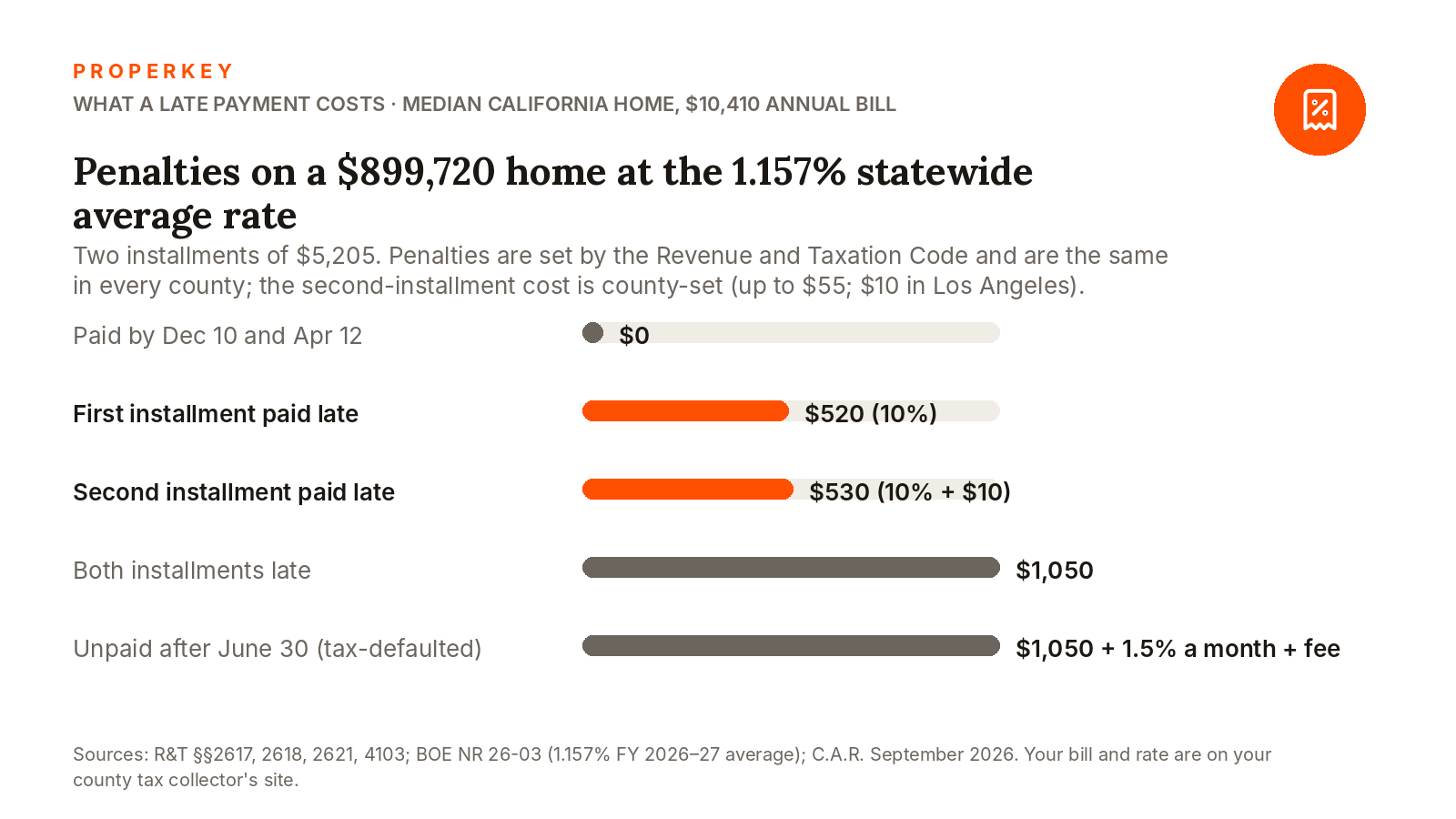
The first installment of California's 2026–27 property tax was due November 1 and becomes delinquent at 5 p.m. on Thursday, December 10, 2026. Pay a day late and the county adds a 10% penalty, no exceptions for a bill that never arrived. On the median California home, $899,720 in September according to C.A.R., the annual bill at the state's average rate of 1.157% is about $10,410, so each installment is roughly $5,205 and the penalty for missing December 10 is about $520. The second installment is due February 1 and would normally be delinquent after April 10, but April 10, 2027 is a Saturday, so the deadline moves to Monday, April 12. Here is how the calendar works, what happens if you miss it, why a new owner gets a second bill, what an impound account does and does not pay, and the exemptions and deferrals worth filing for before the deadlines.
When are California property taxes due?
The Revenue and Taxation Code sets the same dates for every county. Half the tax on real property is due November 1 (§2605) and "if unpaid, [is] delinquent at 5 p.m., or the close of business, whichever is later, on December 10," after which "a delinquent penalty of 10 percent attaches" (§2617). The second half is due February 1 (§2606) and delinquent after April 10 with its own 10% penalty (§2618), plus a cost for preparing the delinquent record that §2621 caps at $55 and that most counties, including Los Angeles, set at $10. When a deadline falls on a weekend or holiday, §2619 moves it to the next business day; the Los Angeles County Treasurer and Tax Collector, which mailed about 2.4 million bills this fall, has already announced April 12, 2027 for the second installment. A mailed payment counts on its postmark date, but a bank's bill-pay check often carries no postmark and is judged by the date it arrives. And §2610.5 is the rule new owners learn the hard way: "failure to receive a tax bill shall not relieve the lien of taxes, nor shall it prevent the imposition of penalties."
What happens if you miss December 10?
The 10% attaches at 5:01 p.m. and the installment can still be paid with the penalty any time before June 30. An installment still unpaid after June 30 makes the property "tax-defaulted": from July 1 the unpaid amount accrues redemption penalties of 1.5% a month, 18% a year, plus a redemption fee (§4103; Los Angeles charges $15). After five years of default the tax collector gains the power to sell the property at auction, three years for nonresidential commercial property or on the request of a city, county, nonprofit or nuisance-abatement lienholder (§3691). Penalties can be cancelled under §4985.2 only for reasonable cause beyond the taxpayer's control, an inadvertent shortfall corrected within 10 days, a court order or a documented hardship from an emergency order; the decision is the tax collector's or auditor's, and "I never got the bill" is not on the list unless the county sent it to the wrong address of record.
How much is the tax, and why is it 1.1% to 1.25%?
Proposition 13 caps the basic tax at 1% of assessed value and limits increases in that value to 2% a year until a sale or new construction resets it (Cal. Const. art. XIII A). Voter-approved bonds sit on top, which is why the actual rate differs by tax-rate area. The Board of Equalization's county average rates for 2025–26 were 1.151% statewide, 1.181% in Los Angeles County, 1.171% in San Diego, 1.155% in Sacramento and 1.113% in Butte; the 2026–27 statewide average is 1.157%. The Los Angeles Auditor-Controller's taxpayers' guide says the total rate "does not exceed 1.25%" in most of the county. Direct assessments and Mello-Roos charges are added as flat amounts on top. The rolls keep growing even in a slow market because sales reset values to today's prices: Los Angeles County's 2026 roll rose 4.42% to $2.272 trillion, San Diego's 4.86% to a record $845 billion, and San Francisco's 2.14% to $361 billion.
Why does a new owner get a second bill?
Because the annual bill was computed on the seller's assessed value. When a sale resets the value, the assessor issues a supplemental assessment for the difference, prorated for the months left in the fiscal year (§75). The supplemental bill has its own calendar under §75.52: if mailed between July and October, its first installment is delinquent December 10 and the second April 10; if mailed between November and June, the first installment is delinquent at the end of the month after mailing and the second four months later, each with the same 10% penalty. A buyer who closed on a $900,000 home that the seller had owned since 2005 can expect a supplemental bill in the thousands, and Los Angeles County warns that "in general, they are not paid out of your impound account." The purchase contract prorates the regular bill between buyer and seller as of the close of escrow on a 30-day month and assigns supplemental bills for periods after closing to the buyer and for periods before closing to the seller (C.A.R. Residential Purchase Agreement ¶17).
Does the lender pay it for you?
If the loan has an impound account, the servicer collects one-twelfth of the annual tax with each payment and pays the installments by their deadlines, holding a cushion of no more than one-sixth of the year's disbursements and sending an annual analysis under Regulation X. California's Civil Code §2954 bars lenders from requiring an impound account on an owner-occupied single-family home except in listed cases, among them a loan of 90% or more of the price, combined loans over 80% of value, a government-insured loan or a higher-priced loan, and §2954.8 requires at least 2% simple interest on the impounded funds. An owner without impounds should calendar November 1 and February 1 and pay by e-check, which is free in Los Angeles, San Diego, Sacramento and Butte counties; cards carry fees of 2.19% to 2.30%. Sacramento does not accept partial payments; Los Angeles does. How impounds work from the borrower's side is covered in do property taxes come out of your mortgage payment.
Which exemptions and deferrals are worth filing?
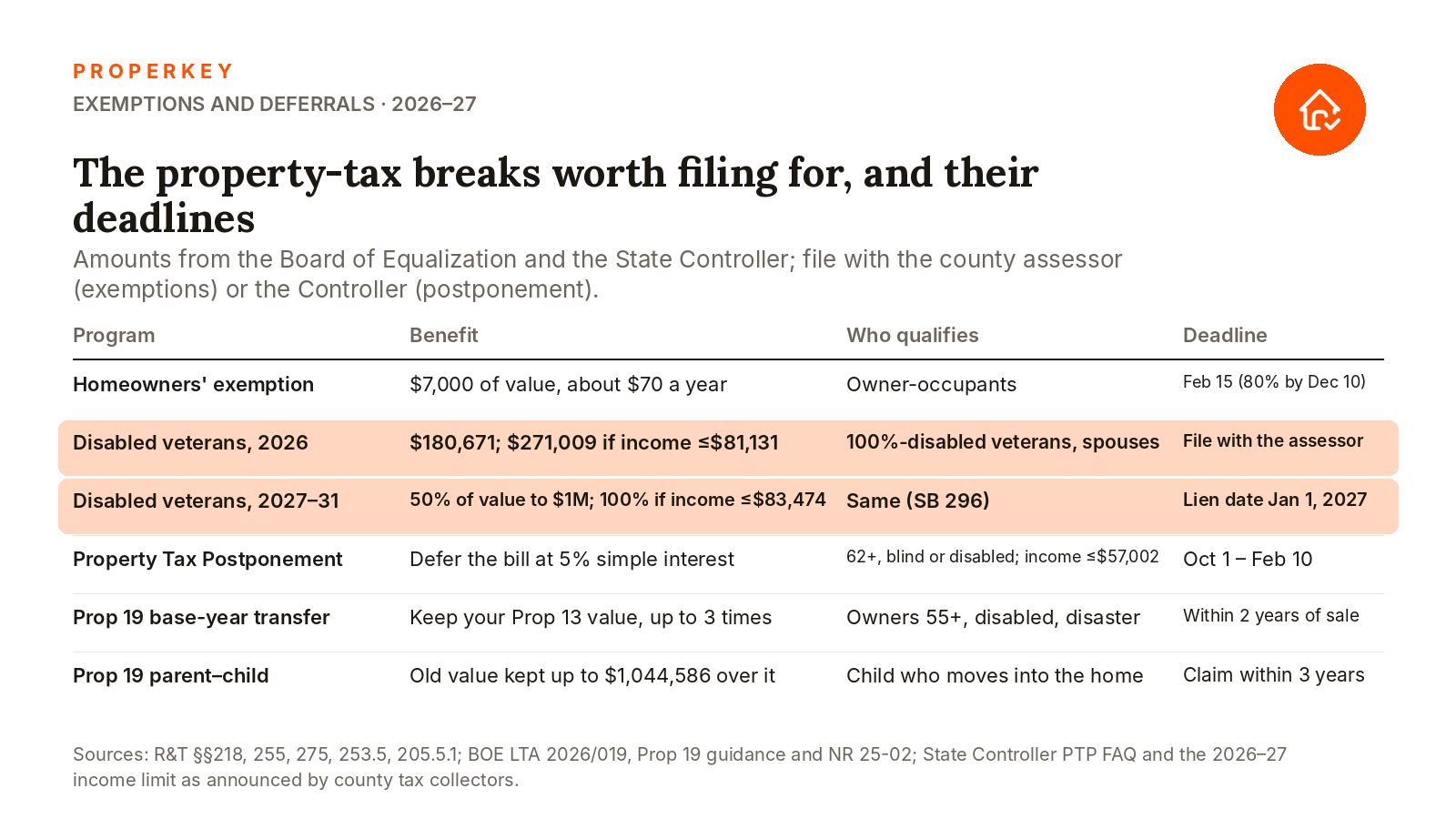
The homeowners' exemption removes $7,000 of assessed value (§218), about $70 a year; file with the assessor by February 15 for the full amount (February 16 in 2027 because the 15th is a holiday) or by December 10 for 80% of it, and it renews automatically while you own and occupy the home (§255, §275, §253.5). The disabled veterans' exemption is far larger: $180,671 of value for 2026, or $271,009 for households with income of $81,131 or less, per BOE Letter to Assessors 2026/019; and from the January 1, 2027 lien date, SB 296 (Chapter 727, Statutes of 2026) replaces it for five years with an exemption of 50% of the home's value up to $1 million, or 100% of that value for households with income of $83,474 or less, both indexed. Seniors 62 and over, and blind or disabled owners, with at least 40% equity and household income under the State Controller's limit, $57,002 for the 2026–27 cycle, can defer the whole bill through the Property Tax Postponement program at 5% simple interest, applying between October 1 and February 10. Owners 55 and over who sell can carry their Proposition 13 value to a replacement home anywhere in the state up to three times under Proposition 19, and a parent-child transfer of a family home that the child moves into keeps the old value up to a cap now set at $1,044,586 (BOE).
What should sellers and buyers do now?
A seller closing between now and December 10 should expect the escrow holder to pay the first installment from the proceeds or credit the buyer for it, and should keep the proration in mind when reading the settlement statement. A buyer should budget for the supplemental bill on top of the impound account, and a buyer without impounds should pay the regular bill in the seller's name if it is still outstanding, since the lien follows the property. Properkey lists homes for a $0 listing fee, and its broker escrow, for transactions in which Properkey is the broker, handles the proration as part of closing and settlement.
Questions people ask
What is the last day to pay California property taxes without a penalty? December 10 for the first installment and April 10 for the second, at 5 p.m. or the close of business; when either date falls on a weekend or holiday the deadline is the next business day, which makes the second 2027 deadline Monday, April 12.
How much is the penalty for paying property taxes late in California? 10% of the installment, plus a county cost of up to $55 (usually $10) on the second installment. After June 30 the unpaid balance is tax-defaulted and accrues 1.5% a month plus a redemption fee.
Do I still owe the penalty if I never received a tax bill? Yes. Revenue and Taxation Code §2610.5 says failure to receive a bill does not prevent penalties. Counties post bills online by parcel number; look yours up in early October.
Will my mortgage company pay my supplemental tax bill? Usually not. Supplemental bills go to the owner, and Los Angeles County says they are generally not paid from impound accounts; call the servicer, but plan to pay it yourself.
This article summarizes California statutes, Board of Equalization and county tax-collector guidance as of November 8, 2026. It is not tax or legal advice; your county tax collector's bill and website control the amounts and payment options.
Sources: C.A.R. September 2026 · R&T §2605 · §2606 · §2617 · §2618 · §2619 · §2621 · §2512 · §2610.5 · §4103 · §3691 · §4985.2 · §75 · §75.52 · §218 · §255 · §275 · §253.5 · §205.5.1 (SB 296) · SB 296 history · Cal. Const. art. XIII A · BOE Publication 29 · BOE county average tax rates · BOE NR 26-03 · BOE LTA 2026/019 · BOE Prop 19 · BOE NR 25-02 · State Controller PTP · 2026–27 PTP income limit (county notice) · 12 CFR 1024.17 · Civ. Code §2954 · §2954.8 · LA County Taxpayers' Guide · LA County TTC release (Oct 1, 2026) · LA County TTC payments · LA County property tax FAQ · LA County 2026 roll · San Diego TTC · San Diego 2026 roll · San Francisco 2026 roll · Sacramento County · Butte County · C.A.R. RPA (public copy)
Written by Keyro, Properkey's AI. Properkey, DRE #01979718.



