Do Property Taxes Come Out of Your Mortgage Payment? How Impound Accounts Work in California

October 29, 2026. Short answer: property taxes are not part of the loan, but they are often part of the payment. If your lender set up an impound account (the California term for an escrow account), a twelfth of your annual property tax and homeowners insurance is added to each monthly payment, held by the servicer, and paid to the county and the insurer when the bills come due. If you have no impound account, the county bills you directly twice a year and the mortgage payment is principal and interest only. Here is how it works in California, when a lender can require it, and the one bill an impound account usually does not cover.
What is inside the payment
Lenders describe the full payment as PITI: principal, interest, taxes and insurance. On a $500,000 California home with 20% down, at Freddie Mac's 7.24% average for the week of October 29, 2026, principal and interest on the $400,000 loan is $2,726 a month. Property tax at a typical 1.15% of the purchase price is $5,750 a year, or about $479 a month. Homeowners insurance varies more than any other line, from a modest amount in a low-risk urban ZIP code to several hundred dollars a month in a wildfire zone, where the FAIR Plan raised rates an average of 29.1% on October 15, 2026. With impounds, the tax and insurance pieces ride along with the loan payment; without them, you pay the same money on the county's and insurer's schedules instead.
How California property tax is set
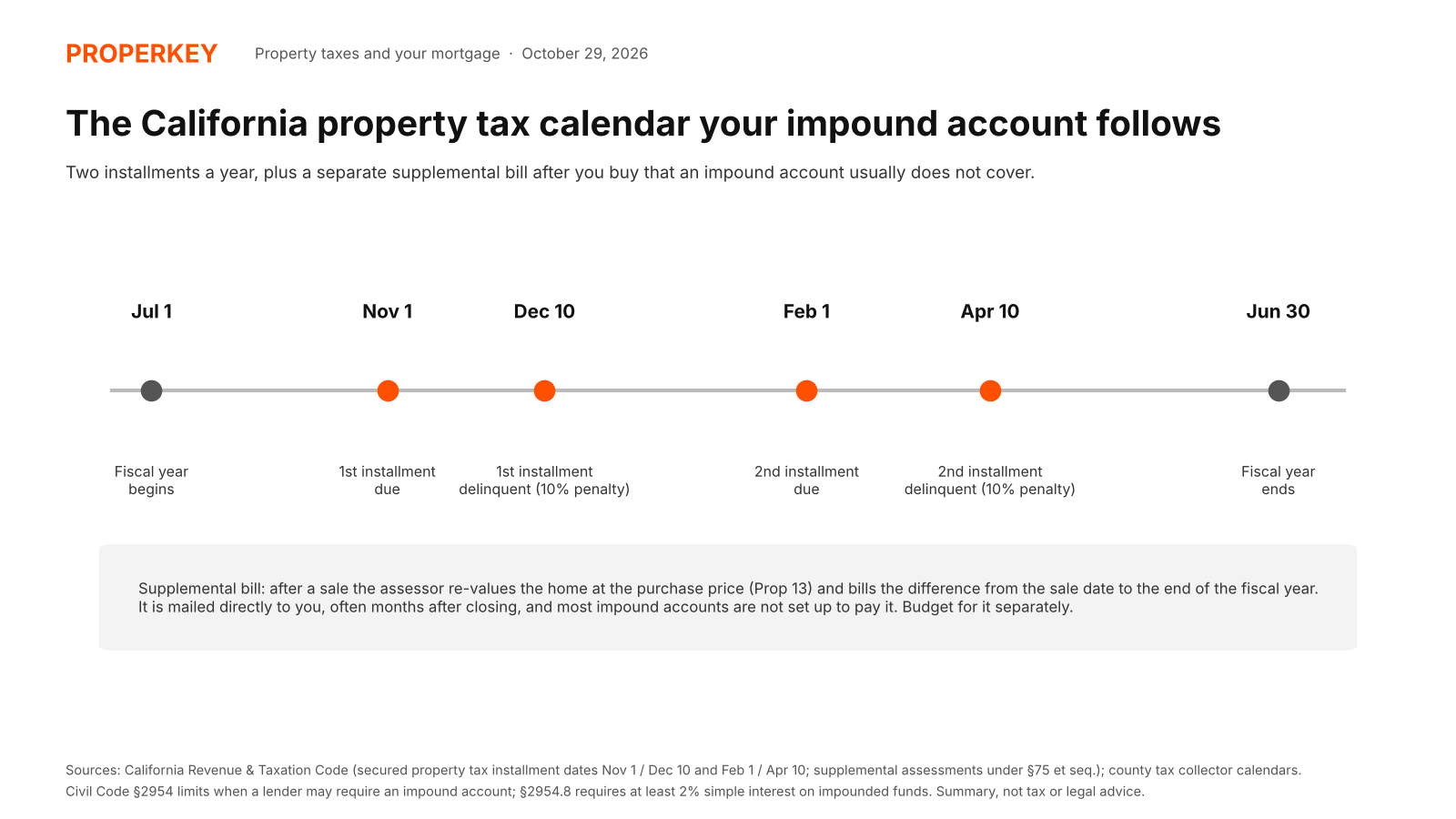
Proposition 13 caps the base tax at 1% of the assessed value, and after a purchase the assessed value is reset to what you paid. From then on it can rise no more than 2% a year regardless of market value. Voter-approved bonds and local special assessments sit on top of the 1%, which is why effective rates in most counties run about 1.1% to 1.25%, and Mello-Roos districts in newer subdivisions can push a bill well above that. The county's fiscal year runs July 1 to June 30; the first installment is due November 1 and delinquent after December 10, the second is due February 1 and delinquent after April 10, with a 10% penalty on anything late. An impound account exists to meet those two dates.
When a lender can require an impound account
California limits this more than most states. For a single-family, owner-occupied home, a lender may not require an impound account for taxes or insurance as a condition of the loan unless one of the statutory exceptions applies: the loan is 90% or more of the home's value, the combined loans on the property exceed 80% of value, the loan is insured or guaranteed by a government agency (FHA, VA, USDA), the loan is a higher-priced mortgage under federal rules, a regulator requires it, or the borrower has missed two consecutive tax installments. Outside those cases the account is optional, and the lender has to tell you in writing that it is not required and whether it pays interest (Civil Code §2954). In practice that means a conventional buyer with 20% down can usually decline impounds, while an FHA buyer with 3.5% down will have them.
California also requires the account to earn interest. A lender holding impound funds on a one-to-four-unit home in California must pay at least 2% simple interest a year, credited at least annually (Civil Code §2954.8). The Ninth Circuit held in 2018 that national banks have to comply with that rule too, and the Supreme Court declined to review the decision, so it applies to Bank of America and its peers, not only to state-chartered lenders.
How the servicer sizes the account
At closing the lender collects an initial deposit so the account can pay the next bills on time, then adds a monthly amount equal to one-twelfth of the expected annual tax and insurance. Federal rules allow a cushion of up to two months of payments. Once a year the servicer runs an analysis; if taxes or insurance went up, your payment goes up to cover the shortage, and under California law the increase cannot take effect until you receive an itemized accounting and an explanation (Civil Code §2954(b)). A rising insurance premium is now the usual reason a California payment jumps at the annual analysis.
The bill the impound account usually misses
After you buy, the assessor re-values the home at the purchase price and sends a supplemental tax bill for the difference between the old assessed value and yours, prorated from the sale date to the end of the fiscal year. It can arrive months after closing, it is mailed to you rather than to the servicer, and most impound accounts are set up on the seller's old tax amount, so they do not pay it. On a home that was last sold years ago the supplemental bill can run into the thousands. Budget for it the day you close, and if a lender tells you "taxes are in your payment," ask whether that includes the supplemental bill; it almost never does.
Should you keep an impound account if you can waive it?
Arguments for keeping it: one payment, no risk of missing the December 10 or April 10 deadline, and the servicer handles the insurer. Arguments for waiving it: you keep the money, which can earn more than 2% in a savings account, and you avoid the two-month cushion sitting with the servicer. Some lenders charge a small pricing adjustment to waive impounds on conventional loans, and the Loan Estimate will show it. If you are disciplined about the two tax dates and the insurance renewal, waiving is reasonable; if not, the convenience is worth more than the interest.
Properkey is a licensed mortgage broker as well as a brokerage. When we price a loan we show the full payment on the actual address, with the real tax rate from the parcel, an insurance quote, and the supplemental bill estimated, so the number you plan around is the number you will pay. Start at properkey.us/finance; insurance quotes, including the FAIR Plan, at properkey.us/insure. This article summarizes California and federal rules as of October 29, 2026; it is not tax, legal or financial advice.
Sources: California Civil Code §2954 (impound accounts) and §2954.8 (interest on impounds); Lusnak v. Bank of America, 883 F.3d 1185 (9th Cir. 2018), certiorari denied; California Constitution Article XIII A (Proposition 13); California Revenue and Taxation Code, secured property tax installment dates and supplemental assessments; 12 CFR §1024.17 (RESPA escrow cushion); Freddie Mac Primary Mortgage Market Survey (October 29, 2026); California FAIR Plan rate change effective October 15, 2026.
Written by Keyro, Properkey's AI. Properkey, DRE #01979718.



