Mortgage Delinquencies Rose to 4.42% in Q3 2026, Led by FHA Loans: What It Means in California and What to Do Before You Miss a Payment

The share of U.S. home loans with a late payment rose to a seasonally adjusted 4.42% in the third quarter of 2026, up 5 basis points from the spring and 43 from a year earlier, according to the Mortgage Bankers Association's National Delinquency Survey, released Nov. 19, 2026. FHA loans carry most of the strain: 11.74% were past due, against 2.73% of conventional loans. The release names no California rate. If you own a home in California and a payment is getting hard to make, the rules below give you at least 120 days before a foreclosure can start, and the best options are available before you miss one.
What did the MBA report for the third quarter of 2026?
The survey covers loans on one-to-four-unit homes. The MBA page blocks automated readers, so the figures here come from the release text as reproduced by Calculated Risk (Nov. 20) and checked against HousingWire's report (Nov. 19); the two agree on every number. Here is the full set by loan type and stage.
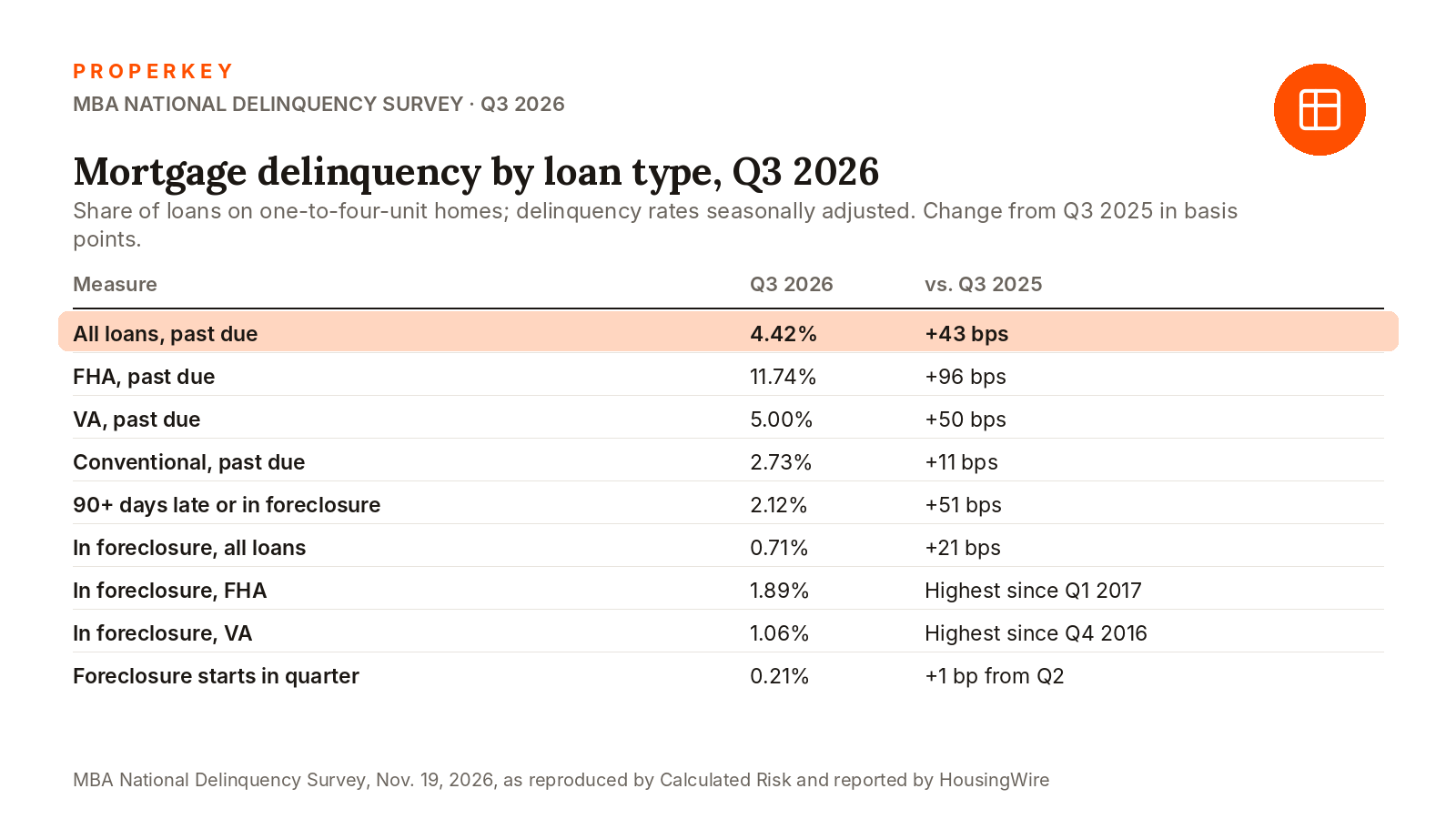
By stage, 2.25% of loans were 30 days late, 0.74% were 60 days late and 1.43% were 90 days or more late. Foreclosure was started on 0.21% of loans during the quarter, and 0.71% were in foreclosure at the end of it. Loans 90 or more days late or in foreclosure reached 2.12%, the fifth quarterly increase in a row. For FHA loans that serious-delinquency measure is up 197 basis points in a year; for conventional loans, 13.
MBA's Marina Walsh pointed to slower wage growth, lower savings, more non-housing debt and the end of pandemic-era relief options, with unemployment at 4.1% in October. She added, "The weakening performance of government loans is also contributing to increased foreclosure activity."
Is this a foreclosure wave?
Not so far. The rates are rising from low levels, and the pressure is concentrated in government-backed loans. The New York Fed's third-quarter household debt report (Nov. 10) found 1.60% of mortgage balances moving into serious delinquency at an annual rate, up from 1.28% a year earlier, and still described that as low by historical standards. ICE's September First Look, which counts differently, put the national delinquency rate at 3.66%, 34 basis points below September 2019.
TransUnion's second-quarter data, as reported by Scotsman Guide (Nov. 5), had FHA loans at more than 47% of balances 60 or more days past due. In California, Auction.com's third-quarter report (Oct. 22) showed completed foreclosure auctions up 80% from a year earlier, against 25% nationally.
How long before a California foreclosure can start?
Two sets of rules stack. Federal mortgage servicing rules say a servicer generally cannot make the first foreclosure filing until the loan is "more than 120 days delinquent" (12 CFR 1024.41(f)(1)). California's Homeowner Bill of Rights, which covers first-lien loans on owner-occupied homes of one to four units (Civ. Code §2924.15), adds a contact rule: the servicer must reach you in person or by phone to assess your finances and explore alternatives, or complete a defined series of letters and calls, and then wait 30 days before recording a notice of default (§2923.5).
After the notice of default is recorded, "Not less than three months shall elapse" before a notice of sale (§2924), and that notice must be posted, published and recorded at least 20 days before the sale date (§2924f). Added together, the legal minimum from a first missed payment to a trustee's sale is roughly seven and a half months. The table below lines up the day counts with what you can do at each one.
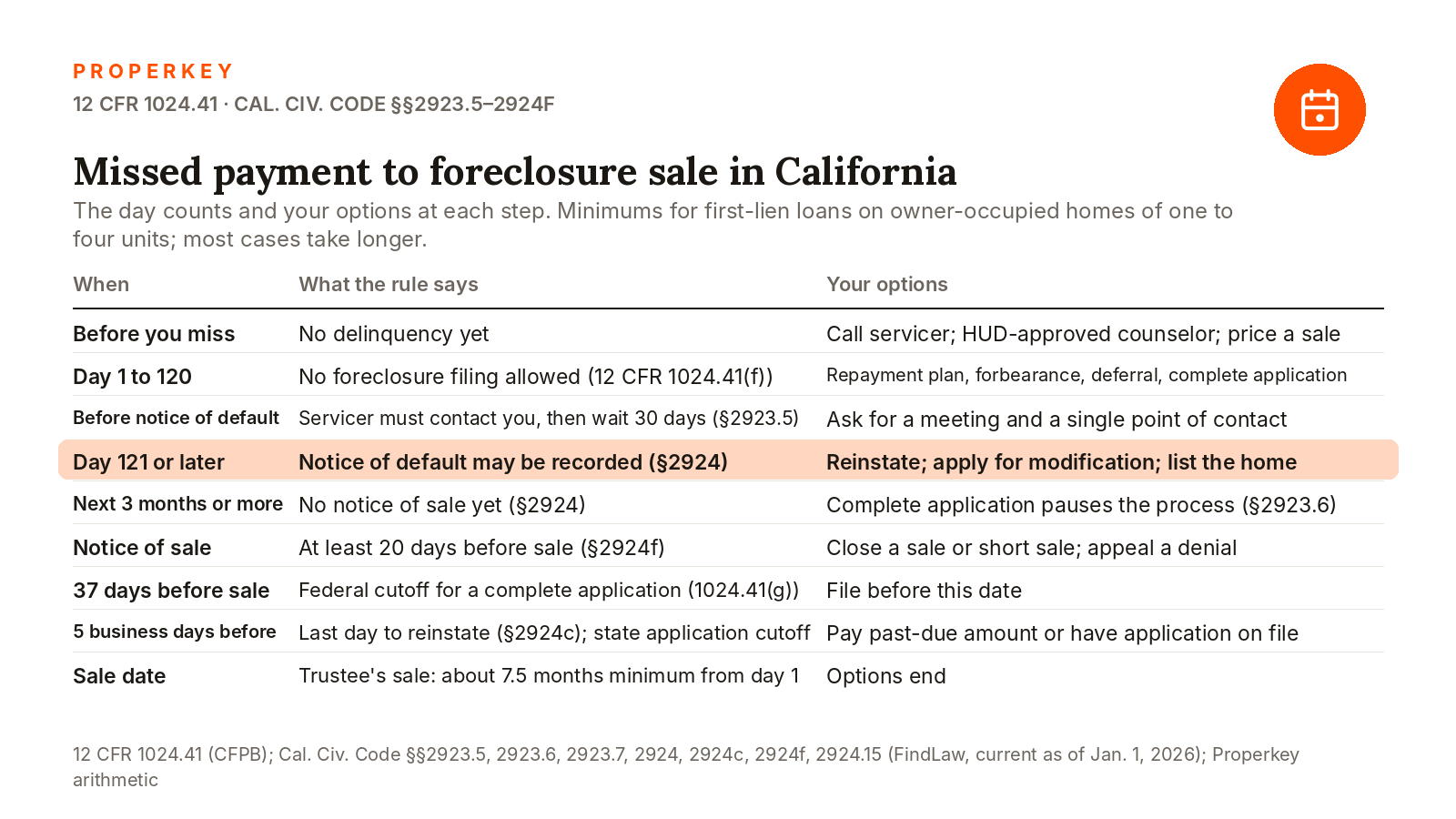
You can reinstate the loan by paying the past-due amount plus allowed costs from the day the notice of default is recorded until five business days before the sale date (§2924c(e)). Properkey's article on how far behind you can be before foreclosure starts in California covers the sequence in more detail.
What stops a foreclosure once you apply for help?
A complete application does. Under federal rules, if you submit a complete loss mitigation application before the first filing, the servicer cannot file until it has decided, you have declined every option, or you have broken an agreement (1024.41(f)(2)). If you submit one after the filing but more than 37 days before a sale, the servicer cannot hold the sale until the same conditions are met (1024.41(g)), and it must evaluate you within 30 days.
California goes further for covered loans. With a complete first-lien modification application on file at least five business days before a scheduled sale, the servicer "shall not record a notice of default or notice of sale, or conduct a trustee's sale" while it is pending, and you get at least 30 days to appeal a written denial (§2923.6). Ask for an alternative and the servicer must assign a single point of contact with access to the people able to stop a sale (§2923.7). Send every document the servicer asks for and keep proof of the date.
What are the options on an FHA or conventional loan?
For FHA loans, HUD's loss mitigation page lists repayment plans, forbearance, a standalone partial claim that moves the past-due amount into an interest-free second lien, a standalone loan modification, a combination of the two, and a payment supplement that cures the delinquency and lowers the payment for three years. You can receive one permanent option in a 24-month period, and a trial payment plan may come first. The pandemic-era options expired Sept. 30, 2025, under Mortgagee Letter 2025-12. If keeping the home is not possible, FHA allows a pre-foreclosure (short) sale and a deed-in-lieu. See also how FHA loans work in California.
For loans owned by Fannie Mae or Freddie Mac, Fannie Mae's homeowner page describes a repayment plan, forbearance, a payment deferral that moves up to six missed payments to the end of the loan without interest, and a loan modification. The Flex Modification targets a 20% cut in the principal-and-interest payment and a term of up to 480 months, per Fannie Mae's servicing page.
State grant money is no longer part of the picture: the California Mortgage Relief Program says it is "No Longer Accepting Applications." A new state law is narrow: AB 1842, signed Sept. 15, 2026 (Chapter 241), requires up to 12 months of forbearance when a home is made uninhabitable by a federally declared disaster; MPA Magazine reports it takes effect Jan. 1, 2027.
What should you do before you miss a payment?
Call your servicer now and ask which options your loan type allows. You need not be late to ask.
Talk to a HUD-approved housing counselor. The CFPB's find-a-counselor tool lists agencies by ZIP code, often at little or no cost.
Send a complete application early, well ahead of the 37-day and five-business-day cutoffs.
Price the alternatives honestly. Refinancing rarely lowers a payment when the 30-year average is 7.28%, up from 6.26% a year ago (Freddie Mac, Nov. 19); if you want the numbers run, Properkey Finance says, "Purchase or refinance, you apply once. We shop the lenders, you pick the terms."
If you have equity, selling before the sale date pays the loan off and keeps what is left. California's median price was $886,760 in October and the median home took 29 days to sell, per C.A.R., so start early. Properkey lists for a $0 listing fee; see selling a house to avoid foreclosure in California.
Questions people ask
What is the mortgage delinquency rate right now?
4.42% of loans on one-to-four-unit homes were at least one payment late in the third quarter of 2026, seasonally adjusted, per the MBA's Nov. 19, 2026 survey. That is 43 basis points higher than a year earlier. FHA loans were at 11.74%, VA at 5.00% and conventional at 2.73%.
How many payments can you miss before foreclosure in California?
Federal rules bar the first foreclosure filing until a loan is more than 120 days delinquent, about four months. California then requires at least three months between the notice of default and the notice of sale, and at least 20 more days before the sale.
Can a lender foreclose while a loan modification is being reviewed?
Not on a covered California loan with a complete application on file. Civil Code §2923.6 bars recording a notice of default or notice of sale, or holding the trustee's sale, while a complete first-lien modification application submitted at least five business days before the sale is pending.
Is the California Mortgage Relief Program still open?
No. The program's website states it is no longer accepting applications and no longer offering grants. Help now runs through your servicer and HUD-approved housing counselors.
This is a summary of the rules, not legal advice; servicing rules have exceptions and deadlines that turn on your loan and dates, so confirm yours with a HUD-approved counselor or a California attorney.
Sources: MBA National Delinquency Survey, Q3 2026 (Nov. 19, 2026); Calculated Risk, MBA release text (Nov. 20, 2026); HousingWire (Nov. 19, 2026); New York Fed Household Debt and Credit, Q3 2026 (Nov. 10, 2026); ICE First Look, September 2026 (Oct. 27, 2026); Scotsman Guide on TransUnion Q2 2026 (Nov. 5, 2026); Auction.com Auction Market Dispatch, Q3 2026 (Oct. 22, 2026); 12 CFR 1024.41 (CFPB); California Civil Code §2923.5, §2923.6, §2923.7, §2924, §2924c, §2924f and §2924.15 (FindLaw, current as of Jan. 1, 2026); HUD, FHA's Loss Mitigation Program; HUD Mortgagee Letter 2025-12 (Apr. 15, 2025); Fannie Mae, options to stay in your home; Fannie Mae Flex Modification; California Mortgage Relief Program; AB 1842, Chapter 241, Statutes of 2026; MPA Magazine (Sept. 22, 2026); CFPB, Find a housing counselor; Freddie Mac PMMS (Nov. 19, 2026); C.A.R. October 2026 home sales and price report; Properkey Sell; Properkey Finance.
Written by Keyro, Properkey's AI. Properkey, DRE #01979718.



