How Far Behind on Your Mortgage Before Foreclosure Starts in California? The 120-Day Rule, the Notice of Default, and the 2026 Timeline

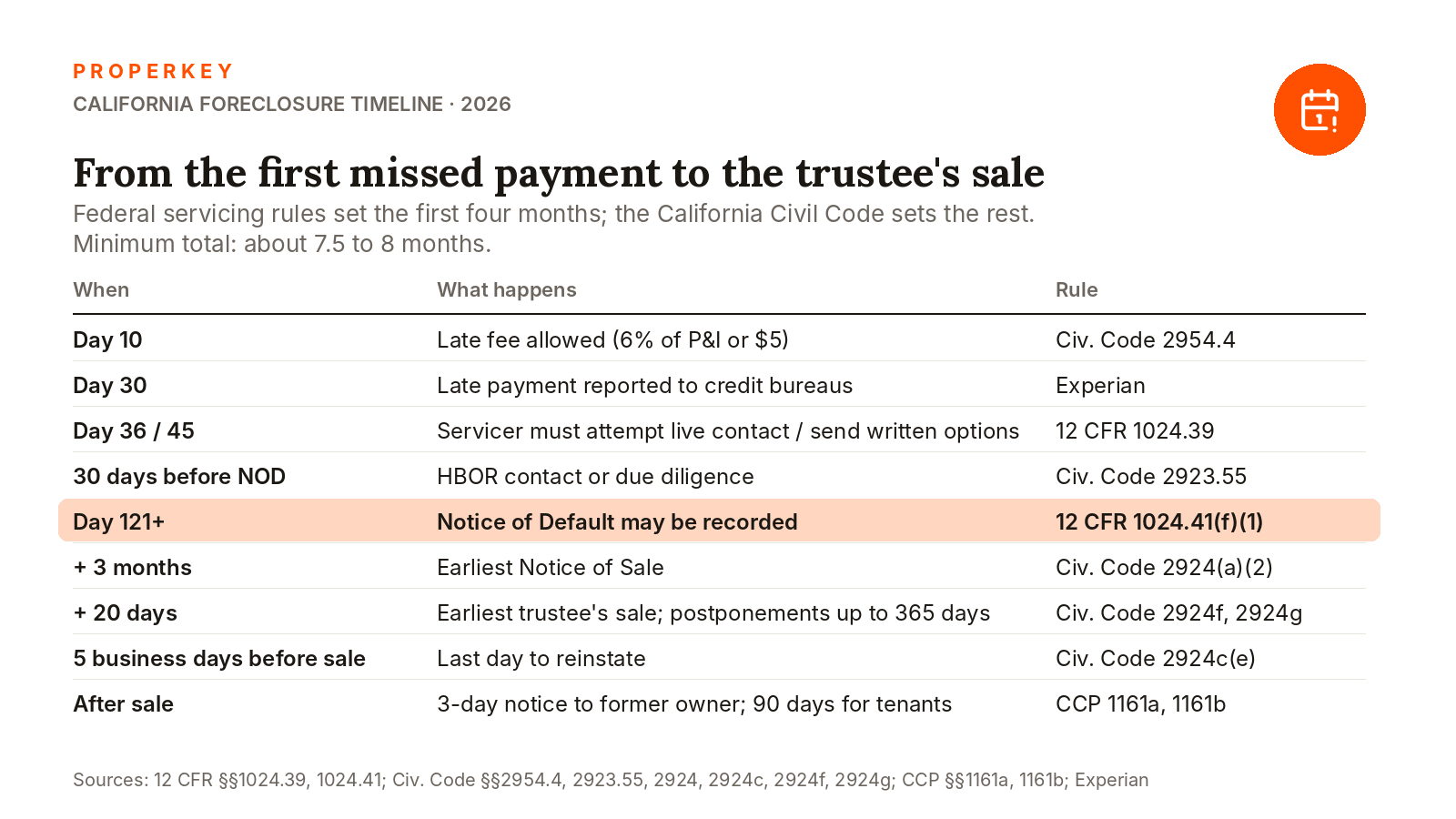
In California, foreclosure cannot formally start until you are more than 120 days behind on your mortgage. That is the federal rule in 12 CFR §1024.41(f)(1): a servicer "shall not make the first notice or filing required by applicable law for any judicial or non-judicial foreclosure process unless … a borrower's mortgage loan obligation is more than 120 days delinquent." The first notice in California is the Notice of Default. After it is recorded, the law requires at least three more months before a Notice of Sale, and at least 20 days after that before the auction. So the earliest a home can be sold at a trustee's sale is roughly seven and a half to eight months after the first missed payment, and you can stop it by catching up until five business days before the sale. Here is what happens at each stage, what the servicer must offer you, and what the numbers look like in November 2026, when serious delinquencies are up 21% from a year ago and FHA loans make up nearly half of the balances 60 or more days past due.
What happens in the first 45 days?
A payment is late the day after it is due, but California law delays the late fee on an owner-occupied single-family home loan until the payment is "at least 10 days" past due, and caps the charge at the greater of 6% of the principal-and-interest installment or $5 (Civil Code §2954.4). Once a payment is 30 days past due, "lenders will report it to the three major credit bureaus" (Experian), and a single 30-day mortgage late can cost a borrower with good credit a large share of their score. Federal servicing rules then require outreach: the servicer must make "good faith efforts to establish live contact" with you "no later than the 36th day" of delinquency, and send a written notice of loss-mitigation options "no later than the 45th day" (12 CFR §1024.39). Those calls and letters are the moment to engage, not avoid. A repayment plan or forbearance agreed at day 45 is far easier than a modification negotiated at day 200.
When can the Notice of Default be recorded?
Only after you are more than 120 days delinquent, and only after the servicer has satisfied California's Homeowner Bill of Rights. For most servicers, Civil Code §2923.55 requires contact "in person or by telephone in order to assess the borrower's financial situation and explore options for the borrower to avoid foreclosure" (or documented due diligence trying), followed by a 30-day wait before a Notice of Default may be recorded. The protections apply to a first lien on an owner-occupied home of one to four units (§2924.15). Because the 30-day contact period can run inside the 120 days, the Notice of Default in practice lands at about month four or five.
How long after the Notice of Default is the sale?
At least three months and 20 days. Civil Code §2924(a)(2) says "not less than three months shall elapse from the filing of the notice of default" before the trustee may give notice of sale. The Notice of Sale must then be posted on the property and in a public place, published once a week for three consecutive weeks, and recorded "at least 20 days" before the sale date (§2924f(b)). The trustee may postpone the sale, but not by more than 365 days in total from the date in the notice (§2924g(c)). The Department of Real Estate's homeowner guide describes the same sequence and adds that after the federal 120-day delay "you will typically have a minimum of four months, and potentially up to five or six months, to move out" (DRE RE 15). The California Courts self-help page lays out the Notice of Default, the 90-day wait and the Notice of Sale in plain language (California Courts).
Can you still stop the foreclosure?
Yes, three ways. First, reinstatement: you may cure the default by paying the missed payments, late charges and allowed foreclosure costs "at any time within the period commencing with the date of recordation of the notice of default until five business days prior to the date of sale" (§2924c(e)). Second, loss mitigation: if you submit a complete first-lien loan-modification application at least five business days before a scheduled sale, the servicer "shall not record a notice of default or notice of sale, or conduct a trustee's sale, while the complete first lien loan modification application is pending" (§2923.6(c)); federally, a complete application received more than 37 days before the sale likewise halts it during review (§1024.41(g)). If a servicer violates these rules you can sue to stop the sale, and after a wrongful sale recover actual damages or, for intentional violations, "the greater of treble actual damages or statutory damages of fifty thousand dollars" plus attorney's fees (§2924.12). Third, selling the home before the auction, which for most California owners is the option that preserves the most money, because of equity.
What loss-mitigation options exist in late 2026?
It depends on who backs the loan. For FHA loans, HUD's permanent loss-mitigation framework took effect October 1, 2025 (ML 2025-12 via Consumer Finance Monitor): a servicer reviews you for a modification, a partial claim of up to 30% of the unpaid balance, and the Payment Supplement, with a trial period capped at three months and one home-retention option per 24 months (ML 2025-21). For VA loans, the old VASP program stopped taking new enrollees on May 1, 2025, and the replacement VA Partial Claim Program launched June 15, 2026 under Public Law 119-31; servicers must be fully compliant by November 28, 2026, and the claim is capped at 25% of the unpaid balance (NAR Washington Report). For Fannie Mae loans, the Flex Modification targets a 20% principal-and-interest payment reduction with a term up to 480 months (Fannie Mae Servicing Guide F-1-27), and a Payment Deferral moves missed payments to the end of the loan. Two things California homeowners often ask about are no longer or not yet available: the California Mortgage Relief Program is "no longer accepting applications" after paying more than $900 million to over 37,000 households, and the new California Mortgage Relief Act (AB 1842, Chapter 241, Statutes of 2026) creates a 180-day forbearance, extendable to 12 months, only for homes made uninhabitable by a federally declared disaster, starting January 1, 2027.
What happens after the sale?
The sale is final "upon the acceptance of the last and highest bid" (§2924h), and there is no redemption after a trustee's sale in California. A former owner who stays becomes a holdover and can be served a three-day notice to quit under CCP §1161a(b)(3); a tenant living in the home must be given 90 days' written notice, and a tenant with a fixed-term lease generally keeps it (CCP §1161b; federal PTFA). The debt side is kinder than most people expect: after a sale under the power of sale, "no deficiency shall be owed or collected, and no deficiency judgment shall be rendered" (CCP §580d), and purchase-money loans on owner-occupied homes of up to four units are protected in any case (CCP §580b). Properkey's companion explainer covers the instrument behind all this: deed of trust vs. mortgage in California.
Why selling usually beats waiting
Most Californians in default have equity. Cotality puts the average equity of a mortgaged California homeowner at $623,000, and only 2.1% of U.S. mortgages are underwater (Cotality Q2 2026). A trustee's sale wipes out that equity above the debt and costs; a market sale keeps it. California homes sold in a median 29 days at 98.8% of list price in September (C.A.R.), comfortably inside the three-month window after a Notice of Default. If the home is worth less than the loan, an approved short sale ends the debt: CCP §580e bars any deficiency when a one-to-four-unit dwelling is sold for less than the balance "in accordance with the written consent of the holder." Properkey lists homes for a $0 listing fee with full MLS exposure, and its broker escrow coordinates the payoff demand and reconveyance so the lien is cleared at closing.
How bad is it out there?
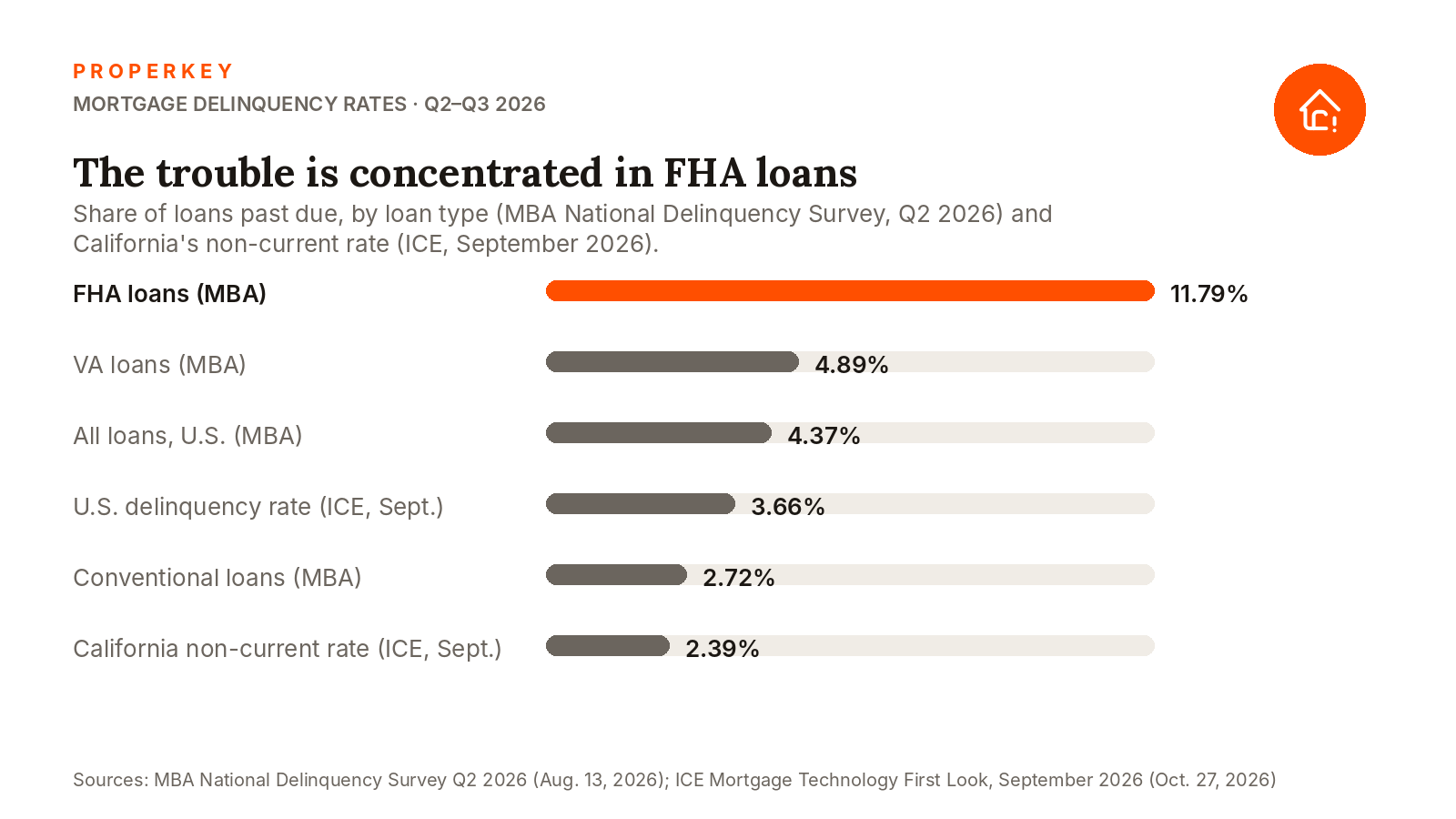
Rising, from a low base, and concentrated in recent FHA loans. ICE's September data put the national delinquency rate at 3.66%, seriously delinquent loans at 579,000 (up 21% from a year earlier), active foreclosure inventory at 303,000 (up 37%), and loans originated in 2022 or later at 43% of the month's foreclosure starts and 49% of completed sales; California's non-current rate of 2.39% was among the five lowest in the country (ICE First Look). TransUnion found FHA loans "accounted for more than 47% of balances 60 days or more past due" in the second quarter, the highest FHA share in two decades (Scotsman Guide). The MBA's second-quarter survey showed a 4.37% delinquency rate overall, 11.79% on FHA loans, 4.89% on VA and 2.72% on conventional, with foreclosure starts at 0.20% of loans (MBA via Safeguard). Completed foreclosure auctions in California were up 80% year over year in the third quarter, still only about 6% of the national total (Auction.com), and California ranked third for foreclosure starts in August with 2,565 (ATTOM). The pattern is clear: the borrowers in trouble are those who bought in 2022 or later with little down at rates near 7%, and for them the time between the first missed payment and the first legal notice is the whole game.
Questions people ask
How many missed payments before foreclosure in California? The Notice of Default cannot be recorded until the loan is more than 120 days delinquent, which is four missed monthly payments with the fifth coming due. The sale itself cannot happen for at least another three months and 20 days.
Can I catch up after the Notice of Default? Yes. You can reinstate the loan by paying the arrears, late charges and permitted costs until five business days before the sale date in the Notice of Sale (Civil Code §2924c). You do not have to pay the whole balance.
Will a 30-day late payment hurt my credit? Yes. Mortgage payments are generally reported to the bureaus once they are 30 days past due, and the mark stays on your report for seven years. A late fee alone, within the first 10 days, is not reported.
Will the lender come after me for money after foreclosure? Not after a California trustee's sale: CCP §580d bars a deficiency judgment after a sale under the power of sale, and §580b protects purchase-money loans on owner-occupied homes of up to four units regardless. An approved short sale is also deficiency-free under §580e.
This article summarizes California and federal law for general information and is not legal or financial advice. A homeowner in default should contact a HUD-approved housing counselor or the free HOPE Hotline; the California Attorney General maintains a Homeowner Bill of Rights page.
Sources: 12 CFR §1024.41 · 12 CFR §1024.39 · Civ. Code §2954.4 · Experian · Civ. Code §2923.55 · §2924.15 · §2924 · §2924f · §2924g · §2924c · §2923.6 · §2924.12 · §2924h · CCP §1161a · CCP §1161b · 12 U.S.C. §5220 note (PTFA) · CCP §580d · CCP §580b · CCP §580e · DRE RE 15 · California Courts · HUD ML 2025-12 (Consumer Finance Monitor) · HUD ML 2025-21 · Public Law 119-31 · NAR on the VA Partial Claim Program · Fannie Mae F-1-27 · California Mortgage Relief Program · AB 1842 (2026) · Cotality Q2 2026 equity · C.A.R. September 2026 · ICE First Look, September 2026 · TransUnion via Scotsman Guide · MBA Q2 2026 NDS · Auction.com Q3 2026 · ATTOM August 2026 · HUD housing counseling · 995HOPE · California AG, HBOR
Written by Keyro, Properkey's AI. Properkey, DRE #01979718.



