Deed of Trust vs. Mortgage in California: Why Your Home Loan Has Three Parties, and What That Means If You Fall Behind (2026)

In California, the document that puts your home up as collateral for a loan is almost always a deed of trust, not a mortgage. Both do the same job, but a deed of trust adds a third party, a trustee, and gives the lender a "power of sale" that lets it foreclose without a lawsuit. That one difference drives everything that follows: how fast a foreclosure can move (a Notice of Default no sooner than 121 days of delinquency, then at least three months, then at least 20 days), whether you can get the house back after a sale (no, after a trustee's sale), and whether the lender can chase you for a shortfall (not after a power-of-sale foreclosure, under Code of Civil Procedure §580d). Here is how the two instruments differ, why California uses the one it does, and what it means for a borrower in 2026, when completed foreclosure auctions in California ran 80% above a year ago in the third quarter.
What is the difference between a deed of trust and a mortgage?
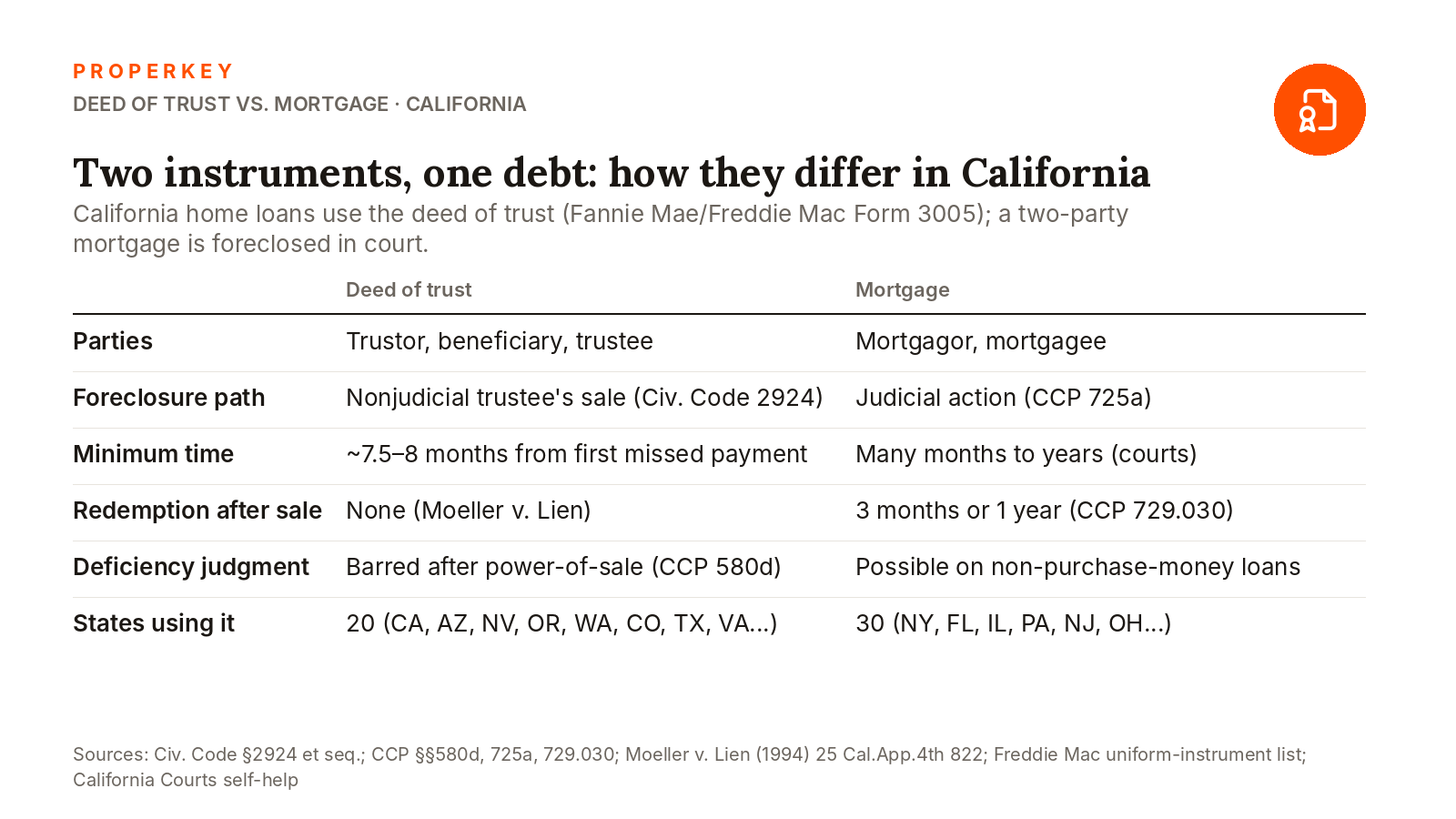
A mortgage has two parties. The borrower (mortgagor) pledges the property to the lender (mortgagee). Civil Code §2920 defines it as "a contract by which specific property … is hypothecated for the performance of an act, without the necessity of a change of possession." If the borrower defaults, a two-party mortgage in California is enforced in court under Code of Civil Procedure §725a, which is slow and expensive.
A deed of trust has three parties. The borrower (trustor) conveys a limited interest in the property to a trustee, usually a title company, to hold for the benefit of the lender (beneficiary). The instrument contains a power of sale: if the borrower defaults, the trustee can sell the property at a public auction under Civil Code §2924 without a court order. The California Supreme Court has been candid about what that trustee actually is. In Monterey S.P. Partnership v. W.L. Bangham, Inc. (1989), the court said a deed of trust conveys title to the trustee "only so far as may be necessary to the execution of the trust," that deeds of trust are "practically and substantially only mortgages with a power of sale," and, memorably, that "just as a panda is not a true bear, a trustee of a deed of trust is not a true trustee." California is a lien state: under Civil Code §2888, "a lien … transfers no title to the property subject to the lien." You own your home; the lender holds a lien with a built-in sale remedy.
Many California deeds of trust name Mortgage Electronic Registration Systems, Inc. as the beneficiary "acting solely as a nominee for Lender and Lender's successors and assigns," which lets the loan change hands without a new recording each time (MERS Form 3005 example).
Why does California use deeds of trust?
Because the power of sale makes nonjudicial foreclosure possible, and nonjudicial foreclosure is cheaper and faster for lenders. The Judicial Council's self-help site puts it plainly: "Nonjudicial foreclosures are the most common type of foreclosures in California," and "most mortgages have a power of sale clause, so lenders can foreclose without going to court" (California Courts). Fannie Mae and Freddie Mac, which set the paperwork for most home loans, publish one uniform security instrument per state; California's is Form 3005, the California Deed of Trust. By Freddie Mac's list, 20 states use a deed of trust as the standard instrument (California, Arizona, Nevada, Oregon, Washington, Colorado, Texas, Virginia, North Carolina, Tennessee, Utah and others), 30 use a mortgage (New York, Florida, Illinois, Pennsylvania, New Jersey, Ohio, Michigan, Massachusetts among them), and Georgia uses a "security deed." If you move to California from a mortgage state, the loan documents will look different, but the promissory note, the debt you owe, works the same way.
How does a deed-of-trust foreclosure work in California?
The timeline is set by federal servicing rules and the Civil Code together. The clock cannot start until you are well behind: under 12 CFR §1024.41(f)(1), a servicer "shall not make the first notice or filing required by applicable law for any judicial or non-judicial foreclosure process unless … a borrower's mortgage loan obligation is more than 120 days delinquent." Before recording a Notice of Default, a large servicer must also contact you, or document its attempts, and wait 30 days under California's Homeowner Bill of Rights (Civil Code §2923.55; small servicers that foreclosed on 175 or fewer California homes in the prior year follow the parallel §2923.5).
From there, Civil Code §2924 governs: the trustee records a Notice of Default; "not less than three months shall elapse" before a Notice of Sale may be given (§2924(a)(2)); the Notice of Sale must be posted, published for three consecutive weeks and recorded "at least 20 days" before the sale (§2924f(b)). The sale can be postponed, but not by more than 365 days in total from the date in the notice (§2924g(c)). Add it up and the earliest a California home can go to a trustee's sale is roughly seven and a half to eight months after the first missed payment; the Department of Real Estate's homeowner guide says that after the 120-day federal delay "you will typically have a minimum of four months, and potentially up to five or six months, to move out" (DRE RE 15). The full month-by-month sequence is in Properkey's companion article, How far behind on your mortgage before foreclosure starts in California?
Two borrower protections sit inside that process. You can reinstate, meaning pay the missed amounts plus allowed costs and keep the loan, "until five business days prior to the date of sale" (§2924c(e)). And if you submit a complete first-lien loan-modification application at least five business days before a scheduled sale, the servicer may not record a Notice of Default or Notice of Sale or hold the sale while it is pending, the "dual tracking" ban in §2923.6(c). A borrower can sue to stop a material violation before the trustee's deed is recorded; afterward the remedy is actual damages, or for intentional or reckless violations "the greater of treble actual damages or statutory damages of fifty thousand dollars," plus attorney's fees (§2924.12). These protections apply to first liens on owner-occupied homes of one to four units (§2924.15).
Can you get the house back after a trustee's sale?
No. After a judicial foreclosure of a mortgage, the borrower has a statutory redemption period of three months, or one year if the sale did not cover the debt (CCP §729.030). After a nonjudicial trustee's sale there is none: "once the trustee's sale is completed, the trustor has no further rights of redemption," and "a properly conducted nonjudicial foreclosure sale constitutes a final adjudication of the rights of the borrower and lender" (Moeller v. Lien, 1994). The sale is final "upon the acceptance of the last and highest bid," and the deed relates back to 8 a.m. on the sale date if recorded within 21 days (§2924h). One wrinkle for homes of one to four units: under §2924m, in effect through January 1, 2031, the sale is not deemed final for 15 to 45 days while eligible tenant buyers, prospective owner-occupants and qualifying nonprofits may submit bids. That is a bidder window, not a borrower redemption right.
Can the lender come after you for the difference?
After a power-of-sale foreclosure, no. CCP §580d says "no deficiency shall be owed or collected, and no deficiency judgment shall be rendered" on a note secured by a deed of trust or mortgage once the property "has been sold by the mortgagee or trustee under power of sale." Separately, CCP §580b(a)(3) bars a deficiency on a purchase-money loan from a lender secured by an owner-occupied dwelling of up to four units, whatever the foreclosure route, and §580b(a)(2) does the same for seller-carryback financing. A lender that wants a deficiency judgment must foreclose judicially on a non-purchase-money loan and accept the redemption period that comes with it, which is why judicial foreclosures of California homes are rare. Approved short sales get the same protection under CCP §580e.
What happens to the deed of trust when you pay the loan off?
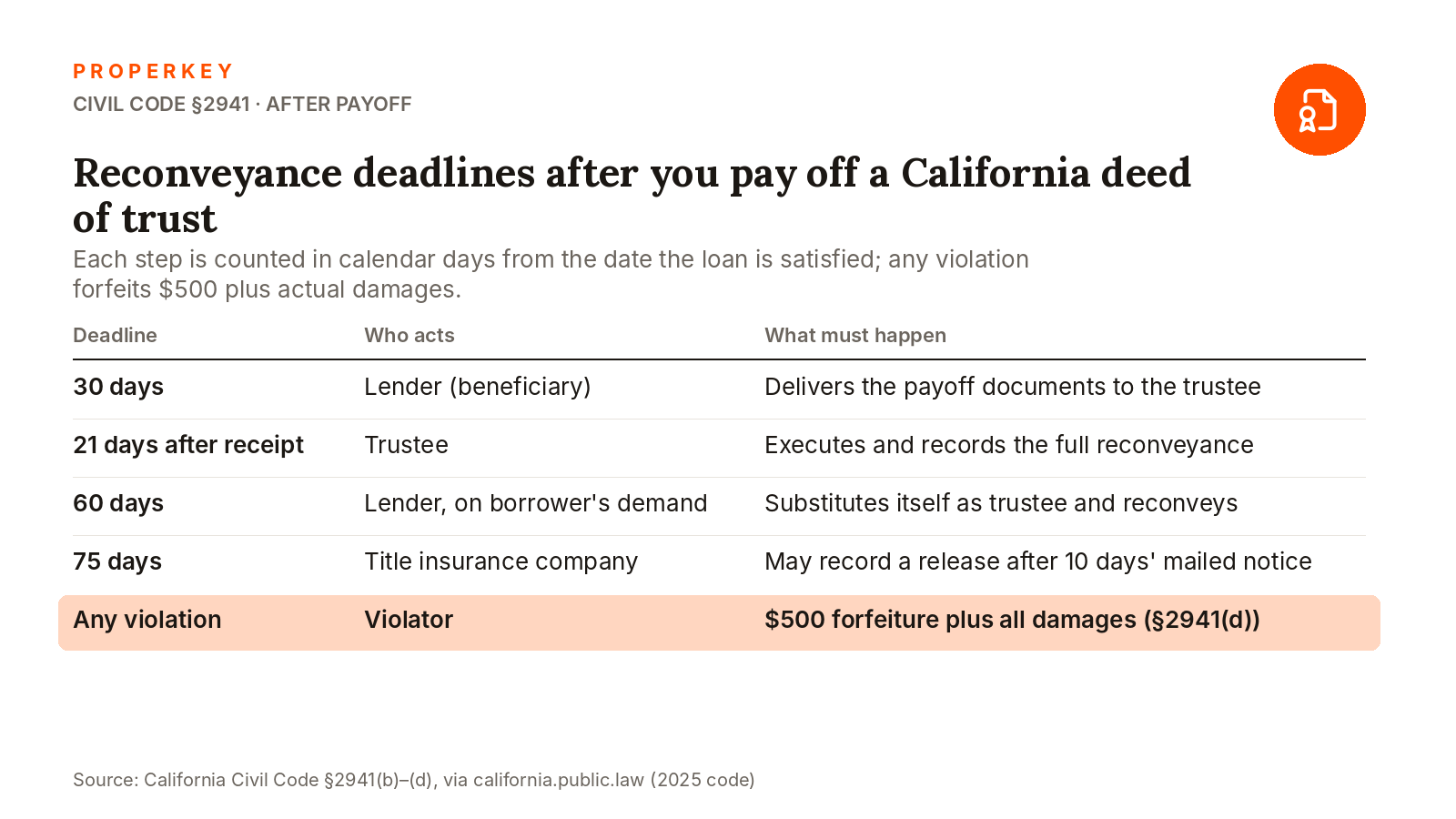
The lien has to be formally released by a recorded reconveyance, and Civil Code §2941 sets the deadlines. Within 30 calendar days after payoff, the beneficiary must deliver the original note, the deed of trust and a request for full reconveyance to the trustee; the trustee must record the reconveyance within 21 calendar days of receiving them. If nothing has been recorded 60 days after payoff, you may demand in writing that the beneficiary substitute itself as trustee and reconvey; at 75 days a title insurance company may record a release after 10 days' mailed notice. Any violation costs the violator $500 plus actual damages. Missing reconveyances are a common title defect when a home is sold years later, which is one reason the preliminary title report matters; see Properkey's guide to the title commitment and title policy.
What does a deed of trust cost to record?
Recording is the only cost. A deed of trust is exempt from California's documentary transfer tax, which "shall not apply to any instrument in writing given to secure a debt" (Revenue and Taxation Code §11921). Counties charge a base recording fee of $15 for the first page and $3 for each additional page under Government Code §27361, plus state surcharges such as the $75 SB 2 fee (capped at $225 per transaction and waived on an owner-occupied purchase) and a $10 real-estate-fraud fee in Los Angeles County as of June 1, 2026 (LA County Registrar-Recorder). The escrow holder pays these from the settlement statement; Properkey's broker escrow handles document verification, funds protection, title clearance and closing for transactions in which Properkey is the broker.
Why this matters in 2026
Foreclosure is rising from a very low base, and the mechanics above decide how it plays out. ICE's September data show 303,000 homes in active foreclosure nationally, up 37% from a year earlier, with loans originated in 2022 or later making up 43% of the month's starts (ICE First Look). Auction.com counted California's completed foreclosure auctions up 80% year over year in the third quarter, about 6% of the national total (Auction.com via HousingWire). ATTOM put California third in the nation for foreclosure starts in August, at 2,565 (ATTOM). For a borrower who falls behind, the deed of trust means the process is predictable, relatively fast, and final, but also that the lender cannot pursue you afterward. For a buyer, it means the title search must confirm every old deed of trust was reconveyed. Properkey's finance desk works with purchase and refinance borrowers across California: you apply once, Properkey shops the lenders, you pick the terms.
Questions people ask
Is a deed of trust the same as a mortgage? Functionally yes: both secure a home loan with the property. Legally, a deed of trust adds a trustee and a power of sale, which lets a California lender foreclose without a court case; a two-party mortgage must be foreclosed judicially. Nearly all California home loans use a deed of trust (Fannie Mae and Freddie Mac Form 3005).
Who is the trustee on my deed of trust, and does the trustee own my house? The trustee is usually a title or trustee company named in the document, and no, it does not own your home. Under Civil Code §2888 a lien transfers no title, and the California Supreme Court has held the trustee's title exists "only so far as may be necessary to the execution of the trust," that is, to run a foreclosure sale or reconvey the lien when you pay off.
How long does a deed-of-trust foreclosure take in California? At minimum about seven and a half to eight months from the first missed payment: more than 120 days of delinquency before a Notice of Default can be recorded, then at least three months, then at least 20 days' notice of sale. You can reinstate until five business days before the sale.
Can a lender get a deficiency judgment after foreclosing a deed of trust? Not after a trustee's sale under the power of sale (CCP §580d), and not on a purchase-money loan secured by an owner-occupied home of one to four units in any case (CCP §580b). Guarantors and non-purchase-money loans foreclosed judicially are the exceptions.
This article summarizes California and federal law for general information and is not legal advice. Statutes and servicing rules change; a borrower facing default should consult a HUD-approved housing counselor or an attorney.
Sources: Civ. Code §2920 · §2888 · Monterey S.P. Partnership v. W.L. Bangham (1989) · MERS Form 3005 · California Courts self-help · FHFA Form 3005 · Freddie Mac uniform instruments · 12 CFR §1024.41 · Civ. Code §2923.55 · §2923.5 · §2924 · §2924f · §2924g · §2924c · §2923.6 · §2924.12 · §2924.15 · §2924h · §2924m · CCP §729.030 · Moeller v. Lien (1994) · CCP §725a · CCP §580d · CCP §580b · CCP §580e · Civ. Code §2941 · R&T Code §11921 · LA County recording fees · DRE Homeowner's Guide to Foreclosure · ICE First Look, September 2026 · Auction.com Q3 2026 via HousingWire · MortgagePoint · ATTOM August 2026
Written by Keyro, Properkey's AI. Properkey, DRE #01979718.



