Title Commitment vs. Title Policy in California: What the Prelim Is, What the Policy Covers, and Who Pays (2026)

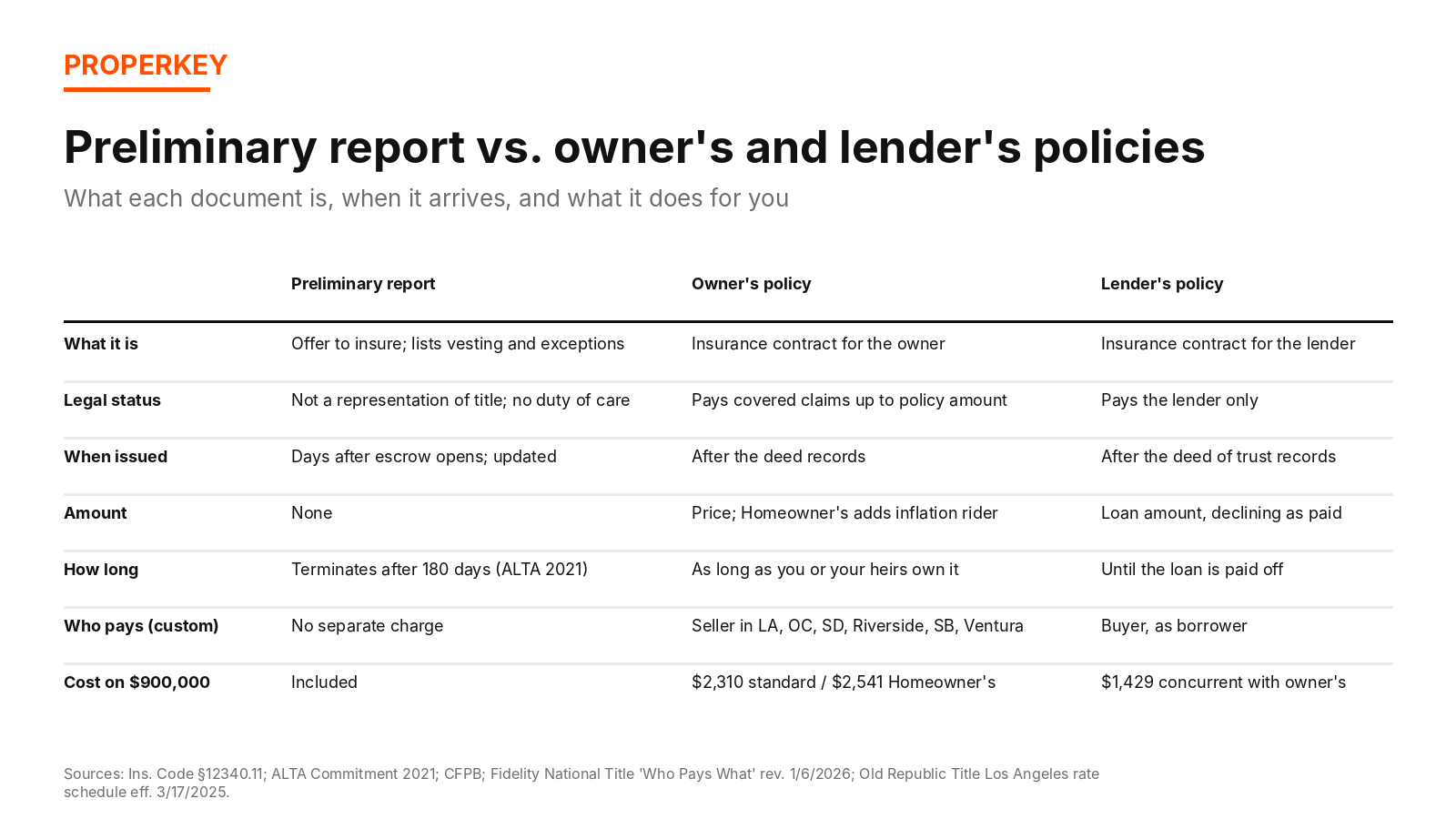
A title commitment and a title policy are two ends of the same transaction. In California the commitment is the preliminary title report, or "prelim": a report the title company issues a few days after escrow opens that lists how title is held, what liens and recorded matters affect the property, and what must be cleared before it will insure. It is not insurance. The title policy is the insurance contract itself, issued after the deed records, and it is the only one of the two documents that pays a claim. The distinction matters because people read the prelim as a guarantee, and California law says plainly that it is not one. Here is what each document is, when you receive it, what it covers, who pays for it in your county, and what it costs on a typical sale.
What is a title commitment or preliminary report?
California's Insurance Code defines the document directly. Under Insurance Code §12340.11, a "preliminary report," "commitment" or "binder" is a report "furnished in connection with an application for title insurance" and is an offer "to issue a title policy subject to the stated exceptions." The statute adds that such a report "shall not be construed as, nor constitute, a representation as to the condition of title to real property, but shall constitute a statement of the terms and conditions upon which the issuer is willing to issue its title policy, if such offer is accepted." California courts have built on that language: in Soifer v. Chicago Title Co. (2010) the Court of Appeal, quoting earlier decisions, called a preliminary report "merely the inducement to purchase a title policy" and held that the statute leaves "no room for the existence of a duty of care" based on the search behind it. If the prelim misses a lien and you never buy the policy, you have no claim against the title company.
Nationally the same document is the ALTA Commitment for Title Insurance (2021 form, effective July 1, 2021). Its layout is the one you will see in California too. Schedule A states the commitment date, the policy to be issued, the proposed insured and amount, how title is currently vested, and the legal description. Schedule B, Part I lists the requirements: what has to happen before the policy issues, such as recording the deed, paying off and reconveying the seller's deed of trust, and returning a signed Statement of Information. Schedule B, Part II lists the exceptions: the recorded matters the policy will not cover, such as property taxes, CC&Rs and easements. The ALTA form also carries an expiration: if the Part I requirements "have not been met within 180 days after the Commitment Date, this Commitment terminates."
What is a title policy?
The policy is the insurance. There are two kinds, and most California purchases involve both. An owner's policy, in the CFPB's words, "protects the homeowner if someone sues and says they have a claim against the home from before the homeowner purchased it." It is issued for the purchase price and, as ALTA's consumer site puts it, protects "for as long as you or your heirs own the property," with a single premium paid once at closing. A lender's policy "protects your lender against problems with the title to your property" and "is usually required to get a mortgage loan." It is written for the loan amount, and ALTA notes "the policy amount decreases each year and eventually disappears as the loan is paid off." A lender's policy pays nothing to the owner.
Both policies are prepared from the recorded documents after closing. Stewart Title's California process guide states that "the final title policy(ies) are prepared based upon recorded documents," which is why the policy arrives weeks after you get the keys rather than at signing.
Standard coverage or Homeowner's Policy: which one are you buying?
California owner's policies come in two tiers, and the difference shows up in Schedule B. The CLTA Standard Coverage policy insures against recorded defects, forged documents in the chain of title before your purchase, and lack of access. The Homeowner's Policy, which Fidelity National Title's comparison describes as adopted by both CLTA and ALTA, adds coverages the standard policy marks "No": post-policy forgery protection, building-permit violations, Subdivision Map Act coverage, restrictive-covenant violations, enhanced encroachment coverage, map inconsistencies, coverage extended to living trusts, and automatic inflation protection for five years. It costs about 10% more on the rate schedules below. For a one-to-four-unit home you intend to live in, it is the policy most California escrows order unless someone asks for the cheaper one.
What is in Schedule B, and what has to be cleared?
Most prelims list the same handful of items. Property taxes appear as an exception, including the supplemental assessment that follows every change of ownership (Revenue and Taxation Code §75.11). CC&Rs, easements and recorded maps stay as exceptions; the policy insures around them, not against them. The seller's deed of trust is a requirement: it must be paid off and reconveyed at closing. Mechanics' liens are the item buyers of recently remodeled homes should read closely. Under Civil Code §8412, a direct contractor can record a claim of lien up to "ninety days after completion of the work of improvement," or 60 days after a recorded notice of completion, so work finished shortly before listing can still produce a lien after your prelim date. Finally, every buyer, seller and borrower is asked for a Statement of Information; Old Republic explains it lets the company "disregard the judgments, liens or other matters on the public records under similar names," which is how a common surname avoids someone else's judgment attaching to your file.
When do you get each document?
The purchase contract sets the clock. In the C.A.R. Residential Purchase Agreement (public copy of the 12/21 revision), paragraph 13A requires that the buyer be provided "a current Preliminary Report" within the seller-delivery period in paragraph 3N(1), which defaults to 7 days after acceptance. The buyer's title-review contingency in paragraph 3L(5) defaults to "17 Days after Acceptance or 5 Days after receipt, whichever is later," and a revised prelim restarts a 5-day window under paragraph 8E(2). Those are defaults; the blanks can be negotiated. The policy itself is issued after the deed records, which in California is also the moment escrow closes; for how recording works and why same-day funding matters, see What Does Close of Escrow Mean in California, and Can Escrow Close Early?
Who pays for title insurance in California?
Custom, not law, decides, and it changes by county. Fidelity National Title's "Who Pays What in California" chart (revised January 6, 2026) shows the seller paying the owner's policy in Los Angeles, Orange, San Diego, Riverside, San Bernardino, Ventura and Santa Clara counties, and the buyer paying it in Alameda, San Francisco and San Mateo. The buyer pays the lender's policy because it is the buyer's loan. Chicago Title's 2026 Customary Practices Guide lists the same counties and adds the caveat that applies everywhere: "the terms of a real estate transaction are deal-specific and negotiable between the parties." The California Department of Insurance's consumer guide says the same thing in plainer words: "In Southern California, the seller is usually responsible for paying the title insurance premium." The county-by-county detail, including escrow fees and transfer taxes, is in Who Pays for Title Insurance in California?
What does it cost?
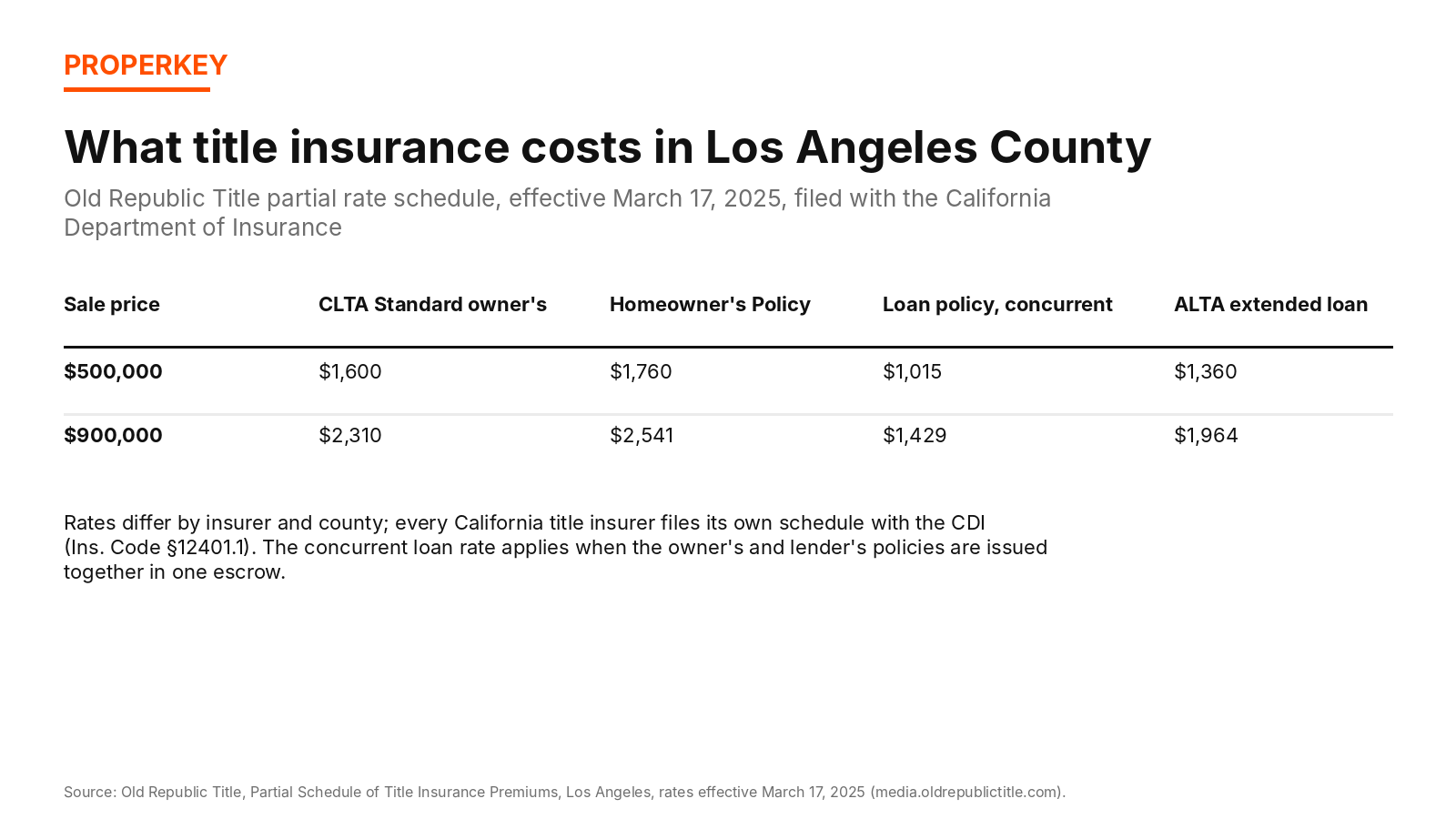
Every California title insurer files its rates with the Department of Insurance under Insurance Code §12401.1, and the CDI guide notes that because "the rates will differ," you "can save money by comparing rates." Old Republic Title's Los Angeles rate schedule (effective March 17, 2025) is a representative public example. On a $500,000 sale the CLTA Standard owner's policy is $1,600, the Homeowner's Policy $1,760, and an ALTA loan policy issued concurrently with the owner's policy $1,015. On a $900,000 sale, close to the C.A.R. September 2026 statewide median of $899,720, the figures are $2,310, $2,541 and $1,429. The "concurrent" loan rate is the discount for buying both policies from the same insurer in the same escrow; a refinance with no owner's policy pays the standalone loan rate instead.
Your Loan Estimate will show these numbers in a way that confuses almost everyone. The CFPB's TRID factsheet explains that the lender's policy must be disclosed at "the full lender's premium, not the discounted, or simultaneous, rate," and the owner's policy is shown as the full owner's premium plus the simultaneous lender's premium minus the full lender's premium, labeled "Title - Owner's Title Policy (optional)." The total is correct; the split between the two lines is not what the title company will actually charge for each. The Closing Disclosure can drop the "(optional)" label when the seller pays.
Why the policy, not the prelim, is the document that matters
The industry's own numbers show why. ALTA reports that title insurers wrote $18.5 billion in premiums in 2025 and paid "more than $667 million" in claims, and an ALTA-commissioned 2024 study found that "36% of all transactions require extensive, nonroutine title clearance efforts" before closing. Fraud is the growing claim category: the FBI's 2025 Internet Crime Report logged 12,368 real-estate complaints and $275.1 million in losses, up from $173.6 million in 2024, and the California DRE's Summer 2026 bulletin devotes an article to seller-impersonation fraud, listing red flags such as "a seller who insists on communicating only by email or text message" and "a vacant property, inherited property, or investment property where the owner is rarely present," and advising licensees to confirm ownership "through public records or a preliminary title report." A forged deed in the chain before your purchase is exactly what an owner's policy covers and a prelim does not.
One policy is getting cheaper for some borrowers. The October 22, 2026 executive order on housing costs directs FHFA to "expand the title acceptance pilot into an ongoing program," allowing automated title review "in lieu of a lender's title insurance policy on eligible refinance transactions" (White House fact sheet; order text, Section 4). It applies to the lender's policy on refinances, not to the owner's policy on a purchase.
When Properkey is the broker, its in-house broker escrow (properkey.us/escrow) handles the closing under the same roof as the sale, with title clearance as one of the four steps it describes: "we confirm you are getting clean ownership with no surprises." Sellers can list for a $0 listing fee at properkey.us/sell, and ordering the prelim before the listing goes live is the cheapest way to find an unreconveyed deed of trust or an old lien while there is still time to clear it.
Questions people ask
Is a title commitment the same as a preliminary title report? In practice, yes. California title companies issue a "preliminary report" under Insurance Code §12340.11; elsewhere the same offer to insure is called a commitment on the ALTA 2021 form. Both list vesting, requirements and exceptions, and neither is insurance.
Can I rely on the preliminary report? Not legally. The statute says it is not "a representation as to the condition of title," and California courts have held the title company owes no duty of care for errors in it. Protection comes only from the policy issued at closing.
Do I need an owner's policy if the lender already has one? The lender's policy covers the lender's loan balance and pays the owner nothing. An owner's policy is the only coverage for your equity, and in most of Southern California the seller pays for it by custom, so the buyer's cost is usually the lender's policy alone.
How long is a title commitment good for? The ALTA 2021 commitment terminates if the Schedule B Part I requirements are not met within 180 days of the commitment date. A California prelim is updated by the title company as escrow progresses, and the purchase contract gives the buyer 5 days to review any revised report.
This is a summary of public sources, not legal, tax or insurance advice.
Sources: Ins. Code §12340.11 · Soifer v. Chicago Title (2010) · ALTA Commitment 2021 · CFPB on owner's title insurance · CFPB on lender's title insurance · ALTA HomeClosing101 · Fidelity National Title policy comparison · R&T Code §75.11 · Civ. Code §8412 · Old Republic, Statements of Information · C.A.R. RPA 12/21 (public copy) · Fidelity "Who Pays What" rev. 1/6/2026 · Chicago Title 2026 Customary Practices Guide · CDI title insurance guide · Ins. Code §12401.1 · Old Republic LA rate schedule · CFPB TRID title factsheet · ALTA 2025 premium volume · ALTA curative-work study · FBI IC3 2025 via ALTA · DRE Bulletin Summer 2026 · White House fact sheet 10/22/26 · EO 14438 text · C.A.R. September 2026 sales report
Written by Keyro, Properkey's AI. Properkey, DRE #01979718.