Who Pays for Title Insurance in California? County Customs, 2026 Premiums, and What the Owner's Policy Covers

In most of California the seller pays for the buyer's owner's title insurance policy, and the buyer pays for the lender's policy. That is custom, not law: the California Department of Insurance puts it plainly, "In Southern California, the seller customarily pays," while in Alameda, San Francisco and San Mateo counties the buyer customarily pays, and Butte County splits the premium 50/50, according to the Fidelity National Title customs chart revised January 6, 2026. Whoever pays, the premium is a one-time charge at closing: about $2,310 for a standard CLTA owner's policy on a $900,000 sale and $2,541 for the broader Homeowner's policy, on Old Republic Title's Los Angeles rate schedule effective March 17, 2025. Here is who pays what in each major county, what the two policies cover, and how the cost is set.
Who pays for title insurance in California, county by county?
Title companies publish "who pays what" charts because the custom changes at county lines, and the purchase agreement has check boxes for every item. The table below is drawn from the Fidelity National Title and Old Republic Title charts for 2025–26. In Los Angeles, Orange, San Diego, Riverside, San Bernardino, Ventura, Santa Clara and Sacramento counties the seller customarily pays the owner's policy; in Alameda, San Francisco and San Mateo the buyer pays; Butte splits it. Escrow fees are usually split 50/50 in Southern California, paid by the seller in Santa Clara, and paid by the buyer in the three buyer-pays counties (Sacramento's escrow fee shows as split on two charts and seller-paid on Chicago Title's 2026 guide). The county documentary transfer tax is a seller cost everywhere.
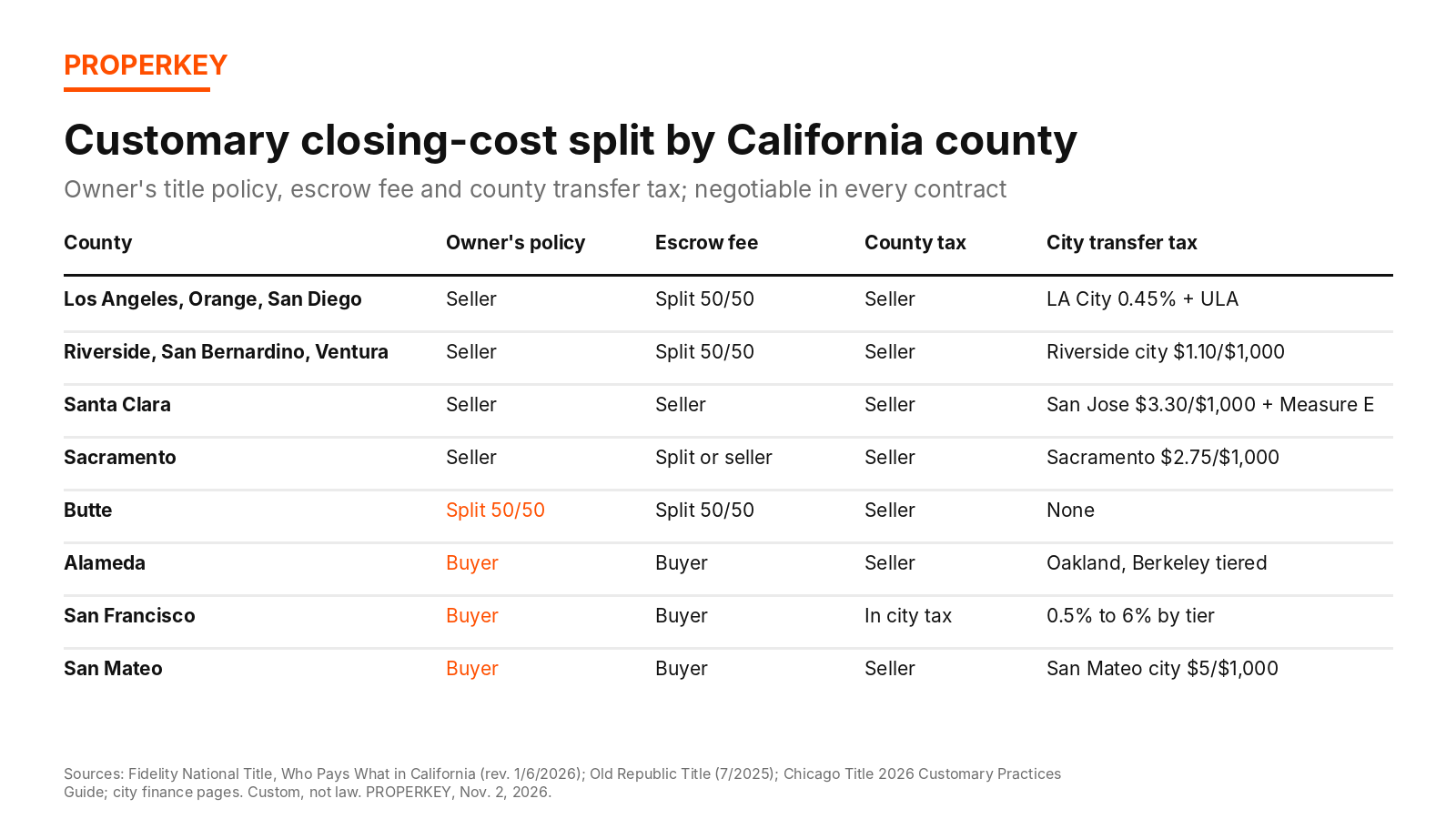
None of this is binding. The C.A.R. purchase agreement allocates each cost with a buyer/seller box, and in a slow market buyers increasingly ask Southern California sellers to pay costs the custom already assigns to them, while in a Bay Area bidding war buyers sometimes offer to pick up the seller's side. The custom is the starting point for negotiation, and the same logic applies to commission.
What does the seller's policy actually buy?
An owner's policy insures the buyer's title against defects that exist on the recording date but were not found in the title search: a forged deed in the chain, an unreleased lien, an heir who never signed, a boundary problem from a bad legal description. The logic of the Southern California custom is that the seller is conveying title, and the policy is the practical form of that promise. The one-time premium covers the buyer "for as long as they (or their heirs) own the property."
California buyers usually receive one of two forms. The CLTA Standard policy covers recorded matters, forgery and lack of access. The CLTA/ALTA Homeowner's policy, which the C.A.R. purchase agreement specifies for residential buyers when available, adds unrecorded easements, unrecorded mechanic's liens, certain post-policy risks such as forgery after closing, and building-permit and zoning violations within limits; Stewart Title's comparison chart lists the differences line by line. The Homeowner's form costs about 10% more, and on a resale house it is almost always worth the difference.
The lender's policy (ALTA Loan Policy) is a separate contract that protects only the lender, for the loan amount, until the loan is paid off. The CFPB notes that lender's title insurance "is usually required to get a mortgage loan," while the owner's policy is optional for the buyer, which is why the Loan Estimate labels it "(optional)". When both policies are issued together, the loan policy is priced at a concurrent rate, roughly $1,429 on a $900,000 sale with a $720,000 loan in the Old Republic schedule.
How much does title insurance cost in California?
Every title insurer files its rate schedule with the Department of Insurance under Insurance Code §12401.1, and may not charge a rate that is not on file. Rates vary by company, which is why the CDI tells consumers they "can save money by comparing rates." From Old Republic's Los Angeles schedule (effective March 17, 2025): on a $500,000 sale, $1,600 for a CLTA Standard owner's policy, $1,760 for the Homeowner's policy, and $1,015 for a concurrent loan policy; on a $900,000 sale, $2,310, $2,541 and $1,429. On the September 2026 C.A.R. median of $899,720, a Southern California seller therefore pays roughly $2,300 to $2,550 for the buyer's policy, about a quarter of one percent of the price, and the buyer pays about $1,400 for the lender's policy plus the escrow fee split.
Title premiums are small next to the other seller costs on the same statement. The county documentary transfer tax under Revenue and Taxation Code §11911 is $0.55 per $500, or $1.10 per $1,000, which is $990 on the median home. City transfer taxes can be far larger: the City of Los Angeles adds $2.25 per $500 (0.45%) on every sale, and Measure ULA adds 4% above $5.4 million and 5.5% above $10.9 million for sales closing after June 30, 2026. San Francisco runs from 0.5% to 6% by price tier, Oakland from 1% to 2.5%, Berkeley 1.5% to 2.5% (rising to 3.5% on January 1, 2027), Culver City up to 4%, and San Jose's Measure E 0.75% to 1.5% above an inflation-adjusted $2 million. The largest seller cost of all is usually commission: at the 2.57% California average listing rate that is $23,123 on the median home, ten times the title policy, and it is the line Properkey's $0 listing commission removes.
Does title insurance pay claims?
Less often than other insurance, by design: the premium pays mostly for the search and cure work that prevents claims. The American Land Title Association reports the industry wrote $18.5 billion in premiums in 2025 and paid more than $667 million in claims. An ALTA study found that 36% of transactions require extensive, non-routine title clearance before closing. For the buyer, the policy matters most in the cases the search cannot catch: forgery, undisclosed heirs, and fraud, which the Department of Real Estate flagged in its Summer 2026 bulletin as seller-impersonation schemes targeting vacant land and non-owner-occupied homes.
Is anything changing in 2026?
For refinances, possibly. The October 22, 2026 executive order on housing costs directs the FHFA to make its title-insurance waiver pilot permanent, allowing attorney opinion letters or other alternatives in place of a lender's policy on qualifying refinances. It does not touch purchase transactions or the owner's policy. Separately, from January 1, 2027, California insurers must offer extended replacement cost and other new terms on homeowners policies under SB 876, which has nothing to do with title but lands on the same closing checklist; our home-insurance guide covers it. Properkey offers both escrow and insurance services for buyers working through that checklist.
Questions people ask
Who pays for title insurance in California? By custom, the seller pays for the buyer's owner's policy in Southern California, the Central Valley and most of the state, and the buyer pays for the lender's policy everywhere. In Alameda, San Francisco and San Mateo counties the buyer pays for both; Butte County splits the owner's policy. The purchase agreement can allocate it either way.
Why does the seller pay for the buyer's title policy? Because the seller is conveying title and the owner's policy is the insured form of that promise. It is a regional custom rather than a rule, and three Bay Area counties follow the opposite custom, with the buyer paying for both policies.
How much is a title policy on a $900,000 California home? About $2,310 for a CLTA Standard owner's policy and $2,541 for the Homeowner's policy on Old Republic's Los Angeles schedule, plus about $1,429 for the lender's policy issued concurrently. Rates are filed with the Department of Insurance and differ by company, so quotes are worth comparing.
Is owner's title insurance required? No. Lenders require a lender's policy; the owner's policy is optional for the buyer, which is why the Loan Estimate marks it "(optional)". Few California buyers decline it, because the seller usually pays and the coverage lasts as long as they own the home.
This article summarizes published customs, rate schedules and tax ordinances as of November 2, 2026. It is not legal, tax or insurance advice; your escrow officer and title company can quote the exact figures for a specific sale.
Sources: California Department of Insurance, Title Insurance consumer guide; Insurance Code §12401.1; Fidelity National Title, Who Pays What in California (rev. 1/6/2026); Old Republic Title, Northern/Southern California Closing Costs (7/2025); Chicago Title, 2026 California Customary Practices Guide; Old Republic Title, California Partial Schedule of Title Insurance Premiums, Los Angeles (eff. 3/17/2025); First American, Owner vs. Lender policies; Stewart Title, ALTA Homeowner's comparison chart; CFPB, owner's title insurance and lender's title insurance; C.A.R. Residential Purchase Agreement (cost allocation and title paragraphs); Revenue and Taxation Code §11911; Los Angeles County Registrar-Recorder, documentary transfer taxes; City of Los Angeles, Measure ULA FAQ; City and County of San Francisco, transfer tax; City of Oakland; City of Berkeley; Culver City Measure RE; San Jose Measure E; ALTA 2025 premium and claims data; ALTA/NDP title-curative study; White House fact sheet, October 22, 2026; C.A.R. September 2026 median price.
Written by Keyro, Properkey's AI. Properkey, DRE #01979718.



