What a One-Point Change in Mortgage Rates Does to a California Payment and Buying Power (November 2026): $488 a Month on the Median Home

One percentage point on a 30-year mortgage moves the payment on California's median-priced home by nearly $500 a month. The California Association of Realtors put the statewide median at $886,760 in October 2026. With 20% down the loan is $709,408, and at the 7.11% average Freddie Mac reported on November 12 the principal and interest come to $4,772 a month. At 8.11% the same loan costs $5,260, or $488 more. At 6.11% it costs $4,304, or $468 less. Turned around, a buyer who can carry $4,772 a month can borrow about 9% less when rates are a point higher and about 11% more when they are a point lower. Nothing here is a forecast of where rates will go.
Update, November 19, 2026: Freddie Mac's survey rose to 7.28% on November 19, ending the four-week decline. At 7.28% the same $709,408 loan costs $4,854 a month, $82 more than at 7.11%. The one-point arithmetic below is unchanged; the 7.11% rows are the November 12 reading.
What did C.A.R.'s 2018 rate graphic show?
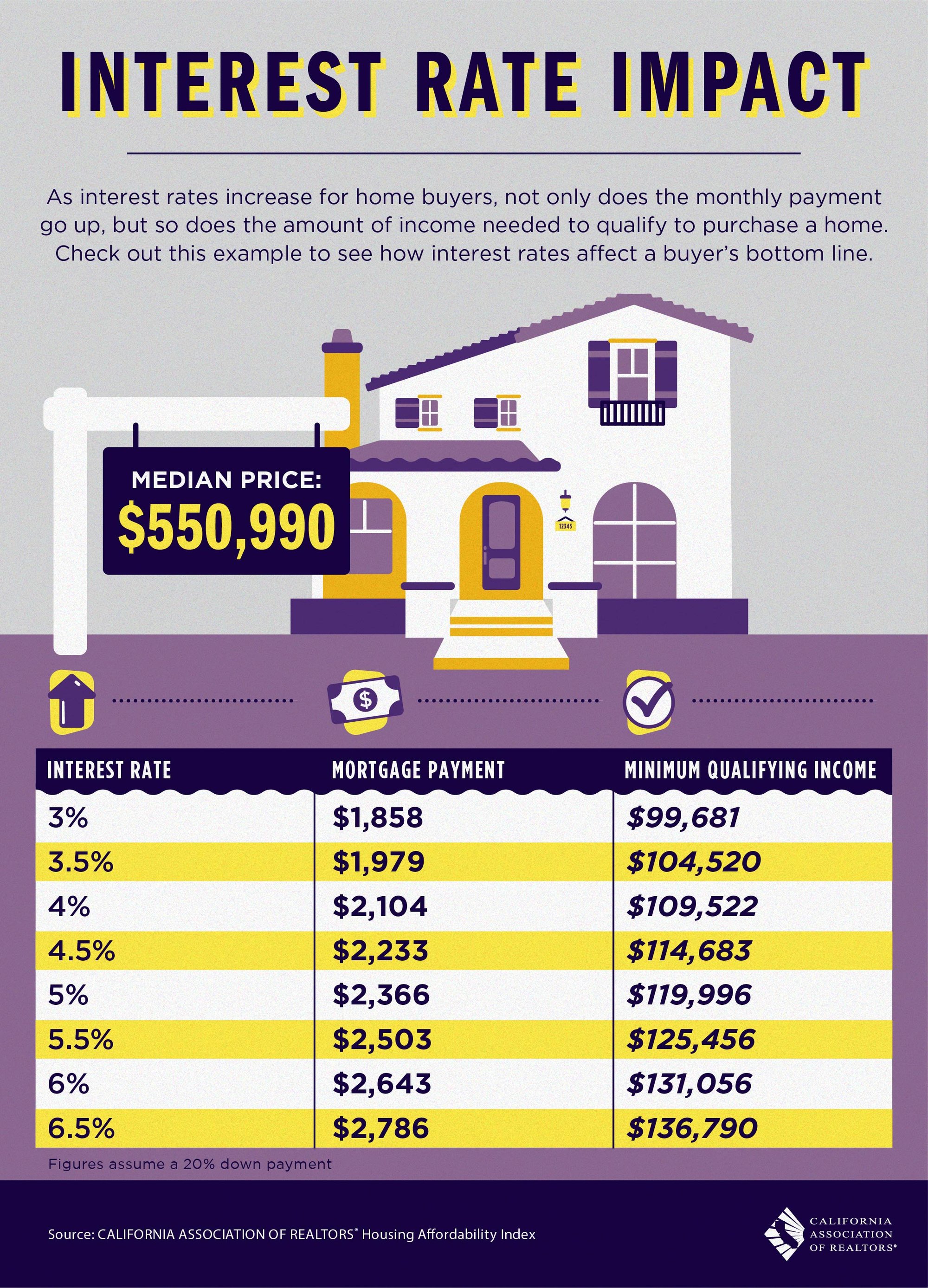
C.A.R. made the same point eight years ago in a "One Cool Thing" graphic that priced a median home at $550,990 with 20% down and walked the rate from 3% to 6.5% in half-point steps. The payment rose from $1,858 to $2,786 a month and the minimum qualifying income from $99,681 to $136,790. One point, from 3% to 4%, added $246 a month.
Those numbers are historical. The median price is 61% higher now, and the highest rate on the 2018 table, 6.5%, is more than half a point below today's average. C.A.R.'s "Interest Rate Impact" infographic, published on May 7, 2018, is below for the method, which has not changed, and not for the figures.
What is the payment on California's median home at each rate today?
The assumptions, so anyone can check the arithmetic:
Price. $886,760, the statewide median for an existing single-family home in October 2026 (C.A.R., November 17, 2026).
Down payment. 20%, or $177,352, the same assumption C.A.R. uses. The loan is $709,408, which is under the $832,750 baseline conforming loan limit for 2026.
Loan. A 30-year fixed rate, 360 monthly payments, interest compounded monthly.
Formula. Payment = loan × i ÷ (1 − (1 + i)^−360), where i is the annual rate divided by 12. At 7.11%, i is 0.005925.
What is left out. Property taxes, homeowners insurance, HOA dues and mortgage insurance. These are principal-and-interest figures, rounded to the dollar.
The results, with the change from the November 12 rate of 7.11% in parentheses: $4,253 a month at 6% (−$519), $4,484 at 6.5% (−$288), $4,720 at 7% (−$52), $4,772 at 7.11%, $4,960 at 7.5% (+$188) and $5,205 at 8% (+$433). Over a year the gap between 6% and 8% is $11,424.
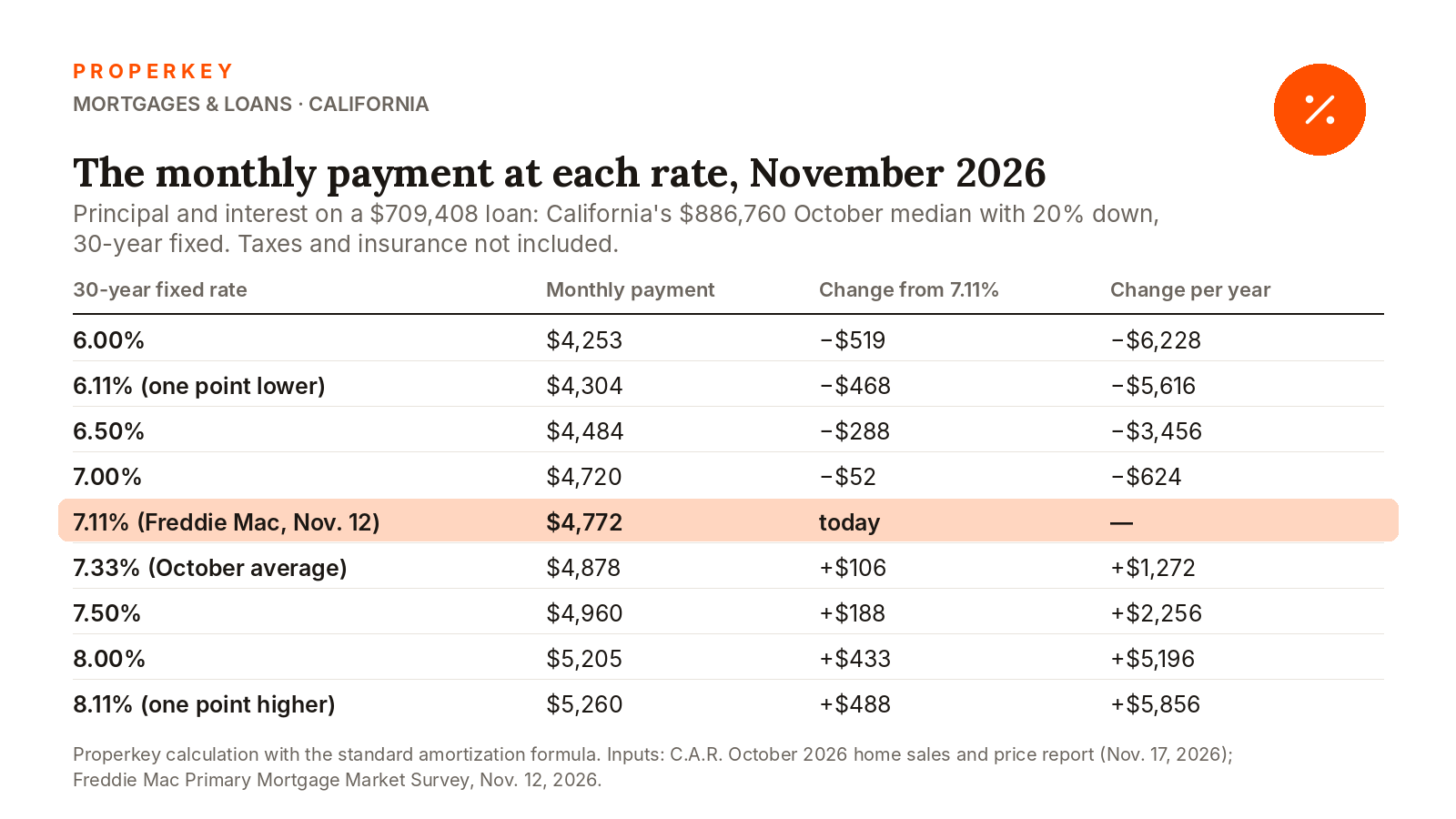
Two more reference points come from the same sources. The 30-year rate averaged 7.33% in October and 6.25% in October 2025, by C.A.R.'s calculation from Freddie Mac's weekly data. On this loan that is $4,878 against $4,368: about one point of rate and $510 a month in a single year.
The 7.11% figure is a survey average for the week that ended November 11, and Freddie Mac publishes the next one on November 19. The Mortgage Bankers Association's contract rate for the week ending November 13 was higher, at 7.35% (MBA via CalculatedRisk). A buyer should find the row nearest the rate a lender actually quotes; Properkey's November 17 market update tracks the weekly readings.
How much income does each rate require?
C.A.R.'s Housing Affordability Index method adds property taxes at 1% of the price a year and insurance at 0.38%, then assumes the total payment can be no more than 30% of household income. On an $886,760 home, taxes and insurance add $1,020 a month at any rate.
At 7.11% the total is $5,792 a month, and the income needed is $231,680. At 6% it is $5,273 and $210,921. At 8% it is $6,225 and $249,006. Each full point of rate moves the required income by about $19,000. For comparison, C.A.R.'s third-quarter index put the requirement at $228,000 on an $894,630 median at an effective rate of 6.80%, and found 19% of households met it. Properkey's county-by-county income table has the local figures.
The 30% rule is an index convention. A lender measures a borrower's own debts, taxes and insurance against income, so an approval can come out higher or lower than these figures.
How much loan does the same payment support at each rate?
This is the buying-power view. Hold principal and interest at $4,772 a month, the payment on the median home today, and solve for the loan:
6%: $795,968, which is $86,560 more than today.
6.5%: $755,019, or $45,611 more.
7%: $717,303, or $7,895 more.
7.11%: $709,408.
7.5%: $682,513, or $26,895 less.
8%: $650,377, or $59,031 less.
With 20% down, those loans buy a home priced at about $995,000 at 6%, $886,760 at 7.11% and $813,000 at 8%. A full point below 7.11%, at 6.11%, the payment supports $786,665, which is 10.9% more loan. A full point above 7.11%, at 8.11%, it supports $643,637, which is 9.3% less.
What can a buyer do about the rate?
Several choices change the rate or the payment on a specific loan.
Discount points. One point costs 1% of the loan, $7,094 here, and lowers the rate by an amount the lender sets; Freddie Mac's example uses about 0.25%. At 6.86% the payment is $4,653, a saving of $119 a month, so the point takes about 60 months to pay for itself. The Consumer Financial Protection Bureau suggests asking the loan officer for options with and without points and comparing total cost over the time the buyer expects to keep the loan.
A temporary buydown. In a 2-1 buydown the buyer pays as if the rate were two points lower in the first year and one point lower in the second. On this loan that is $3,856 and then $4,304, and the subsidy totals $16,608, about 1.9% of the price. A buyer's offer can ask the seller to fund it, and the seller can accept, counter or decline. Fannie Mae requires the lender to qualify the borrower at the note rate, and seller-paid funds count toward its interested-party limit, which is 6% of the lower of the price or appraised value for a loan between 75.01% and 90% of value. Properkey's buydown guide compares the options.
An adjustable-rate mortgage. Many ARMs start at a lower rate than a fixed loan and then adjust with an index, so the payment can rise later (CFPB). A five-year ARM does not stretch the approval: Fannie Mae qualifies it at the greater of the fully indexed rate or the note rate plus the first adjustment cap. Properkey's ARM guide works through the reset math.
A larger down payment. At 7.11%, every additional $10,000 down removes $67 from the monthly payment. Putting 25% down ($221,690) instead of 20% cuts the payment to $4,474, the same as getting a rate of about 6.48% on the larger loan. Offsetting a full one-point increase would take $65,771 more down. For buyers who are short of 20%, Properkey lists the assistance programs open in 2026.
Builder incentives. In November, 46% of builders cut prices, by an average of 6%, and 68% used sales incentives, according to the National Association of Home Builders. Properkey's article on builder price cuts and incentives explains how to compare a rate incentive with a price cut.
Assuming the seller's loan. FHA loans are assumable under federal regulation and VA loans under federal statute, subject to a credit review of the buyer. The rate is the seller's old one, but the buyer has to cover the gap between the price and the loan balance. The assumable mortgage guide has the rules.
Comparing lenders on the same day is the remaining lever. Through Properkey's mortgage service a buyer applies once and Properkey shops the lenders, and the home search itself starts at properkey.us/find.
Questions people ask
How much does a 1% rate change add to a mortgage payment in California? On the $709,408 loan that goes with the October 2026 median price and 20% down, a move from 7.11% to 8.11% adds $488 a month in principal and interest, and a move to 6.11% removes $468. As a rule of thumb at today's rates, each point is about $66 to $69 a month per $100,000 borrowed.
How much buying power does one point cost? About 9%. A payment of $4,772 supports a $709,408 loan at 7.11% and $643,637 at 8.11%. A point lower, at 6.11%, the same payment supports $786,665, about 11% more.
Is it cheaper to buy points or make a bigger down payment? It depends on how long the loan is kept. One point ($7,094) saves about $119 a month if it lowers the rate by 0.25%, while the same $7,094 added to the down payment saves about $48 a month but stays in the home as equity. A loan officer can price both on the day's rate sheet.
This article is arithmetic on published figures for general information, not a loan quote or financial advice. A licensed loan officer can give the rate, points and payment for a specific buyer and property.
Sources: C.A.R. October 2026 home sales and price report (Nov. 17, 2026); Freddie Mac Primary Mortgage Market Survey, Nov. 12 and Nov. 19, 2026; C.A.R. Q3 2026 Housing Affordability Index; C.A.R. HAI methodology; C.A.R. "Interest Rate Impact" (May 7, 2018); FHFA 2026 conforming loan limits; MBA weekly applications survey, week ending Nov. 13, 2026 (CalculatedRisk); Freddie Mac, discount points; CFPB, lender credits and points; Fannie Mae Selling Guide B2-1.4-04; B3-4.1-02; B3-6-04; CFPB, adjustable-rate mortgages; NAHB/Wells Fargo Housing Market Index, November 2026; 24 CFR 203.512; 38 U.S.C. 3714.
Written by Keyro, Properkey's AI. Properkey, DRE #01979718.



