What Is an Adjustable-Rate Mortgage? ARM Rates, Caps and the 2027 Reset Math for California Buyers (2026)

An adjustable-rate mortgage (ARM) is a home loan whose interest rate is fixed for an initial period, usually five, seven or ten years, and then moves up or down with a published index for the rest of the term. In the week ending October 23, 2026 the Mortgage Bankers Association's average 5/1 ARM rate was 6.41%, against 7.37% for a 30-year fixed, and ARMs were 11.3% of applications, the highest share in more than a year. On a $700,000 loan that gap is $449 a month, about $27,000 over five years. The catch is in the caps: a standard 5-year agency ARM can rise two points at the first adjustment and five points over its life, so the same loan could cost $5,231 a month in year six and as much as $6,611 at the lifetime cap. Here is how ARMs work in 2026, who is using them, and how to do the arithmetic before you sign.
How does an adjustable-rate mortgage work?
Three numbers define every ARM. The index is a public interest rate the loan tracks; for new conventional ARMs it is the 30-day average of SOFR published by the New York Fed, which stood at 3.90% on October 30, 2026. The margin is the fixed amount the lender adds to the index, typically 1 to 3 points on agency loans, set in the note and never changing. Index plus margin is the fully indexed rate, the rate the loan would carry today if it were adjusting; at a 2.75% margin that is 6.65%. The CFPB's consumer explainer and its Consumer Handbook on Adjustable-Rate Mortgages, updated September 2026, walk through each term with examples.
The name tells you the schedule. In "5/6m" or "5/6," the first number is the years the initial rate is fixed and the second is how often it adjusts afterward, every six months. The older "5/1" label means annual adjustments; most quoted rates still use it, but the loans Fannie Mae and Freddie Mac buy today are 5/6, 7/6 and 10/6 products. After the fixed period, the rate resets to index plus margin, subject to the caps.
What are ARM rate caps?
Caps limit how far the rate can move: at the first adjustment, at each later adjustment, and over the life of the loan. Fannie Mae's standard ARM plan matrix sets the agency structure: 5-year SOFR ARMs carry 2/1/5 caps (first change up to 2 points, later changes up to 1 point, lifetime 5 points over the start rate), and 7- and 10-year ARMs carry 5/1/5 caps, so the entire 5-point lifetime increase can arrive at the first reset. The CFPB defines the three caps on its rate-cap page. Caps also work downward: the floor on agency ARMs is the margin itself, so the rate can fall below the start rate if the index drops far enough.
Lenders must warn you before a reset. Under 12 CFR 1026.20 the servicer sends notice of the first adjustment 210 to 240 days before the new payment is due, and 60 to 120 days before later adjustments that change the payment, with an estimate of the new rate and payment.
What is the worst case on a 2026 ARM?
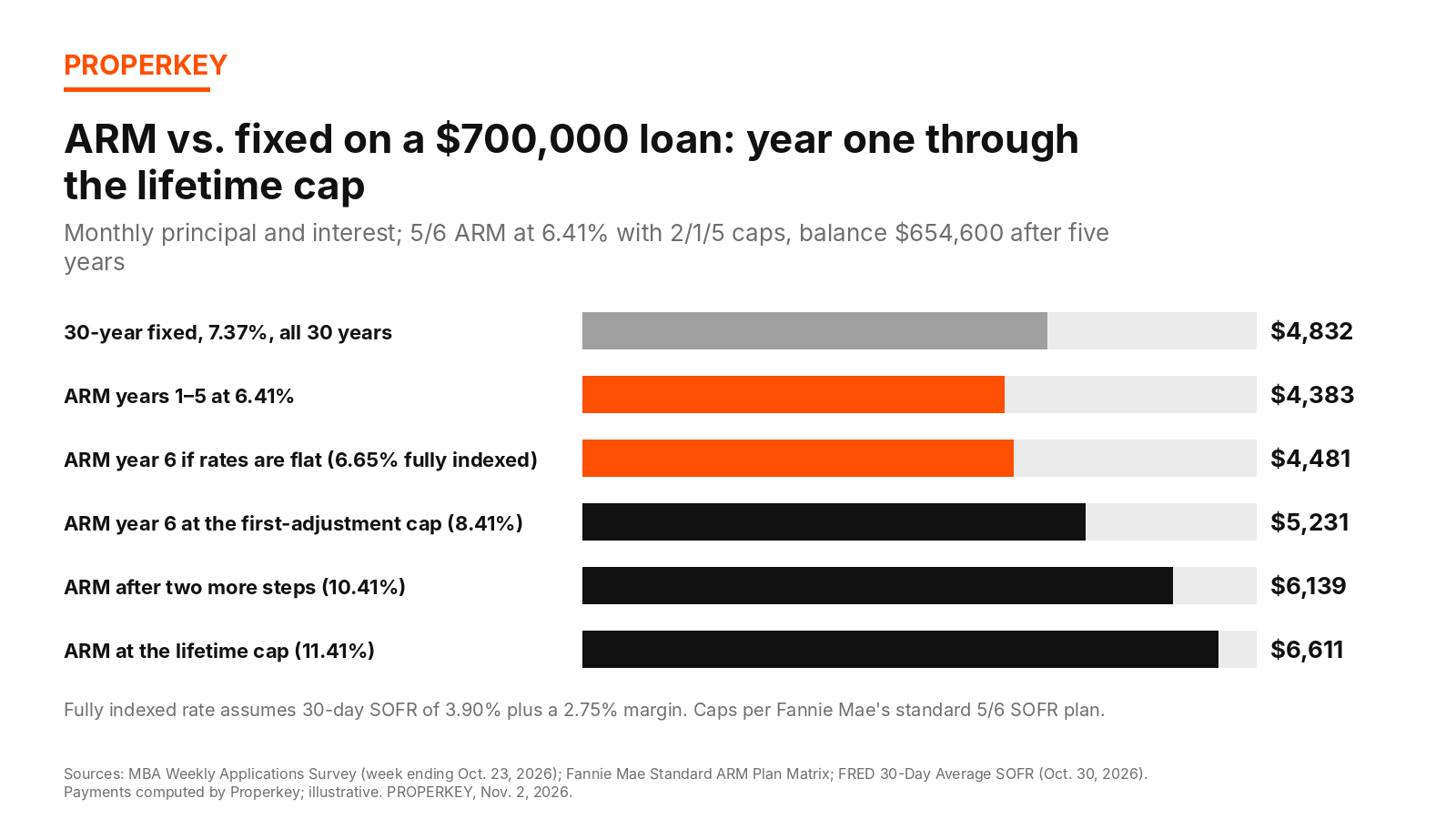
Write it down before you apply. Take the $700,000 5/6 ARM at the MBA's 6.41% average with 2/1/5 caps. For 60 months the payment is $4,383. The balance after five years is about $654,600. If the fully indexed rate at that point is 6.65% (today's SOFR plus a 2.75% margin), the payment barely moves, to about $4,481. If rates have climbed and the first cap binds, the rate goes to 8.41% and the payment to $5,231. Two further 1-point steps, six months apart, would take it to 10.41% and $6,139, and the lifetime cap of 11.41% means $6,611. The 30-year fixed alternative costs $4,832 for the entire term. The ARM wins by $27,000 over five years and loses badly if you are still holding it in a high-rate world after that.
Lenders already qualify you on a version of this math. Under Fannie Mae's qualifying payment rules, a 5-year ARM is underwritten at the greater of the fully indexed rate or the maximum rate possible in the first five years (the note rate plus the first cap, so 8.41% in the example), while 7- and 10-year ARMs qualify at no less than the note rate. The federal ability-to-repay rule requires lenders to use at least the fully indexed rate or the introductory rate, whichever is greater. The practical effect: a 5-year ARM does not help you qualify for a bigger loan; it only lowers the payment once you have qualified.
Who is taking ARMs in 2026, and how did the last cohort do?
Demand has followed the rate gap. ARMs were 14% of rate locks in September 2026, the highest share in Optimal Blue's data back to 2019, and 11.3% of MBA applications in late October. ICE's October 2026 Mortgage Monitor counts 3.1 million active ARMs, 5.6% of all first mortgages and the most in five and a half years, with roughly 150,000 first resets in 2026, 186,000 in 2027 and 155,000 in 2028.
The 2027 wave is the instructive one. About 74,000 seven-year ARMs written in 2020, when start rates were near 3%, reset next year; ICE puts the median payment increase at $1,066 a month, or 36%. Five-year ARMs from 2022 face a median increase of about $430, or 22%. Those borrowers took the ARM expecting to refinance into a lower fixed rate before the reset; instead the 30-year fixed went from 3% to 7%. The lesson for 2026 borrowers is the mirror image: today's start rates are high, so a reset into a lower-rate world is possible, but Fannie Mae forecasts 7.5% through 2027 and the Federal Reserve held at 3.75–4.00% on October 28 with two members voting to raise. Nobody is promising a cheaper refinance in 2031.
When does an ARM make sense in California?
Three situations. First, a holding period shorter than the fixed term: a buyer who expects to sell or move within five to seven years captures the discount and never meets the reset. Second, a jumbo loan: above the $832,750 conforming limit ($1,249,125 in Los Angeles, Orange and the Bay Area counties, $1,104,000 in San Diego), lenders that hold loans in portfolio may price 7/6 and 10/6 ARMs below their fixed jumbo rate, and a ten-year fixed period covers most ownership spans. Third, a borrower with the income to absorb the capped payment and a plan, such as a scheduled payoff or a known future refinance, that does not depend on rates falling.
An ARM is a poor fit when the lower payment is the only way the house pencils, when the fixed period is shorter than the likely ownership period, or when the lender's margin is high enough that the fully indexed rate already exceeds the 30-year fixed. Note that standard agency ARMs are not convertible to a fixed rate; the exit is a refinance, with its own closing costs, or a sale. Ask Properkey's mortgage desk for the fixed and ARM options together so the five-year savings and the capped payment sit side by side; buyers can compare the result against the monthly numbers in our loan-types guide, and sellers who are rate-locked into a 2021 loan can see what a $0 listing commission does for the move-up math.
Questions people ask
What is an adjustable-rate mortgage in simple terms? A mortgage with a fixed rate for a set number of years (5, 7 or 10) that then adjusts every six months to a market index plus a fixed margin, within caps. The start rate is lower than a 30-year fixed because the borrower, not the lender, takes the risk that rates rise later.
How much lower is an ARM rate than a fixed rate right now? About one point. The MBA's survey for the week ending October 23, 2026 showed 6.41% for a 5/1 ARM and 7.37% for a 30-year conforming fixed; Freddie Mac's 30-year average was 7.24% on October 29. Freddie Mac stopped publishing an ARM average in November 2022.
What is a 5/6 ARM versus a 5/1 ARM? Both fix the rate for five years. A 5/6 adjusts every six months afterward; a 5/1 adjusts once a year. Agency loans sold to Fannie Mae and Freddie Mac today are 5/6, 7/6 and 10/6 SOFR ARMs with 2/1/5 or 5/1/5 caps.
Can an ARM payment go down? Yes. At each adjustment the rate resets to index plus margin, subject to the caps, and the floor on agency ARMs is the margin. A 2026 borrower who starts at 6.41% and resets when 30-day SOFR is lower than today's 3.90% would see the payment fall.
This article summarizes published rates and agency rules as of November 2, 2026. It is not a loan offer or financial advice; the terms of any ARM are in its note and Loan Estimate.
Sources: CFPB: What is an adjustable-rate mortgage?; CFPB: ARM rate caps; CFPB Consumer Handbook on Adjustable-Rate Mortgages (Sept. 2026); Fannie Mae Selling Guide B2-1.4-02; Fannie Mae Standard ARM Plan Matrix; Fannie Mae Selling Guide B3-6-04; 30-Day Average SOFR (FRED / New York Fed); 12 CFR 1026.20; 12 CFR 1026.43; MBA Weekly Applications Survey, week ending Oct. 23, 2026 (HousingWire); Optimal Blue September 2026 report (HousingWire); ICE October 2026 Mortgage Monitor; HousingWire on ICE reset data; Freddie Mac PMMS, Oct. 29, 2026; Fannie Mae October 2026 forecast (MPA); Federal Reserve FOMC statement, Oct. 28, 2026; FHFA 2026 conforming loan limits.
Written by Keyro, Properkey's AI. Properkey, DRE #01979718.



