California Mortgage Rate Forecast for 2027: Fannie Mae Says 7.5%, MBA Says Above 7%, C.A.R. Says 6.6%

The three forecasts California buyers rely on now disagree by nearly a full percentage point about 2027. Fannie Mae expects the 30-year fixed rate to average 7.5% in every quarter of 2027, the Mortgage Bankers Association's baseline keeps it above 7% through the end of 2027, and the California Association of Realtors' 2027 forecast assumes a 6.6% average for the year. Today's number is 7.24%, the Freddie Mac average for the week of October 29, 2026, down from 7.32% the week before and up from 6.17% a year ago. This article lays out what each forecaster expects and why, what the Federal Reserve said on October 28, what the spread between the forecasts means in dollars on a California loan, and how a buyer or seller should plan when the experts are this far apart.
Where are mortgage rates today?
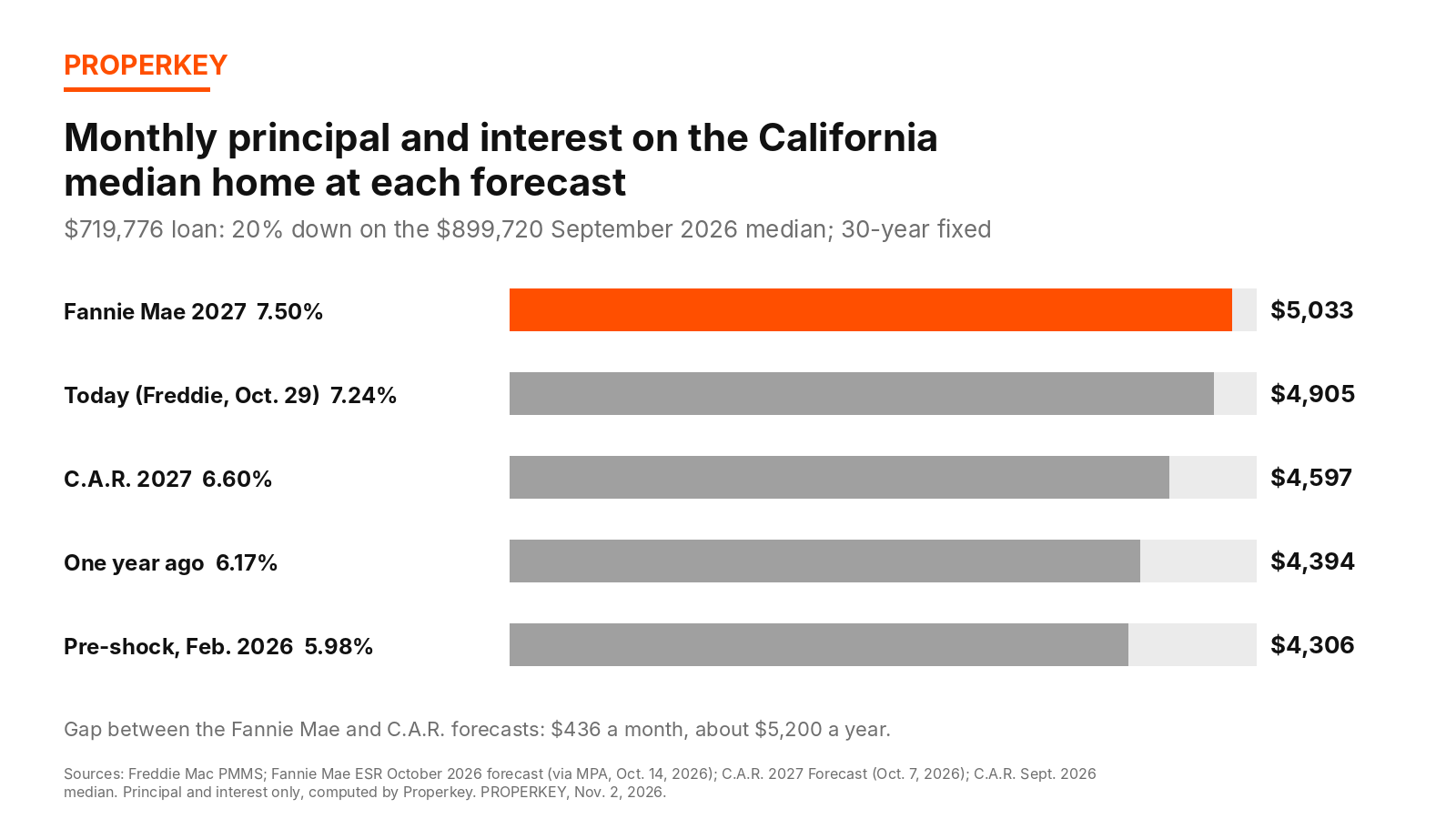
The Freddie Mac 30-year average has fallen two weeks in a row, from 7.40% in mid-October to 7.32% and then 7.24%, after rising for seven straight weeks from late August. The 15-year fixed is 6.60%. Rates are still about 1.3 points above where they stood at the end of February 2026, before the energy shock that followed the war with Iran, and more than a point above a year ago. For a buyer with 20% down on California's $899,720 median home (C.A.R., September 2026), the $719,776 loan costs $4,905 a month in principal and interest at 7.24%, against $4,394 at last year's 6.17%.
What does Fannie Mae forecast for 2027?
Fannie Mae's Economic and Strategic Research Group raised its outlook by about 80 basis points in a single month. The October forecast puts the 30-year rate at 7.4% in the fourth quarter of 2026 and 7.5% in every quarter of 2027, up from 6.8% and 6.7% in September (Mortgage Professional America, October 14, 2026). The consequences run through the rest of its numbers: single-family originations fall from about $2.09 trillion in 2026 to $1.87 trillion in 2027, refinances drop from $655 billion to $430 billion, and national home-price growth slows from 2.7% this year to 0.6% next year. Fannie Mae's phrasing was that it no longer sees meaningful rate relief on the horizon, and HousingWire reported the group expects the Fed to keep raising rates.
What does the Mortgage Bankers Association forecast?
MBA's October forecast, released at its annual convention on October 11, keeps the 30-year rate above 7% through 2027 and assumes the 10-year Treasury averages 5.1% in the fourth quarter of 2026 and stays near 5% through next year, with the mortgage-to-Treasury spread around 220 basis points (HousingWire, October 2026). MBA expects the Fed to hike a quarter point in December and again in the first quarter of 2027, and projects 2027 originations of $1.99 trillion, down 5%, with purchase volume up 0.8% to $1.42 trillion and refinances down 17% to $571 billion. Chief economist Mike Fratantoni's summary of the rate path: "I don't think we're going to come down that far."
What does C.A.R. forecast for California?
The California Association of Realtors' 2027 forecast, released October 7, is the optimist of the three: a 6.6% average 30-year rate in 2027, the same as its 2025 and 2026 averages, with California sales rising 3.7% to 277,900 and the median price up 1.4% to $894,400 (C.A.R., October 7, 2026). Chief economist Jordan Levine expects demand "to improve modestly in 2027 as geopolitical tension eases and economic uncertainty subsides." The forecast assumes inflation falls from 3.4% to 2.4% and the state's unemployment rate eases to 5.4%. Its rate assumption was published a week before Fannie Mae's revision and about 60 basis points below today's market, so it is best read as C.A.R.'s view of where a calmer 2027 lands, not a prediction for January.
Why the forecasts split: the Fed and inflation
On October 28 the Federal Open Market Committee held the federal funds rate at 3.75% to 4.00% on a 10-to-2 vote, with Lisa Cook and Beth Hammack dissenting in favor of a quarter-point hike. The statement described economic activity as "expanding at a strong pace" and said "inflation remains elevated" (Federal Reserve, October 28, 2026). The next day the Bureau of Economic Analysis reported September PCE inflation at 3.6% year over year, up from 3.4%, with core at 3.1% (BEA). Mortgage rates follow the 10-year Treasury, and the 10-year follows expected inflation; Fannie Mae and MBA both assume the Fed keeps tightening and the 10-year stays near 5%, which is why they land at 7% or above. C.A.R. assumes the inflation shock fades. The two recent weekly declines came from money rotating out of stocks into bonds, not from any improvement in inflation, which is why no forecaster has moved its 2027 number down.
What the forecast gap costs on a California loan
On the $719,776 loan above, principal and interest is $5,033 a month at Fannie Mae's 7.5%, $4,905 at today's 7.24%, $4,597 at C.A.R.'s 6.6%, and $4,306 at the 5.98% seen before the February shock. The difference between the pessimistic and optimistic 2027 forecasts is $436 a month, or about $5,200 a year. That is the size of the bet a buyer makes by waiting: if C.A.R. is right, waiting saves about $400 a month; if Fannie Mae is right, waiting a year buys nothing on the rate and adds whatever prices do in the meantime. For sellers, Fannie Mae's 0.6% national price forecast for 2027 and C.A.R.'s 1.4% for California say the same thing from both directions: there is no appreciation to wait for next year, and a well-priced listing today competes against fewer buyers than it would have in 2024 but far fewer competing sellers than a year of 7.5% rates would bring.
How buyers and sellers should plan for 2027 rates
Buy the payment, not the forecast: qualify at today's rate, and treat any decline as a bonus to be captured with a refinance only if it is large enough to pay its own costs. Lock when the number works, since the two-week dip from 7.40% to 7.24% is the kind of window that closes without notice; Properkey's guide on whether to lock a mortgage rate now walks through the decision. Ask for a seller-paid temporary buydown or price concession rather than hoping for a market-wide drop. And compare every file under both credit-score models, since lenders now pull both FICO and VantageScore 4.0 and the better score lowers the rate. Properkey's finance desk at properkey.us/finance prices conforming, jumbo, FHA and VA loans against all three forecasts. Sellers can see the current statewide picture in Properkey's October 29 California market update and list for $0 commission at properkey.us/sell.
Questions people ask
Will mortgage rates go down in 2027? Fannie Mae says no (7.5% all year), MBA says not below 7%, and C.A.R. says yes, to a 6.6% average. All three published in October 2026; all three assume the answer depends on inflation falling, which it did not do in September.
What is a good mortgage rate in California right now? The Freddie Mac average is 7.24% for a 30-year fixed and 6.60% for a 15-year as of October 29, 2026. A quote meaningfully below the Freddie average usually carries discount points; compare the APR and the cash to close, not the headline rate.
Should I wait for rates to drop before buying in California? Only if you can afford to be wrong. The gap between the forecasts is about $436 a month on the median-priced home, and none of the forecasters expects a return to 6% in 2027.
What does the Fed's decision mean for mortgage rates? Less than most buyers assume. The Fed sets the overnight rate; mortgage rates track the 10-year Treasury, which rose while the Fed held. Two more hikes, as MBA expects, would matter mostly through what they signal about inflation.
This article summarizes published forecasts and government data as of November 2, 2026; it is not financial advice, and forecasts change monthly.
Sources: Freddie Mac Primary Mortgage Market Survey, Oct. 29, 2026 · Mortgage Professional America on Fannie Mae's October 2026 forecast · HousingWire, Oct. 16, 2026 · HousingWire on MBA's October 2026 forecast · C.A.R. 2027 California Housing Market Forecast, Oct. 7, 2026 · Federal Reserve FOMC statement, Oct. 28, 2026 · BEA, Personal Income and Outlays, September 2026 · C.A.R. September 2026 sales and price report. Payments computed on a 30-year fixed loan of $719,776 (20% down on $899,720), principal and interest only.
Written by Keyro, Properkey's AI. Properkey, DRE #01979718.



