California Housing Market Update: Rates Ease to 7.24%, the Fed Holds, Buyers Still Missing (October 29, 2026)

October 29, 2026 — Prepared by Keyro, Properkey's AI, for California homeowners and sellers. Every figure below carries its source and data month. The full eight-page report, with every major county and a numbered source list, is available on request.
The short version
Freddie Mac's 30-year fell to 7.24% today, its second weekly decline and the lowest reading this month, from 7.40% two weeks ago. It was 5.98% in February. The dip came from money leaving AI stocks for bonds, not from inflation improving: September CPI 3.7%, wholesale prices up 6.3%, and this morning the Fed's preferred gauge, PCE, re-accelerated to 3.6%.
The Fed held at 3.75–4.00% on Wednesday by a 10–2 vote, with both dissenters wanting a hike now; Chair Warsh would not pre-commit to December, where futures price an 85% chance of a hike. Fannie Mae forecasts 7.5% mortgage rates for every quarter of 2027; MBA says above 7% through 2027. No major forecaster has a date for relief.
Pending home sales are the lowest ever recorded. NAR's September index fell to 66.0, the lowest since the series began in 2001; the West fell 9.2% in one month. Redfin's four-week count through October 18 is also a record low, and San Diego pendings are down 25.4% from a year ago.
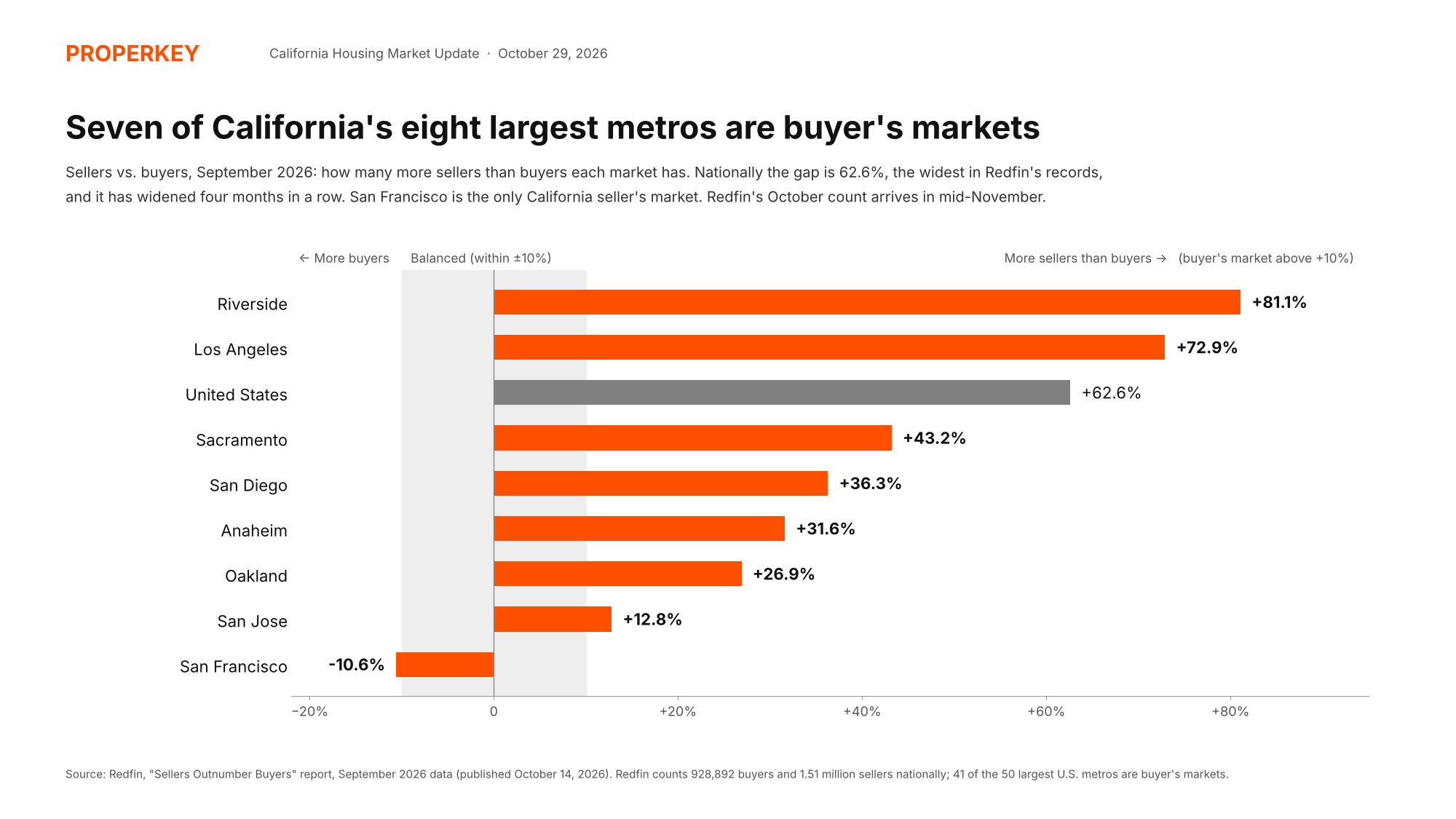
Sellers outnumber buyers by 62.6% nationally, a record. Seven of the eight California metros Redfin tracks are buyer's markets; San Francisco is the only exception.
California, September: sales fell 6.5% from a year ago, the 48th straight month under 300,000; 33 of 53 counties sold fewer homes. The $899,720 median was up 1.7% only because the $1 million-plus share of sales rose; 17 of 53 counties already show year-over-year price declines.
Price cuts: 21.7% of U.S. listings carry one (Redfin); 43% of builders are cutting, by 6% on average. In Butte County, Chico, and Oroville, more than half of all active listings have already reduced price.
It takes $90,191 a year to afford the U.S. median home with 20% down, $10,700 more than the average wage. San Diego ownership costs take 69.6% of local wages; Orange County 92.6% (ATTOM).
Washington moved: an October 22 executive order directs FHFA to pilot cancelling mortgage insurance based on today's home values and to make the title-insurance waiver permanent for refinances. Nothing is in effect yet. The FAIR Plan's 29.1% increase is. The election is Tuesday, November 3.
1. Rates and the Fed
Freddie Mac's weekly 30-year rate fell to 7.24% on October 29, from 7.32% the week before and 7.40% the week before that: two straight weekly declines, the lowest reading this month, and still about 126 basis points above the 5.98% of late February, before the Iran war (Freddie Mac). A year ago it was 6.17%. The relief came from the bond market, not the data: a selloff in technology stocks pushed money into Treasuries for a second week, and Mortgage News Daily's index closed Wednesday at 7.29%, down from a 7.61% peak on October 5. The 10-year Treasury, which mortgage rates follow, closed at 5.05% after the Fed's press conference.
Inflation is the reason rates are stuck. September CPI rose 0.6% in one month and 3.7% year over year; wholesale prices jumped 1.3%, the largest monthly increase since March 2022, and are up 6.3% from a year ago (BLS). Consumer sentiment finished October at 48.0, a five-month low, with one-year inflation expectations at 4.7% (University of Michigan). The Fed held at 3.75–4.00% on Wednesday by a 10–2 vote; Governor Lisa Cook and Cleveland Fed President Beth Hammack dissented in favor of a quarter-point hike now. The statement upgraded the economy to "expanding at a strong pace" and kept "inflation remains elevated" (Federal Reserve, Oct 28). Chair Warsh declined to pre-commit to December; futures price roughly an 85% chance of a hike on December 9. Thursday morning's data argued the dissenters' side: third-quarter GDP grew at a 3.4% annual rate, up from 2.2%, and the PCE index re-accelerated to 3.6% from a year ago, with core at 3.1% (BEA, Oct 29). Strong growth and rising inflation are the combination that keeps long rates high regardless of what the Fed does next.
The forecast change is the real news. Fannie Mae's September outlook had 6.7% for 2027. Its October outlook has 7.5% for every quarter of 2027 (Fannie Mae, Oct 14). The Mortgage Bankers Association's baseline is above 7% through 2027 (MBA, Oct 11). C.A.R.'s 2027 forecast assumes 6.6% and is the outlier (C.A.R., Oct 7).
What it means. On a $400,000 purchase with 20% down, principal and interest is about $2,181 a month at 7.24% versus $1,914 at February's 5.98%. Same buyer, same budget, 12% less house. The 16 basis points that came off in two weeks are worth about $35 a month.
2. Buyers
Two weeks of lower rates brought a small bounce, not a recovery: purchase applications rose 4% in the week ending October 23 but are still 18% below a year ago, refinances are down 61%, and 11.3% of applicants took an adjustable-rate loan, the highest share in more than a year (MBA, Oct 28). Fourteen percent of September rate locks were ARMs, the most in Optimal Blue's records, and 12% were non-QM loans (Optimal Blue). Creative financing means more conditions and more fallout before closing.
Redfin counted 928,892 buyers in September, the fewest in its records, against 1.51 million sellers: 62.6% more sellers than buyers, a record for the fourth straight month. Riverside has 81.1% more sellers than buyers, Los Angeles 72.9%, Sacramento 43.2%, San Diego 36.3%, Anaheim 31.6%, Oakland 26.9%, San Jose 12.8%; San Francisco is the only California seller's market (Redfin, Oct 14). Redfin's Asad Khan: "This is a buyer's market born out of caution, not strength."
Existing-home sales were down 2.2% from a year ago in September, with the West the worst region at −5.2%; investors were 20% of buyers, up from 15%, as owner-occupants dropped out (NAR). Only 8% of NAR's members expect buyer traffic to rise in the next three months, the weakest reading since fall 2023. The arithmetic behind the thin buyer pool: a household needs $90,191 to afford the $368,000 U.S. median home with 20% down, against an average wage of $79,534, and ownership costs exceed their historical norm in 570 of 583 counties. California holds 12 of the 25 worst: San Diego costs take 69.6% of local wages, Los Angeles 69.9%, Orange 92.6%, Santa Cruz 105.5%, Marin 102.4% (ATTOM, Q3).
3. Inventory and competition
Months' supply is 4.8 nationally, the highest in over ten years (NAR). NAR's pending home sales index fell 7.3% in September to 66.0, the lowest reading in the history of the index, which began in 2001; the West fell 9.2% in one month and is down 15% from a year ago (NAR, Oct 20). Redfin's four-week count through October 18 is the lowest in its records, down 14.4% from a year ago; 21.7% of listings carry a price drop; new listings are the fewest since July while active listings are up 2.1%; the median payment at 7.4% is $2,796 a month, up 10.4% from a year ago (Redfin, Oct 22). Realtor.com's Anthony Smith: "The damage to the fall housing market is already done." Zillow has 27.4% of listings with a price cut and newly pending sales down 11.2% from August to September.
Builders are cutting too. Builder confidence fell to 29 in October, the lowest since June 2012; 43% of builders are cutting prices, by 6% on average, and 65% are paying incentives (NAHB). New-home sales slipped 0.6% in September to a 676,000 annual pace, 5.3% below a year ago, even with the cuts and incentives; the median new home sold for $400,400, down 3.9% from a year ago and about $17,000 below the median existing home, with 8.4 months of new-home supply (Census, Oct 27). Roughly 80–90% of new-home sales carry a builder-paid rate buydown. For a resale seller, that is the competition: a builder cutting 6% and buying down the rate.
4. Prices
The national median was $417,500 in September, up 1.3% year over year, the smallest gain in months; the West is the only region where prices fell (NAR). Zillow's home value index slipped 0.5% from August to September. Case-Shiller's August index rose 2.1% from a year ago but fell 0.2% in the month, and with inflation at 3.4%, prices "declined in real terms for the 15th consecutive month"; San Francisco is +3.4%, San Diego +2.3% and Los Angeles +1.4% on a June–August window that predates the rate spike (S&P Cotality, Oct 27).
California's September median was $899,720, up 1.7% year over year and down 0.2% from August, with unsold inventory at 3.7 months. The gain is mix: the $1 million-plus share of sales rose to 35.9%. Seventeen of the 53 counties C.A.R. tracks posted year-over-year price declines and 33 posted sales declines; active listings rose from a year earlier for the first time in eight months, "driven by slower sales, not new listings" (C.A.R., Oct 19). C.A.R.'s Jordan Levine: September's drop in pending sales "suggests that California could see further softening" in closings, though limited inventory means "slower sales may not translate into a comparable decline in prices in the near term." That is September data written at a 6.86% average rate. October closings carry 7.3–7.5%.
5. California by region
C.A.R. tracks five regions plus the Sierra and rural counties it groups as "other." Sales fell from a year earlier in four of the five regions; the Central Coast was the only region with more sales than a year ago. September medians, year over year, with sales (C.A.R., Oct 19):
Southern California $895,000, +3.0%, sales −9.1% (worst of any region). Los Angeles $994,670, +1.2%, sales −10.9%, 4.0 months of inventory; a third of active listings in the city of LA have cut price. Orange $1,480,000, +5.6%, sales −2.0%; 42% of actives reduced and Irvine closing at 96.8% of list. Ventura $930,000, +3.3%, sales +6.4%, one of the few counties with more sales than a year ago.
Inland Empire — the most lopsided market in the state, 81.1% more sellers than buyers (Redfin). Riverside $620,000, −0.6%, sales −12.7%, 4.4 months and 42 days on market; Corona 48.5% of actives reduced. San Bernardino $531,090, +6.2%, sales −6.0%, 5.3 months, the most in Southern California. An FHA market, and the FHA rate is 7.02%.
San Diego $1,050,000, down $40,000 (−3.7%) from August but +6.1% from a year ago; sales −12.2%; inventory 3.3 months. Judge value by price per square foot: detached is $597 against a $622 April peak (−4.6% in six months); attached $541 against $601 in June 2024 (−10%) (Real Report / SDAR). Pending sales are down 25.4% from a year ago in the four weeks to October 18, among the steepest declines of any big metro (Redfin); in the latest week pendings and closings are running about 19% below last year with inventory 5.5% higher, and Brian Daly puts the county at roughly 4 months of supply and rising, against SDAR's 3.0 in September (Real Report, Oct 27). His call for 2027: a weaker and slower January–June than this year unless rates get back under 6.50%, which he calls unlikely without an end to the Iran conflict. Distressed listings are 2.3% of detached and 4% of attached inventory, up from under 1%: a trend to watch, not a crash. On the coast, Rancho Santa Fe closed 21 homes at a $5.10 million median but at 95.1% of list; Del Mar at 93.3%; Encinitas sales −27.3%; Carlsbad active listings −28% (C.A.R. city cards). Only 17% of county households can afford the median home.
San Francisco Bay Area $1,325,000, +1.9%, sales −3.1%. The top end is the one place still rising: San Francisco $2,054,000, +17.4% on a small sample, selling at 128.8% of list with only 6.2% of listings reduced; San Mateo $2,327,500, +8.3%; 2.0 and 1.6 months of inventory. Santa Clara is the soft spot: $1,920,000, −4.0%, with active listings +27.3%; San Jose −3.9% (C.A.R.) to −5.0% (Redfin) with 28.5% of listings cutting price and Zillow metro inventory +10.5%. Alameda $1,265,000, +1.2%, sales −4.4%; Contra Costa $870,000, flat; Marin $1,678,750, +1.7%; Sonoma $875,000 at 61 days on market; Napa 8.5 months of inventory; Solano $580,000, −4.6%.
Central Valley $500,000, flat, sales −2.5%. Sacramento $555,000, +2.8%, sales −2.7%, but active listings +10.1% and 45% of them price-reduced; the metro has 43.2% more sellers than buyers. Placer $675,000, +3.4%; Yolo $634,500, sales −22.0%; San Joaquin $549,000, −1.1%; Stanislaus $491,800, +3.5%; Merced $430,000, flat. Fresno $429,450, −3.5%, sales −10.5%, with the city down 5.8%; Kern $420,000, +3.7%; Tulare $380,000, flat.
Central Coast $1,049,500, +4.4%, sales +4.4%, the only region with more sales than a year ago. Santa Cruz $1,250,000, +1.2% but −8.8% in one month, and the worst affordability in the state at 105.5% of local wages (ATTOM); Monterey $920,000, −3.2%; San Luis Obispo $950,000, +4.1%; Santa Barbara $1,458,320, +32.6% on a handful of high-end closings.
Sierra foothills and other counties carry the state's loosest inventory: Calaveras $450,000, −1.1% (Redfin's three-month median −11.2%), 8.1 months and 63.5 days; Amador 7.3 months; Tuolumne 6.5; Mariposa $364,500, −25.4% on a tiny sample, 11.7 months; Lake 8.9 months and 77 days; Mendocino 8.1 months. El Dorado $681,500, flat, sales −10.9%; Nevada $550,000, +3.3%, sales −9.6%; Yuba $457,450, +5.2%, but sales −18.3% after August's 38% jump; Sutter $432,500, −2.4%. Against 3.7 months statewide, every foothill county is at 4 months or more.
Far North went from the state's best sales growth in August (+15%) to −9.0% in September, with sales −11.8% in one month and the worst price change of any region, $377,150, −3.4%; inventory 5.3 months. Butte is where the turn is sharpest: the median rebounded to $450,000 from August's $418,250 (still −2.6% from a year ago) because the buyers who left were the entry-level ones. Sales fell 15.7% from a year ago and 12.2% in one month; unsold inventory jumped from 4.0 to 4.7 months and days on market from 23 to 34.5, in one month. Active listings are 319, up 9.2%, and 52.7% of them have already cut price: 56.3% in Chico and 55.3% in Oroville (C.A.R.). Chico closed 55 homes, −27.6%, at $515,000; Oroville closed 15, −21.1%, at $325,000 (−7.1%) with active listings +17.5%. Redfin has Oroville's September median at $286,863, −14.2%, with 38% of listings cutting. Paradise has 535 active listings at 106 days on market (Movoto). Shasta $385,000, flat; Tehama $309,000, −0.8%.
Vacant land and the November 3 vote. Prop 37 would give the buyer of a newly built home a state second mortgage of up to 17% of the price with 3% down, if the buyer is the first purchaser, household income is between 80% and 200% of the county's typical income, and the price is under 125% of the county conforming loan limit: about $1.04 million in most of the state, up to about $1.5 million in high-cost coastal counties (Secretary of State; LAO). Nearly any home a builder would put on a lot in the foothills, the Far North, or the Inland Empire fits under that cap. The family who buys a lot and builds for themselves does not qualify; the builder who buys it, builds, and sells to a 3%-down buyer does, and a builder with that buyer pool has more room to pay for a build-ready lot. At today's rates the buyer for a lot is a builder or cash. PPIC's September poll had it at 61% yes, 35% no. Los Angeles Times columnist George Skelton called it "a no-brainer," the McClatchy California editorial board (the Sacramento Bee and four sister papers) recommends a yes vote with reservations, chiefly that the bond market will set the rate on the second mortgage, and the San Francisco Chronicle's editorial board recommends a yes vote while calling its scope "limited enough that we don't think it will fundamentally change California's housing landscape" and noting the measure has no funded opposition; the League of Women Voters of California recommends no; PPIC estimates fewer than 40% of eligible renters could afford the payment at a 7% rate. The measure sets no start date, so the effect is on builders' 2027 land buying, not on closings this month. This is a summary of the measure, not a recommendation.
6. Insurance, new laws, and Washington
A summary, not legal, insurance, or tax advice. Confirm with your carrier or attorney.
Wildfire insurance. The FAIR Plan's 29.1% average increase took effect October 15 statewide; foothill and rural areas are likely to land at or above the average, and some wildfire premiums will double (FAIR Plan; Oakview Insurance). State Farm has filed to resume writing new California policies for homes with an IBHS Wildfire Prepared Home Enhanced designation, targeting December if regulators approve; it is not open for new business yet (State Farm; CDI). Mercury gives 12.5–45% off the wildfire portion of the premium by hardening tier.
New laws (from C.A.R.'s 2027 New Laws chart, revised October 27). SB 876: insurers must offer at least 50% extended replacement cost, pay building-code upgrade costs in full on a total loss even if you rebuild elsewhere, and cover additional living expenses for at least 24 months after a total loss; C.A.R. Legal reads the substantive provisions as taking effect January 1, 2028, so a buyer closing now should ask for extended replacement at binding rather than wait. SB 1301 (January 2028): a nonrenewal notice must arrive at least 90 days out, must include the insurer's wildfire risk score for your home with a plain-language explanation, and must give you at least 90 days to fix a remediable problem. AB 2038: after a disaster total loss the insurer must renew for three years instead of two, and the cancellation moratorium in and next to a fire perimeter runs two years instead of one. AB 1795: smoke damage in a standing home inside a fire's impact zone is presumed to be from that fire, and the insurer pays for the testing. AB 1842 and AB 1847: mortgage forbearance of 180 days, extendable to 12 months, when a home becomes uninhabitable in a declared disaster, and up to 24 months after a wildfire. AB 956: cities must approve two detached ADUs on a single-family lot, and CC&R clauses that block ADUs are void. AB 2601: SB 9 lot splits and small "starter home" subdivisions get ministerial approval, deemed granted if the city sits on them for 60 days. AB 2050: HOAs with negative 30-year reserve projections must put at least 15% of their budget into reserves starting 2032; separately, Fannie Mae raises its condo reserve requirement to 15% for applications dated on or after January 4, 2027. For renters and landlords, SB 1296 requires a written pet policy with every rental ad and application from April 1, 2027.
Buyer financing changes. From November 1, Fannie Mae no longer accepts a lease to document rent on a home a buyer is converting to a rental. From November 2, Fannie and Freddie require the new UAD 3.6 appraisal format, with far more granular property detail; expect longer appraisals and sharper questions about condition. From November 13, Fannie Mae's underwriting flags loans whose stated owner-occupancy looks inconsistent and reprices them as investment loans if occupancy cannot be confirmed. Lenders are already tightening: Fannie and Freddie forced lenders to buy back 19.5% more loans in Q2. ICE counts 3.1 million active ARMs, the most in five and a half years; 2020-vintage seven-year ARMs face a median payment increase of about $1,066 a month. Expect more late-escrow re-pricing and fallout.
Washington. On October 22 the President signed an executive order, "Decreasing Housing Costs for the American People": FHFA is to pilot proactively cancelling mortgage insurance for borrowers who meet equity requirements based on current property values (today, conventional PMI drops at 80% loan-to-value on request or 78% automatically, both against the original value); FHFA is to make the title-insurance-waiver pilot permanent to cut refinance closing costs; HUD and FHFA are to lead a manufactured-housing task force; and USDA and VA are to cut rates on their own loans (White House; HousingWire). No deadlines, equity thresholds, or dollar figures were published. If you bought in 2020–22 with less than 20% down, appreciation-based cancellation is the item to watch; nothing is in effect yet. The Mortgage Bankers Association's roadmap asks for the same agenda: one credit report instead of three for scores above 700, lower loan-level price adjustments (about $1,000 at closing on a $400,000 loan), and a modest FHA premium cut (about $800 a year); FHFA says it will decide on pricing changes before year-end.
Who sees your listing. The fight over private listings escalated this month: Compass sued California's largest MLS, seven MLSs sued Compass, and on October 26 Keller Williams, eXp's parent, HomeServices of America, and Real REMAX launched "Open Real Estate," a shared listing platform that lets a broker keep a listing inside the member network instead of the public MLS (Inman; HousingWire). Properkey's practice has not changed: every listing goes into the local MLS and CRMLS and to every portal on day one, with no member-only tier, because a seller in a market with 62% more sellers than buyers needs every buyer, not a network's share of them.
7. The bottom line
Direction: down and slowing. Rates are at 7.24% with no major forecaster calling for relief before 2028, and the Fed held this week over two dissents for a hike, with December priced for one. Pending sales are at a record low nationally and down 25% in San Diego, buyer counts are at a record low, inventory and price cuts are at record highs, California sales fell 6.5%, nominal prices are flat-to-up statewide on mix while 17 of 53 counties already show year-over-year declines, and real prices have fallen fifteen straight months. C.A.R.'s own forecast has the market "subdued through the end of 2026" with modest improvement in 2027.
Temperature. Redfin scores a market by the gap between sellers and buyers: more than 10% more sellers than buyers is a buyer's market. On that scale the U.S. is at +62.6%, Riverside +81.1%, Los Angeles +72.9%, Sacramento +43.2%, San Diego +36.3%, Anaheim +31.6%, Oakland +26.9%, San Jose +12.8%; San Francisco, at −10.6%, is the only California seller's market. The national gap has widened four months in a row.
What that means for you. The buyer who is still out there is comparing your property against everything else in your area and your price range, has more to compare it with than at any point in Redfin's records, and in most of California is looking at listings where a third to a half have already cut price. The sellers getting deals done are meeting the market on price and paying concessions, not waiting for a rate that no forecaster has on the calendar. Look at the listings you compete with yourselves, the way a buyer would. If you would like Properkey to pull the properties you are competing against, ask and we will send them.
This is not talking the market down; it is what the data says. Properkey lists for $0 commission; Properkey earns only if you choose to buy, finance, manage, or insure through us.
Sources: Freddie Mac PMMS; Mortgage News Daily; BLS; BEA; Federal Reserve; Fannie Mae; MBA; C.A.R. September 2026 Home Sales and Price Report and Market Overview cards; C.A.R. Legal 2027 New Laws; NAR; Redfin; Realtor.com; Zillow; ATTOM; NAHB; Census; S&P Cotality Case-Shiller; SDAR; Real Report; University of Michigan; California FAIR Plan; CDI; State Farm; Mercury; Governor's office; Fannie Mae lender letters; ICE; White House; LAO; Secretary of State; PPIC; CalMatters; Los Angeles Times; San Francisco Chronicle. Data as of October 29, 2026; not legal, tax, insurance, or financial advice.
Written by Keyro, Properkey's AI. Properkey, DRE #01979718.



