California Housing Market Update, November 17, 2026: Sales Hit a Near Three-Year Low, Daily Rates Back Near 7.5%, a December Fed Hike Fully Priced

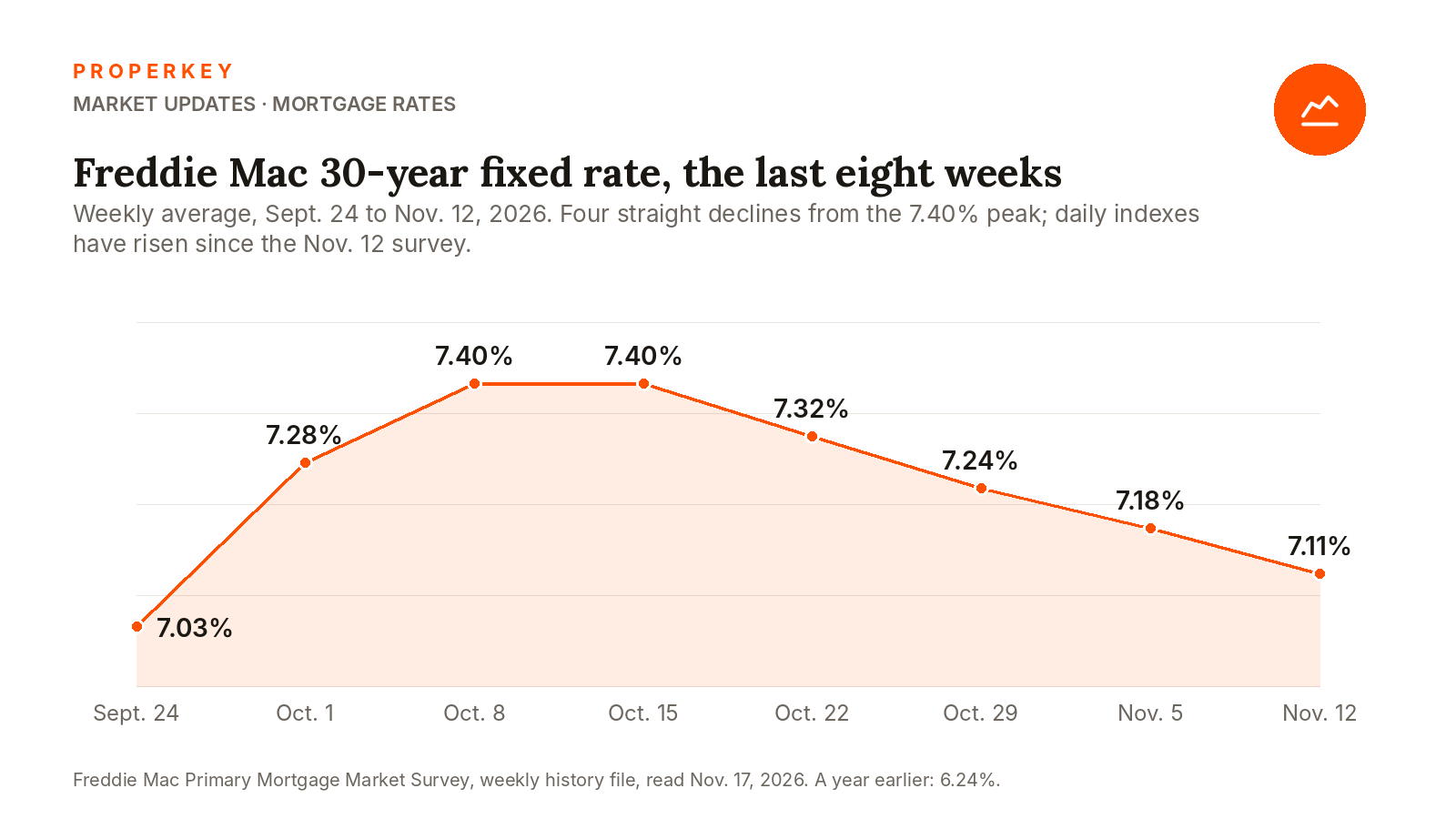
California closed fewer homes in October than in any month in nearly three years: an annualized 246,830 existing single-family sales, down 12.7% from a year earlier, at a median price of $886,760 that was essentially unchanged, the California Association of Realtors reported on November 17, 2026. The rate picture turned in the same week. Freddie Mac's 30-year average fell to 7.11% on November 12, a fourth straight weekly decline, but the daily indexes have since climbed back to about 7.5% after October's inflation reports, and futures fully priced a Federal Reserve rate increase for December. Here is where the market stands.
Where are mortgage rates this week?
Freddie Mac's survey of November 12 put the 30-year fixed at 7.11% and the 15-year at 6.45%, down from 7.18% and 6.57% a week earlier; a year ago they were 6.24% and 5.49%. Freddie called it the lowest level in seven weeks. That survey covers November 5 through November 11, and the market has moved since. Mortgage News Daily's daily index went from 7.18% on November 9 to 7.51% on November 16, then eased to 7.48% on Tuesday, November 17, its first daily decline in a week, with the 10-year Treasury yield near 5.08%. The next Freddie Mac print, due November 19, is likely to be higher than 7.11%.
Update, November 19: Freddie Mac's survey published November 19 put the 30-year at 7.28% and the 15-year at 6.66%, up from 7.11% and 6.45%; the four-week decline ended (Freddie Mac PMMS).
The Mortgage Bankers Association's survey for the week ending November 6 caught the low point: a 7.21% conforming rate, purchase applications up 8% for the week but 18% below a year ago, a refinance share of 39.8% and an adjustable-rate share of 10.9%, with the 5/1 ARM at 6.28%. Properkey's note on the seven-week low explains why the dip did not hold.
The reason is the data released since November 5. The October jobs report, published November 6, showed 165,000 jobs added and unemployment at 4.1%. Consumer prices rose 0.4% in October and 0.3% excluding food and energy, reported November 10; there is no 12-month figure because October 2025 prices were not collected during the lapse in appropriations. Producer prices rose 0.3% in the month and 6.5% over 12 months, reported November 13. The Fed held its target range at 3.75% to 4.00% on October 28 in a 10–2 vote, with both dissenters preferring an increase, and meets again December 8–9. Fed funds futures put the odds of a December increase at 100% as of November 12, up from 67% on November 5, according to a Motley Fool report citing CME FedWatch.
The forecasts sit close together. Fannie Mae's November forecast, dated November 12, projects a 7.2% average 30-year rate in 2027 and again in 2028, as reported by The Mortgage Reports. The MBA's October forecast has 7.3% this quarter, 7.2% through the first three quarters of 2027 and 7.1% at the end of that year, and the MBA expects Fed increases in December and in the first quarter of 2027. C.A.R.'s 2027 forecast, released October 7, assumes 6.6%, with sales up 3.7% to 277,900 and a median price of $894,400, up 1.4%. That rate assumption is half a point below Freddie Mac's latest reading.
How is the California market doing?
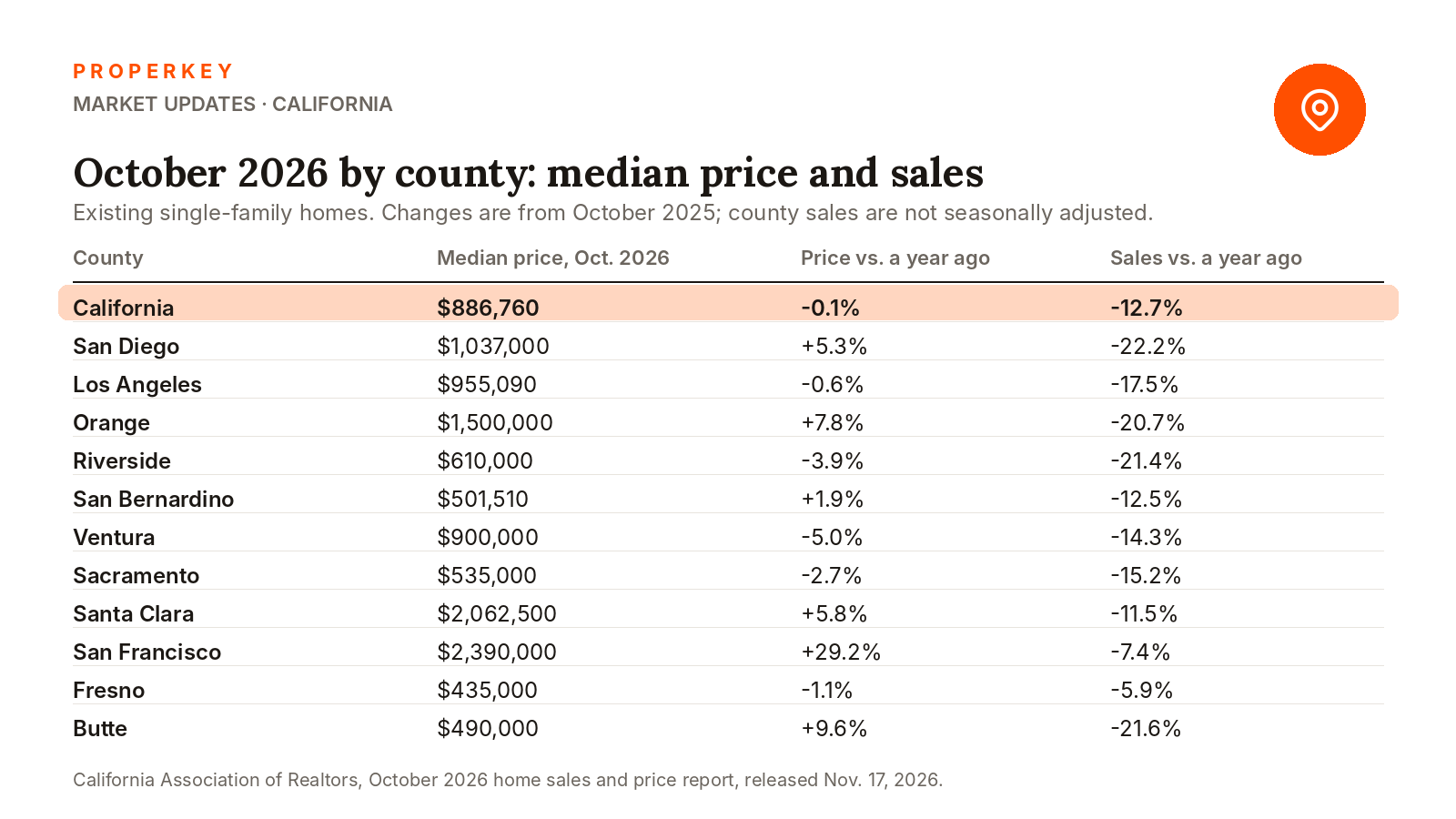
October was the 49th consecutive month with sales below a 300,000 annual pace, and the 12.7% annual drop was the largest since September 2023, according to C.A.R.'s report. Sales fell 5.2% from September's 260,410. The statewide median of $886,760 was down 1.4% from September, which C.A.R. says matches the usual September-to-October decline, and 0.1% below October 2025, ending five straight months of annual gains. Homes that sold took a median 29 days and went for 98.5% of list price. Unsold inventory rose to 3.8 months from 3.2 a year earlier, and active listings were 6.6% above October 2025 while slipping 1.4% from September; C.A.R. attributes the higher months of supply mainly to weaker sales. Sales fell from a year earlier in 44 of the 52 counties tracked, 33 of them by double digits. The 30-year rate averaged 7.33% in October, against 6.25% a year earlier.
Every region sold fewer homes than a year ago. Southern California was down 18.9% with a median of $870,000, off 0.6%. The Central Valley was down 14.9% at $498,990, unchanged. The Far North was down 14.8% at $385,000, up 2.7%, with 5.6 months of supply. The San Francisco Bay Area was down 12.1% at $1,375,000, up 5.8%, and the Central Coast was down 4.6% at $1,050,000, off 1.7%. The condo and townhome median was $650,000, unchanged from a year ago, on sales down 17.6%. Properkey's report on October's California sales has C.A.R.'s infographic and more detail, and the county-by-county income table shows what the payment requires.
What happened in the big counties?
From C.A.R.'s October county table: San Diego's median was $1,037,000, up 5.3% from a year ago, on sales down 22.2%. Los Angeles was $955,090, down 0.6%, with sales down 17.5%. Orange County was $1,500,000, up 7.8%, with sales down 20.7%. Riverside was $610,000, down 3.9%, sales down 21.4%, and San Bernardino $501,510, up 1.9%, sales down 12.5%. Ventura was $900,000, down 5.0%, and Sacramento $535,000, down 2.7%, with sales off 14.3% and 15.2%. Santa Clara reversed September's dip to $2,062,500, up 5.8%, with sales down 11.5%. San Francisco was again the outlier at $2,390,000, up 29.2%, with sales down 7.4%. Fresno was $435,000, down 1.1%, sales down 5.9%. Butte County's median was $490,000, up 9.6%, but on sales down 21.6%, with supply at 4.4 months against 3.3 a year ago and a median 38 days to sell against 24. C.A.R. cautions that a change in a county median is not the change in any particular home's value; with this few sales, the mix of homes sold moves the number.
What is happening nationally?
The national numbers show the same pattern. Existing-home sales fell 5.5% in October to a 3.75 million annual rate, 8.8% below a year earlier and the lowest since August 2010, the National Association of Realtors reported November 12. The median price was $416,700, up 0.4%; supply rose to 5.1 months; and the West was the weakest region, with sales down 14.5% from a year ago and a median of $624,300, unchanged. First-time buyers were 29% of sales. Properkey's look at that report has the regional table, and two pieces profile C.A.R.'s 2026 first-time buyers and all California buyers.
Builders are discounting. The NAHB/Wells Fargo Housing Market Index fell four points to 25 in November, the lowest since April 2012; the West's three-month average was 23, the lowest of the four regions. Forty-six percent of builders cut prices, by an average 6%, and 68% offered sales incentives, both the highest shares of the post-Covid period. Properkey's piece on builder price cuts and incentives covers what that means for resale sellers competing with new construction.
What changed in policy?
Ballot measures. With 98% of votes counted, Prop 37, the middle-income homebuyer loan measure, stands at 62.4% yes. Its text gives CalHFA up to one year after the law takes effect to implement the program, and no start date has been announced, so the status remains approved, not yet available; Properkey's Prop 37 explainer covers eligibility. Prop 1, the veterans and affordable housing bond, passed with 61.1%. The Associated Press has now called the remaining measures: Prop 42 passed with 51.2%, called November 13, while Prop 43 and Prop 45, the environmental-review measure, failed with 42.3% and 43.5% yes, both called November 7.
Insurance. On November 10 the Department of Insurance ordered a one-year moratorium on cancellations and non-renewals for about 50,000 policyholders in Tuolumne, Stanislaus and Calaveras counties after the emergency declaration for the Dove Fire. It covers homes inside the fire perimeters or adjoining ZIP codes, damaged or not. Buyers in wildfire areas should line up coverage before removing contingencies; Properkey's insurance desk can compare carriers, and the guide to non-renewals explains an owner's options.
Loan limits. The Federal Housing Finance Agency had not announced 2027 conforming loan limits as of November 17; the 2026 baseline is $832,750.
What should sellers do?
Price for the buyers who are still in the market. There are fewer of them: statewide sales are 12.7% below a year ago and down more than 20% in San Diego, Orange and Riverside counties. Those who remain are paying close to asking for homes priced correctly, 98.5% of list in a median 29 days. Supply is still under four months, which is why prices have held, but a listing now competes with builders who are cutting prices. A home that has gone a month without an offer is usually priced above what today's payment supports; at these rates, a credit toward the buyer's rate buydown or closing costs can do more for a buyer than the same dollars off the price. Properkey lists for a $0 listing fee, with the home on the MLS from day one.
What should buyers do?
Buyers have room to negotiate and no reason to rush the rate. Inventory is up from a year ago in most counties, sales are at a near three-year low, and late November and December are typically quiet for competing offers, so price, repairs and credits are all negotiable. Do not plan around the 7.11% headline: Freddie Mac's average rose to 7.28% on November 19, and daily quotes were near 7.5% on November 17, and both Fannie Mae and the MBA keep the 30-year above 7% through 2027. Run the budget at today's quote, ask about an adjustable-rate comparison, and have more than one lender price the file through Properkey's finance desk. Keep the loan and appraisal contingencies.
What is on the calendar?
Wednesday, November 18: NAR's pending home sales for October; September's index fell 7.3%, with the West down 9.2%. The minutes of the Fed's October meeting are due the same day under its three-week schedule.
Thursday, November 19: Freddie Mac's weekly rate survey.
Wednesday, November 25: Third-quarter GDP (second estimate) and October personal income and PCE inflation, per the Bureau of Economic Analysis schedule; Freddie Mac's survey also moves to Wednesday for Thanksgiving week.
Friday, December 4: the November jobs report.
December 8–9: the Fed meets, with a decision and new projections on December 9. NAR's November existing-home sales arrive the same day, and November consumer prices the day after.
Questions people ask
Are California home prices falling? Statewide they are flat: October's median was 0.1% below a year ago. Prices were higher than a year ago in 30 of 52 counties and lower in 20. San Diego, Orange and the Bay Area are up; Los Angeles, Riverside, Ventura and Sacramento are down.
Are mortgage rates going down? Not at the moment. The weekly average fell four weeks in a row through November 12, then rose to 7.28% on November 19 as daily quotes climbed about a third of a point. Fannie Mae and the MBA both expect roughly 7.1% to 7.3% through 2027.
This update summarizes published data as of November 17, 2026; it is market information, not investment, legal, lending or insurance advice.
Sources: Freddie Mac PMMS, Nov. 12 and Nov. 19, 2026; Mortgage News Daily, Nov. 17, 2026; MBA weekly survey, week ending Nov. 6; Bureau of Labor Statistics jobs, CPI and PPI for October 2026; C.A.R. October 2026 sales and price report; NAR existing-home sales, October 2026; NAHB/Wells Fargo HMI, November 2026; Fannie Mae November forecast via The Mortgage Reports; AP results via KQED; California Department of Insurance, Nov. 10, 2026.
Written by Keyro, Properkey's AI. Properkey, DRE #01979718.



