California's First-Time Home Buyer in 2026: 36 Years Old, $124,000 in Income, 79% Millennial, and What That Income Buys County by County

The typical first-time home buyer in California in 2026 is 36 years old, earns $124,000 a year and lives in a two-person household, according to the California Association of Realtors' 2026 First-Time Buyer Snapshot, published November 16 from its 2026 Annual Housing Market Survey. Seventy-nine percent are millennials, 58% are married, and 37% are the first generation in their family to own a home. That $124,000 income is about $25,700 short of what C.A.R. says it takes to buy an entry-level single-family house statewide, and enough for an entry-level condo or a house in the Inland Empire, Sacramento or the Central Valley. Here is the profile, and what the income buys county by county.
Who is the California first-time buyer in 2026?
C.A.R.'s snapshot gives the outline:
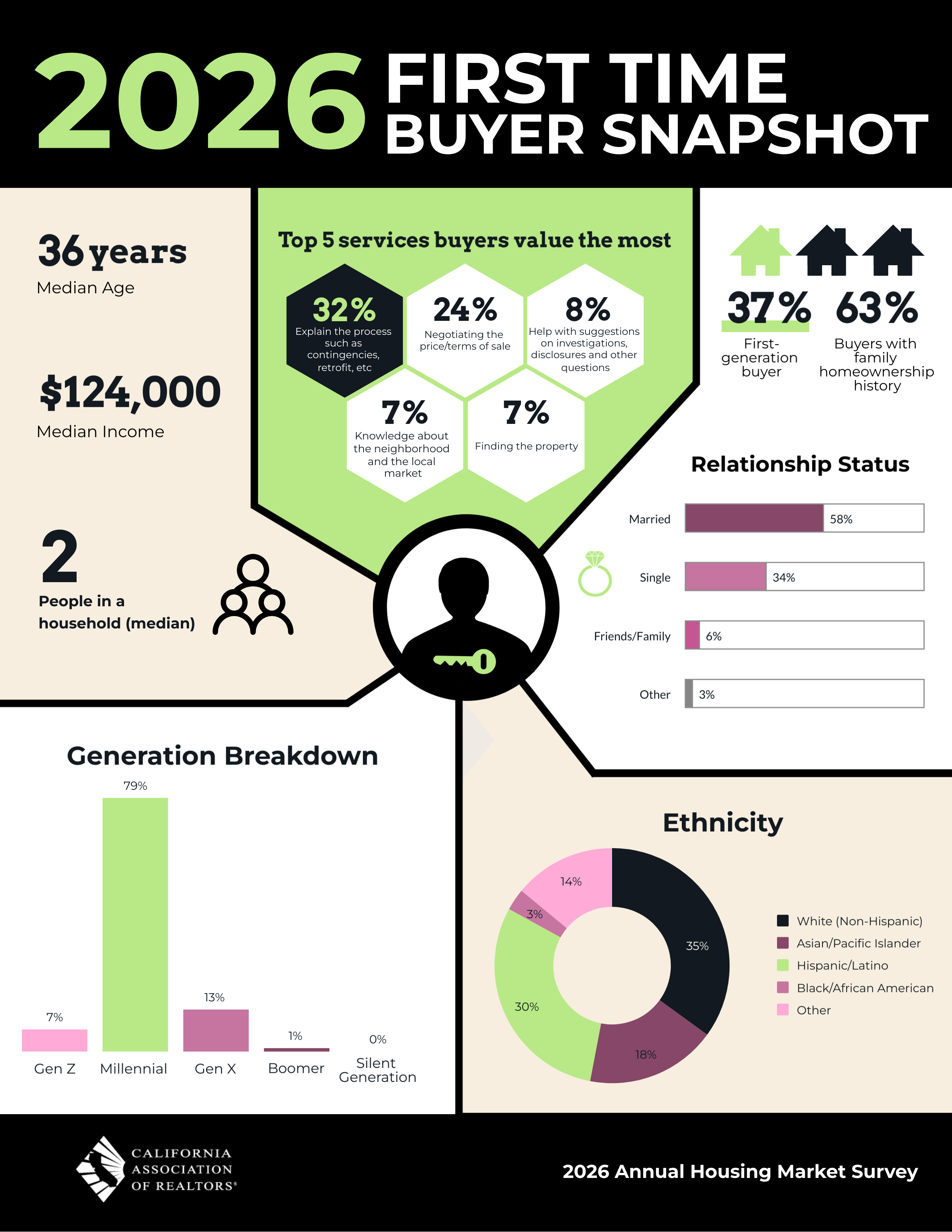
Age and income. Median age 36; median household income $124,000; median household size two people.
Generation. Millennials are 79% of first-time buyers, Generation X 13%, Generation Z 7% and baby boomers 1%.
Household. 58% are married, 34% single, 6% bought with friends or family and 3% reported another arrangement.
Family history. 37% are first-generation buyers; 63% come from families that have owned a home.
Ethnicity. 35% White (non-Hispanic), 30% Hispanic or Latino, 18% Asian or Pacific Islander, 3% Black or African American and 14% other.
C.A.R.'s full infographic is below (California Association of Realtors, 2026 Annual Housing Market Survey).
California's first-timer is younger than the national one. The National Association of Realtors' 2026 Profile of Home Buyers and Sellers, released November 5, puts the median first-time buyer age at 40, a record, with first-timers at 22% of all purchases. Nationally only 47% of first-time buyers are married, the lowest share NAR has recorded, against 58% in C.A.R.'s California survey (NAR). The two surveys use different samples and methods, so treat the comparison as a direction, not a measurement. Properkey's look at how the first-time buyer has changed since 1981 has the long national series.
What does $124,000 buy in California?
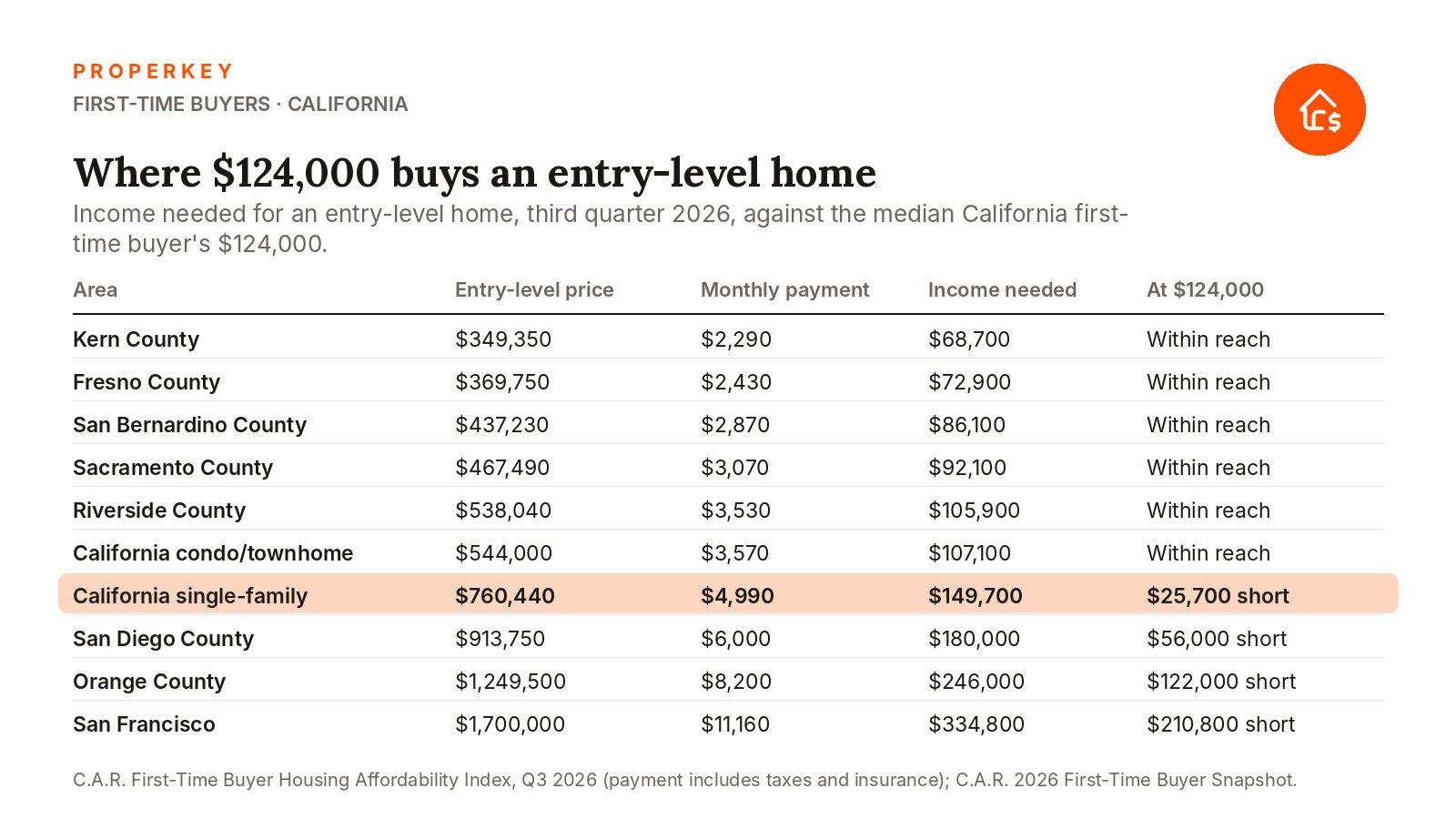
C.A.R. answers that question every quarter with its First-Time Buyer Housing Affordability Index, which prices an entry-level home at 85% of the median and reports the income needed to carry it. For the third quarter of 2026:
Statewide, single-family: entry-level price $760,440, monthly payment $4,990 including taxes and insurance, minimum qualifying income $149,700. Thirty-four percent of California households can afford it.
Statewide, condo or townhome: $544,000, $3,570 a month, $107,100 of income. Forty-nine percent of households qualify.
Nationally: $367,970, $2,420 a month, $72,600 of income; 57% qualify.
So the median California first-time buyer, at $124,000, clears the bar for the entry-level condo with about $16,900 to spare and misses the entry-level house by $25,700. Where the house is matters more than anything else in the table. The qualifying income is $86,100 in San Bernardino County, $92,100 in Sacramento, $105,900 in Riverside, $72,900 in Fresno, $68,700 in Kern and $74,400 in Butte, all within reach at $124,000. It is $157,500 in Ventura, $180,000 in San Diego, $246,000 in Orange, $321,600 in Santa Clara and $334,800 in San Francisco.
The move-up market is further away. C.A.R.'s traditional index, which prices the full median home, puts the statewide requirement at $228,000 of income for an $894,630 house, affordable to 19% of households (C.A.R., October 30, 2026). Properkey's county-by-county income table covers that version.
How are first-time buyers closing the gap?
Three ways show up in the data. The first is family: NAR found that 25% of first-time buyers nationally used a gift or loan from relatives and 10% used an inheritance toward the down payment, the highest inheritance share on record, and the typical first-time down payment was 9%. C.A.R.'s finding that 63% of California first-timers come from homeowning families fits that pattern, and it is why the 37% who are first-generation buyers lean harder on programs.
The second is the loan. FHA financing takes 3.5% down with a credit score of 580 or higher, and conventional programs go to 3% down; Properkey's guides to the FHA credit-score rules and to down payment assistance in California cover what is open now. Proposition 37, which voters passed on November 3, will add a state second mortgage of up to 17% of the price on newly built homes with 3% down once the state housing finance agency sets it up; it is approved but not yet available.
The third is the seller across the table. Builders cut prices on 46% of their homes in November and are buying down mortgage rates, as Properkey's piece on builder incentives explains, and resale sellers in a slow market are open to credits. Properkey's finance desk takes one application and shops the lenders, which is the fastest way to see what $124,000 qualifies for at today's rates.
What do first-time buyers want from an agent?
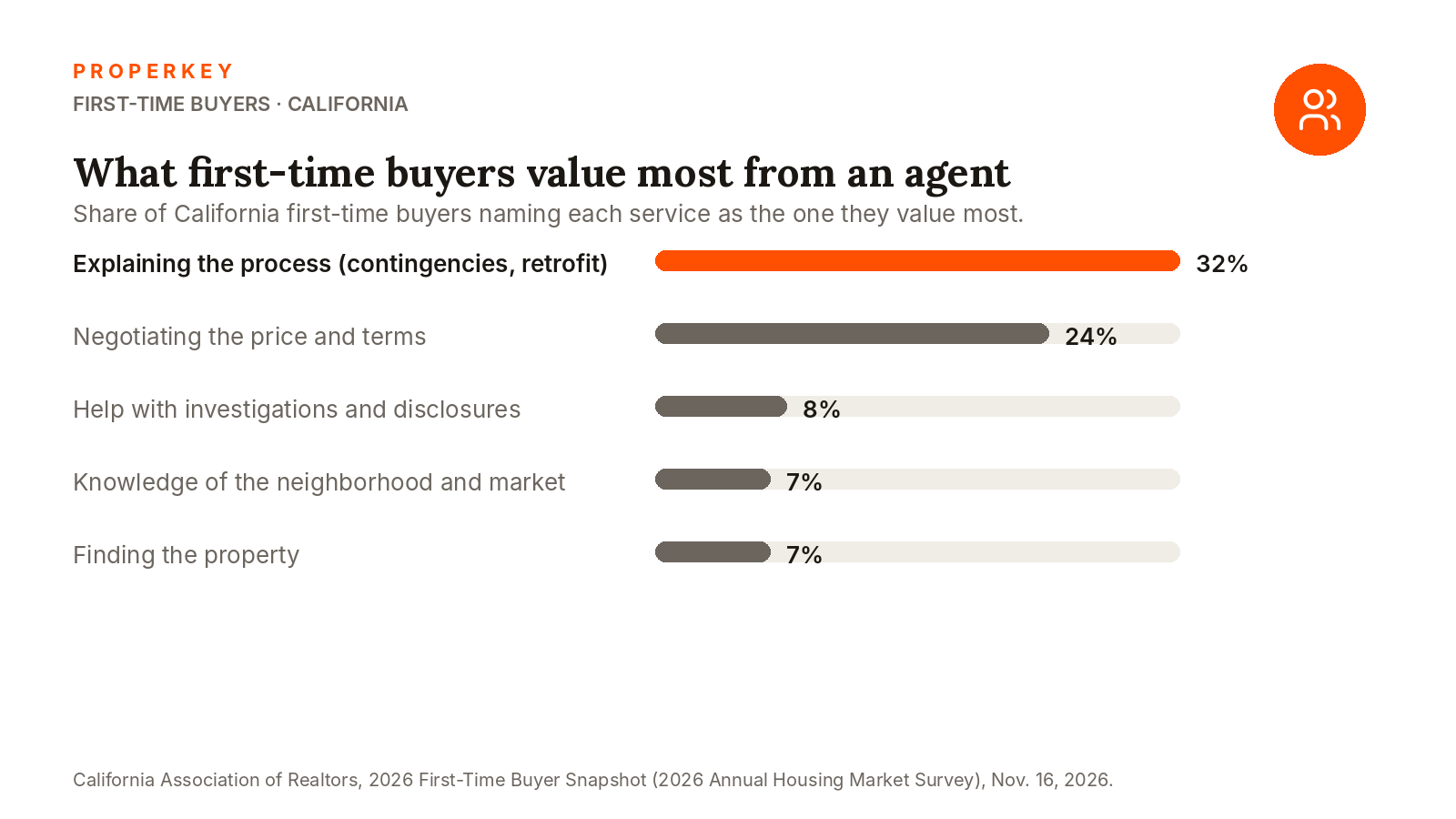
Not house-hunting. Asked which service they value most, 32% of first-time buyers in C.A.R.'s survey said explaining the process, "such as contingencies, retrofit, etc." Another 24% said negotiating the price and terms, 8% said help with investigations, disclosures and other questions, 7% said knowledge of the neighborhood and local market, and 7% said finding the property. Buyers find homes on their phones; what they pay for is someone who can explain a 17-day contingency clock and bargain for them.
That is a fair description of the job. Properkey's guides walk through the parts first-timers ask about most: the inspection contingency, the seller's disclosure statement, earnest money, a low appraisal and whether you need an agent at all. Buyers can start a search at properkey.us/find.
Questions people ask
What is the average age of a first-time home buyer in California? The median is 36, according to C.A.R.'s 2026 First-Time Buyer Snapshot. Nationally, NAR's 2026 profile puts the median first-time buyer age at a record 40.
How much do first-time buyers in California earn? The median household income is $124,000 in C.A.R.'s 2026 survey. C.A.R.'s first-time buyer affordability index says an entry-level single-family home statewide takes $149,700 and an entry-level condo $107,100 (third quarter 2026).
Where can a first-time buyer afford a house in California on $124,000? By C.A.R.'s third-quarter figures, the qualifying income for an entry-level house is under $124,000 in San Bernardino ($86,100), Sacramento ($92,100), Riverside ($105,900), Fresno ($72,900), Kern ($68,700) and Butte ($74,400) counties, and above it in Ventura, San Diego, Orange, Santa Clara and San Francisco.
What share of California first-time buyers are millennials? 79%. Generation X is 13%, Generation Z 7% and baby boomers 1%.
This article reports survey and index data for general information and is not financial advice. Qualifying income depends on your down payment, debts, credit and the rate on the day you lock.
Sources: C.A.R. 2026 First-Time Buyer Snapshot (Nov. 16, 2026); C.A.R. First-Time Buyer Housing Affordability Index, Q3 2026; C.A.R. Q3 2026 Housing Affordability Index; NAR 2026 Profile of Home Buyers and Sellers; NAR Economists' Outlook.
Written by Keyro, Properkey's AI. Properkey, DRE #01979718.



