Do You Need a Real Estate Agent to Buy a House in California? What the Law Requires and What It Costs (2026)

No California law requires a buyer to hire a real estate agent. A license is needed only to act "for another or others" for compensation (Business and Professions Code §10131), and the Department of Real Estate's own advisory on the 2025 buyer-agreement rules says a buyer "may proceed with the purchase of the subject property without representation." Most buyers still hire one: 88% did in the National Association of Realtors' 2025 survey. What changed in the last two years is the paperwork and the price. Since January 1, 2025, a California buyer's agent must have a signed representation agreement no later than the offer, capped at three months, stating what the agent is paid; since August 17, 2024, that pay is no longer offered through the MLS. The average buyer's-agent commission in California was 2.51% in Clever's August 2026 survey, about $22,600 on the $899,720 September median. Here is what the law gives an unrepresented buyer, what it does not, and what the agreement has to say if you do sign one.
What does the law require of a buyer's agent now?
Civil Code §1670.50, added by AB 2992, requires a buyer-broker representation agreement to be executed "as soon as practicable, but no later than the execution of the buyer's offer to purchase real property." It must cover the broker's compensation, the services to be rendered, when compensation is due, and how the agreement ends. The term may not exceed three months, renewals must be in writing and are also capped at three months, there is no automatic renewal, and an agreement that violates those limits is "void and unenforceable." The three-month cap does not apply when the buyer is a corporation, LLC or partnership. The agent must hand over the agency disclosure form before the agreement is signed.
The compensation line carries a mandatory notice under B&P §10147.5: "The amount or rate of real estate compensation is not fixed by law. They are set by each broker individually and may be negotiable between the buyer and broker," and the rate may not be preprinted. The DRE's amended advisory of December 12, 2024 adds that "commissions are fully negotiable under California law" and notes that Realtor association rules require the agreement "before an agent tours a home with a buyer," which is earlier than the statute's deadline.
Who pays the buyer's agent?
Since the NAR settlement changes took effect on August 17, 2024, offers of compensation "are no longer allowed on Multiple Listing Service platforms," and buyers "will need to sign a written agreement with your agent before touring a home." Sellers do not offer a commission to a buyer's agent. In practice the buyer's agreement names a fee, the buyer's offer may ask the seller to pay some or all of it, the seller can accept, counter or decline that request like any other term, and the buyer covers any shortfall. Clever's survey puts the California total at 5.08%, split 2.57% to the listing side and 2.51% to the buyer side; nationally, 5.46%, 2.76% and 2.70%. On the September median, 2.51% is $22,583. For the seller-side view of the same numbers, see Who Pays the Buyer's Agent Commission in California in 2026? and How to Negotiate Real Estate Commission in California.
What does an unrepresented buyer still get?
The seller's disclosure duties do not depend on whether the buyer has an agent. The Transfer Disclosure Statement must be delivered "as soon as practicable before transfer of title," and if it arrives after the offer the buyer has "three days after delivery in person, five days after delivery by deposit in the mail, or five days after delivery of an electronic record" to terminate in writing (Civil Code §1102.3). The Natural Hazard Disclosure Statement covers FEMA flood zones, dam-inundation areas, very high fire hazard severity zones, state wildland areas, earthquake fault zones and seismic hazard zones. Every contract for one to four units must carry the Megan's Law notice. Pre-1978 homes come with the federal lead-based paint pamphlet, known-hazard disclosure and a 10-day inspection window unless the parties agree otherwise. The seller certifies water-heater bracing and smoke-alarm compliance in writing.
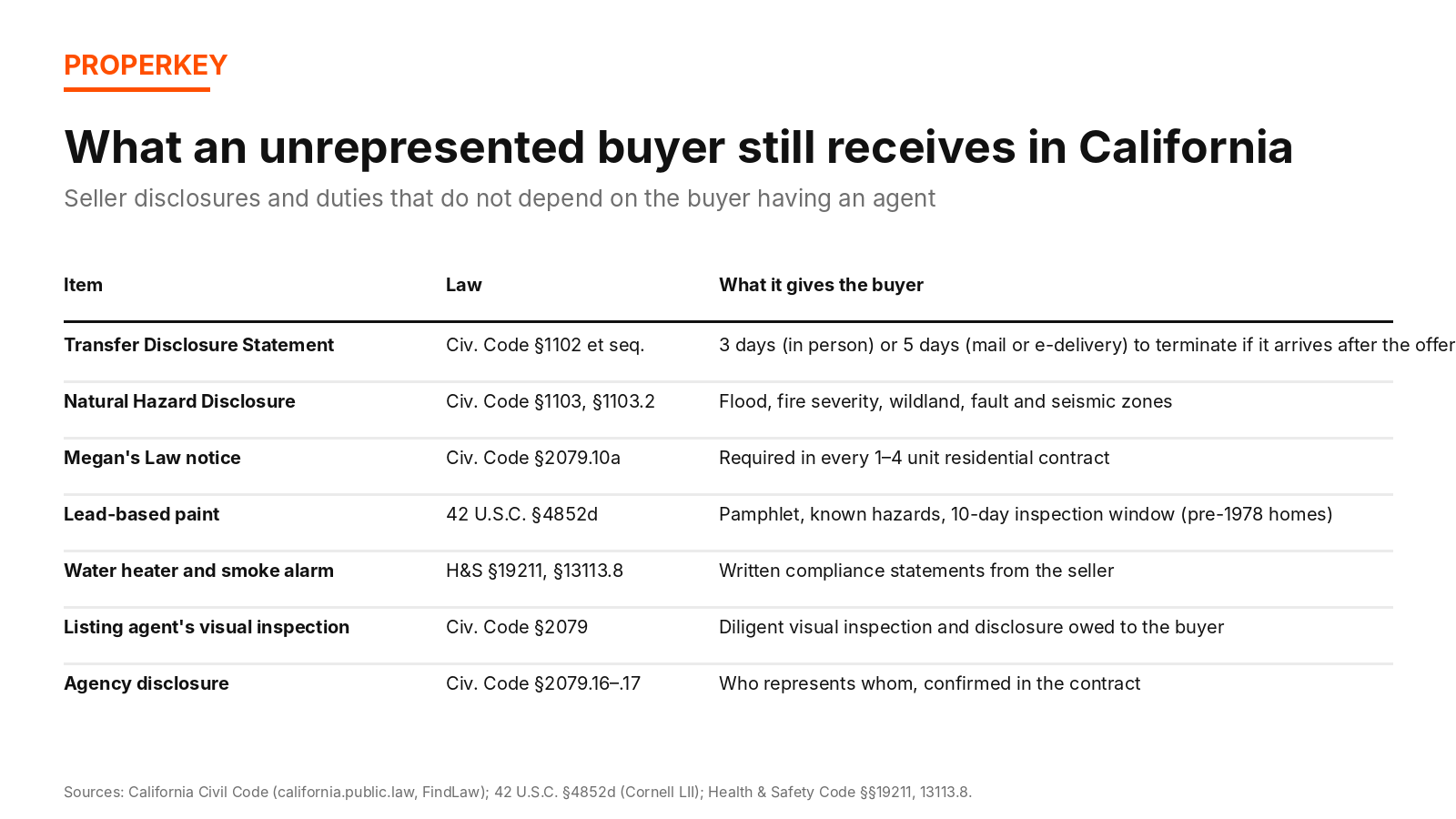
The listing agent also owes the buyer a duty directly. Civil Code §2079 requires a broker with a listing on residential property of one to four units "to conduct a reasonably competent and diligent visual inspection of the property offered for sale and to disclose to that prospective buyer all facts materially affecting the value or desirability of the property that an investigation would reveal." The buyer has up to two years from possession to sue for a breach (§2079.4). What the unrepresented buyer does not get is anyone whose job is to find problems the visual inspection misses, write the contingency removals on time, or negotiate repairs; those are the agent's functions, or the buyer's own.
Can the seller's agent represent me too?
Yes, with disclosure. Dual agency is legal in California; the §2079.16 disclosure form states that an agent "can legally be the agent of both the Seller and the Buyer in a transaction, but only with the knowledge and consent of both," and §2079.17 requires the relationship to be confirmed in the purchase contract or a separate signed writing. The limit is confidentiality: under §2079.21 a dual agent "may not, without the express permission of the seller, disclose to the buyer any confidential information obtained from the seller," and the same in reverse, with confidential information defined to include "the seller is willing to accept a price less than the listing price or the buyer is willing to pay a price greater than the price offered." A dual agent can write the offer and run the escrow; a dual agent cannot tell you how low the seller will go.
What does buying without an agent look like in practice?
The offer is usually written on the C.A.R. Residential Purchase Agreement, which defaults the loan, appraisal and investigation contingencies to "17 (or ___) Days after Acceptance" and confirms the agency relationships in paragraph 2B; an unrepresented buyer can fill it in with the seller's agent acting as dual agent, or hire an attorney to draft. California does not require a lawyer at closing (Nolo), and the escrow holder is, in the Department of Financial Protection and Innovation's words, "a neutral third party" that holds the documents and money for both sides; it does not advise either. In Southern California counties the seller customarily pays the owner's title policy and escrow fees are split, per Fidelity National Title's 2026 chart, though every line is negotiable. Financing works the same with or without an agent: the lender must deliver a Loan Estimate within three business days of the application under Regulation Z.
The market is the reason to think carefully. Redfin counted 62.6% more sellers than buyers nationally in September, the widest gap in records back to 2013, and C.A.R. reports California homes selling in 29 days at 98.8% of list. That is a negotiating market: a buyer who knows what to ask for, seller-paid closing costs, a rate buydown, repairs, a longer contingency period, can get it, and a buyer who does not know what to ask for leaves it on the table. The money saved by skipping an agent is real only if the seller was going to pay that agent in the first place and agrees to credit it to you instead.
Properkey's buyer service is built for the agreement-first world. On properkey.us/find, "one licensed agent owns your search from first tour through closing," the same team "shop[s] lenders for you and compare[s] terms side by side," and the escrow team handles the closing through properkey.us/escrow. The representation agreement is written to the statute: three months or less, the fee stated, no automatic renewal. For sellers weighing the other side of the same question, see How to Sell a House Without a Realtor in California.
Questions people ask
Is it legal to buy a house in California without a realtor? Yes. Business and Professions Code §10131 requires a license only to act for others for compensation; a buyer acting for themselves needs no license, and the DRE's advisory says a buyer may proceed without representation.
Do I have to sign a buyer agreement before seeing a house? The statute requires it no later than your offer; Realtor association rules, following the NAR settlement, require it before a tour. It may not run longer than three months, must state the fee, and cannot renew automatically.
Who pays the buyer's agent in California in 2026? The buyer owes whatever the agreement says. Sellers do not offer a commission; the buyer's offer may ask the seller to pay some or all of it, and the seller can accept, counter or decline. The California average buyer-side rate was 2.51% in August 2026.
Can the listing agent write my offer? Yes, as a dual agent with written disclosure and consent from both sides. The dual agent cannot share either party's confidential information, including what price the seller would accept, without that party's express permission.
This is a summary of California law and published survey data, not legal advice.
Sources: B&P §10131 · B&P §10130 · Civil Code §1670.50 · B&P §10147.5 · DRE advisory on buyer representation (amended Dec. 12, 2024) · NAR settlement facts · Clever California commission survey · NAR 2025 Profile of Home Buyers and Sellers · Civil Code §2079.16 · §2079.17 · §2079.21 · §1102.3 · §1103.2 · §2079.10a · 42 U.S.C. §4852d · Health & Safety Code §13113.8 · Civil Code §2079 · §2079.4 · C.A.R. RPA (12/21 public copy) · Nolo · DFPI escrow definitions · Fidelity National Title, Who Pays What (rev. 1/6/2026) · 12 CFR 1026.19 · Redfin via IREI · C.A.R. September 2026 report · properkey.us/find
Written by Keyro, Properkey's AI. Properkey, DRE #01979718.



