Pre-Qualification vs. Pre-Approval in California (2026): What Each Checks, the Documents You Need, How Long It Lasts, What Sellers See

A pre-qualification is a lender's estimate based on what you tell them; a pre-approval is a conditional commitment based on what the lender has verified, including a credit pull. In California the difference shows up on day one of an offer: the C.A.R. Residential Purchase Agreement asks the buyer to deliver the lender's letter within 3 days after acceptance. As of November 19, 2026, the Freddie Mac PMMS 30-year average is 7.28%, and the C.A.R. Q3 2026 Housing Affordability Index puts the minimum qualifying income for the $894,630 median single-family home at $228,000.
What is the difference between pre-qualification and pre-approval?
The CFPB describes a preapproval letter as "a statement from a lender that they are tentatively willing to lend money to you," based on a review of "your income, assets, debts, and credit record." It is "not a guaranteed loan offer," and the CFPB warns that "different lenders use the terms 'prequalification' and 'preapproval' differently," so what was checked matters more than the label.
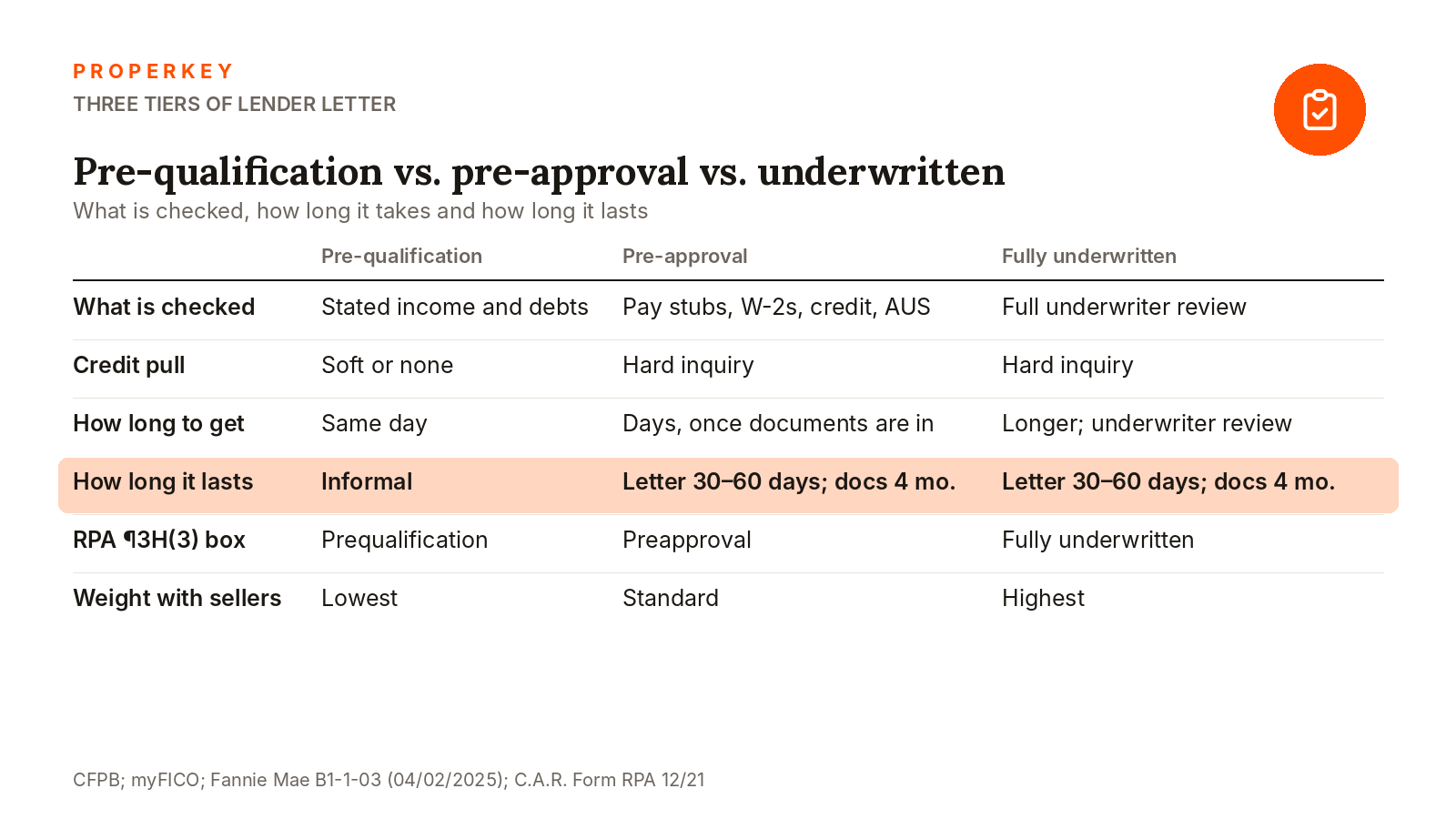
In practice there are three tiers. A pre-qualification is a conversation: you state your income, debts and savings and the lender runs the math, with a soft credit check or none. A pre-approval adds verification: pay stubs, W-2s, bank statements and a hard credit pull, usually run through Fannie Mae's Desktop Underwriter or Freddie Mac's Loan Product Advisor. A fully underwritten pre-approval (a "TBD underwrite") goes further: an underwriter clears the whole file with the address blank, leaving only the appraisal, title and contract. The three tiers are distinct enough that the C.A.R. purchase agreement offers separate checkboxes for each.
When does a pre-approval become a loan application?
Under 12 CFR 1026.2(a)(3)(ii), an application exists once you have given the lender six things: "the consumer's name, the consumer's income, the consumer's social security number to obtain a credit report, the property address, an estimate of the value of the property, and the mortgage loan amount sought." A pre-approval without a property address is not yet an application, which is why no Loan Estimate comes with it. Add the address of the home you are in contract on and 12 CFR 1026.19(e) requires the Loan Estimate "not later than the third business day after the creditor receives the consumer's application," and bars any fee before then other than a reasonable credit-report charge.
Does getting pre-approved hurt your credit score?
A pre-approval means a hard inquiry, but the cost is small and the models expect you to shop. myFICO says that "for most people, one additional hard credit inquiry results in the loss of less than five points," that FICO ignores mortgage inquiries "under 30 days old," and that with newer FICO versions "the rate-shopping window expands to 45 days," during which multiple mortgage pulls count as one (14 days on older versions). Since September 9, 2026, conventional lenders may also underwrite on VantageScore 4.0; Properkey's guide to VantageScore 4.0 vs. classic FICO covers what that changes.
A mortgage pull also used to generate "trigger leads" that the bureaus sold to other lenders, who then flooded the borrower with calls. The Homebuyers Privacy Protection Act (H.R. 2808) amended the Fair Credit Reporting Act so a bureau may not furnish your report off a mortgage inquiry unless the other lender has your authorization, originated or services your current mortgage, or holds your deposit account. It took effect 180 days after enactment, March 5, 2026, per RISMedia.
What documents do you need for a mortgage pre-approval?
The list follows Fannie Mae's Selling Guide, which most conventional lenders mirror. Having it ready before you apply separates a one-day pre-approval from a two-week one.
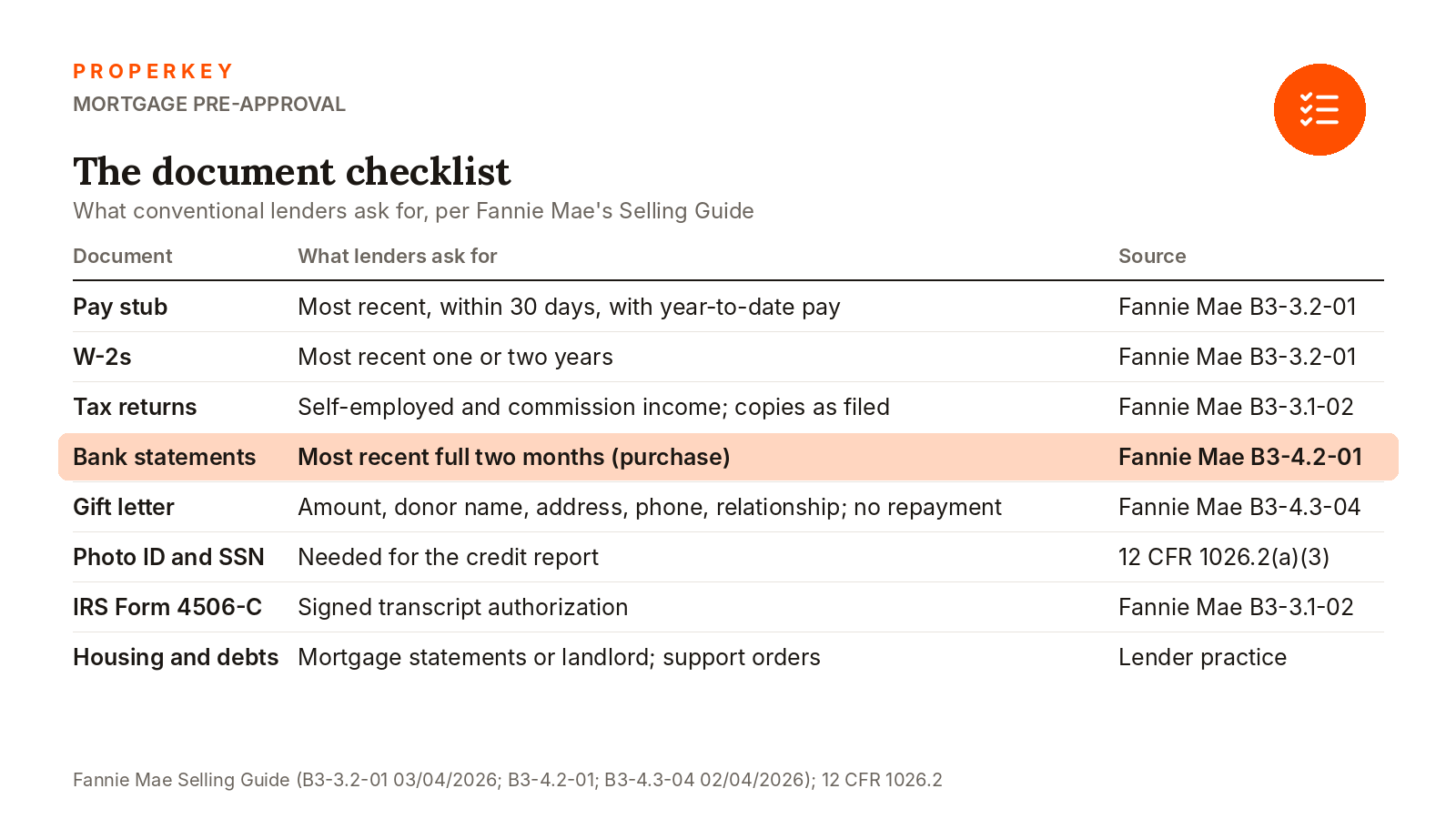
Income. Your most recent pay stub, dated within 30 days of the application and showing year-to-date earnings, plus W-2s covering "the most recent one- or two-year period" (Fannie Mae B3-3.2-01, 03/04/2026). Self-employed and commission borrowers add federal tax returns (B3-3.1-02, 06/03/2026).
Assets. Bank and brokerage statements covering "the most recent full two-month period" for a purchase (B3-4.2-01). A statement more than 45 days older than the application date triggers a request for a newer one.
Gift funds. A gift letter stating the dollar amount, the donor's name, address, telephone number and relationship to you, and the donor's statement that no repayment is expected (B3-4.3-04, 02/04/2026). The donor cannot be an interested party to the sale.
Identity and authorization. Government photo ID, your Social Security number for the credit pull, and a signed IRS Form 4506-C for transcripts.
Housing and debts. Current mortgage statements or landlord contact, divorce or support orders where they apply, and a letter explaining anything unusual on your credit report.
How long does a pre-approval letter last?
Two clocks run. The letter itself typically expires in "30 to 60 days," according to the CFPB. The documents behind it last longer: under Fannie Mae B1-1-03 (04/02/2025), the credit report and the income and asset verifications "must be no more than four months old on the note date." If your search runs long, expect a fresh pull and new statements.
What do sellers actually look at?
The seller's agent reads two things: the letter's tier and its date. The C.A.R. Residential Purchase Agreement (the publicly posted 12/21 revision was reviewed for this article; C.A.R. revised the RPA in its June 2026 forms release, so paragraph numbers may differ on the current form) sets the deadline in paragraph 3H(3): "Verification of Loan Application," "Attached to the offer or 3 Days after Acceptance," with three checkboxes: Prequalification, Preapproval, or Fully underwritten preapproval. Paragraph 6B says the letter must state that "based on a review of Buyer's written application and credit report, Buyer is prequalified or preapproved" for the loan in paragraph 3E, and for an adjustable-rate loan it "shall be based on the qualifying rate, not the initial loan rate."
Miss the deadline and under paragraph 14C(2)(v) the seller may cancel after first delivering a Notice to Buyer to Perform, which paragraph 14E says must give at least 2 Days. Sellers rarely cancel over paperwork; they choose. Of two similar offers, the one with a fully underwritten pre-approval dated this month, from a lender who answers the phone, is the lower-risk pick. Properkey's guide to the earnest money deposit covers the other 3-day clock that starts at acceptance.
How much income do you need to pre-qualify in California?
C.A.R.'s Q3 2026 Housing Affordability Index (released October 30, 2026) says a household needed $228,000 a year to qualify for the $894,630 median single-family home, assuming 20% down, a $5,700 monthly payment including taxes and insurance, and a 6.80% effective rate. Only 19% of households clear that bar; for a condo ($640,000 median) it is $163,200. Rates have since risen: the Freddie Mac PMMS for November 19, 2026 is 7.28% for the 30-year fixed, up from 7.11% the week before and 6.26% a year ago, while the October statewide median eased to $886,760.
The lender is solving for your debt-to-income ratio. For conventional loans run through Desktop Underwriter, Fannie Mae B3-6-02 (04/02/2025) sets "the maximum allowable DTI ratio" at 50%; manually underwritten conventional loans cap at 36%, stretching to 45% with the credit score and reserves in the Eligibility Matrix. FHA manual underwriting starts at 31% housing and 43% total, rising to 37/47 with one compensating factor and 40/50 with two, per HUD Mortgagee Letter 2014-02, a table carried into Handbook 4000.1. The old 28/36 rule is tighter than any of these; see Properkey's how much mortgage your income supports and its $700,000 mortgage example.
If you would rather not repeat the paperwork for every quote, Properkey's mortgage service runs on one file: "Purchase or refinance, you apply once. We shop the lenders, you pick the terms."
Questions people ask
Is a pre-approval a guarantee that I will get the loan?
No. The CFPB calls it a statement that the lender is "tentatively willing to lend" and "not a guaranteed loan offer." Final approval still depends on the appraisal, title and a re-check of income, assets and credit before closing.
How many days do I have to deliver the pre-approval letter in California?
Under paragraph 3H(3) of the C.A.R. Residential Purchase Agreement (12/21 revision), the letter is attached to the offer or delivered within 3 Days after Acceptance unless the parties write in another number. Miss it and the seller can serve a Notice to Buyer to Perform giving at least 2 Days, then cancel.
Will shopping several lenders ruin my credit score?
Not if you shop inside the window. myFICO says one extra hard inquiry usually costs under five points, inquiries under 30 days old are ignored, and mortgage inquiries within 45 days (14 on older FICO versions) count as one. Since March 5, 2026, the Homebuyers Privacy Protection Act also stops bureaus from selling your inquiry to lenders you never contacted.
This is a summary of the rules, not legal, tax or lending advice; your lender's program guidelines and the current C.A.R. form control.
Sources: CFPB, Get a preapproval letter; CFPB, What information do I have to provide to receive a Loan Estimate; 12 CFR 1026.2(a)(3); 12 CFR 1026.19(e); myFICO, How to rate shop; H.R. 2808, Homebuyers Privacy Protection Act (enrolled); RISMedia, March 5, 2026; Fannie Mae B3-3.2-01; Fannie Mae B3-3.1-02; Fannie Mae B3-4.2-01; Fannie Mae B3-4.3-04; Fannie Mae B1-1-03; Fannie Mae B3-6-02; HUD Mortgagee Letter 2014-02; C.A.R. Form RPA, 12/21 revision (public copy); C.A.R. June 2026 forms release; C.A.R. Q3 2026 Housing Affordability Index; C.A.R. October 2026 sales and price report; Freddie Mac PMMS, Nov. 19, 2026; Properkey, VantageScore 4.0 vs. classic FICO.
Written by Keyro, Properkey's AI. Properkey, DRE #01979718.



