VantageScore 4.0 vs. Classic FICO for a California Mortgage (November 2026): What Fannie Mae and Freddie Mac Allow, and What to Ask a Lender

One in five conventional loans delivered in October 2026 carried a VantageScore 4.0 credit score, but only about 8% were actually priced on it, according to a Bank of America Global Research report built on Recursion data and reported by HousingWire on November 16, 2026. Rocket Mortgage and United Wholesale Mortgage accounted for 95% of the loans priced with the new score; at every other lender combined, about 13% of loans had a VantageScore reported and about 1% were priced with it. For a California buyer the rule itself is settled: since September 9, 2026, any lender approved by Fannie Mae or Freddie Mac may deliver a conventional loan on either Classic FICO or VantageScore 4.0, and since October 1 both scores are read against the same fee grid. Whether a buyer benefits depends on the lender.
What do Fannie Mae and Freddie Mac allow in November 2026?
The Federal Housing Finance Agency's credit score page (last updated October 2) and the enterprises' joint Credit Score Models and Credit Reports playbook (updated November 5) set out the current state:
Two scores can be delivered. Classic FICO remains approved. VantageScore 4.0 has been open to every approved lender, without prior written approval, since September 9, 2026 (Fannie Mae Lender Letter LL-2026-06; Freddie Mac Bulletin 2026-H).
The lender chooses, loan by loan. A lender may order Classic FICO, VantageScore 4.0 or both, but delivers only one, and "the same credit score model must be used for all borrowers on the loan."
FICO 10T is approved but not usable yet. Fannie Mae's letter says "FICO Score 10T is not currently eligible for delivery," and no date has been announced. Classic FICO has no retirement date.
Three credit reports are still required. A lender that elects VantageScore 4.0 "must request VantageScore 4.0 from each of the three credit repositories." The loan is still represented by each borrower's middle score, then the lowest borrower.
Manual underwriting is no longer FICO-only. Fannie Mae's Selling Guide section B3-5.1-01, republished November 4, 2026, lists VantageScore 4.0 as eligible for Desktop Underwriter and manually underwritten loans alike.
FHA is on a later clock. Mortgagee Letter 2026-11 (October 8, 2026) adds FICO 10T and VantageScore 4.0 for case numbers assigned on or after January 1, 2027, and keeps the 500 and 580 thresholds. Properkey's guide to the credit score needed for a California mortgage covers the minimums and fee bands by loan type.
Is the tri-merge credit report going away?
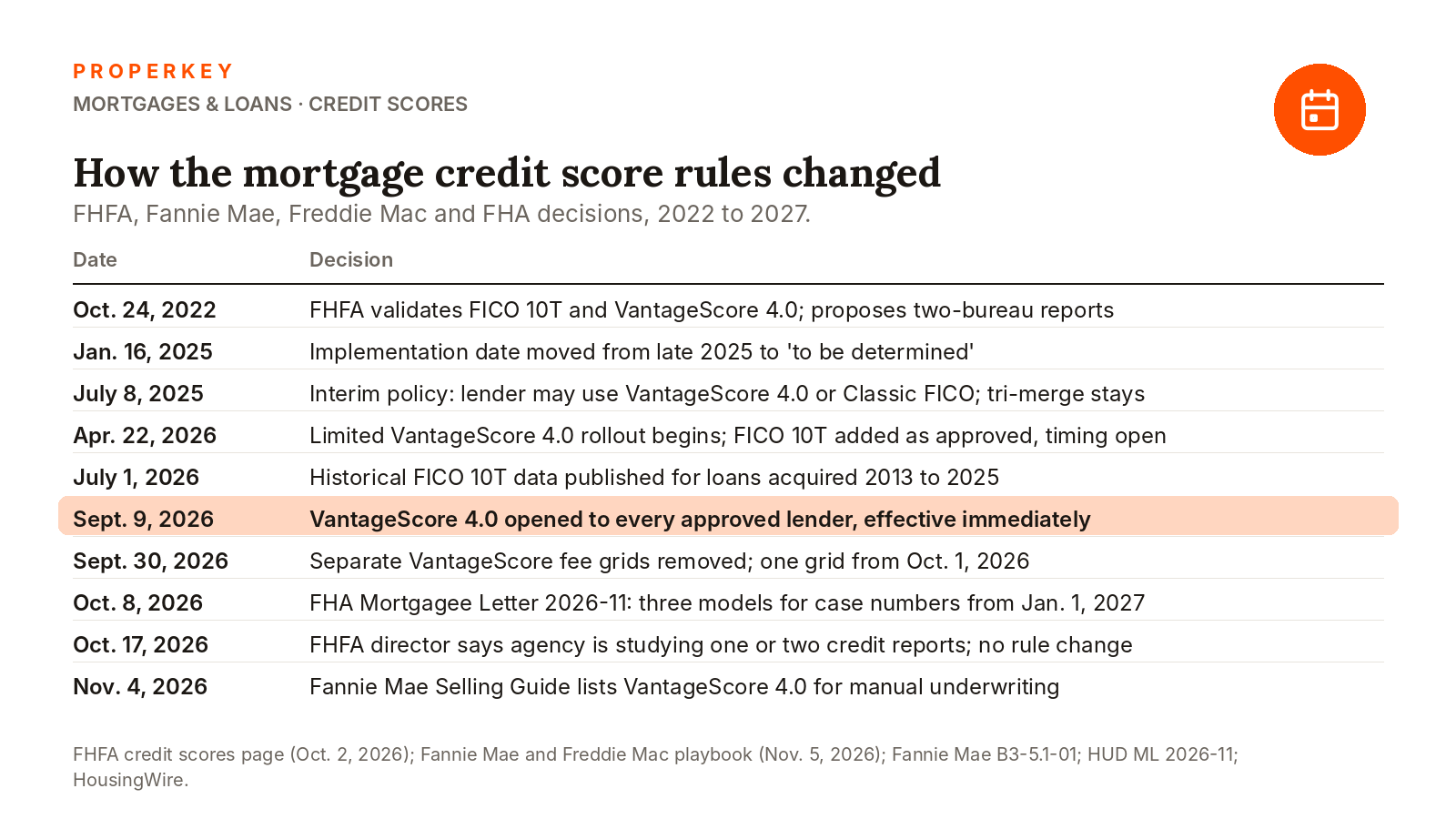
Not yet. FHFA proposed a two-bureau "bi-merge" report when it validated the new models in October 2022, postponed it in January 2025, and kept the three-bureau requirement under the July 2025 interim policy. Its current FAQ says adding VantageScore 4.0 does not change credit reporting requirements for now. A bi-merge announcement reported as imminent in early October did not come; Director Bill Pulte cancelled his appearance at the Mortgage Bankers Association convention, and on October 17 he wrote that the agency is "studying the usage of just one or two credit reports" (HousingWire, October 19). As of this writing no guidance has changed the three-report rule.
Are the two scores priced the same?
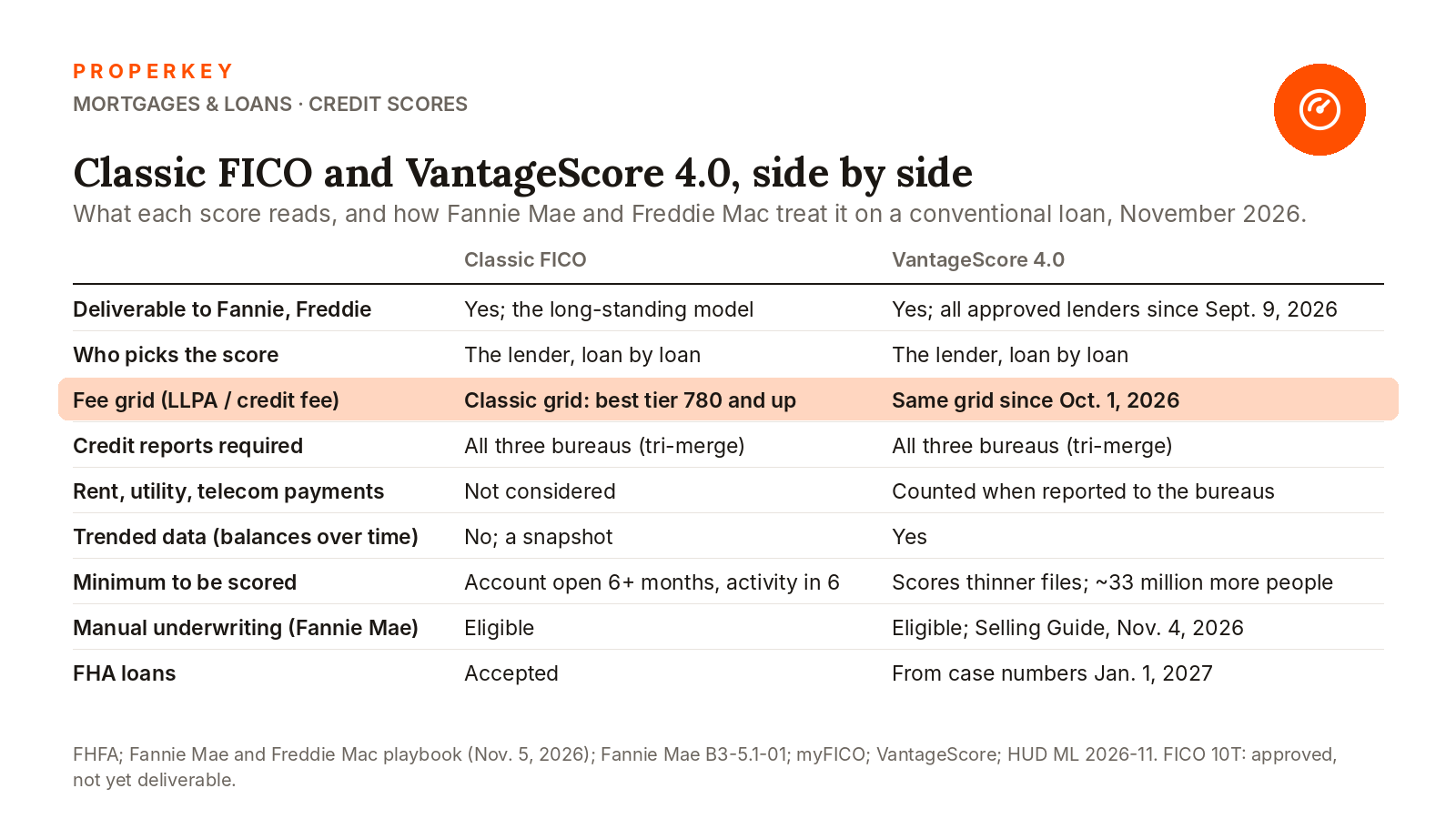
Yes, since October 1. When VantageScore 4.0 opened to all lenders on September 9, the enterprises published separate fee grids that set each VantageScore band 20 points above its FICO equivalent: the best purchase tier was 780 and up for FICO and 800 and up for VantageScore (HousingWire, September 9). The offset was dropped three weeks later. The playbook states that on September 30 "the GSEs removed the separate VantageScore 4.0 grids and aligned loan-level pricing across Classic FICO and VantageScore 4.0," for Fannie Mae loans purchased or pooled, and Freddie Mac loans settled, on or after October 1, 2026.
The fee is the loan-level price adjustment, paid at closing or folded into the rate. On Fannie Mae's Classic FICO purchase grid in the LLPA Matrix published September 9, a loan at 75.01% to 80% loan-to-value pays 1.375% at a 700 to 719 score, 1.250% at 720 to 739, 0.875% at 740 to 759 and 0.375% at 780 and above. On a $700,000 loan, which is 80% of an $875,000 home, a borrower whose Classic FICO is 705 would pay $9,625; if the same borrower's VantageScore 4.0 is 745 and the lender delivers on it, the fee is $6,125, a difference of $3,500. That is an illustration: some borrowers score lower on VantageScore, and the matrix waives these fees entirely for "first-time homebuyers with qualifying income ≤100% area median income (AMI) or 120% AMI in high-cost areas."
How do VantageScore 4.0 and Classic FICO differ?
Both are built from the same three credit files; they differ in what they read and whom they can score.
Rent, utilities and telecom. The playbook says the newer models "consider trended credit data and additional data such as rent, which are not currently considered as part of the Classic FICO score." VantageScore says its models use rent and utility payments when they are reported to the three bureaus.
Trended data. Classic FICO reads a snapshot. VantageScore 4.0 looks at how balances and payments have moved; the Congressional Research Service describes a 24-month window (CRS, July 17, 2026).
Minimum scoring criteria. A FICO score requires "at least one account opened for six months or more" and one account reported within the past six months (myFICO). VantageScore 4.0 scores thinner and newer files; the company says it can score "approximately 33 million more consumers," more than 10 million of them at 620 or above.
The rent advantage has a catch: the data must be on the credit report. CRS cites a Consumer Financial Protection Bureau estimate that only 1.7% to 2.3% of renters are likely to have rent reported. Under California's AB 2747, since April 1, 2025, landlords must offer tenants positive rent reporting to at least one national bureau, for a fee of up to $10 a month; buildings of 15 or fewer units are generally exempt (California Apartment Association). A renter planning to buy should accept the offer well ahead of applying; Properkey also has a guide to getting a mortgage with no credit history.
Why are so few loans priced with VantageScore?
Lenders pull the score faster than they use it. The Bank of America report counted 148 sellers delivering loans with a VantageScore 4.0 pulled in October and 173 in the first ten days of November, but only 22 and 37 that priced with it (8 in September). Rocket and UWM made up 65% of loans with the score pulled. Among VantageScore-priced loans where both scores were reported, the VantageScore averaged about 43 points above FICO; lenders deliver it when it is the higher number.
A higher score is not automatically a lower rate. A Milliman study of Rocket and UWM loans from May to August 2026, before the single grid, found VantageScore loans carried rates about 9 basis points higher after controlling for borrower characteristics. Compare offers, not scores.
What should a California buyer ask a lender?
Do you pull Classic FICO, VantageScore 4.0 or both, and which will you deliver on my loan?
What is my middle score under each model, and each co-borrower's? One model applies to everyone on the loan, so the answer turns on the lowest borrower.
Will you price the loan both ways and show the rate, points and lender credits for each on a Loan Estimate?
Does the mortgage insurance quote change with the score model?
Do I qualify for the first-time-buyer fee waiver or a down payment assistance program, and which score does that program use?
A lender may deliver only Classic FICO; if so, get a second quote from one that prices both. Properkey has a guide to shopping for a mortgage rate, and with Properkey Finance you apply once, the lenders are shopped and you pick the terms. Rates and prices are in the November 17 market update.
Questions people ask
Can I make my lender use VantageScore 4.0? No. Fannie Mae and Freddie Mac leave the choice to the lender, loan by loan, and a lender that is not ready may keep using Classic FICO. You can choose a lender that uses it.
Is VantageScore 4.0 always higher than FICO? No. It reads different data, so it can be higher or lower for the same person. The 43-point average gap in the October data comes only from loans that lenders chose to price on VantageScore.
Do lenders still pull all three credit reports? Yes. Fannie Mae, Freddie Mac and FHA still require scores from Equifax, Experian and TransUnion. FHFA has said it is studying one or two reports, but no rule has changed.
Can I use FICO 10T for a mortgage? Not on a conventional loan today. It is approved by FHFA but not yet eligible for delivery to Fannie Mae or Freddie Mac; FHA will accept it for case numbers assigned on or after January 1, 2027.
This article summarizes agency guidance and published data for general information and is not financial advice; a licensed mortgage loan originator can price a specific loan. An earlier Properkey article covers how credit scores are built.
Sources: HousingWire, Nov. 16, 2026 (Bank of America Global Research / Recursion) · FHFA credit scores · FHFA credit score FAQ · FHFA, Oct. 24, 2022 · FHFA, Apr. 22, 2026 · Fannie Mae and Freddie Mac playbook, Nov. 5, 2026 · Freddie Mac credit score models · Fannie Mae LL-2026-06 · Fannie Mae B3-5.1-01 · Fannie Mae LLPA Matrix · HUD Mortgagee Letter 2026-11 · HousingWire, Sept. 9, 2026 · HousingWire, Oct. 1, 2026 (one grid) · HousingWire, Oct. 1, 2026 (bi-merge) · HousingWire, Oct. 19, 2026 · Scotsman Guide, Oct. 12, 2026 · VantageScore FAQs · myFICO · CRS IF12588, July 17, 2026 · Milliman, Sept. 28, 2026 · California Apartment Association (AB 2747)
Written by Keyro, Properkey's AI. Properkey, DRE #01979718.



