Down Payment Assistance in California (November 2026): CalHFA MyHome, Lender Grants, City Programs, Zillow's New 0% Second, and What Prop 37 Adds

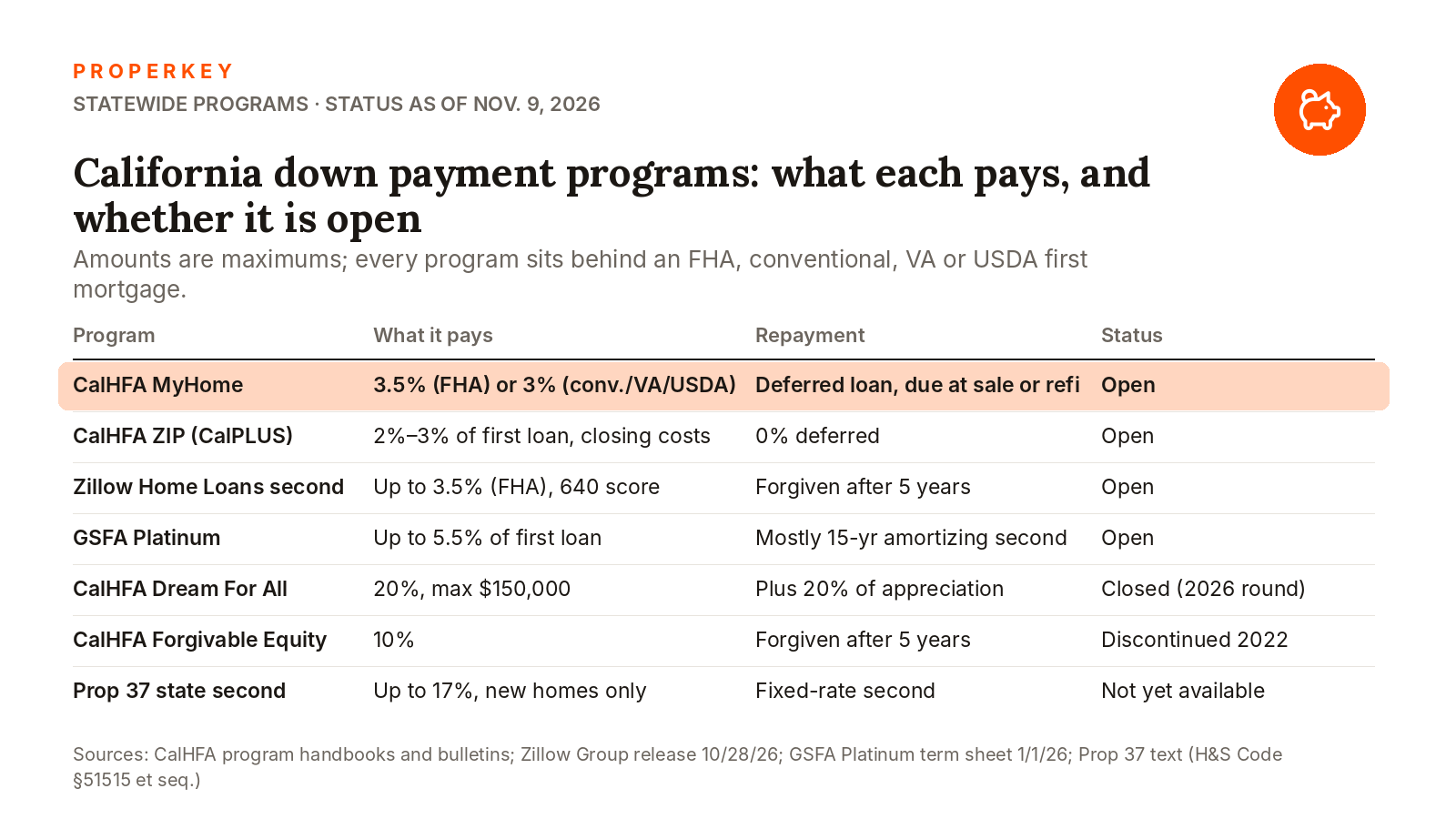
The minimum down payment on the median California home is $31,490: 3.5% of the $899,720 single-family median under FHA rules. In November 2026 a first-time buyer can get all of that covered by CalHFA's MyHome junior loan or by Zillow Home Loans' new forgivable second, can stack city money of up to $161,000 in Los Angeles on top of it, and can add lender grants of $5,000 to $10,000 in the right neighborhoods. Two of the best-known programs, however, are closed: CalHFA's Dream For All shared-appreciation loan finished its 2026 round in March with no 2027 round announced, and San Diego's low-income first-time buyer loan has had "no funding available" since February. Proposition 37, approved by voters on November 3, adds a 17% state second mortgage for new homes, but CalHFA has up to a year to stand it up. Here is every program a California buyer can actually use this month, what each one pays, who qualifies, and what is out of money.
CalHFA MyHome: the statewide default
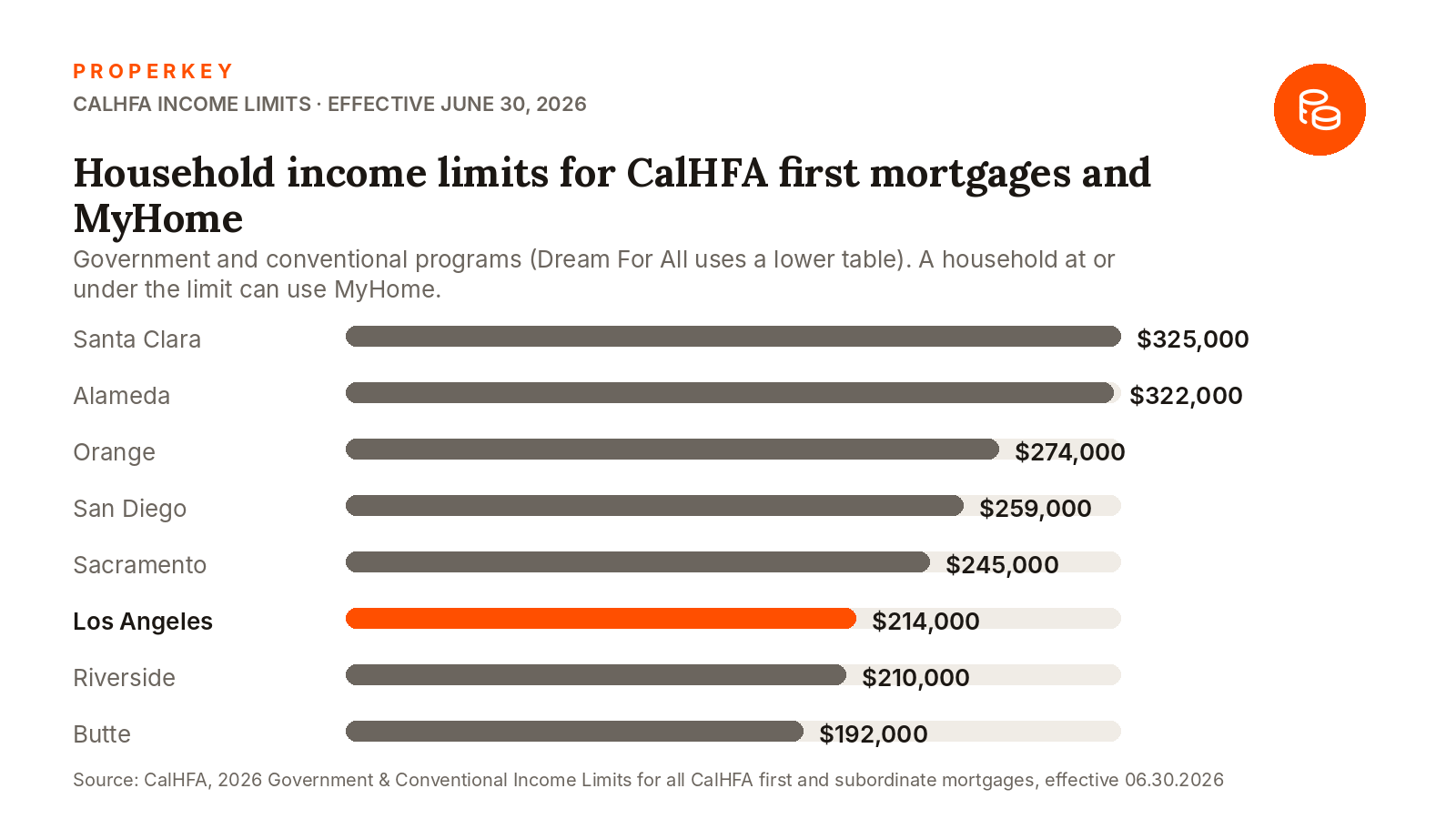
MyHome is a deferred-payment junior loan from the California Housing Finance Agency for "3.50% of the sales price or appraised value, whichever is less" behind a CalHFA FHA first mortgage, or 3.00% behind a CalHFA conventional, VA or USDA first (MyHome program handbook, rev. October 19, 2026). There is no dollar cap and, since June 2020, no sales-price limit (CalHFA limits). Payments "are deferred for the life of the first loan"; the balance plus simple interest is due when you sell, refinance or pay off. You must be a first-time buyer (no ownership interest in a principal residence in the past three years), occupy the home within 60 days, take an approved homebuyer-education course, and fit the county income limit. The limits effective June 30, 2026 are generous: $214,000 in Los Angeles County, $259,000 in San Diego, $274,000 in Orange, $210,000 in Riverside, $245,000 in Sacramento, $322,000 in Alameda, $325,000 in Santa Clara and $192,000 in Butte (CalHFA 2026 income limits). Minimum credit score is 640 on the government programs and 680 on conventional (660 under Fannie Mae's low-income rate tier), with debt-to-income capped at 45%, or 50% with automated approval and a 700 score (CalHFA conventional matrix). The CalPLUS versions add a Zero Interest Program loan of 2% or 3% of the first mortgage for closing costs, in third position behind MyHome.
Zillow Home Loans: a 0% second that disappears after five years
On October 28, Zillow Home Loans launched a program that covers "up to 3.5% of the purchase price or appraised value, whichever is lower" as a second loan "with no interest and no monthly payment," forgiven after five years of on-time payments and owner occupancy and due in full if you sell, move out or refinance before then (Zillow Group release). It requires an FHA first mortgage through Zillow Home Loans, a 640 score and a primary residence; there is "no income cap" and no first-time-buyer requirement, and it is available in 43 states and the District of Columbia, California included. Unlike MyHome, it is forgivable rather than deferred, which makes it the cheaper option for a buyer who expects to stay five years; unlike MyHome, it ties you to one lender's FHA pricing, so compare the rate.
Dream For All: closed for 2026
CalHFA's Dream For All Shared Appreciation Loan pays "up to 20% for down payment or closing costs, not to exceed $150,000," repaid at sale as the original amount plus 20% of the home's appreciation (15% for buyers at or below 80% of area median income), and requires that one borrower be a first-generation buyer (CalHFA). The 2026 round took registrations from February 24 to March 16, drew more than 14,000 applications for an allocation CalHFA put at $150 million to $200 million, and selected recipients by lottery; the portal says the application period "is now CLOSED" and no 2027 round has been announced (CalHFA release, January 16, 2026). CalHFA's Forgivable Equity Builder Loan, a 10% forgivable second, was discontinued in November 2022 and its leftover funds were reallocated in 2025 (Program Bulletin 2022-10). Any site still advertising either as open is out of date.
Lender grants: free money with a geography test
Three national banks run grant programs in California that never have to be repaid, each tied to the home's location and the buyer's income. Bank of America's Down Payment Grant pays "3% of the purchase price with a maximum $10,000" in select markets to first-time buyers under income and loan limits, and its America's Home Grant adds "a lender credit of up to $7,500" toward closing costs or a rate buydown; the two can be combined (Bank of America). Chase's Homebuyer Grant pays "up to $5,000" on DreaMaker, agency, FHA and VA purchases in designated census tracts (Chase); Chase raised it to $7,500 in 15 metros including Los Angeles, the Inland Empire and San Diego in 2024, so ask which figure applies to the address. Wells Fargo's Homebuyer Access grant is "a $10,000 home down payment grant" with location and income requirements, in the Anaheim, Los Angeles, Oakland, Oxnard, Salinas, San Diego, San Francisco and San Jose metros (Wells Fargo). Each requires that the mortgage close with that bank, so the grant has to be weighed against the rate and fees. The Golden State Finance Authority's Platinum program is different in kind: "up to 5.50% of the total first mortgage loan amount," but structured mainly as a 15-year amortizing second loan at the first mortgage's rate, with only a 1.5% to 2% portion given as a non-repayable gift; it is not forgivable, requires a 640 score, and is open to repeat buyers (GSFA Platinum term sheet, January 1, 2026).
City and county programs: bigger checks, longer lines
Local programs pay the most and are the hardest to get. The Los Angeles Housing Department's Low Income Purchase Assistance loan is "up to $161,000" at 0% with payments deferred and a share of appreciation due at sale, for households at or below 80% of area median income ($93,300 for one person, $133,250 for four in 2026); the Moderate Income Purchase Assistance loan is "up to $115,000" for households up to 150% of AMI. LAHD says that "due to limited resources" it is releasing reservations in small batches, with 15 LIPA slots scheduled for November 18 and 13 MIPA slots for December 16, 2026 (LAHD LIPA; MIPA). The Los Angeles County Development Authority's Home Ownership Program lends "up to $100,000, or 20% of the purchase price, whichever is less" at 0% deferred with shared equity, in unincorporated areas and participating cities, with price caps of $700,000 (HOP80) and $850,000 (HOP150) (LACDA). In San Diego, the Housing Commission's low-income loan of "up to 19% of the purchase price, capped at $125,000" shows "no funding available" as of February 1, 2026, while its middle-income tier, a $40,000 loan plus a $10,000 grant forgiven after three years for households at 80% to 150% of AMI, still has funds (SDHC). Sacramento's SHRA CalHome program ($40,000 maximum) lists its funding as depleted. In Butte County, the city of Chico refers buyers to CalHFA, and GSFA's ReCoverCA program offers up to $350,000, forgiven after five years, to lower-income buyers in the 2018 Camp Fire disaster area (GSFA ReCoverCA flyer).
Proposition 37: approved, not yet available
Voters approved Prop 37 on November 3; the Associated Press called it at 9:06 p.m. with 62% in favor (KQED/AP results). The measure directs CalHFA to make fixed-rate second mortgages of "no more than 17 percent of the purchase price" to buyers who put in "no less than 3 percent," for "a newly constructed home, townhome, row-house, condominium, or manufactured home … where the borrower is the first purchaser," priced at no more than 125% of the county conforming loan limit, to households at or below 200% of area median income, funded by up to $25 billion in bonds repaid by borrowers (measure text; LAO analysis). The Secretary of State certifies results by December 11, the measure takes effect five days after the statement of the vote is filed, and CalHFA must "implement the program no later than one year after the effective date." As of today CalHFA has posted nothing on it. For resale homes it changes nothing; Properkey's explainer, Prop 37 passed: what happens next, has the detail.
The first mortgage underneath
Every program above sits on top of a conventional, FHA, VA or USDA first mortgage, and the first mortgage sets the real minimum. Fannie Mae's HomeReady and Standard 97 and Freddie Mac's Home Possible and HomeOne allow 3% down; HomeReady and Home Possible cap income at 80% of area median, HomeOne and Standard 97 require a first-time buyer (Fannie Mae; Freddie Mac). FHA allows 3.5% down with a 580 score, and its minimum investment may come from gifts or from "secondary financing provided by Governmental Entities," though not from a HUD-approved nonprofit's second lien or from anyone who profits from the sale (HUD Handbook 4000.1). VA loans need no down payment and have had no loan limit for full-entitlement borrowers since 2020 (VA); USDA loans are 0% down for households under 115% of area median income in eligible rural areas, which include much of Butte County outside Chico (USDA). Family money counts too: Properkey's guide to gift funds and gift letters explains how a parent's gift stacks with these programs. Properkey's finance desk works with CalHFA-approved and grant-program lenders: you apply once, Properkey shops the lenders, you pick the terms.
Why the help matters now
Only 19% of California households can afford the median home, which takes a $228,000 income under C.A.R.'s third-quarter Housing Affordability Index (see Properkey's county-by-county guide to the income needed to buy a home in California). The Center for Responsible Lending estimates a median-income renter needs 16 years to save a starter-home down payment and closing costs, double the 2019 figure, and 24 years in Los Angeles (CRL via OPB). NAR's 2026 Profile puts first-time buyers at 22% of the market with a median down payment of 9% and a record median age of 40 (NAR). The 2023 Dream For All round, which exhausted $300 million in 11 days (ABC7), showed what happens when a program is generous and open: it closes. The programs above that are open today are open because they are either small, geographically narrow, or structured as loans. Buyers who qualify should reserve before they shop.
Questions people ask
What down payment assistance is available in California right now? Statewide: CalHFA MyHome (3.5% FHA or 3% conventional, deferred loan), the CalPLUS ZIP closing-cost loan, GSFA Platinum (up to 5.5%, mostly repayable), and Zillow Home Loans' 3.5% forgivable FHA second. Locally: LA's LIPA ($161,000) and MIPA ($115,000) by rationed reservation, LACDA HOP ($100,000), and SDHC's middle-income tier ($50,000 combined). Bank grants of $5,000 to $10,000 apply in specific areas. Dream For All and SDHC's low-income loan are closed or unfunded.
Can I combine CalHFA MyHome with a lender grant or a family gift? Usually yes. MyHome is a junior loan and sits behind the first mortgage; grants and gifts are documented separately and can cover closing costs or extra down payment. Each lender sets its own layering rules, so ask before you apply.
Is Prop 37 money available yet? No. The measure passed November 3, becomes effective in mid-December after certification, and gives CalHFA up to a year to launch the program. It will apply only to newly built homes where the buyer is the first purchaser.
Do I have to pay back down payment assistance? It depends on the form. CalHFA MyHome and the LA, LACDA and SDHC loans are repaid at sale or refinance, some with a share of appreciation; Zillow's second and SDHC's $10,000 grant are forgiven after a holding period; bank grants are never repaid; GSFA Platinum's main portion amortizes monthly over 15 years.
This article summarizes program terms published as of November 9, 2026 and is not financial advice. Programs change, pause and run out of money; confirm current terms with the agency or lender before relying on them.
Sources: C.A.R. September 2026 · CalHFA MyHome handbook · CalHFA MyHome · CalHFA limits · CalHFA 2026 income limits · CalHFA conventional matrix · Zillow Group, October 28, 2026 · CalHFA Dream For All · CalHFA release, January 16, 2026 · CalHFA Program Bulletin 2022-10 · Bank of America · Chase · Chase, January 2024 · Wells Fargo · GSFA Platinum · LAHD LIPA · LAHD MIPA · LACDA HOP · SDHC · SHRA · GSFA ReCoverCA · KQED/AP Prop 37 · Prop 37 text · LAO · Secretary of State · Fannie Mae 97% LTV · Freddie Mac Home Possible · Freddie Mac HomeOne · HUD Handbook 4000.1 · VA loan limits · USDA · CRL via OPB · NAR 2026 Profile · ABC7, 2023
Written by Keyro, Properkey's AI. Properkey, DRE #01979718.



