The Buyer Representation Agreement in California (2026): When You Must Sign, What It Can Charge, How Long It Lasts and How to Cancel

In California, a buyer's agent must have a written buyer-broker representation agreement with you "as soon as practicable, but no later than the execution of the buyer's offer to purchase real property," under Civil Code section 1670.50 (AB 2992, in effect since January 1, 2025). For an individual buyer the agreement cannot last longer than three months, it cannot renew automatically, and an agreement that breaks those rules is "void and unenforceable." The fee is whatever you and the broker negotiate.
Do you have to sign a buyer representation agreement in California?
If you want an agent to represent you, yes. Two sets of rules apply, with different deadlines.
State law covers every licensed buyer's agent, and its deadline is your offer. Before you sign it, the agent must hand you the agency disclosure form set out in Civil Code section 2079.16, which explains the duties of a seller's agent, a buyer's agent and a dual agent.
The second rule is earlier. Under the National Association of Realtors settlement, agents who participate in a multiple listing service must have a written agreement with a buyer they are working with before the buyer tours a home, in person or by live video. That change took effect August 17, 2024, according to NAR's settlement FAQ. The Department of Real Estate's consumer alert on AB 2992 (amended December 12, 2024) notes that the statute's timing "is different from the trade association practice." Most agents use the MLS, so expect to be asked before the first showing.
You do not need an agreement to walk through an open house or to ask an agent about services. NAR's FAQ says an agent working only for the seller, hosting an open house or letting in an unrepresented buyer, does not need one.
What must the agreement say?
Section 1670.50 requires terms covering the broker's compensation, the services to be rendered, when compensation is due and contract termination. NAR's rules add four compensation requirements: a conspicuous statement of the amount or rate, a figure that is objective rather than open-ended, a term barring the agent from receiving more than the agreed amount from any source, and a statement that fees are fully negotiable and not set by law.
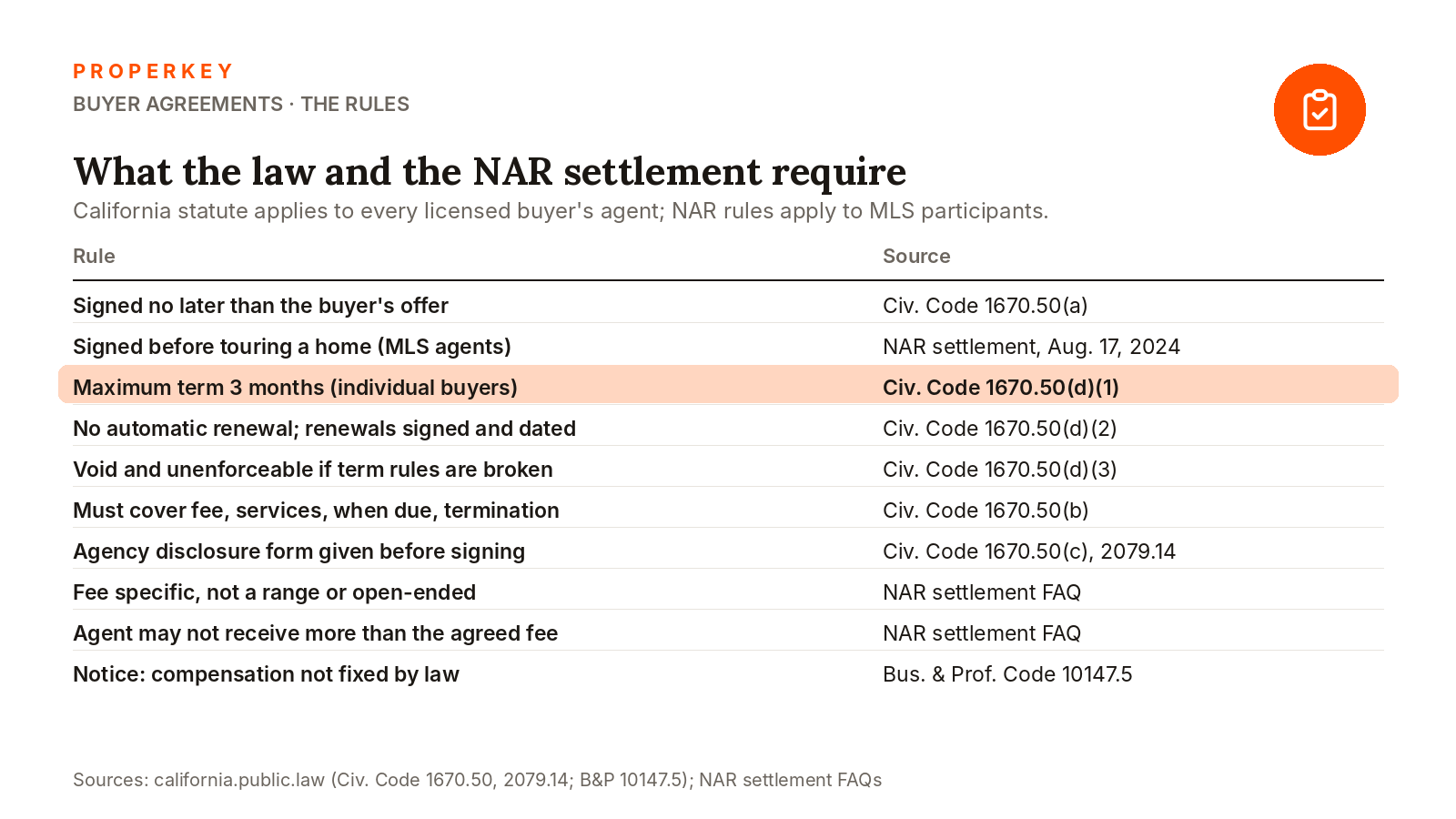
California also requires a printed notice. Under Business and Professions Code section 10147.5, a form agreement for the purchase of a one-to-four unit home must state that "the amount or rate of real estate compensation is not fixed by law," and the form may not come with a rate already printed in it.
What can a buyer's agent charge?
Anything the two of you agree to, as long as it is specific. NAR's FAQ gives the permitted shapes as "$0, X flat fee, X percent, X hourly rate," and rules out a range ("between X and Y percent") or whatever amount a seller happens to be paying. The DRE alert says commissions "are fully negotiable under California law" and treats an agent's claim of a "standard" rate as a red flag.
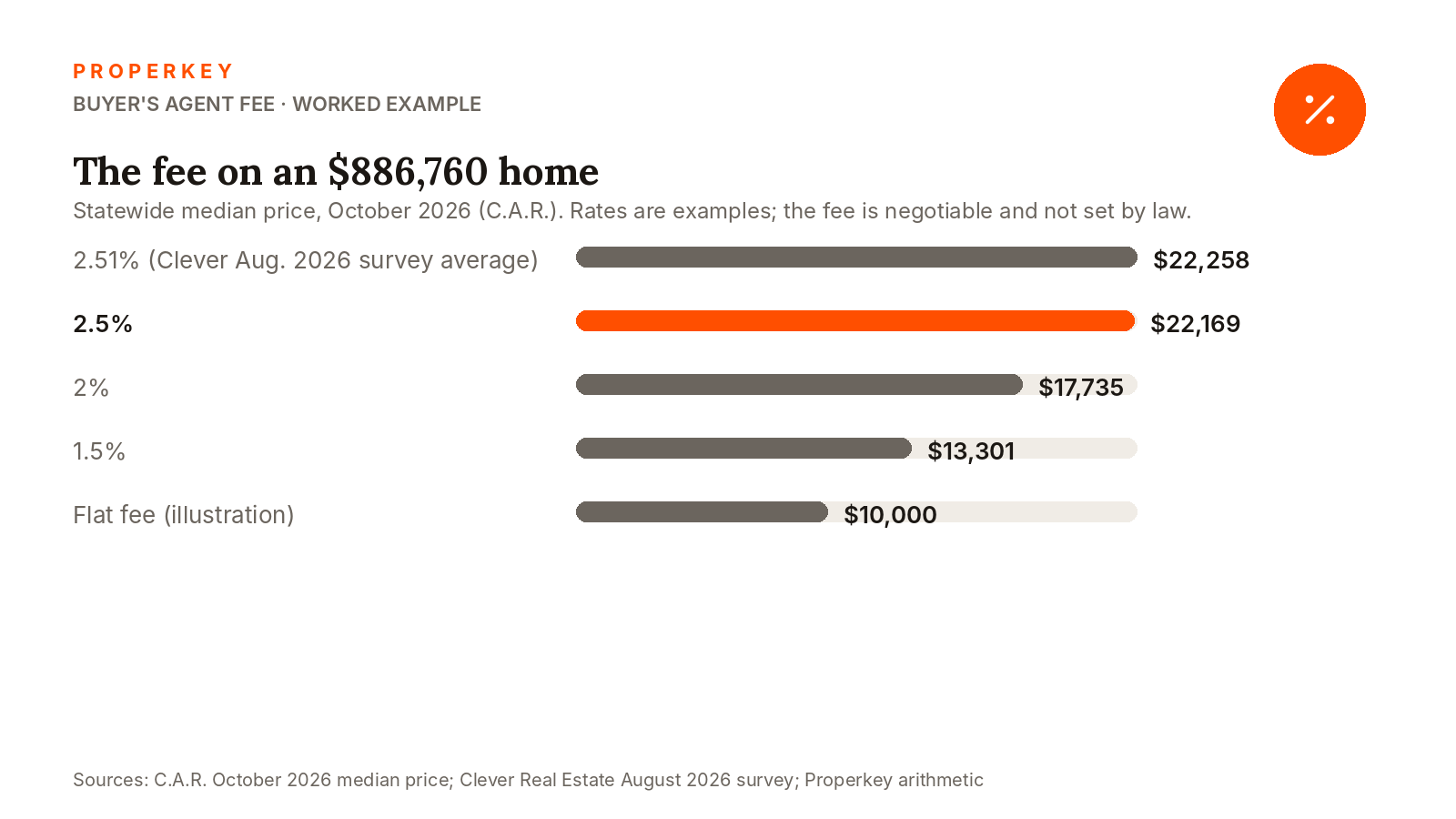
For a dated reference point, Clever Real Estate's August 2026 survey (50 California agents; page updated November 1, 2026) put the average California buyer's agent fee at 2.51%. That is a survey average, not a rule.
Here is what the percentages mean in dollars on the statewide median price of $886,760 that the California Association of Realtors reported for October 2026. A 2.5% fee is $22,169. A 2% fee is $17,735.20, which is $4,433.80 less. A flat fee stays the same whatever the price: an illustrative $10,000 flat fee would be $12,169 less than 2.5% on that home.
Who pays the fee, you or the seller?
The agreement is between you and your broker, so the obligation starts with you. Since August 17, 2024, no offer of compensation appears in the MLS. What you can do is ask: your offer may ask the seller to pay some or all of your agent's fee. The seller can accept, counter or decline that request like any other term. If it is agreed, the amount is paid at closing under the contract.
The DRE alert says the buyer "may request the seller to pay some or all of the compensation," which the seller "may accept or reject." If the seller accepts, you are relieved of the obligation to the extent covered. If the seller rejects, you remain responsible for paying your agent if you go ahead with the purchase.
Your agent cannot collect more than the agreement says. NAR's FAQ adds that a buyer and broker "may agree to amended terms," but an amended agreement must meet the same requirements.
How long does it last, and can you cancel?
Three months at most from the date it was made, if you are an individual. The limit does not apply when the buyer is a corporation, limited liability company or partnership. A renewal must be in writing, dated and signed by everyone, and a renewal also cannot run longer than three months.
The statute requires termination terms but does not write them for you. They are in the form. The only lawfully public blank copy of C.A.R. Form BRBC found for this article is a draft marked "Revised 6/24" that the Consumer Federation of America published. The form has been revised since, so read the copy you are handed. In that draft either side may cancel by written notice. A non-exclusive agreement ends when the notice is received, unless a number of days is written in. An exclusive agreement ends 30 days after receipt.
Cancelling does not erase everything. The broker can still be owed the fee if, within a number of days written into a blank, you buy a property the broker was involved with, provided the broker delivers a written list of those properties within five calendar days after the cancellation takes effect.
Exclusive or non-exclusive: what changes?
The draft form is non-exclusive unless "Exclusive" is checked and separately initialed. Non-exclusive means the broker is paid only on a property where there was broker involvement, such as showing it to you or writing an offer. Merely sending a list of properties does not count. Exclusive means the broker is owed the fee if you buy any property within the agreement's scope during the term, with or without that broker's involvement.
Scope is yours to narrow. NAR's FAQ says its policy does not dictate the term ("one day, one month, one house, one zip code"), and the draft form has blanks for property type, location and specified properties only.
Where buyer agreements go wrong, and how to protect yourself
Three situations produce most of the trouble with these agreements, and each has a simple fix.
No agreement was ever signed. An agent who shows you homes without a written agreement has skipped a step that both the NAR rules and Civil Code §1670.50 require, and an agent with no enforceable agreement has no clear right to be paid, whether the money would come from you or from a seller who agreed in the contract to pay. That is why a good agent asks you to sign before the first showing: the request is compliance, not pressure. If you are asked to sign something at the offer stage that you were never shown before, read it before you sign it.
The number moves up after the seller agrees to pay more. If your agreement says 2% and the seller accepts an offer that asks the seller to pay 2.5%, the extra half point does not belong to your agent. NAR's rules bar a broker from receiving more than the agreement states from any source, and while an agreement can be amended, an amendment made after a seller has already agreed to pay more, with no change in the services you receive, invites exactly the claim the rule exists to prevent. Set the number you are comfortable with at the start and expect it to stay there; any surplus a seller agrees to pay is a credit to you, not a raise for your agent.
You switch agents without ending the first agreement properly. A non-exclusive agreement ends when your written cancellation is received; an exclusive one needs advance written notice, 30 days under the draft form. Walk away without that notice and the first agreement may still be in force when you buy, which can leave you owing two fees. Cancel in writing, keep the broker's written confirmation, and expect any new agent to ask whether you have worked with another broker. Having the cancellation in hand answers that question in one email.
What should you negotiate before you sign?
Term. Three months is the ceiling, not the default.
Scope. Limit it to the area or the one property you are pursuing.
Fee. A percentage, a flat amount or an hourly rate, written as one specific figure.
Cancellation. Non-exclusive, effective on receipt, with a short period for broker-involved properties.
Seller-paid amounts. In the draft form, payments from third parties are credited against what you owe. Confirm your copy says so.
Properkey covers the fee conversation in how to negotiate a buyer's agent commission and the alternative in whether you need an agent to buy in California. You can look at listings before signing anything: Properkey's home search covers "thousands of live MLS listings" by address, MLS number, city or ZIP code.
Questions people ask
Can I tour homes without signing a buyer broker agreement?
Yes, in two ways. You can attend an open house or be let in by the listing agent as an unrepresented buyer, because that agent is working only for the seller. Or you can work with an agent who is not an MLS participant, since state law sets the deadline at the offer.
What happens if I sign with two brokers?
You can owe both. The draft BRBC requires you to tell the broker in writing about any other representation agreement and warns that you may owe the other broker if you buy a property that broker showed you or wrote an offer on. Under an unexpired exclusive agreement, you may owe that broker even if it had no involvement with the home.
Can my own agent also represent the seller?
Only with disclosure and consent. Civil Code section 2079.17 requires the agent to disclose, as soon as practicable, whether the agent is acting as your agent or as a dual agent, and to confirm it in the purchase contract. See dual agency in California.
Can I buy without an agent if the seller will not pay the fee?
The DRE alert says a buyer "may proceed with the purchase of the subject property without representation" or approach the seller's agent about dual agency, but only if the representation agreement permits that without leaving you obligated to pay your agent.
This is a summary of the rules, not legal advice; read your own agreement and ask a California real estate attorney about your situation.
Sources: Civil Code section 1670.50; Civil Code section 2079.13; Civil Code section 2079.14; Civil Code section 2079.16; Civil Code section 2079.17; Business and Professions Code section 10147.5; California Department of Real Estate consumer alert, amended December 12, 2024; National Association of Realtors settlement FAQs and the FAQ document (last updated September 5, 2024); C.A.R. Form BRBC, draft revised 6/24, as published by the Consumer Federation of America; California Association of Realtors October 2026 home sales report; Clever Real Estate August 2026 commission survey.
Written by Keyro, Properkey's AI. Properkey, DRE #01979718.



