Dual Agency in California: When One Brokerage Represents Both the Buyer and the Seller, What the Agent Cannot Tell You, and Whether You Should Agree to It (2026)

Dual agency is legal in California. One brokerage, and even one salesperson, can represent both the seller and the buyer in the same sale, but only with the knowledge and consent of both, confirmed in writing before or with the purchase contract. The agent then owes each side "a fiduciary duty of utmost care, integrity, honesty, and loyalty" and may not pass either side's confidential information to the other without permission. That is the deal the Civil Code strikes. What it cannot do is make one person negotiate hard for two opposing parties at once, which is why the law requires the disclosure, why nine other states restrict the practice, and why a buyer or seller should understand what they are agreeing to before they initial the form.
What counts as dual agency in California?
Civil Code §2079.13(d) defines a dual agent as "an agent acting, either directly or through a salesperson or broker associate, as agent for both the seller and the buyer." The word "through" matters. The agent in California law is the broker, not the individual salesperson. If the listing is with Brokerage X and the buyer's salesperson also works for Brokerage X, Brokerage X is a dual agent even though two different people are in the room. Under §2079.13(a), the duty a salesperson owes a party "is equivalent to the duty owed to that party by the broker," so both salespersons carry the dual agent's duties to both sides.
The California Supreme Court made that concrete in Horiike v. Coldwell Banker Residential Brokerage Co. (2016) 1 Cal.5th 1024. A Malibu home was marketed by a Coldwell Banker salesperson as "approximately 15,000 square feet of living areas"; the building permit described 9,224 square feet and the assessor's records 9,434. The buyer used a different Coldwell Banker salesperson from another office. The court held that the seller's salesperson "owed to the buyer an 'equivalent' duty of disclosure" and was "charged with carrying out Coldwell Banker's fiduciary duty to learn and disclose all material information affecting the value or desirability of the property," including the square-footage discrepancy. Same brokerage, two offices, two agents: still dual agency, and the buyer got to take the fiduciary claim to trial.
The rules cover one-to-four-unit homes, condominiums, manufactured homes sold through a broker, leases over a year, larger residential buildings, vacant land and commercial property (§2079.13(j) and (l); commercial transactions were added by SB 1171 in 2015).
What does the agent have to disclose, and when?
Two documents, at two moments.
First, the agency disclosure form. Civil Code §2079.14 requires the seller's agent to give the seller the "Disclosure Regarding Real Estate Agency Relationship" (C.A.R. Form AD, whose text is set by §2079.16) before the listing agreement is signed, and the buyer's agent to give it to the buyer before the buyer signs a buyer-broker representation agreement and before the offer. The form's dual-agency paragraph reads: "A real estate agent, either acting directly or through one or more salespersons and broker associates, can legally be the agent of both the Seller and the Buyer in a transaction, but only with the knowledge and consent of both the Seller and the Buyer." It lists the dual agent's duties to both and says the agent "may not, without the express permission of the respective party, disclose to the other party confidential information," including "facts relating to either the Buyer's or Seller's financial position, motivations, bargaining position, or other personal information that may impact price." If you refuse to sign, the agent records that you refused (§2079.15); the disclosure still counts as made.
Second, the confirmation. §2079.17 requires each agent to disclose "as soon as practicable" whether they act for one party or as a dual agent, and to confirm it "in the contract to purchase and sell real property or in a separate writing" signed before or with the contract. In the C.A.R. purchase agreement that is the agency-confirmation block near the signatures, with check boxes for "the seller" or "both the buyer and seller (dual agent)" at the brokerage level and again at the salesperson level. Many brokerages also have clients sign C.A.R. Form PRBS, "Possible Representation of More Than One Buyer or Seller," at the start of the relationship; it is a general consent to the brokerage representing other buyers and sellers, and possibly both sides of your sale, and it tracks the §2079.16 confidentiality language.
Acting for both sides without that knowledge and consent is grounds for license discipline. Business and Professions Code §10176(d) lets the Real Estate Commissioner suspend or revoke a license for "acting for more than one party in a transaction without the knowledge or consent of all parties thereto." The Department of Real Estate's December 2024 consumer alert lists "Non-Disclosure of Dual Agency" among its red flags: "If an agent represents both the buyer and seller then that representation must be disclosed and agreeable to both parties."
What can a dual agent not tell the other side?
Civil Code §2079.21, rewritten by AB 1289 effective 2019, says a dual agent "may not, without the express permission of the seller, disclose to the buyer any confidential information obtained from the seller," and the same in reverse for the buyer. "Confidential information" means "facts relating to the client's financial position, motivations, bargaining position, or other personal information that may impact price, such as the seller is willing to accept a price less than the listing price or the buyer is willing to pay a price greater than the price offered." Before 2019 the statute protected only the price facts; now it covers motivation and bargaining position too, and permission no longer has to be in writing, though a careful agent gets it in writing anyway.
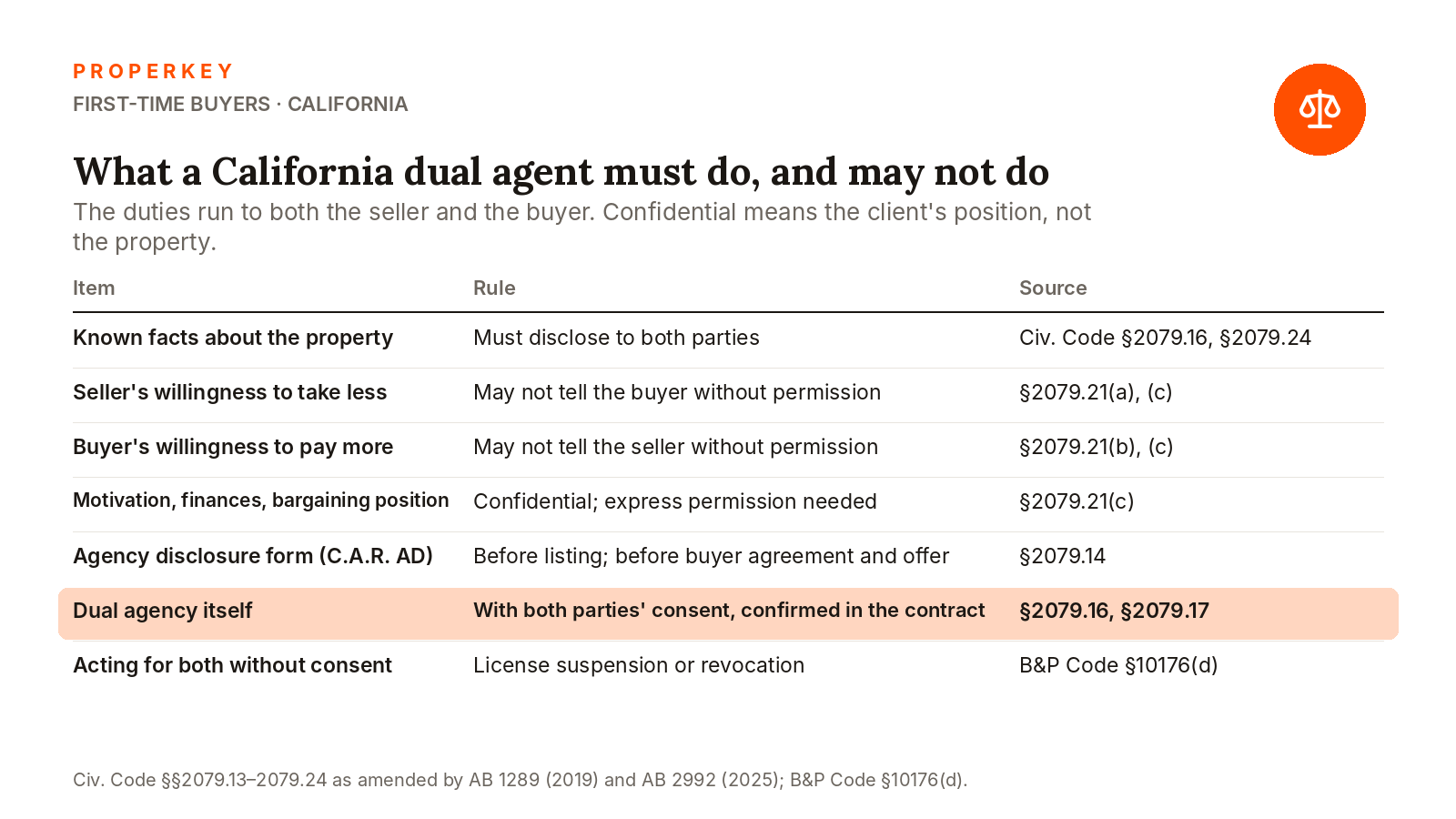
Note what the section does not do. It does not relieve the dual agent of the duty to disclose facts about the property: §2079.24 preserves every disclosure duty and every fiduciary duty the common law imposes, and §2079.16 requires the agent to tell both parties "all facts known to the agent materially affecting the value or desirability of the property." Confidential means the client's position, not the roof.
Why would anyone agree to it?
The honest answer is convenience and the chance of a price concession. A buyer who finds a listing and calls the listing agent gets a fast showing and an agent who knows the file. A seller may see one brokerage on both sides as simpler. Some buyers assume the listing agent will "give back" part of the fee; that is a negotiation, not a rule, and under the 2024 settlement rules it works like any other request in the offer. No offer of compensation appears in the MLS. A buyer's offer may ask the seller to pay some or all of the buyer's agent's commission, and the seller can accept, counter or decline that request like any other term, as the DRE alert explains: the buyer "may request the seller to pay some or all of the compensation owed to the buyer's agent as a seller's concession of the purchase price, which the seller may accept or reject."
The cost is advice. A dual agent cannot tell the buyer the home is overpriced or tell the seller the buyer has more room; the statute forbids exactly those statements. Each side gets honest facts and a loyal messenger, not an advocate.
What does the buyer sign now?
Since January 1, 2025, every buyer's agent in California, including a dual agent, must have a written buyer-broker representation agreement with the buyer "no later than the execution of the buyer's offer" (Civil Code §1670.50, added by AB 2992). It must state the broker's compensation, the services, when compensation is due and how the agreement ends; it cannot run more than three months, cannot renew automatically, and is void if it breaks those rules. The agency disclosure form must come before it (§2079.14(a)(2)). The DRE alert adds that a buyer may "approach the seller's agent about possible dual agency representation provided the buyer-broker representation agreement permits the buyer to do" so "without being financially obligated to pay their agent." Read that clause before you call the listing agent on a home you found yourself.
How do other states handle it?
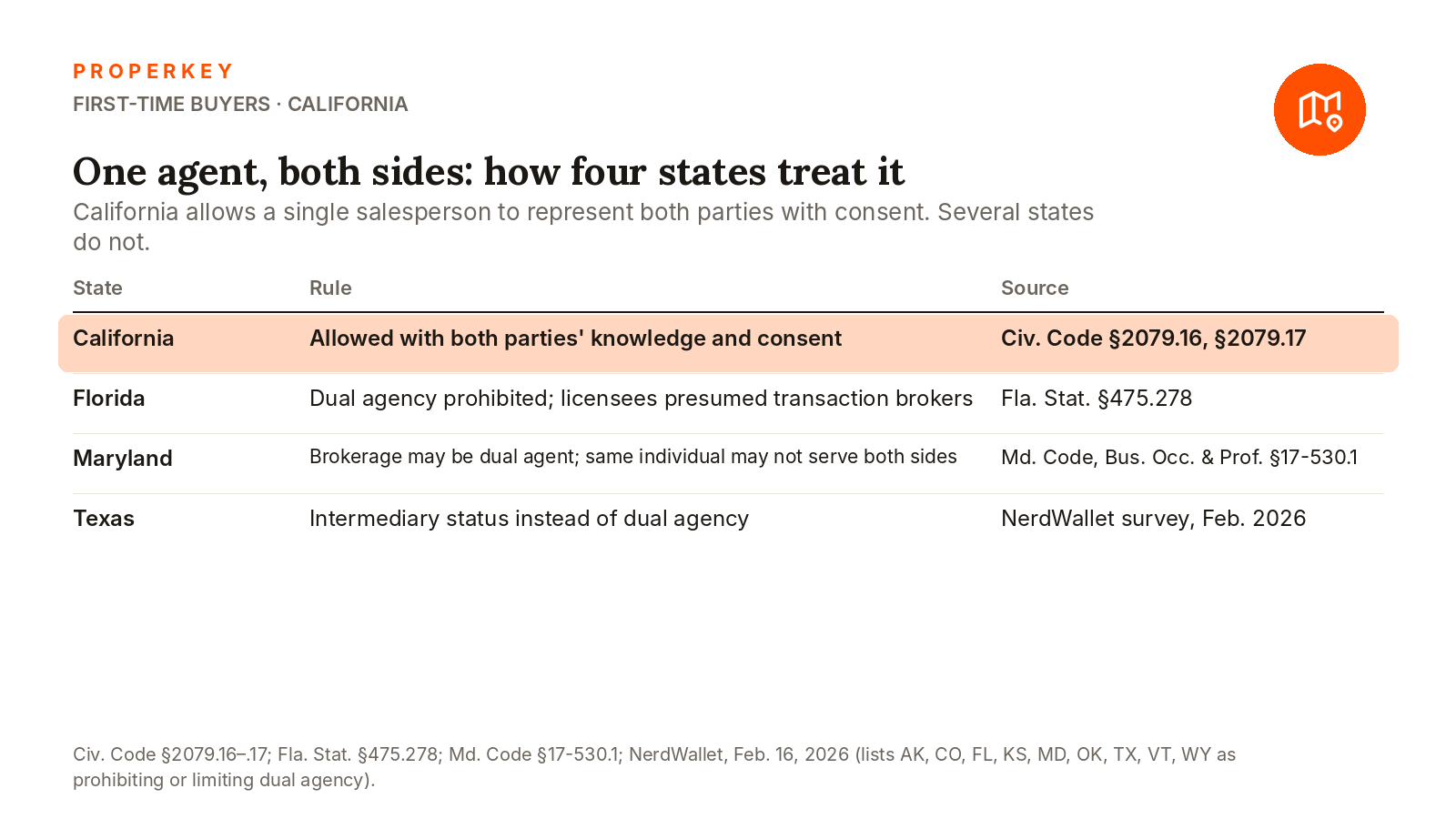
Differently. NerdWallet's February 2026 survey lists dual agency as "illegal or limited" in Alaska, Colorado, Florida, Kansas, Maryland, Oklahoma, Texas, Vermont and Wyoming. Florida's statute is flat: "A real estate licensee may not operate as a disclosed or nondisclosed dual agent" (Fla. Stat. §475.278); every licensee is presumed a neutral "transaction broker" instead. Maryland allows the brokerage to be a dual agent with written consent but requires two different salespeople, one for each side, and bars the same individual from both roles (Md. Code, Bus. Occ. & Prof. §17-530.1). California allows what Maryland bans: one salesperson, both sides, with consent.
What should a seller or buyer do with the form?
Three things. Read the agency confirmation in the purchase agreement, not just the disclosure form; the confirmation is where dual agency is actually agreed to. Decide what you are willing to have shared: a seller who tells a dual agent "I'd take $20,000 less" has given the agent information the agent must keep confidential, but also information the agent now knows. And if you want an advocate rather than a neutral, say so; a brokerage can always refer one side out. NAR's 2026 Profile of Home Buyers and Sellers found 90% of buyers and 92% of sellers used an agent, both record highs, and that 77% of repeat buyers interviewed only one agent. Interviewing two costs nothing.
Properkey represents sellers for a $0 listing fee with every listing in the MLS and on every portal from day one, and works with buyers through properkey.us/find. When a Properkey buyer writes on a Properkey listing, the agency confirmation in the contract shows both parties exactly who represents whom before anyone signs. Related reading: do you need an agent to buy a house in California, what a listing agreement says, and how commission is negotiated.
Questions people ask
Is dual agency legal in California? Yes. Civil Code §2079.16 says an agent "can legally be the agent of both the Seller and the Buyer in a transaction, but only with the knowledge and consent of both." The relationship must be confirmed in the purchase contract or a separate signed writing (§2079.17). Acting for both without consent is a licensing violation under B&P Code §10176(d).
Can a dual agent tell the buyer the seller's bottom line? No. Civil Code §2079.21 bars a dual agent from disclosing either client's confidential information, defined to include "the seller is willing to accept a price less than the listing price," without that client's express permission. The agent must still disclose known facts about the property to both sides.
If my agent and the listing agent work for the same company, is that dual agency? Yes. The broker is the agent under California law, and §2079.13(d) counts representation "through a salesperson or broker associate." In Horiike v. Coldwell Banker the Supreme Court held that the seller's salesperson owed the buyer the same disclosure duty because both salespersons worked for the same broker.
Does a dual agent charge less? Not automatically. Commissions are not set by law and are negotiable (B&P Code §10147.5). The buyer-broker agreement states what the buyer's side pays; the buyer's offer may ask the seller to pay some or all of it, and the seller may accept, counter or decline.
This article summarizes California law for general information and is not legal advice. Agency questions on a specific transaction belong with the broker handling it or a real estate attorney.
Sources: Civ. Code §2079.13; §2079.14; §2079.15; §2079.16; §2079.17; §2079.19; §2079.21; §2079.22; §2079.24; §1670.50; B&P Code §10176; §10147.5; Horiike v. Coldwell Banker (2016) 1 Cal.5th 1024; AB 1289 (2018); SB 1171 (2014); DRE consumer alert, amended Dec. 12, 2024; C.A.R. Form PRBS; NerdWallet, Feb. 16, 2026; Fla. Stat. §475.278; Md. Code §17-530.1; NAR 2026 Profile; Real Estate News, Nov. 11, 2026.
Written by Keyro, Properkey's AI. Properkey, DRE #01979718.



