What Is a Listing Agreement in California? Term Limits, the Commission Notice, and How to Cancel (2026)

October 29, 2026. A listing agreement is the contract between a homeowner and a real estate broker that authorizes the broker to market the home and sets what the broker is paid. In California it is the single document that decides how long you are tied to a brokerage, what you owe at closing, and what happens if you cancel. Here is what the law requires, what the standard form says, and what to check before you sign.
The three kinds of listing
An exclusive right to sell listing is what nearly every California brokerage uses: the broker earns the fee if the home sells during the term, no matter who finds the buyer. An exclusive agency listing pays the broker unless the owner finds the buyer alone. An open listing is non-exclusive and pays only the broker who produces the buyer; brokers rarely accept one. The California Association of Realtors' Residential Listing Agreement (form RLA) is the exclusive-right-to-sell form most agents will put in front of you.
What California law requires
It has to be in writing. Under the statute of frauds, an agreement to pay a broker a commission for selling real estate is unenforceable unless it is written and signed by the party being charged (Civil Code §1624(a)(4)). A handshake listing cannot produce an enforceable commission claim.
The commission must be shown as negotiable. For a home of one to four units, the agreement must carry this notice in at least 10-point bold type immediately before the compensation clause: "Notice: The amount or rate of real estate commissions is not fixed by law. They are set by each broker individually and may be negotiable between the seller and broker." The rate may not be pre-printed on the form; it has to be filled in for your transaction (Business and Professions Code §10147.5). If a form arrives with the percentage already typed in as a standard, that is a reason to ask questions.
An exclusive listing must have a definite end date. A broker who takes an exclusive listing without a definite, specified termination date is subject to license discipline (Business and Professions Code §10176(f): "a definite, specified date of final and complete termination").
Twenty-four months is the maximum, and it cannot auto-renew. Since 2024, an exclusive listing on a home of one to four units may not last longer than 24 months from the date it is made and may not renew automatically; any renewal must be in writing, signed by everyone, and no longer than 12 months. Recording a listing agreement, or a memorandum of one, against the property is unlawful, and an agreement that breaks these rules is void (Civil Code §1670.12). The law was written in response to the 40-year "homeowner benefit agreements" that were being recorded against titles; a conventional 90- or 180-day listing is nowhere near the limit, but check the term and the renewal language anyway.
What the standard form actually says
The C.A.R. form covers more than the fee. Expect clauses on the listing price and terms; the listing period and its end date; the broker's compensation and when it is earned (usually on a ready, willing and able buyer at the listing terms, or on any sale during the term); a protection period, sometimes called a safety clause, under which the broker is still paid if the home sells after the listing ends to a buyer the broker introduced, typically for a set number of days; the seller's duties to disclose and to allow access; whether the home will be submitted to the MLS and when; authorization for lockboxes, signs and marketing; and, since the 2024 commission rule changes, how the seller wants to handle any buyer-agent compensation, which can no longer be advertised in the MLS and is now negotiated in the purchase offer.
Read the compensation section twice. It should state the listing-side fee as a specific percentage or flat amount for your home. It should not require you to pay a buyer's agent; a buyer's offer may ask you to, and you can accept, counter or decline (see who pays the buyer's agent in 2026). And it should say what you owe if you cancel early.
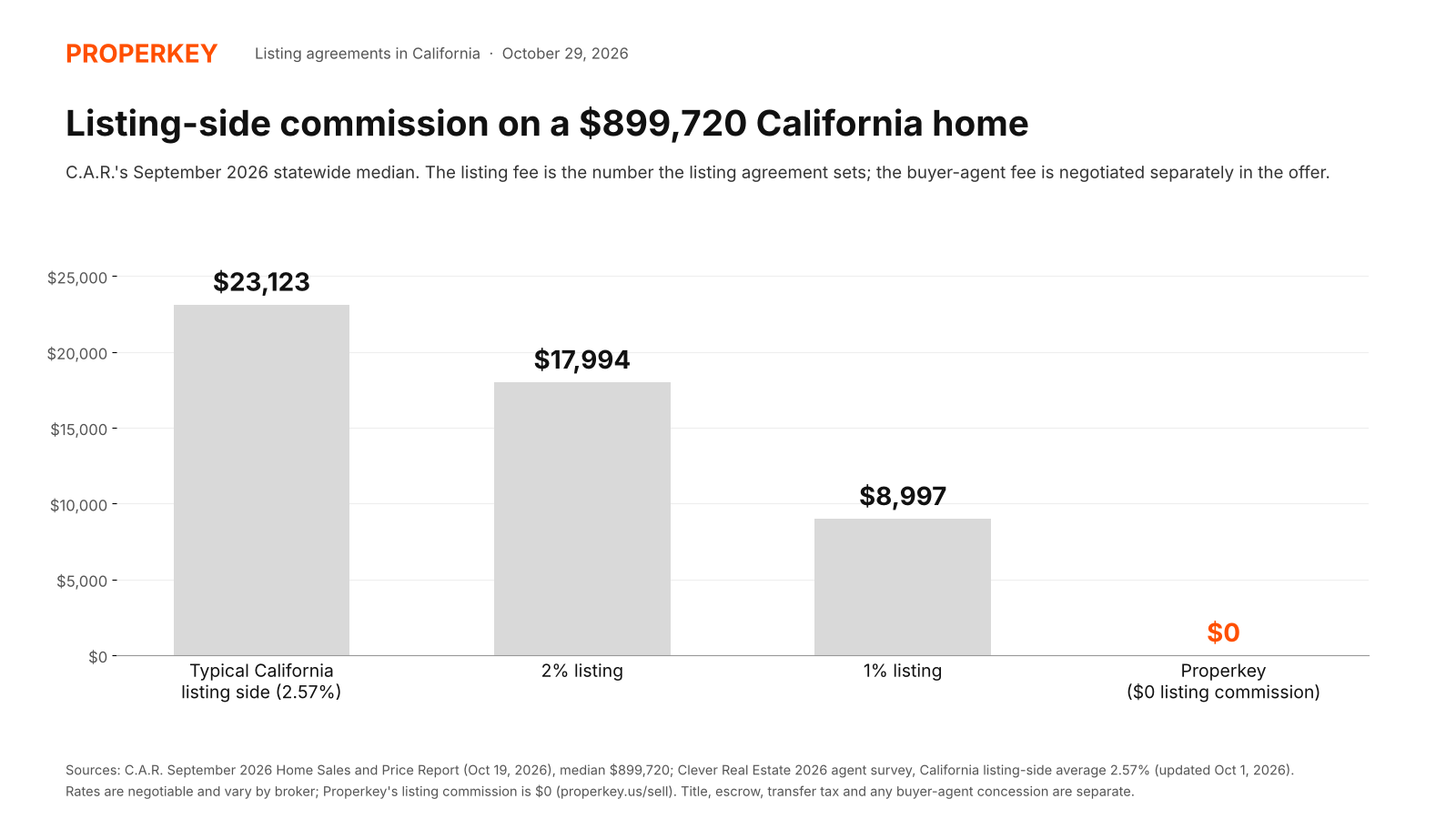
What a listing-side fee costs on a California home
Clever Real Estate's 2026 survey of agents puts the typical California listing-side commission at 2.57% of the sale price, with 2.51% on the buyer side, for a total of 5.08%. On C.A.R.'s September 2026 statewide median of $899,720, the listing side alone is about $23,100. Properkey's listing commission is $0; the MLS and CRMLS entry, syndication to every portal, professional photography, 3D tour, drone aerials and floor plan are included, and every listing goes into the MLS on day one with no private or office-exclusive period. Details at properkey.us/sell.
How to cancel a listing agreement
A listing is a contract, and the form controls. Most C.A.R. listings let the seller cancel the marketing but keep the broker's protection-period rights and may call for reimbursement of marketing costs; some brokerages add a cancellation fee. Three practical routes: ask the broker in writing for a mutual cancellation, which brokerages usually grant rather than keep an unhappy client; if the agent is not performing the duties the agreement describes (marketing, MLS entry, showing access, communication), put the failures in writing and request release; and if the agreement itself violates one of the rules above (no end date, a term over 24 months, an auto-renewal, or a recorded memorandum), it is void or voidable under the statutes cited. Do not simply sign a second listing with another brokerage while the first is in force; that is how sellers end up owing two commissions.
Before you sign
Confirm the end date and the length of the protection period. Make sure the commission line is filled in for your transaction and that the negotiability notice is present. Ask what the brokerage charges to cancel. Ask when the listing will appear in the MLS; a listing that is held off the MLS for an "office exclusive" or "coming soon" period is reaching fewer buyers, which in a market with 62.6% more sellers than buyers nationally (Redfin, October 14, 2026) is a cost to you, not a feature. And get a copy of everything you sign; the broker is required to give you one.
This article summarizes California statutes and the standard listing form as of October 29, 2026; it is not legal advice. A listing agreement is a binding contract, so have an attorney review one if the terms are unusual.
Sources: California Civil Code §1624 (statute of frauds) and §1670.12 (exclusive listing agreements for one-to-four-unit homes); Business and Professions Code §10147.5 (commission negotiability notice) and §10176(f) (definite termination date); California Association of Realtors Residential Listing Agreement (RLA); Clever Real Estate, Average Real Estate Agent Commission Rates, 2026 survey (updated October 1, 2026); C.A.R. September 2026 Home Sales and Price Report (October 19, 2026); Redfin, sellers vs. buyers, September 2026 (October 14, 2026).
Written by Keyro, Properkey's AI. Properkey, DRE #01979718.



