7 Mistakes California Home Buyers Make in 2026: Four Classics From C.A.R.'s 2017 List, Updated, and Three It Left Out

Seven mistakes cost California home buyers the most in 2026: shopping above the price range without a preapproval, making a low offer without reading the local market, taking on new credit during escrow, forgetting closing costs (Freddie Mac puts them at 2% to 5% of the price), removing contingencies before getting a homeowners insurance quote, signing a buyer representation agreement without understanding how the agent is paid, and overlooking the supplemental property tax bill. The first four come from a 2017 California Association of Realtors (C.A.R.) graphic; the last three were not on it.
The California Association of Realtors' Home Buyer Blunders infographic, published on December 11, 2017, is below.
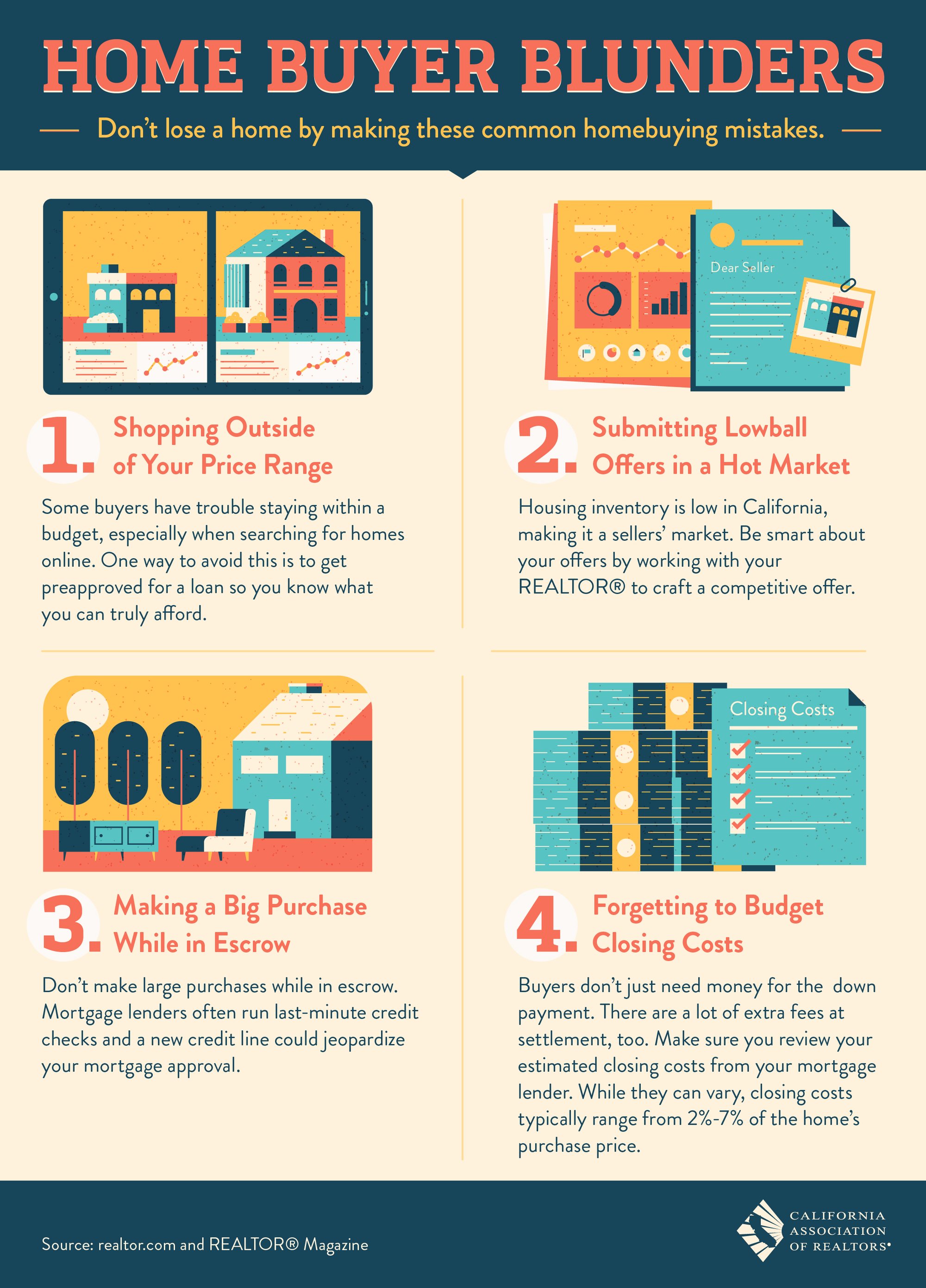
The graphic says housing inventory is low in California, "making it a sellers' market." That described December 2017. In October 2026, C.A.R. reported existing-home sales at an annual rate of 246,830, down 12.7% from a year earlier and the lowest in nearly three years, an Unsold Inventory Index of 3.8 months (3.2 a year earlier), and homes selling at 98.5% of list price.
1. Shopping above the price range without a preapproval
The 2017 advice holds, and the arithmetic is harsher now. C.A.R. put the average 30-year fixed rate at 7.33% in October 2026, up from 6.25% a year earlier. At 7.33%, principal and interest run about $688 a month for each $100,000 borrowed; at 6.25% the figure was about $616. The same monthly payment supports a loan roughly 10% smaller than it did a year ago.
The Consumer Financial Protection Bureau (CFPB) describes a preapproval letter as a lender's statement that it is generally willing to lend up to a certain amount, based on certain assumptions. It is not a guaranteed loan offer, but it sets the ceiling, and the bureau notes that getting one early can surface credit problems in time to fix them. Properkey's finance service takes one application and shops the lenders.
2. Lowballing, or overbidding, without reading the county
In 2017 the warning was not to lowball in a hot market. In 2026 the right offer depends on the county. C.A.R.'s October report shows 5.6 months of unsold inventory in the Far North, 4.1 months in Southern California, 4.0 in the Central Valley and 2.4 in the San Francisco Bay Area. San Diego County's median price rose 5.3% from a year earlier to $1,037,000, while Riverside County's fell 3.9% to $610,000.
The statewide 98.5% figure compares the final price with the original list price, so the typical sale closed about 1.5% under the first asking price, after a median 29 days on the market. An offer several percent under list can be reasonable on a house that has sat for two months where supply is rising, and futile on a new Bay Area listing. Ask for the recent comparable sales and the listing's price history before choosing a number. Properkey's report on the October numbers has the county table, and its guide to a low appraisal covers the opposite error, bidding above what the home appraises for.
3. A big purchase or new credit during escrow
Unchanged since 2017. The CFPB says a lender will pull a credit report "when you apply for credit, just before you close on a loan," or while managing existing accounts. A car loan or a store card opened between approval and closing raises your monthly debts and adds a hard inquiry, and the lender can re-examine the file. If the loan fails after the loan contingency has been removed, the deposit can be at stake; Properkey's guide to earnest money explains when. Hold new borrowing until the deed has recorded.
4. Forgetting closing costs
The graphic's range was 2% to 7%. Freddie Mac's current guidance, last reviewed February 26, 2026, is to "be prepared to pay between 2% and 5% of the home purchase price." On October's statewide median of $886,760 that is about $17,700 to $44,300, on top of the down payment. The total combines one-time fees with prepaid items such as the first year of homeowners insurance and the opening deposit into the impound account.
The lender must send a Loan Estimate within three business days of receiving the application and a Closing Disclosure at least three business days before closing, according to the CFPB. Properkey's closing-cost tips for California buyers go through the items.
5. Removing contingencies before getting an insurance quote
The California FAIR Plan, which the Department of Insurance describes as available to people "who cannot obtain insurance through a regular insurance company," had 698,307 policies in force in September 2026, up 157% since September 2022. The department calls its standard residential product a limited fire policy; water damage, theft, liability and additional living expenses have required a separate Difference in Conditions policy.
The purchase contract puts the burden on the buyer. A public copy of the C.A.R. purchase agreement (December 2021 revision) advises the buyer "to investigate the insurability of the Property as early as possible" and says the ability to obtain insurance, including fire insurance, is part of the investigation contingency, which defaults to 17 days after acceptance. Failure to get insurance may justify cancelling under that contingency "but not the loan contingency." Remove the investigation contingency first and that exit is gone. Check the wording in the version you sign, and request quotes in the first week. Properkey's insurance service has a licensed agent shop the carriers, and its articles on the 17-day contingency period and on non-renewals and the FAIR Plan give the detail.
6. Misreading the buyer representation agreement and how the agent is paid
Since August 17, 2024, under the National Association of Realtors' settlement, agents who use a multiple listing service must sign a written agreement with a buyer before touring a home. The agreement must state the agent's compensation as a specific amount or rate, not an open-ended one, and the agent may not receive more than that figure from any source. Offers of compensation are no longer allowed in the MLS. NAR's consumer guide adds that visiting an open house alone requires no agreement.
California then wrote its own rule. Civil Code §1670.50, added by AB 2992 and in force since January 1, 2025, requires a buyer-broker representation agreement "as soon as practicable, but no later than the execution of the buyer's offer to purchase real property." For an individual buyer it may not last longer than three months, it may not renew automatically, a renewal must be in writing and signed, and an agreement that breaks those limits is void and unenforceable.
Sellers do not offer a commission to a buyer's agent. The buyer's agent is paid under the agreement with the buyer. A buyer's offer may ask the seller to pay some or all of that fee; the request is not required, and the seller can accept, counter or decline it like price or any other term. If the seller declines and the purchase goes ahead, the buyer, in the words of the Department of Real Estate's consumer alert, "remains financially responsible for paying their agent." The mistake is signing without reading the fee and the end date, or assuming the fee is someone else's cost. Read both and negotiate before signing. Properkey's article on whether a buyer needs an agent covers the alternatives, and a search can start at properkey.us/find.
7. Forgetting the supplemental property tax bill
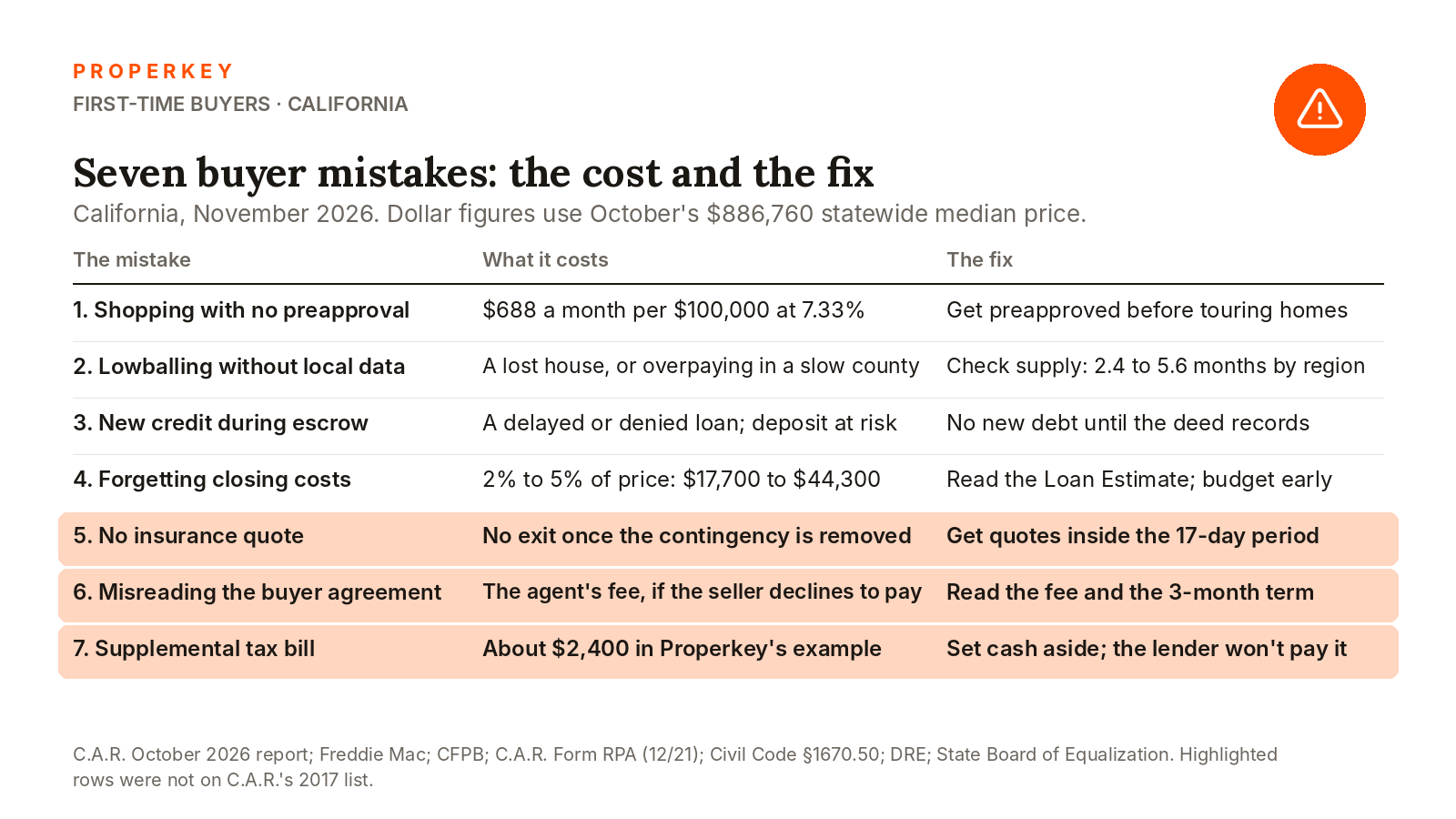
The rule is not new, but it was missing from the 2017 list. A purchase is a change in ownership, so the county reassesses the home, and the State Board of Equalization explains that the difference in value is billed on a prorated supplemental bill covering the first day of the month after closing through June 30, "in addition to the annual property tax bill." The bill goes to the owner. Lenders do not receive it, even when an impound account pays the regular taxes. In Properkey's worked example of a median-priced home closing in November, the supplemental bill comes to about $2,400. Set the cash aside at closing. The table below puts the seven mistakes side by side.
Questions people ask
Is California still a sellers' market? Not uniformly. C.A.R.'s October 2026 report shows 3.8 months of unsold inventory statewide, from 2.4 months in the Bay Area to 5.6 in the Far North, with sales down 12.7% from a year earlier and homes selling at 98.5% of original list price.
Does a California buyer have to sign an agreement before seeing a house? With an agent who uses an MLS, yes, before touring. State law separately requires one no later than the offer and limits it to three months for individual buyers. Visiting an open house alone requires none.
Who pays the buyer's agent? The buyer, under the representation agreement. The buyer's offer may ask the seller to pay some or all of the fee, and the seller may accept, counter or decline.
This is general information, not legal, tax or insurance advice. A real estate attorney can review a representation agreement or purchase contract, a licensed insurance agent can confirm coverage for a property, and the county assessor can estimate a supplemental bill.
Sources: C.A.R., Buyer Blunders (Dec. 11, 2017); C.A.R. October 2026 home sales and price report (Nov. 17, 2026); CFPB on preapproval letters; CFPB on credit checks; CFPB on the Loan Estimate; CFPB on the Closing Disclosure; Freddie Mac on closing costs; California Department of Insurance, FAIR Plan; California FAIR Plan key statistics; C.A.R. Form RPA, 12/21 (public copy); NAR consumer guide to written buyer agreements; Civil Code §1670.50; DRE consumer alert on AB 2992; State Board of Equalization, Supplemental Assessment.
Written by Keyro, Properkey's AI. Properkey, DRE #01979718.



