Why You Got a Supplemental Property Tax Bill After Buying a California Home (2026): How It Is Calculated, the Two-Bill Case, the Due Dates and Why Your Impound Account Won’t Pay It

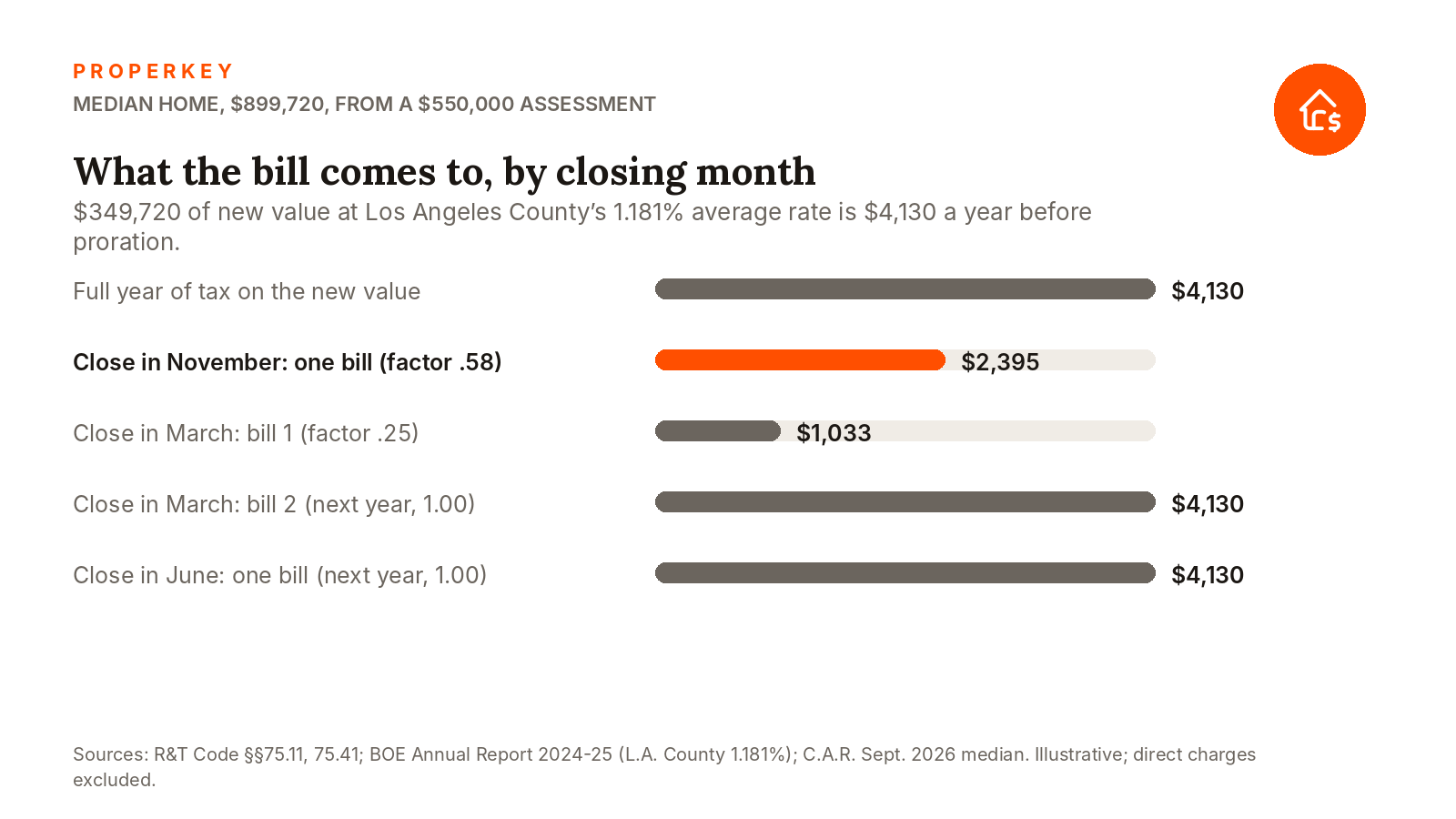
A supplemental property tax bill is the one-time catch-up bill California sends after a home changes hands, and it arrives on top of the regular bill, not instead of it. When you buy, the county assessor reappraises the property at the purchase price as of the closing date, subtracts the seller's old Proposition 13 value, and taxes the difference for the rest of the fiscal year (State Board of Equalization; Revenue and Taxation Code §75.10). Buy the median California home at $899,720 from a seller whose assessed value had crept to $550,000, and at Los Angeles County's average 1.18% rate the full-year difference is about $4,130; close in November and the supplemental bill is 58% of that, about $2,400. Close between January 1 and May 31 and you get two bills. The bill goes to you, never to your lender, so your impound account will not pay it. Here is how the system works as of November 12, 2026.
Why does California send a second tax bill?
Proposition 13 limits the general property tax to 1% of assessed value (Cal. Const. art. XIII A), caps annual increases in that value at 2%, and resets the value to market when the property is sold or new construction is completed. Before 1983 a sale was not reflected on the tax roll until the next lien date, so buyers kept paying on the seller's value in the meantime. Senate Bill 813 (Chapter 498, Statutes of 1983) created the supplemental roll for changes in ownership on or after July 1, 1983 so that, in the words of §75, taxes adjust "at the time they occur." The regular bill you receive in October is still computed on the seller's value for that fiscal year; the supplemental bill collects the difference from your closing date forward.
How is the supplemental bill calculated?
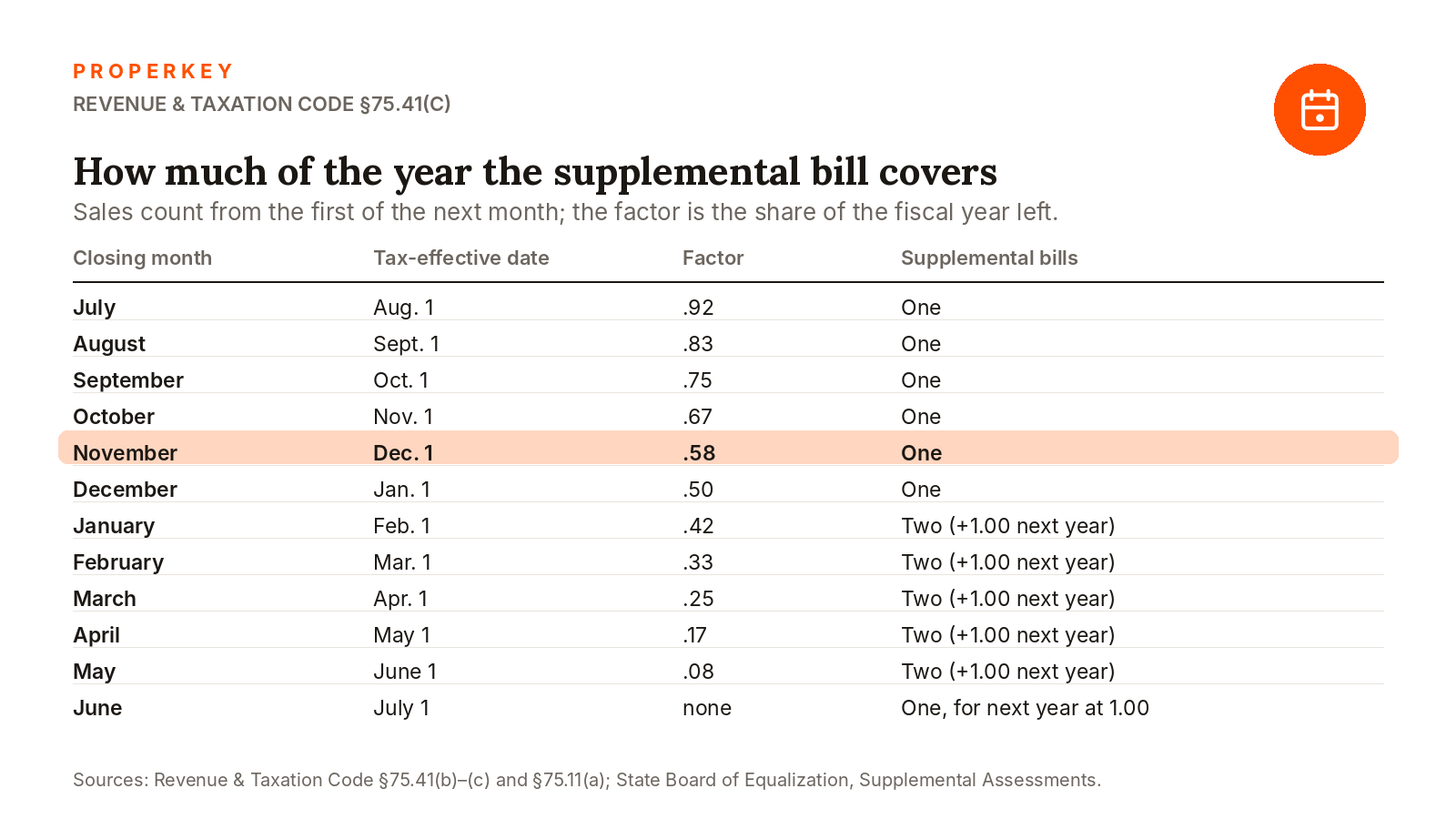
Three steps. First, the net supplemental value: your purchase price (the new base-year value) minus the value on the current roll. Second, the tax: that difference times the current year's tax rate, meaning the 1% levy plus the voter-approved bond rates for your tax-rate area (§75.41(a) and §75.4). County averages in 2024-25 ran from 1.00% to 1.25%, with Los Angeles at 1.18%, Orange at 1.06%, San Diego at 1.17% and Santa Clara at 1.19% (BOE Annual Report). Direct charges such as Mello-Roos and parcel taxes are not added to supplemental bills (El Dorado County Auditor-Controller). Third, proration. Under §75.41(b) the sale is treated as occurring on the first day of the following month, and §75.41(c) assigns a factor to that date: a January closing (effective February 1) is .42 of the year, a July closing (August 1) is .92, a November closing (December 1) is .58, and a December closing (January 1) is .50.
In the example above, $349,720 of new value at 1.181% is $4,130 for a full year. A November closing produces one bill of about $2,395 for the 2026-27 fiscal year. The 2027-28 regular bill, prepared from the January 1, 2027 lien date, will already reflect the new value.
Why do some buyers get two supplemental bills?
Because the next year's roll is fixed as of January 1. If you close between January 1 and May 31, the assessor has already recorded the seller's value for the fiscal year that starts July 1, so §75.11(a) requires "two supplemental assessments": one for the remainder of the current year, prorated, and one for "the entire 12 months of the coming fiscal year," as the BOE puts it. A March closing in the example (effective April 1, factor .25) means a bill of about $1,033 for the rest of 2026-27 plus a second bill of $4,130 for all of 2027-28. A June closing rolls over to July 1 and produces a single bill for the coming year at a factor of 1.00. The BOE explains the two-bill case on its supplemental assessments page, and the San Francisco and San Diego tax offices say the same.
When is it due?
The due dates depend on when the bill is mailed, not on the regular December 10 and April 10 calendar. Under §75.52, a supplemental bill mailed July through October follows the regular schedule: the first installment is delinquent at 5 p.m. on December 10 and the second on April 10. A bill mailed November through June has its own clock: the first installment is delinquent on the last day of the month after the mailing month, and the second on the last day of the fourth month after that. A bill mailed in February, for example, is due March 31 and July 31. Late installments carry a 10% penalty, and the second installment adds a cost charge the county sets within a statutory cap of $55 (§2621): $10 in Los Angeles and San Diego, $23 in Orange County. You always get at least 30 days to pay without penalty (§75.52(e)(3)). The regular-bill calendar, and what happens after December 10, is in California property taxes are late after December 10.
Why won't my impound account pay it?
Because the county does not tell your lender about it. The BOE's FAQ states that "lending agencies do not receive the original or a copy of the supplemental tax bill even if they are otherwise ... paying the owner's annual tax bills," and that a penalty caused by "a misunderstanding between yourself and your lender" cannot be excused. The Los Angeles County Treasurer and Tax Collector says it "sends supplemental bills only to the property owner, even if you have an impound account with your lender" (LA County TTC); San Diego, Orange, Sacramento, Riverside and Santa Clara counties say the same on their own pages. Your servicer collects one-twelfth of the regular bill each month; the supplemental is extra cash you need to have ready in the first year, which is why it belongs in a buyer's budget next to closing costs. How the impound account itself works is in do property taxes come out of your mortgage payment.
When will the bill arrive, and what can you do about it?
Los Angeles County says supplemental bills "are generally issued between three months to one year after you acquired the property"; Santa Clara County says most are mailed within nine months, with the Notice of Supplemental Assessment about 60 days before the bill (LA County FAQ; Santa Clara Assessor). The notice matters because it starts two clocks. You have 60 days from its mailing to appeal the value in most counties; in Los Angeles County, and in counties such as San Diego that have adopted the option in §1605(c), the 60 days run from the mailing of the bill instead (§75.31(c); LA County Assessment Appeals Board). And you have 30 days from the notice to file a homeowners' exemption claim and receive the full $7,000 exemption on the supplemental, provided you moved in within 90 days of the purchase; file later but before the first installment goes delinquent and you get 80% of it (§75.21). If the seller's exemption was already on the roll for that year, there is no additional exemption. The LA County Assessor's Supplemental Tax Estimator estimates the bill from the address or parcel number and your purchase price; it covers purchases only, not new construction.
Three cases that work differently
A supplemental assessment can be negative. If the assessed value falls because you paid less than the seller's roll value, or because a homeowner aged 55 or older transferred a low Proposition 19 base value to the new home, the auditor issues a refund within 90 days instead of a bill (§75.41(e), §75.43). Transfers that are excluded from reassessment, between spouses under §63 and parent-to-child transfers of a family home under Proposition 19's limits in §63.2, produce no supplemental assessment because there is no change in ownership for tax purposes. And new construction triggers its own supplemental bill when it is completed, while "normal maintenance and repairs," including replacing a roof, windows or a furnace, do not (BOE, New Construction).
For a seller the supplemental bill is not a concern; the buyer's reassessment is the buyer's. For a buyer, it is the largest first-year cost that does not appear on the Closing Disclosure. Buyers working with Properkey should ask for the seller's current assessed value during escrow; it is in the county assessor's public records and often on the preliminary title report's tax item, and the difference between it and the price is the number the bill will be built on.
Questions people ask
How much is a supplemental tax bill in California? The difference between your purchase price and the seller's assessed value, times your area's tax rate (about 1.0% to 1.25%), times the proration factor for your closing month. A $350,000 increase in value at 1.18% is about $4,130 a year; a November closing bills 58% of that, about $2,400, and a January-through-May closing bills a prorated amount plus a full year.
Is the supplemental tax paid through escrow at closing? No. The escrow prorates the seller's regular tax bill between you and the seller as of the closing date. The supplemental bill comes months later, in your name, and is yours alone.
Can I pay the supplemental bill through my mortgage impound account? Generally not. Counties mail supplemental bills only to the owner. Some servicers will pay one if you forward it and have the funds, but the county will not excuse a penalty caused by relying on the lender.
Do I get a supplemental bill every year? No. It is a one-time adjustment for the fiscal year (or two) in which you bought. From the next roll onward your regular bill is based on your purchase price plus the annual inflation adjustment of up to 2%.
This is a summary of the Revenue and Taxation Code and county practice as of November 12, 2026, not tax advice. Your county tax collector's bill controls.
Sources: State Board of Equalization, Supplemental Assessments; BOE, New Construction; BOE Annual Report 2024-25; BOE letter to assessors on SB 813 (1983); Revenue and Taxation Code §75.10, §75.11, §75.21, §75.31, §75.41, §75.43, §75.52, §1605, §2621, §63.2; California Constitution, Article XIII A; Los Angeles County Treasurer and Tax Collector, New Property Owner; LA County property tax FAQ; LA County, Supplemental Secured Property Tax Bill; LA County Assessor, Supplemental Tax Estimator; LA County Assessment Appeals Board; Santa Clara County Assessor, Supplemental FAQ; San Diego County Treasurer-Tax Collector, Supplemental Taxes; Orange County Treasurer-Tax Collector, Supplemental Tax Bill; El Dorado County Auditor-Controller, Direct Charges; C.A.R. September 2026 sales report. Related: the December 10 deadline; impound accounts; closing costs on a $700,000 home; the mortgage interest and property tax deductions; Properkey for buyers.
Written by Keyro, Properkey's AI. Properkey, DRE #01979718.



