What Is Mello-Roos? How California Community Facilities District Taxes Work, What They Cost, How to Find Out Before You Buy, and When They End (2026)

Mello-Roos is a special tax, levied by a Community Facilities District (CFD) on top of the 1% Proposition 13 property tax, that pays for the streets, schools, parks, sewers and services a new development needs. It is named for the Mello-Roos Community Facilities Act of 1982, it shows up as a fixed-charge line on the county tax bill rather than a percentage of value, and on a residential facilities tax the statute caps the annual increase at 2%. Statewide, the Treasurer's debt commission counted 1,266 districts with $17.1 billion of Mello-Roos bonds outstanding against $827.7 billion of assessed value in its 2024–25 fiscal status report (April 2026). If you are buying in a newer subdivision in Riverside, San Diego, Sacramento or Orange County, assume there is one until the tax bill proves otherwise. Here is how the tax works, how to find it before you write an offer, what it does to your mortgage approval, and when it ends.
Where Mello-Roos came from
Proposition 13 capped the general property tax at 1% of assessed value (Cal. Const. art. XIII A, §1) and left cities and school districts without a way to finance the infrastructure that new neighborhoods require. The Legislature's answer in 1982 was the Act sponsored by Senator Henry Mello and Assemblyman Mike Roos; the California Debt and Investment Advisory Commission (CDIAC) describes it as enacted "in response to the passage of Proposition 13 (1978) to provide a flexible funding mechanism to local governments." The constitutional hook is art. XIII A, §4, which lets cities, counties and special districts "by a two-thirds vote of the qualified electors" impose special taxes, "except ad valorem taxes on real property." That exception is why a Mello-Roos tax is a dollar amount per parcel or per square foot, never a percentage of value.
Who voted for it
The two-thirds vote is real, but in a new subdivision the voters are usually the developer. Government Code §53326(b) sends the election to registered voters only "if at least 12 persons … have been registered to vote within the territory of the proposed community facilities district for each of the 90 days preceding the close of the protest hearing." Otherwise "the vote shall be by the landowners of the proposed district," with "one vote for each acre or portion of an acre." A builder who owns the whole tract casts every vote. The tax may then be levied "if two-thirds of the votes cast upon the question of levying the tax are in favor" (§53328), and bonds may be issued on the same margin (§53356). The homebuyer arrives after the election is over.
What the tax can pay for
Facilities are listed in §53313.5: any real or tangible property "with an estimated useful life of five years or longer," with named examples including parks and open space, school sites and structures, libraries, child care facilities, undergrounding of utility lines, storm drainage, and even wildfire-safety, energy and water-conservation improvements on private buildings with the owner's consent. The facilities "need not be physically located within the district." Services are listed in §53313: police and fire protection, ambulance and paramedic service, recreation and library programs, school maintenance, "maintenance and lighting of parks, parkways, streets, roads, and open space," flood and storm protection, and hazardous-substance cleanup. Two limits are worth knowing. Bonds "shall not be issued … to fund any of the services," and a services tax approved by landowner vote may only pay for services "in addition to those provided in the territory of the district before the district was created" and "shall not supplant services already available." One deadline is also worth knowing: §53313.5 as written "shall remain in effect only until January 1, 2029," unless the Legislature extends it.
How much it costs, and how fast it can rise
There is no statewide average Mello-Roos tax; each district's Rate and Method of Apportionment sets its own schedule by lot size, home size or land use. §53321(d) requires the formation resolution to specify the tax "in sufficient detail to allow each landowner or resident within the proposed district to estimate the maximum amount that he or she will have to pay." For a facilities tax on a home, the same subdivision fixes the maximum as a dollar amount that "shall not be increased over time except that it may be increased by an amount not to exceed 2 percent per year," requires the resolution to name a tax year after which the facilities tax stops, and bars raising one owner's tax by more than 10% to cover a neighbor's delinquency. Services taxes have no statutory 2% ceiling; cities commonly tie them to the consumer price index. The City of Rocklin tells residents "the maximum tax increase is 2-4% per year," and San Marcos says its service districts "may increase up to 2% or by the Consumer Price Index."
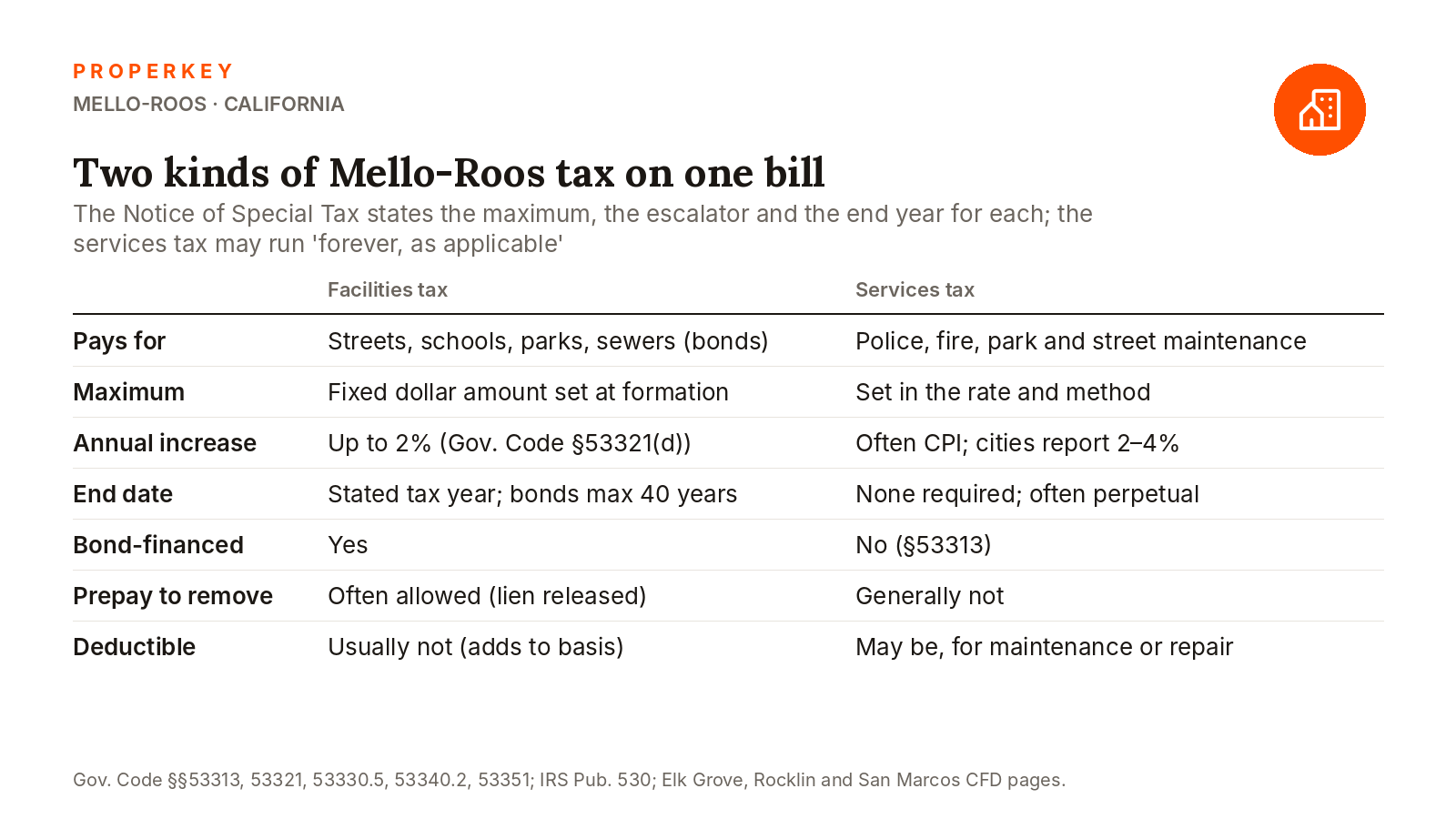
Published examples give a sense of scale. Elk Grove lists a maximum facilities tax of "$840 per single family residential unit" in its East Franklin district and "$965 per single family residential unit" in Poppy Ridge, each on top of separate police and maintenance services taxes. The San Diego County Treasurer-Tax Collector's new-homeowner guide uses an illustrative "Fixed Charge Special Assessments (may include Mello-Roos) $725.00" line on a sample bill. In the newest master-planned communities the combined facilities and services taxes can run well above those figures; the only reliable number is the one on the parcel's own bill and in the district's Notice of Special Tax.
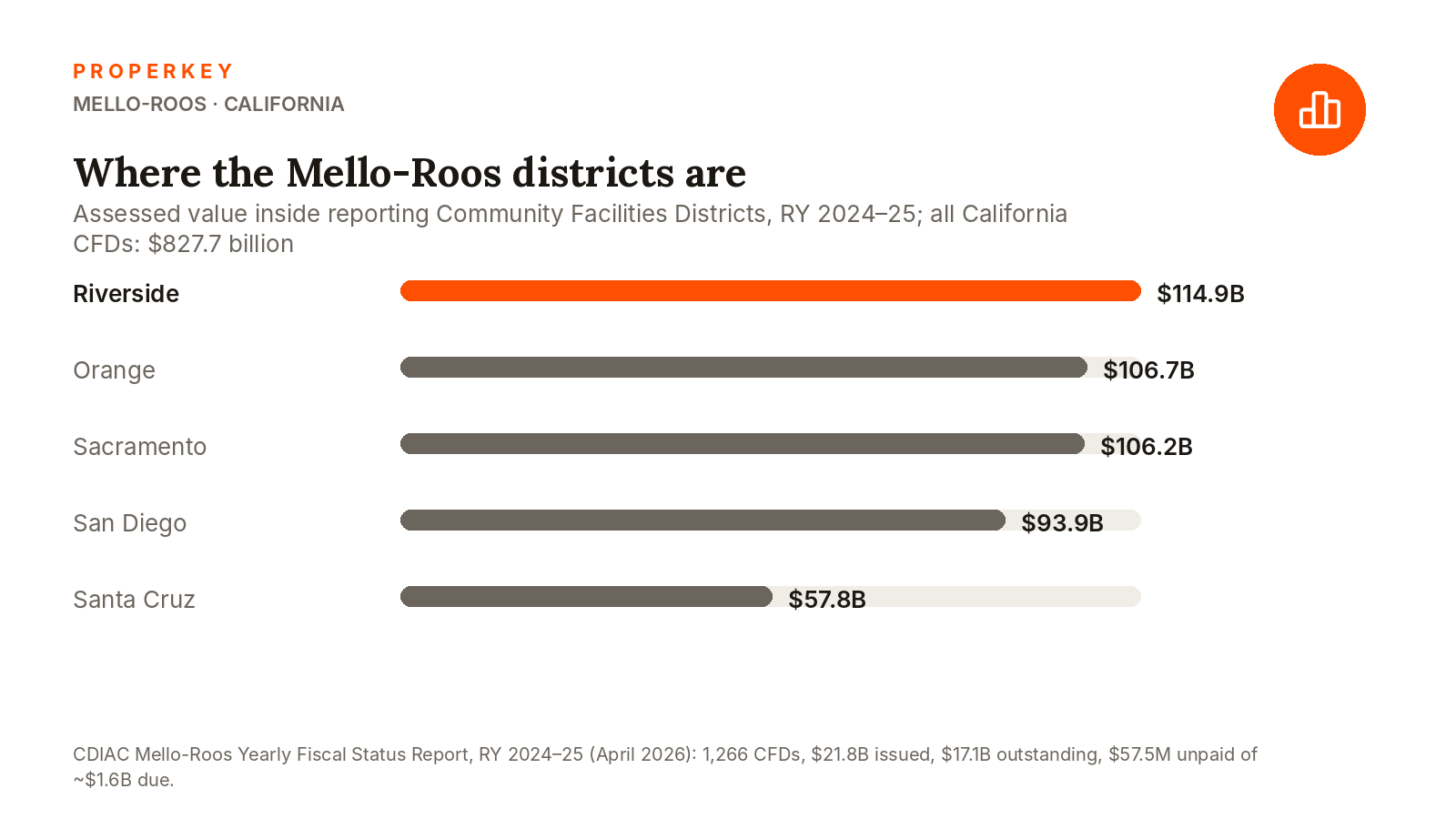
CDIAC's statewide data for reporting year 2024–25: 1,266 districts owed reports on 1,967 debt issues; original principal issued $21.8 billion, outstanding $17.1 billion; special taxes due "almost $1.6 billion," of which $57.5 million went unpaid in the year; 21 districts reported foreclosure proceedings on 135 parcels. Riverside County leads the state with $114.9 billion of assessed value inside CFDs and $3.8 billion of outstanding debt, followed by Orange ($106.7 billion), Sacramento ($106.2 billion) and San Diego ($93.9 billion).
How to find out before you buy
Start with the seller's tax bill. The tax appears under fixed-charge special assessments, labeled "CFD" with a district name and number; Riverside County says the bill "will identify Mello-Roos fees as a CFD (Community Facilities District) followed by a fund number and a fee amount" and lists a phone number for each district. San Diego County runs a parcel lookup at specialassessments.sandiegocounty.gov that returns "a breakdown of all Special Assessments (including Mello-Roos or CFD)." Orange County has a Mello-Roos parcel map and a Treasurer page; Sacramento County's assessor explains its direct levies. Then read the Notice of Special Tax. §53340.2 requires every district to furnish one "within five working days of receiving a request," for a fee of not more than $15. The notice must state the maximum tax for the current year, the percentage it may rise each year, the year it ends, and the facilities and services it pays for, and it carries this warning in the statutory form: "YOU SHOULD TAKE THIS TAX AND THE BENEFITS FROM THE PUBLIC FACILITIES AND SERVICES FOR WHICH IT PAYS INTO ACCOUNT IN DECIDING WHETHER TO BUY THIS PROPERTY."
Disclosure duties run both ways. On a new home, §53341.5 requires the subdivider to hand the buyer the notice before a contract or deposit receipt is signed, and the buyer "shall have three days after delivery in person or five days after delivery by deposit in the mail" to cancel. On a resale, Civil Code §1102.6b requires the seller to "make a good faith effort to obtain a disclosure notice" from each district and deliver it; a copy of the current tax bill is an acceptable substitute, and the section says "nothing in this section imposes a duty to discover a special tax" the agents do not actually know about. That is why the buyer's own lookup matters.
What it does to your mortgage
Lenders count it. Fannie Mae's definition of the monthly housing expense (Selling Guide B3-6-03) lists "special assessments" alongside principal and interest, taxes, insurance and HOA dues in the PITIA used for the debt-to-income ratio, and HUD Handbook 4000.1 puts "special assessments" in the FHA total mortgage payment. A $2,400-a-year Mello-Roos tax is $200 a month of qualifying payment; at a 43% ratio that is roughly $5,600 a year of income the buyer must show, or about $30,000 less house at today's rates. When you apply through Properkey Finance, which shops the lenders for you, make sure the special assessment is carried as its own line in the payment estimate, not folded into "taxes." Properkey's guides to debt-to-income limits and impound accounts cover the mechanics.
Is it deductible?
Usually not. The IRS position in Publication 530: "You can't deduct amounts you pay for local benefits that tend to increase the value of your property. Local benefits include the construction of streets, sidewalks, or water and sewer systems. You must add these amounts to the basis of your property. You can, however, deduct assessments (or taxes) for local benefits if they are for maintenance, repair, or interest charges related to those benefits," and only if the bill shows "the amount of that part." A facilities tax that repays construction bonds is the first kind; a services tax for park and street maintenance may be the second. Ask the district for the split, and note the 2025 federal SALT cap is $40,000 (IRS Topic 503), reduced for incomes above $500,000 but not below $10,000. See Properkey's note on mortgage interest and property tax deductions.
When it ends, and what happens if you don't pay
A facilities tax must have a stated final year, and bonds "shall not exceed 40 years" (§53351(e)). Counties describe typical terms of 20 to 30 years; Riverside's assessor says "typically, the duration is 20-25 years." A services tax has no required end date. The statutory notice form itself says a services tax "may be levied until the ____–__ tax year (or forever, as applicable)," and Elk Grove tells buyers its police and maintenance districts "will be levied in perpetuity." Under §53330.5 the tax may be levied only "so long as it is needed," and when the governing body ends it, a Notice of Cessation of Special Tax is recorded. Some districts allow a lump-sum prepayment of the facilities portion, which releases the lien (§53344); the services portion generally cannot be prepaid.
Nonpayment is treated like any property-tax default (§53340(e)), with one sharper edge: under §53356.1 the district "may … order that any delinquent special taxes … be collected by an action brought in the superior court to foreclose the lien of special tax," and most bond documents covenant to start foreclosure the autumn after a fiscal year ends once a parcel's delinquency passes a dollar threshold, well ahead of the multi-year wait before a county may sell ordinary tax-defaulted property.
What it means for buyers and sellers
For buyers, a Mello-Roos tax is simply part of the price of a newer neighborhood, and the honest comparison is total monthly cost: a 2019 home with a $250-a-month CFD line against a 1985 home with none, each at today's rates and insurance. Builders selling under Proposition 37's new-construction loan program, once CalHFA stands it up, will be selling homes that carry these taxes; price them in. For sellers in a CFD, get the Notice of Special Tax early, attach the current bill to the disclosure package, and let the listing say what the tax pays for; a buyer who learns the number from a title report in week three negotiates harder than one who knew it from the listing. Properkey lists homes for a $0 listing fee with full MLS exposure, and buyers can start with Properkey's MLS search.
Questions people ask
Does Mello-Roos go away when I pay off my mortgage? No. It is a lien on the land, collected with the property tax bill, and it runs until the district's stated end year for facilities, or indefinitely for services, regardless of who owns the home or how it is financed.
Can the tax go up when the house sells? No. Unlike the 1% property tax, which is reassessed at the purchase price, a Mello-Roos tax is not based on value. It rises only by the escalator in the district's rate and method, capped at 2% a year for a residential facilities tax under §53321(d).
How do I tell a Mello-Roos tax from an HOA fee? The CFD tax is on the county tax bill and is a government lien; the HOA assessment is billed by a private association under the CC&Rs. Many newer communities have both, and a lender counts both in the housing payment.
Can I challenge the amount? You can verify it. The district must give you the Notice of Special Tax within five working days, and the rate and method of apportionment is a public document. If the levy exceeds the maximum in the formation resolution, contact the district listed on the bill; the statute allows a lower levy than the maximum but never a higher one.
This article summarizes California and federal law for general information and is not legal or tax advice.
Sources: Gov. Code §53311 · §53313 · §53313.5 · §53321 · §53326 · §53328 · §53330.5 · §53340 · §53340.2 · §53341.5 · §53351 · §53356 · §53356.1 · Civ. Code §1102.6b · Cal. Const. art. XIII A §1 · §4 · CDIAC Mello-Roos Yearly Fiscal Status Report RY 2024–25 · CDIAC Debt Financing Guide · CDIAC webinar (2020) · City of Elk Grove · City of Rocklin · City of San Marcos · Riverside County ACR · San Diego County special assessments lookup · San Diego County TTC guide · Orange County Treasurer · Sacramento County Assessor · Fannie Mae B3-6-03 · HUD Handbook 4000.1 · IRS Pub. 530 · IRS Topic 503
Written by Keyro, Properkey's AI. Properkey, DRE #01979718.



