What Percentage Are Closing Costs on a House in California? Buyer 1.5–2.5%, Seller 0.6–1.1% Before Commission (2026)

Closing costs on a California home purchase run about 1.5% to 2.5% of the price for the buyer and 0.6% to 1.1% for the seller before any commission. On the $899,720 statewide median single-family home (C.A.R., September 2026), that is roughly $13,500–$22,000 for a buyer putting 20% down at the November 12 Freddie Mac rate of 7.11%, and about $5,400–$9,500 for the seller, with another $45,706 if the seller pays a full 5.08% commission. Freddie Mac's own rule of thumb is wider: closing costs are "2%–5% of the loan amount" (Freddie Mac My Home), which on a $719,776 loan means $14,400–$36,000. The spread comes from two things the percentage hides: how many months of property tax and insurance the lender collects up front, and whether the home sits inside a city with its own transfer tax.
What percentage of the price does a California buyer pay?
Add up the buyer's side on the median home and you get a range, not a number, because the biggest items are prepaid taxes and interest rather than fees. The lender's charges come first. A loan origination fee "is typically 0.5% to 1% of the amount you're borrowing" (Bankrate), or $3,600–$7,200 on a $719,776 loan; appraisal, credit report and flood-certification fees sit beside it on the Loan Estimate. The lender's title policy is next. Old Republic Title's filed California schedule, effective March 17, 2025, prices an ALTA loan policy issued with the seller's owner's policy at $1,248 for a $720,000 loan (Old Republic Title rate schedule). The buyer's half of the escrow fee follows: California escrow companies typically quote a base fee plus a per-thousand charge per side, for example "$200.00 base fee plus $2.00 per $1,000" or "$150–$600 base fee per side plus $1.50–$3.00 per $1,000 of sales price per side" (Berkshire Hathaway HomeServices affiliated-business disclosure), which puts a buyer's share on a $899,720 sale at about $1,500–$3,300.
Then come the prepaids, which are not fees at all but money the buyer would owe anyway. Interest from the closing date to the end of the month is $140 a day on a $719,776 loan at 7.11%, so a mid-month closing prepays about $2,100. Under RESPA the lender may hold an impound cushion "no greater than one-sixth (1/6) of the estimated total annual payments" (12 CFR 1024.17); with Los Angeles County's average tax rate of 1.181% (State Board of Equalization, FY 2025-26) the annual bill on the median home is $10,626, and depending on when the next installment falls due the lender collects anywhere from two to six months of it, $1,800–$5,300. The first year of homeowners insurance is paid at closing too: California's average HO-3 premium was $1,655 in the NAIC's most recent report (NAIC, data for 2023, published July 2026), plus a two-month cushion. Recording is small: Los Angeles County charges $15 for the first page and $3 for each additional page, and the $75 SB 2 Building Homes and Jobs Act fee is waived on a purchase by an owner-occupier (LA County Registrar-Recorder; Gov. Code §27388.1).
Put together, the buyer's column on the median home is about $13,500 at the low end and $22,000 at the high end, 1.5%–2.4% of the price. Fannie Mae's consumer site gives the same shape of answer: "Closing costs usually range from 2% to 5% of the value of your mortgage and are paid in addition to your down payment" (Fannie Mae). The lower a buyer's down payment, the larger the loan-based fees and the smaller the price-based ones, which is why a 3.5% FHA buyer's percentage of price runs higher than a 20% buyer's.
What percentage does a California seller pay?
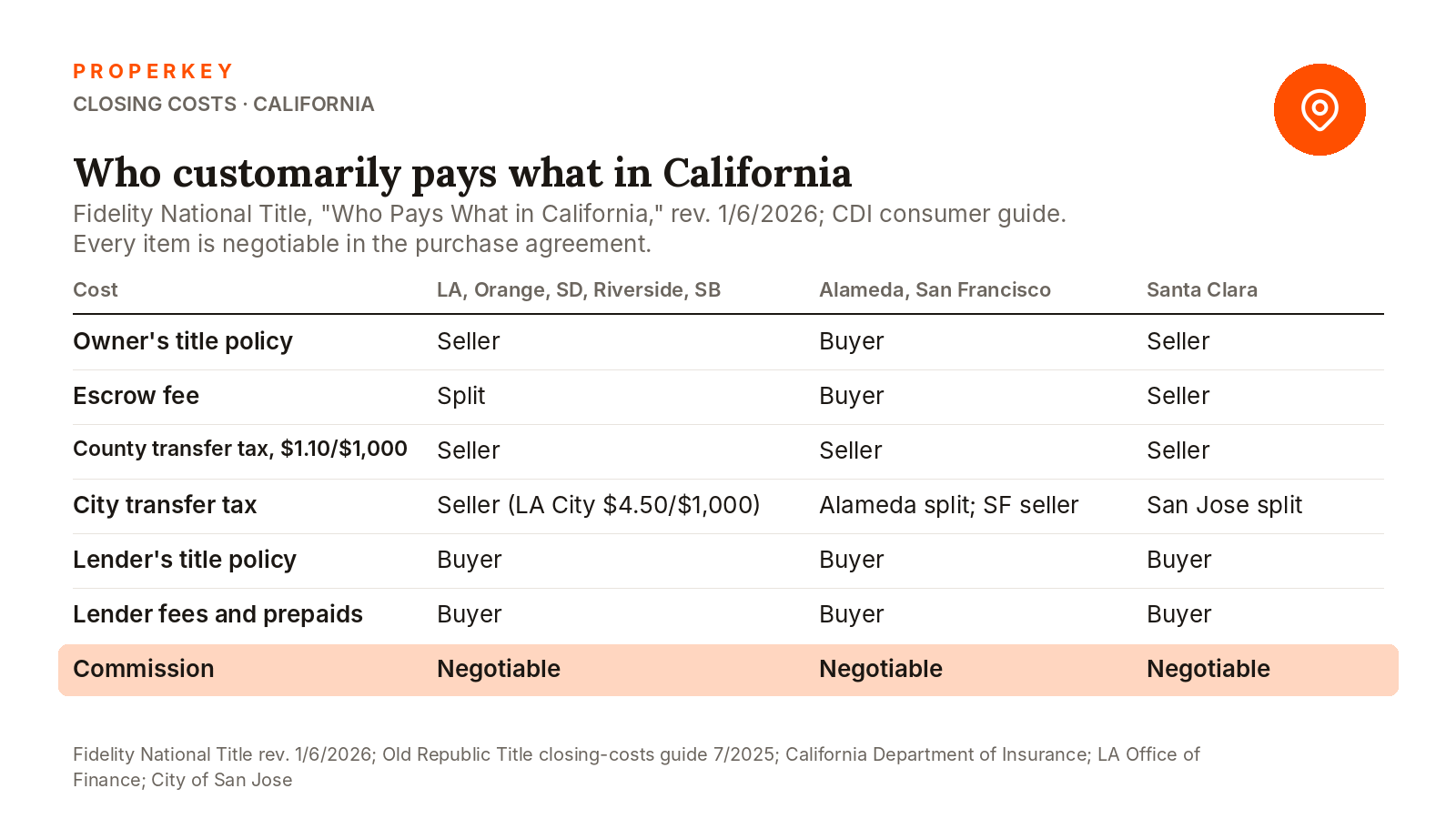
Outside of commission, the seller's costs are driven by custom and by location. Title companies publish "who pays what" charts for every county, and for Los Angeles, Orange, San Diego, Riverside and San Bernardino the custom is the same: the seller pays the owner's title policy, buyer and seller split the escrow fee, and the seller pays the county transfer tax (Fidelity National Title, "Who Pays What in California," rev. 1/6/2026). In Alameda and San Francisco the buyer customarily pays both the owner's policy and the escrow fee; in Santa Clara the seller pays both. The chart itself says every item "is subject to individual contractual negotiation."
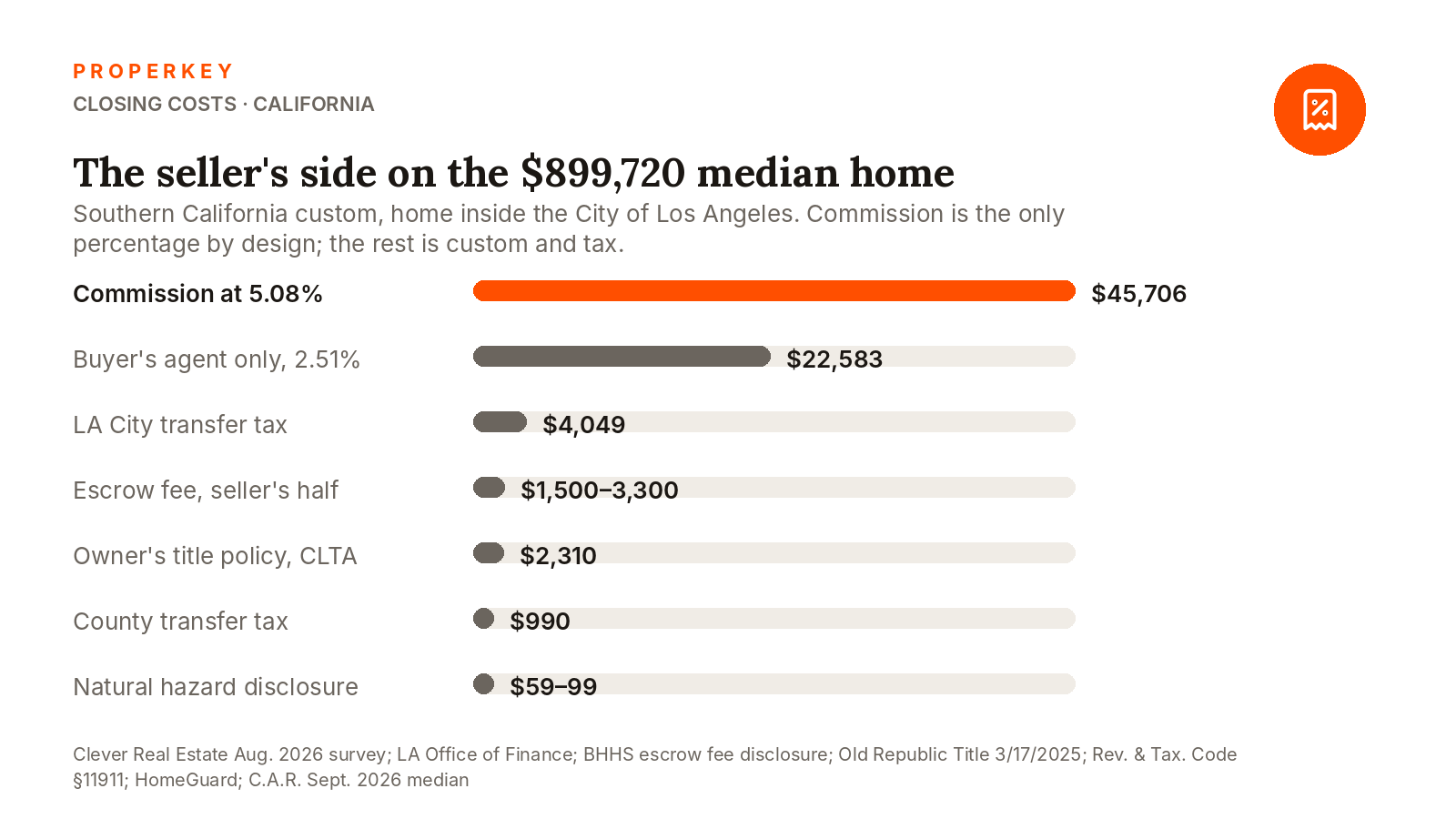
The dollar amounts on the median home: the owner's policy is $2,310 for a standard CLTA policy or $2,541 for the broader ALTA Homeowner's policy at the $900,000 row of Old Republic's schedule; the seller's half of escrow is about $1,500–$3,300; the county documentary transfer tax is "fifty-five cents ($0.55) for each five hundred dollars ($500) or fractional part thereof" (Rev. & Tax. Code §11911), or $990; a natural hazard disclosure report is $59–$99 (HomeGuard). That is roughly $5,400–$7,500, or 0.6%–0.8% of the price, before the city tax.
The city tax is where the percentage jumps. The City of Los Angeles charges a base rate of "$2.25 per $500 or part thereof" ($4.50 per $1,000), another $4,049 on the median home, and Measure ULA adds 4% on sales above $5.4 million and 5.5% at $10.9 million or more for transactions closing July 1, 2026 through June 30, 2027 (LA Office of Finance). San Francisco's rate climbs by price tier, from $3.40 per $500 between $250,000 and $1 million to $11.25 per $500 from $5 million to $10 million (SF Treasurer). Oakland charges 1.5% on sales between $300,001 and $2 million (City of Oakland), Berkeley 1.5% up to $1.7 million and 2.5% above it (City of Berkeley), and San Jose's Measure E adds 0.75% on sales above $2.3 million (City of San Jose). A median-priced sale inside the City of Los Angeles therefore costs the seller about 1.1% of price in closing costs; the same sale in unincorporated county or a city without its own tax is closer to 0.6%.
Where does the commission fit?
Commission is the one seller cost that is a percentage by design, and it dwarfs everything else. Clever Real Estate's August 2026 agent survey puts California's average total at 5.08% of the sale price, 2.57% for the listing agent and 2.51% for the buyer's agent (Clever). On $899,720 that is $45,706, about five times the seller's other closing costs combined. Since August 17, 2024, offers of buyer-agent compensation "are no longer allowed on Multiple Listing Service (MLS) platforms" and "compensation for your agent remains fully negotiable" (National Association of Realtors), so what a seller pays toward the buyer's agent is now a line in the purchase contract, not a given. Properkey lists homes for a $0 listing fee with full MLS exposure and professional photos and a 3D tour, which removes the 2.57% listing side; a buyer's offer may ask the seller to pay some or all of the buyer's agent's fee, and the seller may accept, counter or decline that request. Properkey's breakdown of realtor fee percentages covers the rest.
Why is the national average lower than California's?
The most recent national closing-cost study is older than it should be. ClosingCorp's 2021 purchase report, released in April 2022, found average single-family closing costs of $6,905 including transfer taxes (1.81% of the sale price) and $3,860 excluding them (1.01%); California's average excluding taxes was $5,664, the fourth-highest in the country (ClosingCorp via RISMedia). No comparable report has been published since, so those are 2021 figures. The percentage gap between California and the national number is mostly a price gap: a $900,000 home carries larger title premiums, larger escrow fees and far larger prepaid taxes than a $400,000 one, even though many of the percentages behind them decline as price rises.
How do you see your own number before closing?
Two federal forms do the work. The lender must deliver a Loan Estimate "within three business days of receiving your application," and the Closing Disclosure "at least three business days before you close on the mortgage loan" (CFPB; 12 CFR 1026.19). Page 2 of the Closing Disclosure lists every charge in the buyer's and seller's columns, and the "Calculating Cash to Close" table reconciles the Loan Estimate to the final figures. On the seller's side, the escrow holder's estimated closing statement does the same job before signing. Properkey's broker escrow handles transactions in which Properkey is the broker, and its finance desk shops the lenders so the origination line can be compared before it is locked. For a line-by-line example, see why closing costs are so high in California and the $700,000 purchase worked through.
Questions people ask
Are closing costs a percentage of the price or of the loan?
Both, depending on the item. Lender fees, the lender's title policy and prepaid interest scale with the loan amount; transfer taxes, the owner's title policy, escrow fees and property-tax impounds scale with the price. That is why Freddie Mac quotes "2%–5% of the loan amount" on one page and "between 2% and 5% of your purchase price" on another (Freddie Mac). For a buyer with 20% down the two bases are close; for a 3.5%-down buyer they are not.
Can the seller pay the buyer's closing costs in California?
Yes, through a seller credit written into the purchase agreement, within the lender's limits on interested-party contributions. Properkey's guide to seller credits for closing costs covers the Fannie Mae, FHA and VA caps.
Which closing costs are tax deductible?
Generally only mortgage interest (including prepaid interest) and property taxes paid at closing, within the federal and California limits; most fees are added to the home's basis instead. See whether mortgage interest is deductible in California for 2026.
Why did the buyer's cash to close exceed the closing costs?
Because cash to close adds the down payment and subtracts any seller credit and the earnest-money deposit already in escrow. A $179,944 down payment on the median home plus $15,000 of closing costs, less a $27,000 deposit, is $167,944 due at signing.
This article is a summary of published rates, statutes and customary practices as of November 13, 2026, not legal, tax or lending advice. Every figure is negotiable or lender-specific; read your own Loan Estimate and estimated closing statement.
Sources: C.A.R. September 2026 sales and price report · Freddie Mac PMMS, Nov. 12, 2026 · Freddie Mac My Home: closing your loan · Freddie Mac My Home: understanding homebuying costs · Fannie Mae closing costs calculator · Bankrate: origination fees · Old Republic Title California rate schedule (eff. 3/17/2025) · BHHS California Properties affiliated-business disclosure (escrow fee formulas) · 12 CFR 1024.17 (RESPA escrow cushion) · BOE average countywide tax rates, FY 2025-26 · NAIC homeowners insurance report (2023 data) · LA County recording fees · Gov. Code §27388.1 · Fidelity National Title: Who Pays What in California (rev. 1/6/2026) · Rev. & Tax. Code §11911 · HomeGuard NHD pricing · LA Office of Finance: Measure ULA · San Francisco transfer tax · Oakland transfer tax · Berkeley transfer tax · San Jose Measure E threshold · Clever: California commission survey (Aug. 2026) · NAR settlement facts · ClosingCorp 2021 closing cost report · CFPB: Closing Disclosure · 12 CFR 1026.19
Written by Keyro, Properkey's AI. Properkey, DRE #01979718.



