Why Are Closing Costs So High in California? Every Line on a $900,000 Purchase, Who Pays It, and How to Cut It (2026)

Closing costs feel high in California because most of them are percentages of a very large number. On a $899,720 purchase, the September 2026 statewide median according to C.A.R., a buyer with 20% down typically pays $6,600 to $10,600 in lender, title, escrow and recording fees, then another $9,000 or so in prepaid interest, property-tax impounds and a year of insurance, before any discount points. The seller's side is bigger: about $5,000 in transfer taxes in the City of Los Angeles, $2,500 for the buyer's title policy, half the escrow fee, and the commission, which at California's 5.08% average runs to $45,700. Nationally, the CFPB's latest figure for median total loan costs on a purchase is $6,684 (2023 data), up more than 36% in two years. Here is every line, who customarily pays it, and which ones a buyer or seller can actually shrink.
Why are closing costs higher in California than elsewhere?
Price. Title premiums, escrow fees, transfer taxes, impounds and commissions are all scaled to the sale price or the loan, and California's median is roughly double the national $417,500. Freddie Mac tells buyers to expect 2% to 5% of the loan amount; at a $720,000 loan that is $14,400 to $36,000, a range wide enough to cover both a lean no-point closing and a heavy one with impounds and two discount points. The only national survey of closing costs by state, ClosingCorp's for 2021 (reported by RISMedia), put California's average at $5,664 excluding taxes, fourth highest, against $3,860 nationally; no newer state survey has been published. Two other things make California stand out: city transfer taxes, which Los Angeles, San Francisco, Oakland, Berkeley, Culver City, Santa Monica and San Jose layer on top of the county's $1.10 per $1,000, and property-tax impounds, which at an effective rate of about 1.15% on a $900,000 home mean the lender is collecting $885 a month from day one.
What does the buyer pay on a $900,000 purchase?
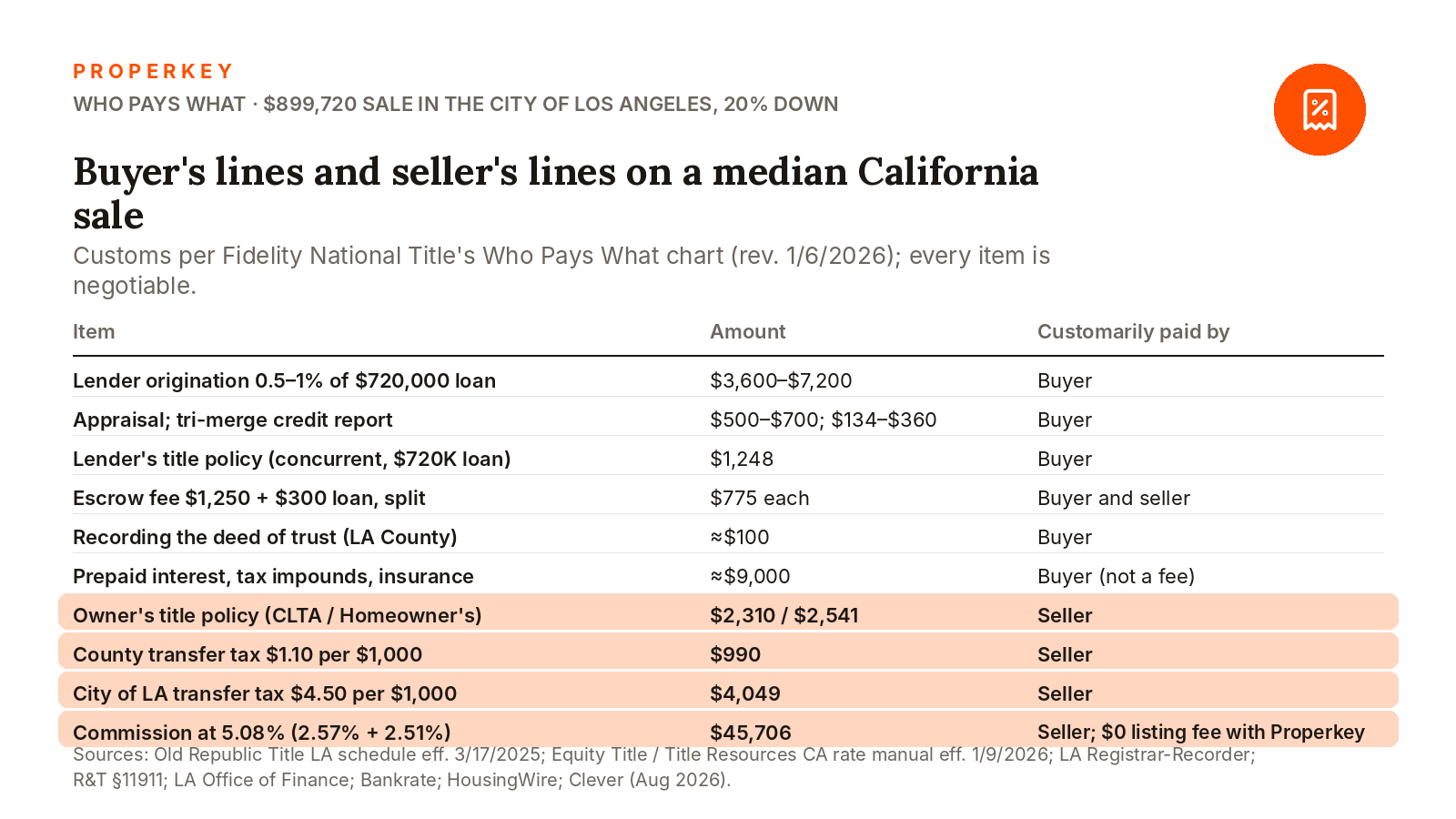
Assume Los Angeles County, 20% down, a $720,000 loan and a mid-month closing. The lender's own fees come first: an origination charge of 0.5% to 1% of the loan, $3,600 to $7,200 (Bankrate), or itemized underwriting and processing fees in the few-hundred-dollar range each; an appraisal that in California runs roughly $500 to $700 and more in high-cost metros (HomeLight); and a tri-merge credit report that now costs lenders far more than it did, with large lenders passing through $134 to $180 for one borrower and up to $360 for two after bureau price increases of about 43% for 2026 (HousingWire, MBA NewsLink). Then the title and escrow charges: a lender's title policy issued concurrently with the owner's policy, $1,248 on a $720,000 loan under Old Republic's Los Angeles schedule effective March 17, 2025; the buyer's half of an escrow fee that Equity Title's filed California schedule (effective January 9, 2026) sets at $1,250 for a sale between $800,001 and $900,000 plus $300 when there is a loan, so $775 each side; and the small items that schedule prices at $50 per document prepared, $25 per wire and $20 per recording. Recording a deed of trust at the Los Angeles Registrar-Recorder costs $15 for the first page and $3 for each additional page plus a $7 fraud-notification fee and a $10 real-estate-fraud fee, about $100 on a typical 20-page instrument; the $75 Building Homes and Jobs Act fee does not apply to an owner-occupied purchase under Gov. Code §27388.1. Add a natural hazard disclosure report at $59 to $99 (HomeGuard) if the contract puts it on the buyer. Total: roughly $6,600 to $10,600 before points.
The second group is not a fee at all but money the buyer would spend anyway, collected early. Prepaid interest from the funding date to month-end runs $141.63 a day on $720,000 at the November 5 Freddie Mac rate of 7.18%, or $2,124 for 15 days. The initial deposit to the impound account covers property taxes at Los Angeles County's average rate of 1.181% (BOE), $885 a month on this price, for however many months separate the closing from the next installment, often $3,000 to $7,000, plus a cushion the servicer may set at up to one-sixth of the year's disbursements under Regulation X. A year of homeowners insurance is due at closing; the NAIC's latest state data put California's average HO-3 premium at $1,655 for 2023, with two more months into the impound. Discount points are optional and cost 1% of the loan each (CFPB). Fannie Mae's loan-level price adjustments are the hidden one: a 740–759 score at 80.01%–85% loan-to-value carries a 1.000% adjustment and a 680–699 score 1.875%, $7,200 and $13,500 on $720,000, usually absorbed into the rate rather than shown on the Closing Disclosure.
What does the seller pay?
The customs are regional, and Fidelity National Title's "Who Pays What" chart (revised January 6, 2026) is the reference. In Los Angeles, Orange, San Diego, Riverside, San Bernardino, Ventura, Santa Clara and Sacramento counties the seller customarily buys the owner's title policy, $2,310 for a standard CLTA policy or $2,541 for the Homeowner's policy at $900,000 on the Old Republic schedule; in Alameda, San Francisco and San Mateo the buyer does. The escrow fee is split in Southern California and Sacramento, paid by the buyer in Alameda, San Francisco and San Mateo, and by the seller in Santa Clara. The seller pays the county documentary transfer tax everywhere on the chart, $0.55 per $500 under R&T §11911, which is $990 on this sale. City taxes are the variable: Los Angeles adds $4.50 per $1,000 (LA Office of Finance), another $4,049, and Measure ULA adds 4% above $5.4 million and 5.5% above $10.9 million for closings through June 30, 2027. San Francisco charges $3.75 per $500 between $1 million and $5 million (0.75%); Oakland 1.5% between $300,001 and $2 million; Berkeley 1.5% up to $1.7 million and 2.5% above, rising to 3% and 3.5% on January 1, 2027 under Measure W; Culver City 1.5% from $1.5 million and 3% from $3 million; Santa Monica $3 per $1,000 under $5 million and 5.6% at $8 million and up; San Jose's Measure E 0.75% from $2.3 million (the threshold was indexed on July 1, 2025) on top of its $3.30 per $1,000.
Then the commission. Clever Real Estate's August 2026 California survey put the average total at 5.08%, 2.57% for the listing side and 2.51% for the buyer's agent; on $899,720 that is $45,706, of which $23,123 is the listing fee. Since the NAR settlement took effect on August 17, 2024, offers of buyer-agent compensation no longer appear on the MLS and every piece is negotiated (NAR). Properkey lists for a $0 listing fee, with full MLS exposure and pro photos with a 3D tour, so the only commission question is whether to accept a buyer's request that the seller pay some or all of the buyer's agent's fee.
Why did closing costs jump after 2021?
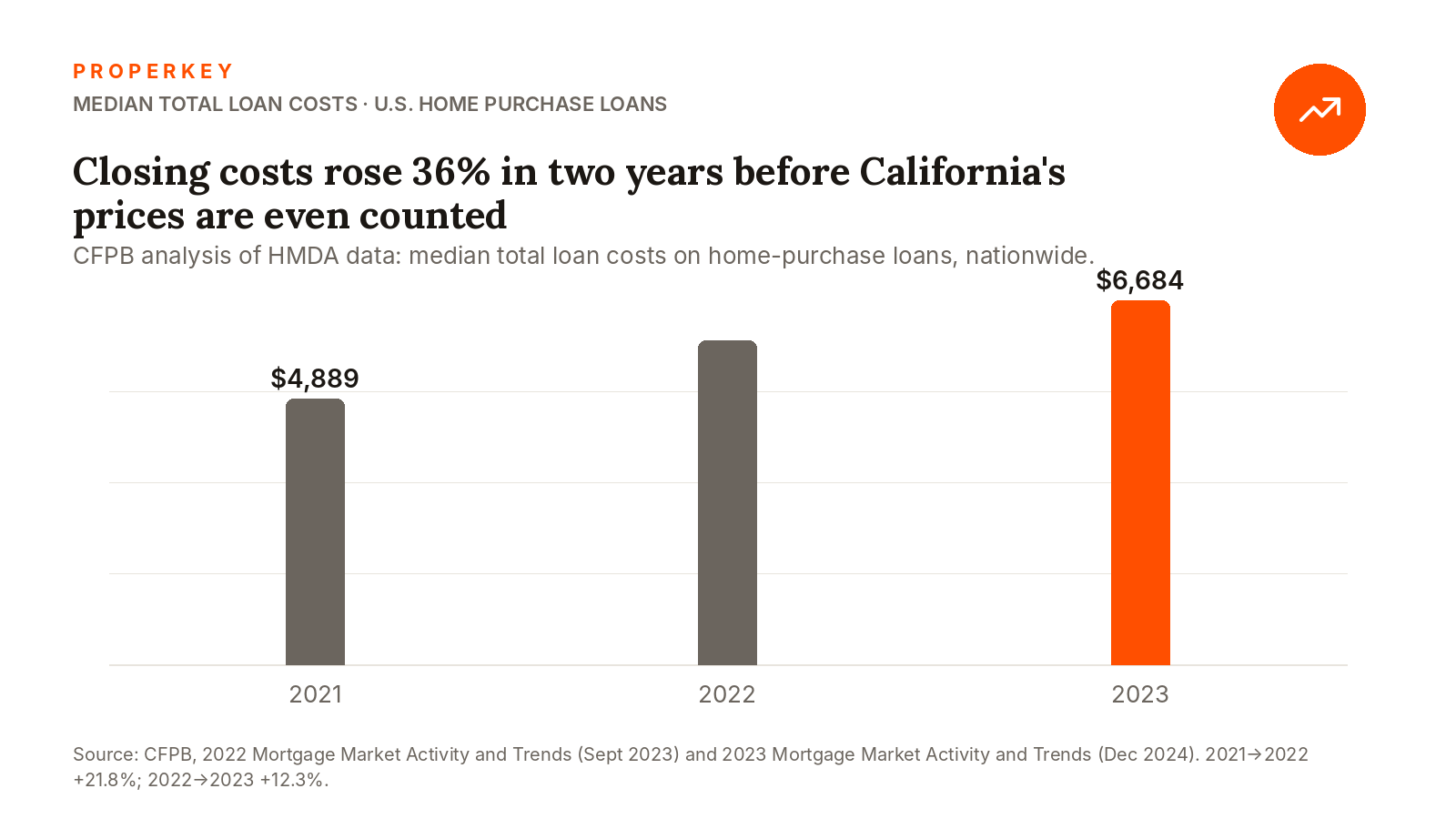
The CFPB's HMDA analysis shows median total loan costs on purchase loans rising from $4,889 in 2021 to $5,954 in 2022, the largest annual jump since the data began in 2018, and to $6,684 in 2023 (2022 report, 2023 report). Its May 2024 request for information on closing costs summarized the two-year rise as more than 36% and noted that title premiums typically run 0.5% to 1% of the price. Higher rates pushed buyers to pay points, credit-report costs rose, and prices kept the percentage-based items growing.
How can a buyer cut closing costs?
Start with the Loan Estimate. Under the TRID rule (12 CFR 1026.19(e)) the lender's own charges and transfer taxes cannot rise at all from the estimate; recording fees and third-party services chosen from the lender's list can rise 10% in aggregate; and prepaid interest, insurance and impounds have no cap but must be estimated in good faith. Section C of page 2 lists the services you may shop for, and the CFPB says shopping title services alone can save as much as $500. Compare estimates from more than one lender on the same day. Ask the seller for a credit: Fannie Mae allows interested-party contributions of 3% of the price above 90% loan-to-value, 6% from 75.01% to 90% and 9% at 75% or below (B3-4.1-02), FHA 6%, VA 4% in concessions with closing costs excluded, USDA 6%, and Properkey's guide to seller credits walks through the contract language. Take lender credits instead of paying points if you may sell or refinance within a few years. Close late in the month to cut prepaid interest. If you put 20% down, Civ. Code §2954 says a lender cannot require an impound account on an owner-occupied single-family home except in listed cases such as a loan of 90% or more or a government-insured loan, so you can keep that cash, though some lenders price for it. First-time buyers within CalHFA's income limits can use MyHome for closing costs as well as the down payment. And ask the HOA for its fee estimate up front: Civ. Code §4530 requires the association to quote document fees based on its actual cost, and §4575 bars transfer fees beyond the cost of changing its records.
How can a seller cut them?
The commission is the lever: a $0 listing fee removes $23,123 on the median sale, and the buyer-agent fee is a negotiation, not a custom. The transfer tax is set by statute and cannot be negotiated away, only allocated; the title policy and escrow fee can be, since the purchase agreement allocates each cost by checkbox. Properkey's related guides cover who pays for title insurance by county, a $700,000 purchase line by line, the prelim versus the policy and how escrow closes; Properkey's broker escrow handles transactions in which Properkey is the broker.
Questions people ask
What is a normal closing cost on a $900,000 house in California? For the buyer, about $6,600 to $10,600 in fees plus roughly $9,000 in prepaid interest, tax impounds and insurance, or 1.7% to 2.2% of the price all in, before points. For the seller in the City of Los Angeles, about $8,300 in transfer taxes, title and escrow before commission.
Are closing costs negotiable? The lender's fees and who pays each title, escrow and transfer item are negotiable; the transfer tax rate, recording fees and the premium on a filed title schedule are not. Seller credits toward the buyer's costs are allowed up to each program's cap.
Why is my cash to close so much higher than my closing costs? Because the Closing Disclosure adds prepaid interest, the impound deposit and the insurance premium to the fees. Those are not costs of the loan; they are the first months of owning the home, paid early.
Who pays closing costs in California, the buyer or the seller? Both, by custom that varies by county: in Southern California the seller buys the owner's title policy and pays the transfer taxes while the two sides split escrow; in San Francisco, Alameda and San Mateo the buyer pays title and escrow. Everything is subject to the contract.
This article summarizes published fee schedules, statutes and rules as of November 8, 2026 for a $899,720 Los Angeles example. It is not legal, tax or lending advice; your Loan Estimate and escrow instructions control.
Sources: C.A.R. September 2026 · CFPB 2023 Mortgage Market Activity and Trends · CFPB 2022 Data Point · CFPB RFI on closing costs (May 2024) · Freddie Mac My Home · ClosingCorp 2021 via RISMedia · Bankrate on origination fees · HomeLight on appraisal costs · HousingWire on 2026 credit-report costs · MBA NewsLink · Old Republic Title LA rate schedule · Equity Title / Title Resources CA rate manual · LA Registrar-Recorder fees · Gov. Code §27388.1 · HomeGuard NHD · Freddie Mac PMMS · BOE county tax rates · 12 CFR 1024.17 · CFPB on points · Fannie Mae LLPA matrix · Fidelity National Title "Who Pays What" · R&T §11911 · LA Office of Finance · San Francisco transfer tax · Oakland · Berkeley · Culver City · Santa Monica · San Jose Measure E · NAR settlement facts · properkey.us/sell · 12 CFR 1026.19 · CFPB on shopping closing services · Fannie Mae B3-4.1-02 · USDA HB-1-3555 ch. 6 · Civ. Code §2954 · CalHFA MyHome · Civ. Code §4530 · Civ. Code §4575 · C.A.R. RPA (public copy)
Written by Keyro, Properkey's AI. Properkey, DRE #01979718.



