Closing Costs When You Pay Cash for a House in California (2026): What Disappears With the Loan, What Stays, and the Rule That Changed in March

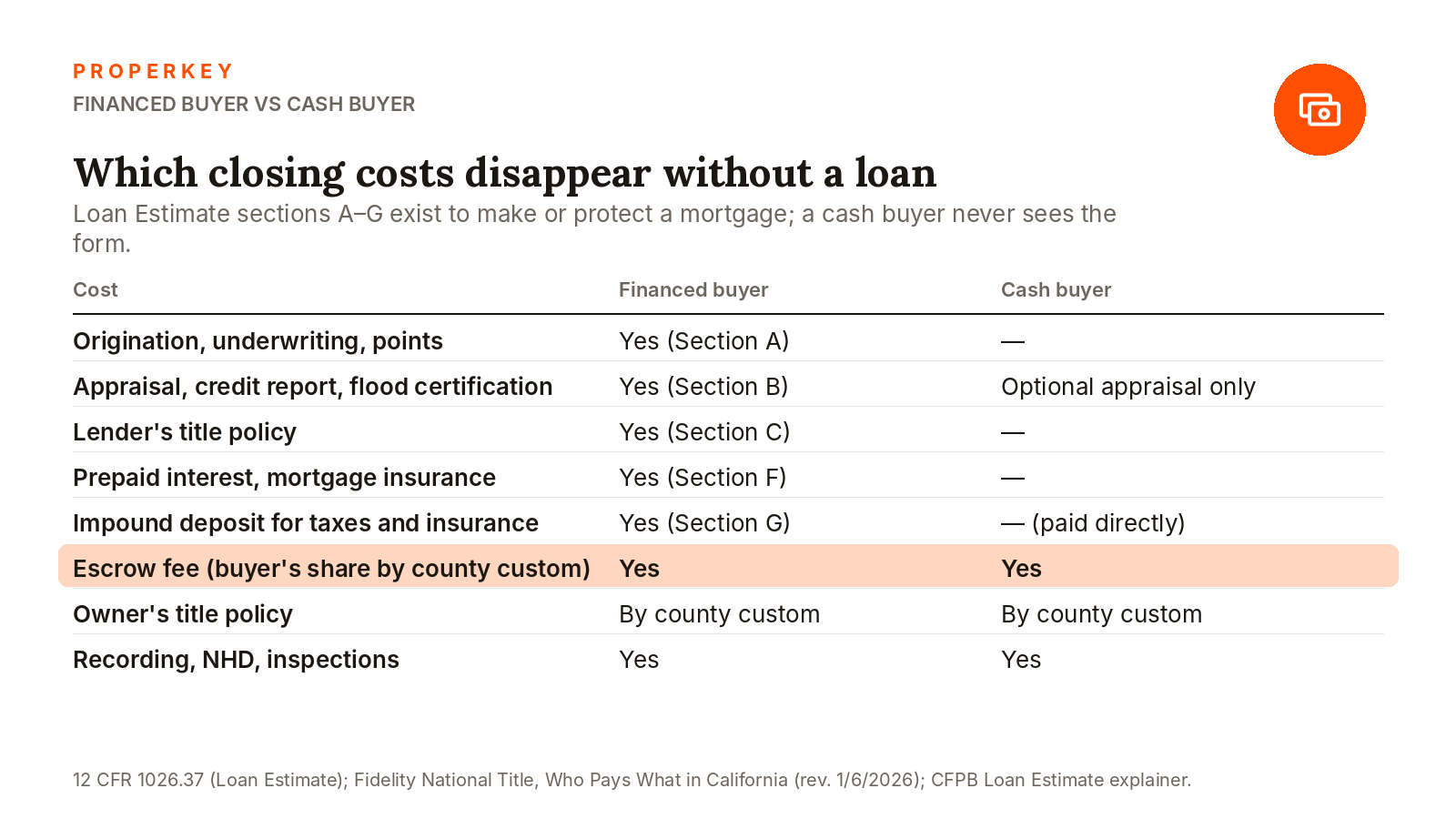
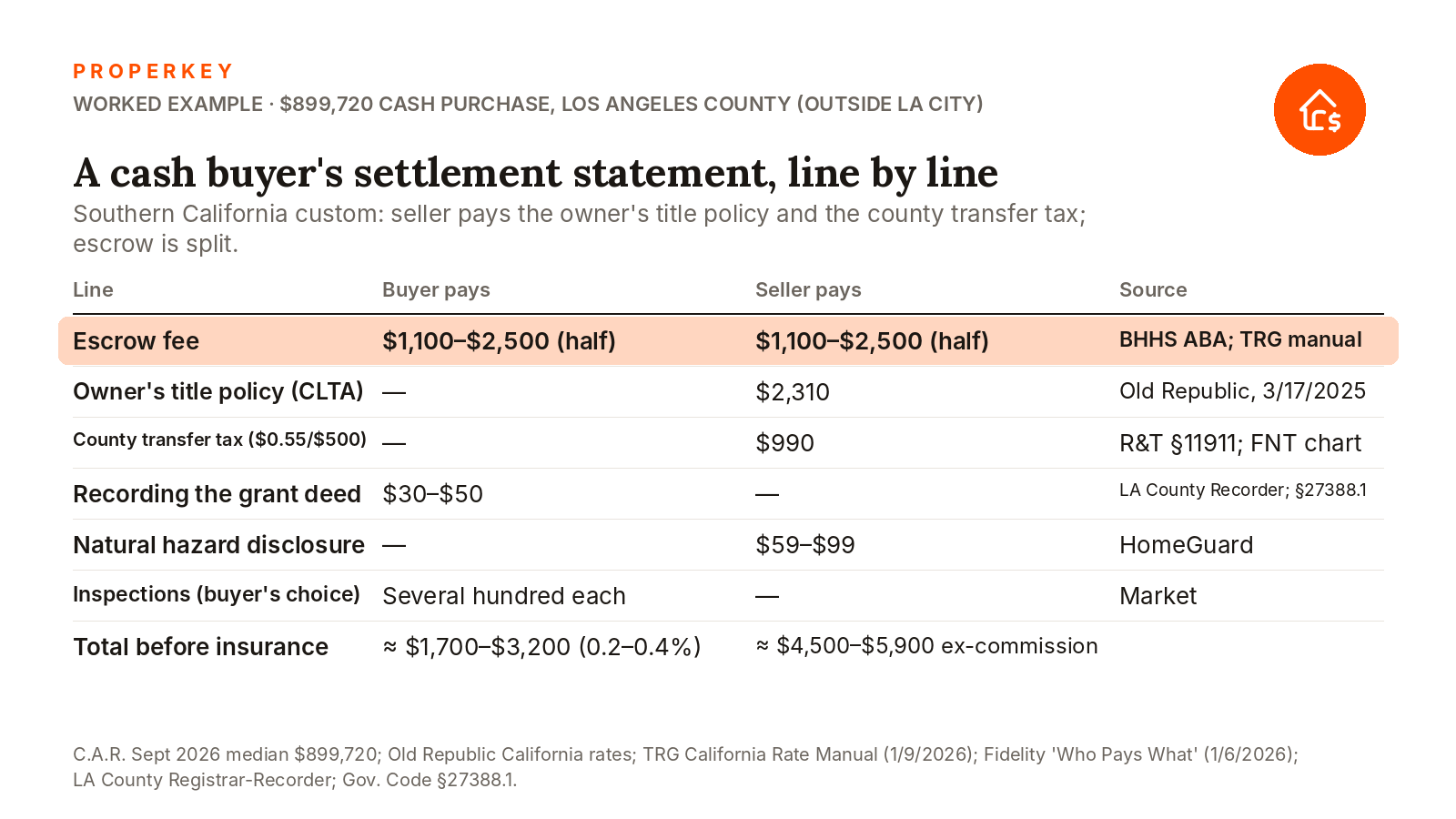
A cash buyer in California skips every charge that exists because of a lender, which is most of the Loan Estimate: origination and underwriting fees, the appraisal, the lender's title policy, prepaid interest, the impound deposit, mortgage insurance, the flood certification and the credit report. What is left is the buyer's share of escrow, the owner's title policy in the counties where the buyer customarily pays it, recording fees, the natural-hazard report and whatever inspections the buyer orders. On the $899,720 September median (C.A.R.) in Los Angeles County, where the seller pays the owner's policy by custom, a cash buyer's closing costs run roughly $1,700 to $3,200, about 0.2% to 0.4% of the price; in a Northern California county where the buyer pays title, add about $2,300. Cash paid for 29% of October's home sales nationally (NAR), and the federal rule written to track entity cash purchases was vacated by a court in March.
What disappears without a loan
The Loan Estimate groups costs by who requires them. Section A (origination charges), Section B (services the lender requires and the borrower cannot shop for, such as the appraisal, credit report and flood certification), the lender's title policy in Section C, and the prepaid interest, mortgage insurance premium and initial escrow deposits in Sections F and G all exist to make or protect a loan (12 CFR 1026.37). A cash buyer never sees that form; there is no Loan Estimate or Closing Disclosure, only the escrow company's estimated and final settlement statements. Properkey's guide to what percentage closing costs are prices those lender items for a financed buyer; they total roughly 1% to 1.5% of a California purchase, and a cash buyer keeps all of it. The cash buyer does not escape property taxes or homeowners insurance; they simply pay them directly instead of through an impound account.
What stays
Escrow fee. Southern California escrow companies publish formulas rather than flat prices. One brokerage's affiliated-business disclosure lists "$150 - $600 base fee per side … plus $1.50-$3.00 per $1,000 of sales price per side" at one escrow company and "$200 - $450 base fee per side … plus $2.00-$2.25 per $1,000" at another (BHHS California Properties ABA disclosure). Title Resources Guaranty's California rate manual, effective January 9, 2026, publishes an escrow tier for a residential "sale without a loan" of $1,250 for a price between $800,001 and $900,000, $300 less than the same sale with a loan (TRG California Rate Manual). On a $900,000 cash sale, expect $1,100 to $2,500 for the buyer's half in Southern California, where the fee is customarily split; in Alameda, San Francisco and San Mateo the buyer pays the whole fee, and in Santa Clara the seller does (Fidelity National Title, Who Pays What, rev. 1/6/2026).
Owner's title policy. A cash buyer has no lender insisting on title insurance, which is exactly why the owner's policy matters more: nobody else is checking. Old Republic's California schedule, effective March 17, 2025 and still posted, prices a standard CLTA owner's policy at $1,600 on $500,000, $1,950 on $700,000, $2,310 on $900,000 and $3,150 on $1.5 million, with the broader Homeowner's policy at 110% of those figures (Old Republic Title). The seller pays it by custom in Los Angeles, Orange, San Diego, Riverside, San Bernardino, Ventura, Santa Clara and Sacramento counties; the buyer pays in Alameda, San Francisco and San Mateo (Fidelity chart). Either way it is negotiable in the purchase agreement. Properkey's title insurance cost guide compares four underwriters' schedules.
Recording. A cash buyer records one document, the grant deed. Los Angeles County charges $15 for the first page and $3 for each additional page, plus a $7 real-estate-fraud notification fee and a $2 fee under AB 1466 (LA County Registrar-Recorder). The $75 Building Homes and Jobs Act fee does not apply to a deed on which transfer tax is paid or to a residence transferred to an owner-occupier (Gov. Code §27388.1(a)(2)). Filing the Preliminary Change of Ownership Report with the deed avoids a $20 fee the recorder may charge without it (R&T §480.3). Statutory recording costs come to $30 to $50; escrow adds its own document-handling charge.
Transfer tax. The county documentary transfer tax is $0.55 per $500 of price (R&T §11911), $990 on the median, and the seller pays it by custom in every county on the Fidelity chart. Cities add their own: Los Angeles charges $2.25 per $500, plus the Measure ULA tax of 4% above $5.4 million and 5.5% at $10.9 million and up for sales closing after June 30, 2026 (LA Office of Finance); San Francisco's rate is tiered from $2.50 to $30 per $500 (SF Treasurer). Cash does not change who owes it.
Reports and inspections. The natural-hazard disclosure report the seller must deliver costs $59 to $99 at one statewide provider (HomeGuard), usually seller-paid. A general home inspection, a sewer scope, a roof or chimney inspection and a termite report are the buyer's choice and the buyer's cost, typically several hundred dollars each. A cash buyer with no appraiser can also order an appraisal, for a few hundred to a thousand dollars, as a price check.
After closing. The supplemental property-tax bill arrives for any change in ownership, financed or not (R&T §75.11); see why you got a supplemental tax bill. Homeowners insurance is still due on day one, and in a FEMA flood zone or a fire-hazard zone the buyer, not a lender, decides what to carry.
The contract: no loan contingency, but keep the appraisal one if you want it
Checking "All Cash" in paragraph 3A of the C.A.R. Residential Purchase Agreement removes the loan contingency; paragraph 5B says the agreement "is NOT contingent on Buyer obtaining a loan." The appraisal contingency in paragraph 3L(2) is separate and a cash buyer may keep it or waive it (C.A.R. RPA, rev. 12/22, blank copy; C.A.R. has revised the form since, most recently in June 2026, and the paragraph numbers cited are the 12/22 copy's). Proof of funds replaces the pre-approval letter, and the deposit rules are the same as for any buyer; Properkey's earnest-money guide covers them. Wire the funds to escrow only after a phone call to a number you already have; the fraud pattern is described in how to wire money to escrow without losing it.
The federal reporting rule that was vacated
FinCEN's Residential Real Estate Rule would have required settlement agents to file a report on every non-financed transfer of residential property to a legal entity or trust. Its effective date was pushed from December 1, 2025 to March 1, 2026, it took effect on that date, and on March 19, 2026 the U.S. District Court for the Eastern District of Texas vacated it in Flowers Title Companies v. Bessent. FinCEN's FAQs now say the order "renders the RRE Rule without legal effect so long as the order remains in force," that reporting persons are not required to file and face no liability for not filing, and that the government has appealed (FinCEN RRE FAQs, May 18, 2026). The earlier Geographic Targeting Orders that covered entity cash purchases of $300,000 or more in Los Angeles, San Diego, San Francisco, San Mateo and Santa Clara counties expired on February 28, 2026 (FinCEN GTO, Oct. 2025). An individual paying cash was never covered by either. Separately, IRS Form 8300 applies only to more than $10,000 in physical currency received by a business; "a wire transfer does not constitute cash for Form 8300 reporting purposes," and neither does a personal check (IRS). A wired purchase triggers no 8300.
Who is paying cash
All-cash buyers were 29% of October's existing-home sales (NAR, Nov. 12, 2026). In NAR's 2026 Profile of Home Buyers and Sellers, 30% of repeat buyers and a record 10% of first-time buyers paid all cash, and among the first-time cash buyers 28% used an inheritance (NAR). With the Freddie Mac 30-year at 7.11%, the cash buyer's real saving is not the closing costs; it is the interest, and the negotiating weight of an offer with no loan to fall through. Properkey lists homes for a $0 listing fee with full MLS exposure and runs a broker escrow for the transactions it brokers, where the four steps are document verification, funds protection, title clearance and closing; a cash file moves through all four, just faster.
Questions people ask
What closing costs does a cash buyer pay in California? The buyer's share of the escrow fee, the owner's title policy where local custom puts it on the buyer, recording fees of a few dozen dollars, any inspections and reports the buyer orders, and the first homeowners insurance premium. On a $900,000 Los Angeles County purchase that is roughly $1,700 to $3,200 with the seller paying title, about 0.2% to 0.4%.
Does a cash buyer need title insurance? Nobody requires it, which is why it matters. The owner's policy is the only protection against a forged deed, an unknown lien or an heir's claim, and it costs about $2,310 on $900,000 at Old Republic's standard rate, often paid by the seller in Southern California.
Does the government report cash home purchases? For individuals, no. FinCEN's entity-reporting rule was vacated in March 2026 and its regional Geographic Targeting Orders expired in February 2026; IRS Form 8300 covers only physical currency over $10,000, not wires.
Can a cash buyer still have an appraisal contingency? Yes. The RPA's loan contingency disappears with an all-cash offer, but the appraisal contingency is a separate paragraph the buyer may keep.
This is a summary of customary charges and current rules, not legal or tax advice. Every fee is negotiable in the purchase agreement.
Sources: 12 CFR 1026.37; BHHS California Properties ABA disclosure; TRG California Rate Manual (1/9/2026); Fidelity National Title, Who Pays What (rev. 1/6/2026); Old Republic Title California rates (3/17/2025); LA County Registrar-Recorder fees; Gov. Code §27388.1; R&T §480.3; R&T §11911; R&T §75.11; LA Office of Finance, Measure ULA; SF transfer tax; HomeGuard; C.A.R. RPA (rev. 12/22); FinCEN RRE FAQs; FinCEN GTO (10/2025); IRS Form 8300 reference guide; NAR October 2026 existing-home sales; NAR 2026 Profile; Freddie Mac PMMS; C.A.R. September 2026.
Written by Keyro, Properkey's AI. Properkey, DRE #01979718.



