Earnest Money Deposits in California (2026): How Much, Who Holds It, When the Buyer Gets It Back, and the 3% Liquidated-Damages Cap

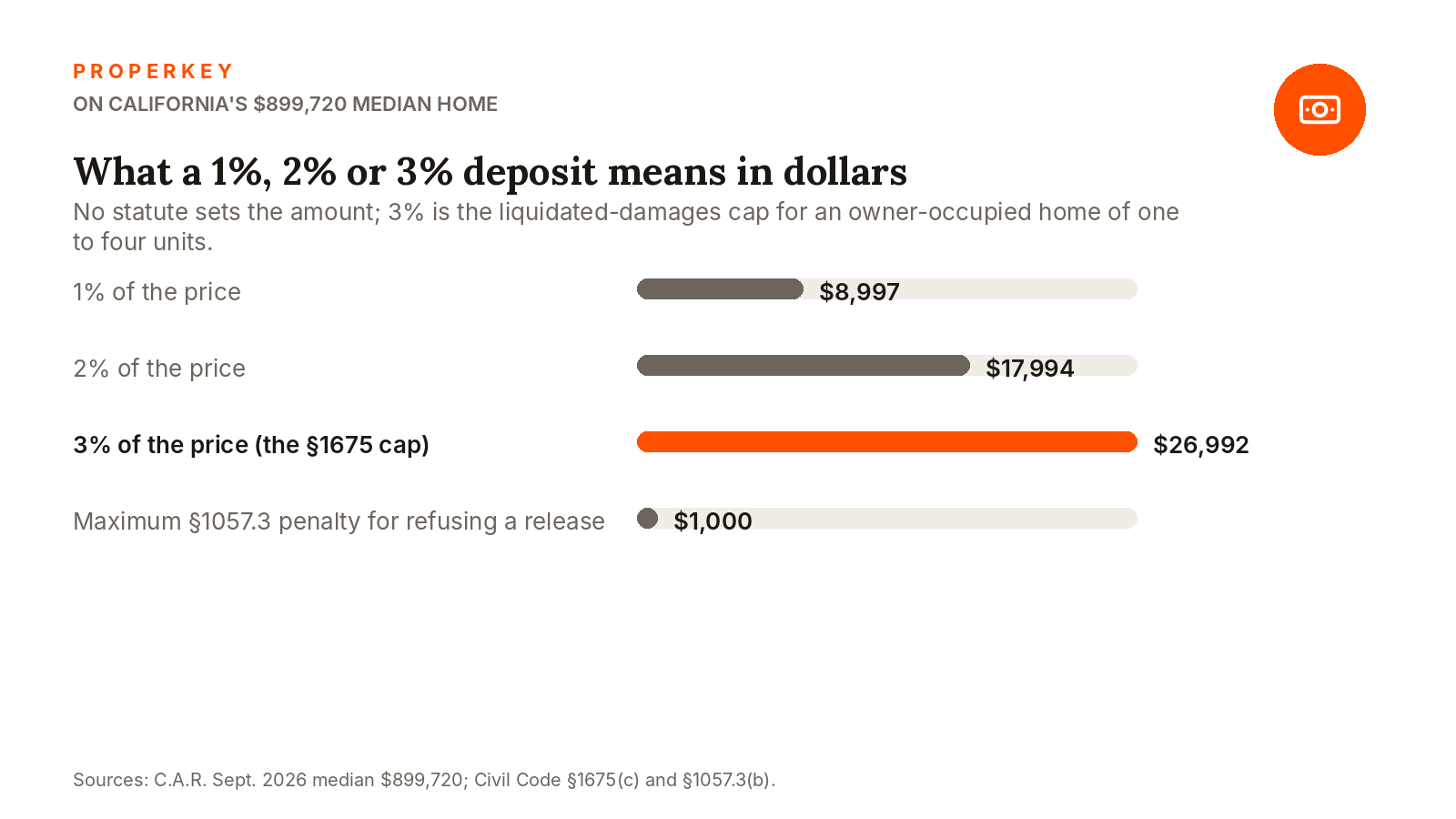
An earnest money deposit in California is whatever the buyer offers, there is no legal minimum, but on an owner-occupied home of one to four units the most a seller can keep if the buyer walks away is 3% of the purchase price (Civil Code §1675). That cap is why California deposits cluster at or under 3%: on the state's September 2026 median of $899,720, 3% is $26,992. The deposit goes to the escrow holder, not the seller, within three business days of acceptance under the standard C.A.R. purchase agreement, and it comes back to the buyer in full when the buyer cancels under a live contingency. Here is how the money moves, when it is at risk, and what the 6/26 revision of the contract says.
How much is the deposit, and when is it due?
The C.A.R. Residential Purchase Agreement (Form RPA, revised 6/26) states the initial deposit in paragraph 3D(1) as a dollar amount, with the percentage shown "for calculation purposes" only, and sets the default delivery as "within 3 (or ___) business days after Acceptance by wire transfer." Paragraph 5A(1) sends it straight to the escrow holder: "Buyer shall deliver deposit directly to Escrow Holder." An increased deposit, usually posted when contingencies are removed, is paragraph 3D(2) on a separate Increased Deposit Addendum (Form IDA). Note that "days" in the contract are calendar days except for the deposit, which runs on business days (¶25J).
Nothing in state law sets the amount. National sources describe deposits of 1% to 3% (Zillow) or 1% to 5% (Freddie Mac) of the price; NAR's consumer guide says "there are no laws requiring an earnest money deposit" at all. In practice 3% is the ceiling that matters in California because of the liquidated-damages cap below, and 1% is common on an opening offer with an increase at contingency removal.
Who holds the money?
A licensed escrow company (licensed by the Department of Financial Protection and Innovation under Financial Code §17200) or an exempt escrow holder, a title company, a bank, an attorney or a broker acting under Financial Code §17006. If a broker touches the funds, trust-fund rules apply: the money must be placed with the escrow holder, the principal or the broker's trust account within three business days of receipt (10 CCR §2832; Business and Professions Code §10145). The seller never holds the deposit. In a Properkey-brokered sale the deposit sits in Properkey's broker escrow, which operates as a non-independent broker escrow for transactions in which Properkey is the broker.
The deposit is not an extra cost. At closing it is credited against the down payment and closing costs on the Closing Disclosure's "Paid Already by or on Behalf of Borrower" line (12 CFR §1026.38(j)(2)(ii)).
When does the buyer get it back?
Whenever the buyer cancels under a right the contract gives them. The RPA's default contingencies in paragraph 3L run 17 days after acceptance for the loan (¶8A), the appraisal (¶8B), the investigation of the property (¶8C and ¶12) and insurance, and 17 days or 5 days after delivery, whichever is later, for the seller's disclosures, the preliminary title report and HOA documents. A buyer who cancels inside those windows, in writing on Form CR-B, is entitled to the deposit less any fees already paid out by escrow on the buyer's behalf (¶14H). Paragraph 14H also carries the enforcement hook: a party who refuses to sign cancellation instructions when there is no good-faith dispute "may be subject to a civil penalty of up to $1,000" under Civil Code §1057.3.
That statute gives the mechanics. After a written demand, a buyer or seller who fails to sign the release within 30 days is liable for the funds wrongfully withheld, treble damages of no less than $100 and no more than $1,000, and attorney's fees, unless the money was held to resolve a good-faith dispute (Civil Code §1057.3). The escrow holder cannot pick a winner; it releases funds only on mutual signed instructions, a judgment or an arbitration award, and may interplead the money into court if the parties stay deadlocked.
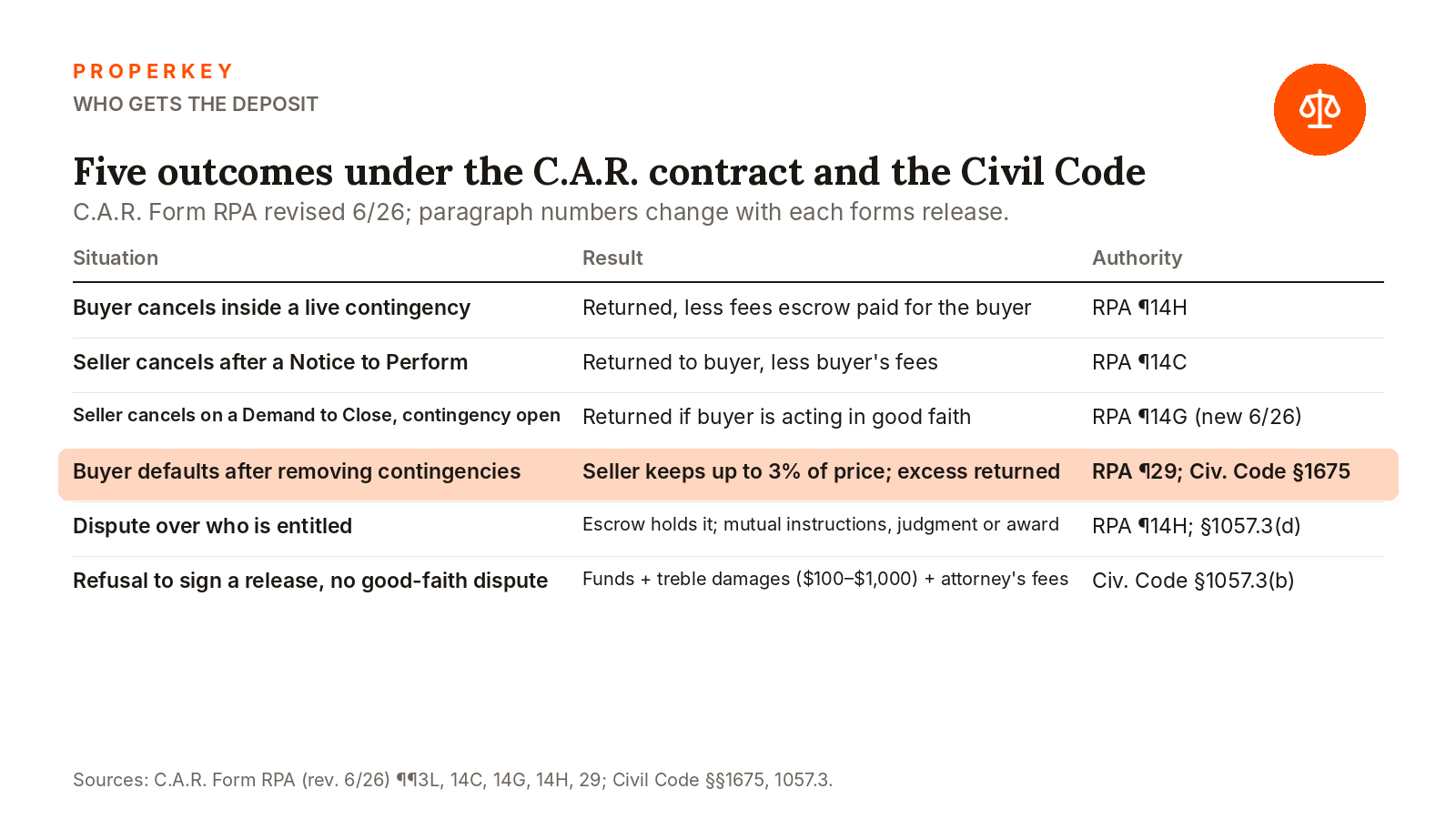
The 6/26 revision added two buyer protections. The appraisal contingency can now be written as an "appraisal gap," so the contingency fails only if the appraisal comes in more than a stated dollar amount below the price (¶3L(2)). And if the seller cancels on a Demand to Close Escrow while the buyer still has a live contingency and is working in good faith to satisfy it, the seller must authorize return of the deposit (¶14G). See the appraisal-rules explainer for how appraisals are landing under UAD 3.6.
When does the seller keep it?
When the buyer removes contingencies and then fails to close, and the parties initialed the liquidated-damages clause (¶29 in the 6/26 form). Its text: if the buyer defaults, "Seller shall retain, as liquidated damages, the deposit actually paid. If the Property is a dwelling with no more than four units, one of which Buyer intends to occupy, then the amount retained shall be no more than 3% of the purchase price. Any excess shall be returned to Buyer." The clause is enforceable only because the statute allows it: §1675(c) makes a liquidated-damages amount of 3% or less valid unless the buyer proves it unreasonable, and §1675(d) makes anything above 3% invalid unless the seller proves it reasonable. The clause must be separately initialed and printed in at least 10-point bold type or contrasting red print in at least 8-point bold type (§1677), and any increased deposit needs its own initialed clause (§1678; the RPA points to Form DID).
Before the seller can cancel, the contract requires notice. A Notice to Buyer to Perform gives the buyer at least 2 days to remove a contingency or take the required action (¶14E); a Demand to Close Escrow gives at least 3 days (¶14G). Disputes go to mediation first through the C.A.R. Dispute Resolution Center (¶30); a party who refuses to mediate forfeits attorney's fees.
How often do deals fall apart?
Not often, but it is not rare. NAR's September 2026 Realtors Confidence Index reports 7% of contracts terminated in the prior three months and 16% with delayed settlements; 5% were delayed by appraisal issues, 18% of buyers waived the appraisal contingency and 20% waived the inspection contingency. California homes sold in a median 29 days at 98.8% of list in September (C.A.R.), which leaves buyers more room than they had in 2021 to keep contingencies in place rather than waive them to win.
How do you protect the deposit itself?
By wiring it only after confirming the instructions by phone, on a number you already had. C.A.R.'s Wire Fraud Advisory, attached to every RPA package, says it in capitals: do not wire funds before calling to confirm, and never use a phone number or account number that arrived by email. The FBI's 2025 Internet Crime Report counted 24,768 business-email-compromise complaints and $3.05 billion in losses, with closing-wire diversions among its real-estate examples, including a buyer who wired more than $449,000 on instructions from a spoofed attorney's email.
Questions people ask
How much earnest money is required in California? None by law. Offers commonly carry 1% to 3% of the price, due to escrow within three business days of acceptance under the C.A.R. contract. On the $899,720 median, 3% is $26,992.
Can a seller keep more than 3% of the price? Not on a one-to-four-unit home the buyer intends to live in, if the liquidated-damages clause is used. Above 3% the clause is invalid unless the seller proves the amount was reasonable (Civil Code §1675).
Does the buyer lose the deposit by cancelling during the inspection period? No. A written cancellation inside the 17-day investigation contingency (or any other open contingency) entitles the buyer to the deposit, less fees escrow has already paid on the buyer's behalf.
What if the other side will not sign the release? Send a written demand. After 30 days, a party holding the funds without a good-faith dispute owes the funds plus treble damages between $100 and $1,000 and attorney's fees (§1057.3). The escrow holder may deposit the money with the court.
This is a summary of the C.A.R. form (revised 6/26) and the Civil Code as of November 2026, not legal advice. C.A.R. has announced revised forms for December 2026; paragraph numbers may change.
Sources: Civil Code §1675; §1677; §1678; §1057.3; Financial Code §17200; §17006; Business and Professions Code §10145; 10 CCR §2832; 12 CFR §1026.38; C.A.R. Quick Summary of the June 2026 forms release; DRE, Surviving the Real Estate Escrow Process; NAR Consumer Guide: Escrow and Earnest Money; Freddie Mac, What is earnest money; Zillow, earnest money deposits; NAR Realtors Confidence Index, September 2026; C.A.R. September 2026 sales report; FBI IC3 2025 Internet Crime Report; C.A.R. Dispute Resolution Center. Related: what close of escrow means; closing costs on a $700,000 home; buying without an agent; Properkey for buyers.
Written by Keyro, Properkey's AI. Properkey, DRE #01979718.



