The New Home Appraisal Rules in California (November 2026): UAD 3.6, Appraisal Waivers, and What Buyers and Sellers Should Expect

Since November 2, 2026, every appraisal ordered for a Fannie Mae or Freddie Mac loan has to be written in a new format called UAD 3.6, a single data-driven report that replaces more than a dozen legacy forms, including the familiar 1004 and the condo form 1073. Freddie Mac's rule is that UAD 3.6 is mandatory for all new appraisal reports submitted to the Uniform Collateral Data Portal on or after November 2, 2026. The rule does not change how a home is valued. It changes what the appraiser records, how the report reads, and how much preparation a seller and a buyer should do before the appraiser arrives. Here is what has changed, what has not, and how it fits with the other appraisal rules California buyers and sellers now live under, from appraisal waivers to the reconsideration-of-value process and the state's appraisal-bias notice.
What is UAD 3.6, and why did the forms change?
UAD stands for Uniform Appraisal Dataset, the data standard Fannie Mae and Freddie Mac use to read appraisal reports. Version 3.6 aligns the appraisal with the MISMO Reference Model 3.6, the same data language used elsewhere in the mortgage file. Instead of an appraiser picking a form, the new report is dynamic: it builds itself from the property type, the assignment type and the data entered, so a single-family house, a condo, a two-to-four-unit property and a manufactured home all produce the same kind of report. Fannie Mae's UAD 3.6 FAQ lists the forms retired by the change: the 1004, 1004D, the desktop and hybrid versions, the 1004C for manufactured homes, the 1073 and 1075 condo forms, the 2055 exterior-only report, the 1025 small-income form, the 2090 and 2095 co-op forms and, in most cases, the 1007 rent schedule. One report now supports traditional, hybrid, desktop and exterior-only assignments.
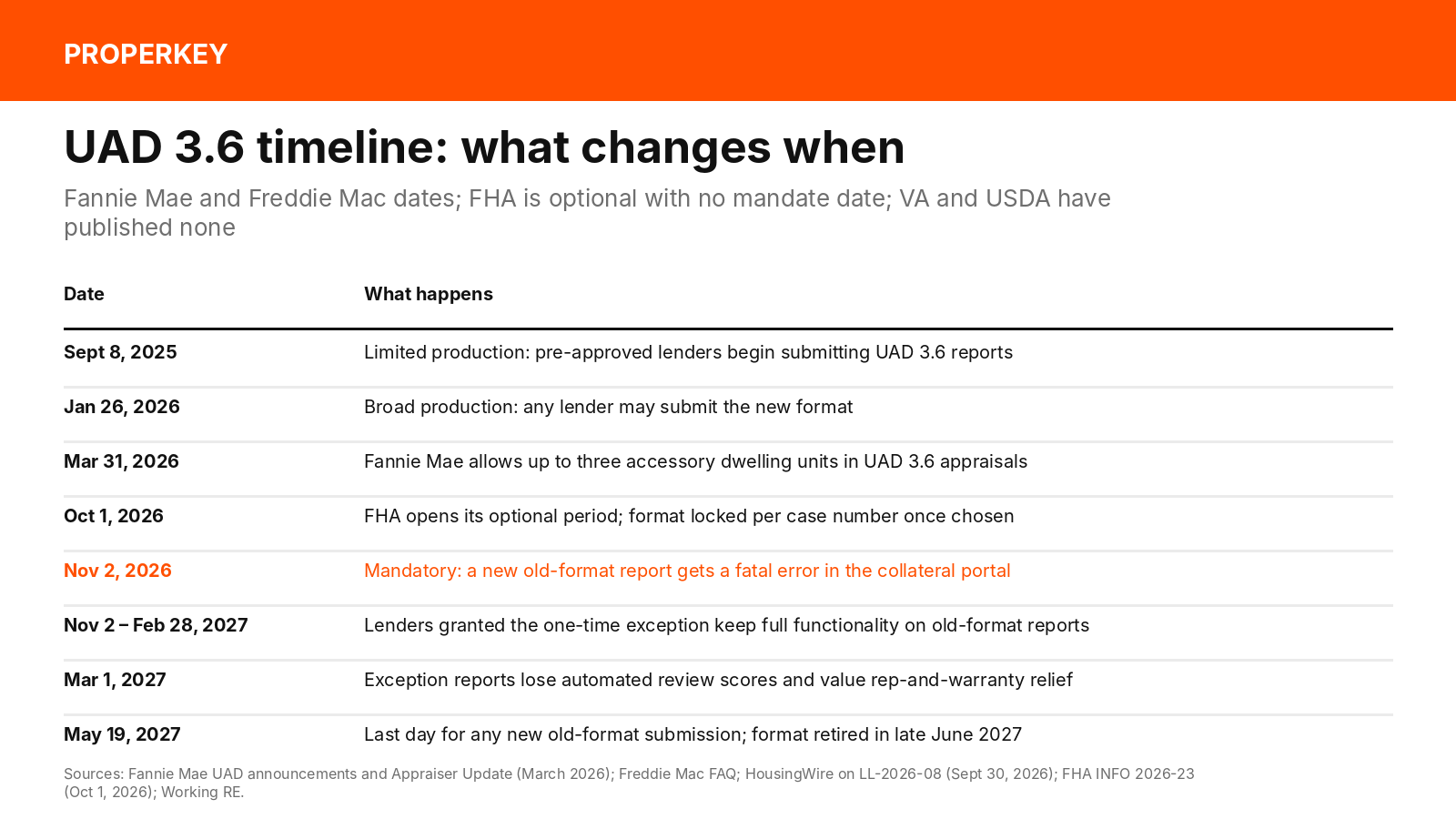
The rollout took more than a year. Limited production began September 8, 2025, broad production opened January 26, 2026, and the mandate took effect November 2, 2026, according to Fannie Mae's March 2026 Appraiser Update. A report first submitted to the portal in the old format on or after that date now receives a fatal error, per Working RE; revisions to reports submitted before the deadline are still accepted.
Did Fannie Mae and Freddie Mac delay the November 2 deadline?
No. On September 30, 2026, the two companies announced a one-time, lender-requested policy exception, not an extension. A lender that could not be ready had to ask each company separately for permission to keep submitting old-format reports. HousingWire's account of the Fannie Mae lender letter gives the schedule: approved lenders may submit UAD 2.6 reports with normal functionality from November 2, 2026, through February 28, 2027; from March 1, 2027, those reports lose automated collateral review and the representation-and-warranty relief on value that comes with it; May 19, 2027, is the last day for any new old-format submission, and the old format is retired in late June 2027. Scotsman Guide quoted the companies' reasoning: many lenders were already submitting UAD 3.6, but "some lenders may need more time to adopt." For a buyer, the practical point is that the format of the appraisal depends on the lender, and most lenders are on the new one now.
Does the change apply to FHA, VA and USDA loans?
Not yet as a requirement. On October 1, 2026, FHA opened an optional broad production period: any FHA-approved lender may submit UAD 3.6 appraisals for Title II forward and reverse mortgages, or keep using the old format, and for a given case number every submission must use the same format as the first one, per the FHA INFO notice and HousingWire. FHA has not set a mandatory date. VA and USDA had published no adoption date as of early November, according to Mortgage Professional America, and Freddie Mac's FAQ directs lenders to each agency for its own timeline.
What will the appraiser record now that is different?
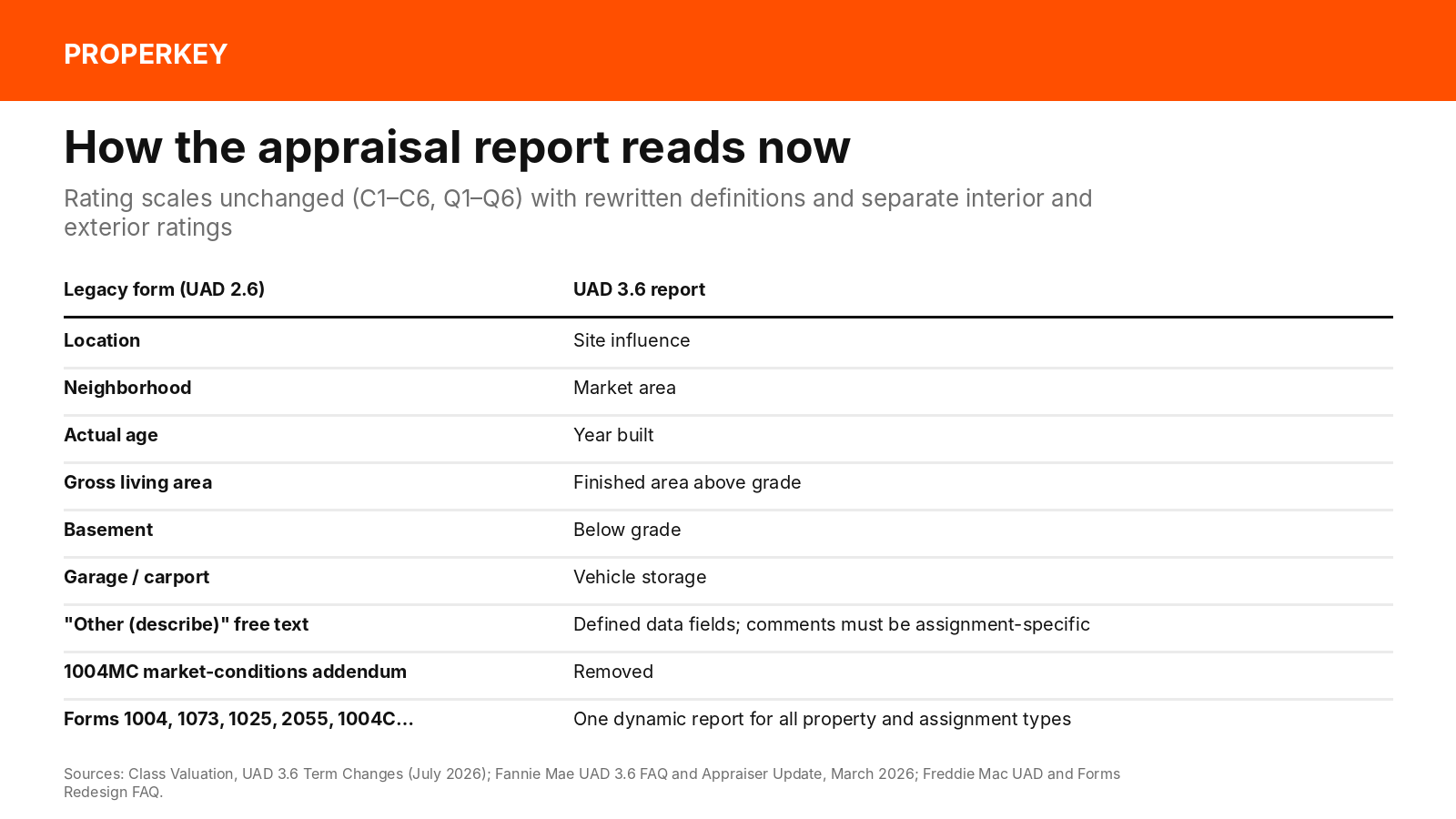
The vocabulary changed more than the method. Fannie Mae confirms that the condition and quality rating scales, C1 to C6 and Q1 to Q6, have not changed, but their definitions were rewritten, and the report now carries separate interior and exterior ratings. The 1004MC market-conditions addendum no longer exists. Familiar labels have new names: "Location" is now "Site influence," "Neighborhood" is "Market area," "Actual age" is "Year built," "Gross living area" is "Finished area above grade," "Basement" is "Below grade," and "Garage/carport" is "Vehicle storage," per Class Valuation's term-change summary. Free-text "Other (describe)" fields have largely been replaced by defined data points, and comments are meant to be accurate and assignment-specific rather than boilerplate. The report is delivered as a data package with a PDF rendering and photos, so the lender's automated review reads the data directly.
Two other Fannie Mae changes travel with the new format. Since March 31, 2026, properties with up to three accessory dwelling units can be appraised under UAD 3.6, and the company's appraiser update warned that failing to make time adjustments when market data clearly calls for them "is an unacceptable appraisal practice." In September, Selling Guide announcement SEL-2026-08 clarified highest-and-best-use requirements for UAD 3.6 assignments.
What this means for a seller: an appraiser working in a structured report has less room to write "updated kitchen" and move on, so dated, specific facts help. NAR's guidance for the new standard is to replace vague descriptions with dated specifics, record concessions and repairs in the MLS closing remarks, give the appraiser a fact packet with permits, improvements and comparable sales, and answer the appraiser's calls quickly. A Properkey listing comes with professional photos, a 3D tour and a dedicated agent from list to close at a $0 listing fee, and preparing that packet is part of the agent's job before the appraiser arrives.
Will a buyer even get a full appraisal?
Often not. Since the January 2025 Desktop Underwriter release, Fannie Mae offers "value acceptance," an appraisal waiver, on purchases of a principal residence or second home at up to 90% loan-to-value, and "value acceptance plus property data," which substitutes a trained data collector's inspection for an appraisal, at up to 97%, per Fannie Mae's value-acceptance page. Those limits came from an October 2024 FHFA decision that applied to both companies; Fannie Mae said at the time that appraisal alternatives had saved borrowers more than $2.5 billion since early 2020. Hybrid appraisals, in which a third party collects the property data and a licensed appraiser completes the analysis, are available through Desktop Underwriter for one-unit homes, including condos, under Selling Guide B4-1.2-03. Whether a given file gets a waiver, a hybrid or a traditional appraisal is the underwriting system's call, not the buyer's, which is one reason Properkey's finance desk runs a file through more than one lender before the buyer picks terms.
Automated valuations that feed those decisions are themselves regulated now. The interagency quality-control rule for automated valuation models, adopted by FHFA, the CFPB and the banking regulators, took effect October 1, 2025, and requires confidence, anti-manipulation, conflict-of-interest, testing and nondiscrimination controls on any AVM used to set a home's value for a mortgage.
What if the appraisal comes in low?
Two rules decide what happens next. The first is the purchase contract. Paragraph 3L(2) of the C.A.R. Residential Purchase Agreement makes the sale contingent on an appraisal at no less than the purchase price, or a lower figure the parties fill in, with a default of 17 days after acceptance; paragraph 8B says the contingency is "solely limited to the value determined by the appraisal," and if the box for no appraisal contingency is checked, the buyer cannot use the loan contingency to cancel over a low value, per the public copy of the 12/21 form (the paragraph numbering is unchanged in the current 12/24 revision). "Appraisal gap" is not contract language; it is the industry's term for a buyer agreeing in advance to cover some or all of the difference between price and appraised value. In September 2026, 18% of buyers nationally waived the appraisal contingency and 5% of contracts were delayed by appraisal issues, according to NAR's Realtors Confidence Index.
The second rule is the reconsideration of value. Since October 31, 2024, Fannie Mae and Freddie Mac have required lenders to tell borrowers at application, and again when the appraisal is delivered, that they may ask for a reconsideration of value if they believe the appraisal is inaccurate, unsupported or discriminatory; the borrower may request one reconsideration per appraisal report, the appraiser must correct errors and respond in the report, and the lender decides. FHA adopted the same framework for case numbers assigned on or after October 31, 2024, in Mortgagee Letter 2024-16. Separately, Regulation B requires the lender to give the applicant a copy of the appraisal promptly on completion and no later than three business days before closing; the new report format does not change that.
What does California add?
Since July 1, 2022, Civil Code §1102.6g has required every contract for the sale of real property in California to contain a notice stating that any appraisal must be unbiased and not influenced by the race, color, religion, gender, sexual orientation, disability, age, source of income or other protected status of anyone connected with the transaction, and telling the buyer how to complain to the lender, the broker or the state's Bureau of Real Estate Appraisers. The notice also travels with refinance disclosures. At the federal level, the interagency PAVE task force on appraisal bias was effectively disbanded in 2025, so the California notice and the reconsideration-of-value process are the working remedies for a buyer who believes a valuation was unfair.
What should a California seller or buyer do differently now?
Sellers: assemble a one-page fact sheet with the year of each improvement, permits, square footage from the county or a measured floor plan, and the three best recent sales, and leave it for the appraiser. Make the whole home accessible, including the garage, any ADU and below-grade space, because the new report records each area separately. Expect the appraiser to ask more questions and to spend more time on site than before.
Buyers: ask the lender, before the appraisal is ordered, whether the file is eligible for value acceptance or a hybrid, and whether the lender is on UAD 3.6 or operating under the exception. Keep the appraisal contingency unless the market demands otherwise, and if the value comes in low, use the reconsideration-of-value process before deciding whether to renegotiate, cover the gap or cancel. With the Freddie Mac 30-year rate at 7.18% this week and the California median at $899,720, a 3% shortfall on the median home is about $27,000 the buyer would otherwise have to bring in cash. Properkey's broker escrow is available for transactions in which Properkey is the broker.
Questions people ask
Does UAD 3.6 make appraisals more expensive or slower? Neither Fannie Mae nor Freddie Mac has published turn-time or fee data for the new format, and early industry figures are not independently verified. Appraisers report spending more time on site and asking for more documentation. A seller who prepares a fact packet removes most of the extra back-and-forth.
Can a buyer refuse a hybrid or desktop appraisal and insist on a full one? The lender's underwriting system determines which valuation method the loan is eligible for; a buyer can ask the lender to order a traditional appraisal, and some lenders will at the buyer's cost, but the buyer cannot require it under the loan program's rules.
How many times can a buyer challenge a low appraisal? Under the Fannie Mae, Freddie Mac and FHA policies in force since October 31, 2024, one reconsideration of value per appraisal report. The request should identify specific errors or omitted comparable sales rather than simply disagree with the number.
Is the appraisal contingency still 17 days in California? Yes, by default. Paragraph 3L(2) of the C.A.R. purchase agreement sets 17 days after acceptance unless the parties write in a different number or check "no appraisal contingency."
This article is a summary of published rules, not legal or lending advice; the loan program, the lender's overlays and the contract control in any individual transaction.
Sources: Freddie Mac UAD and Forms Redesign FAQ; Fannie Mae UAD 3.6 FAQ; Fannie Mae Appraiser Update, March 2026; Fannie Mae SEL-2026-08; HousingWire on the UAD 3.6 policy exception; Scotsman Guide; Working RE; FHA INFO; HousingWire on FHA's optional period; Mortgage Professional America; Class Valuation term changes; NAR, Appraisal Ready; Fannie Mae value acceptance; Scotsman Guide on the FHFA waiver expansion; Fannie Mae Selling Guide B4-1.2-03; FHFA AVM quality-control rule; C.A.R. RPA 12/21 (public copy); NAR Realtors Confidence Index; Fannie Mae reconsideration of value; HUD Mortgagee Letter 2024-16; 12 CFR 1002.14; Civil Code §1102.6g; Bureau of Real Estate Appraisers; HousingWire on PAVE; Freddie Mac PMMS; C.A.R. September 2026 sales report.
Written by Keyro, Properkey's AI. Properkey, DRE #01979718.



