How Much Does Title Insurance Cost in California? Owner's and Lender's Policy Premiums by Home Price, and Who Pays (2026)

Title insurance on a California home costs a one-time premium of about $1,600 on a $500,000 purchase, $2,310 on a $900,000 purchase and $3,150 at $1.5 million for a standard CLTA owner's policy, with the broader ALTA Homeowner's policy priced at 110% of that (Old Republic Title, California schedule effective March 17, 2025). The lender's policy issued in the same transaction runs roughly $500 to $1,429 depending on coverage, and on a refinance a flat "residential financing rate" of $645 to $1,100 replaces it. Every California title insurer files its rates with the Department of Insurance, so the four largest underwriters land within a few percent of one another at every price point; the real cost drivers are the price of the home, which policy form the buyer chooses, and which county's custom decides who pays.
How much is an owner's title policy in California?
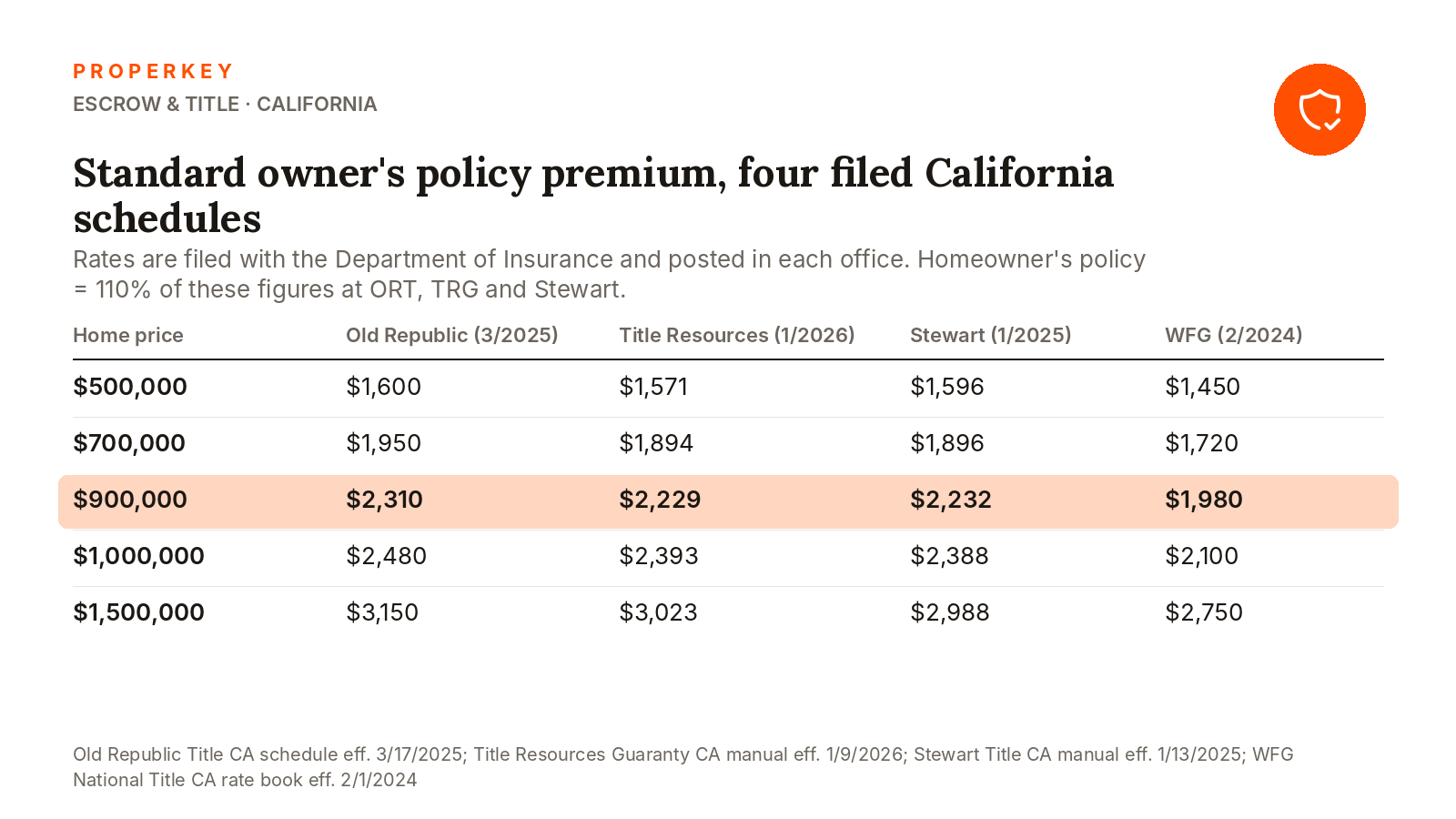
California rates are lookup tables, not percentages. Old Republic's filed schedule, still its current posted schedule as of November 2026, prices a CLTA standard owner's policy at $1,600 for a $500,000 home, $1,950 at $700,000, $2,310 at $900,000, $2,480 at $1 million and $3,150 at $1.5 million; the ALTA Homeowner's policy for one-to-four-unit homes is $1,760, $2,145, $2,541, $2,728 and $3,465 at the same points (Old Republic rate table). Amounts round up to the next $10,000 row.
The other filed schedules sit close by. Title Resources Guaranty's California manual effective January 9, 2026 lists a standard owner's policy at $1,571, $1,894, $2,229 and $2,393 for $500,000, $700,000, $900,000 and $1 million, with the Homeowner's policy at 110% of the schedule (TRG California Rates and Rules Manual). Stewart Title's residential rate, effective January 13, 2025, is $1,596, $1,896, $2,232 and $2,388, adding $6 per $5,000 above $1 million (Stewart California Rate Manual). WFG National Title's partial schedule effective February 1, 2024 is a little lower at $1,450, $1,720, $1,980 and $2,100 (WFG California rate book). The marginal rate falls as price rises: Old Republic's standard policy works out to about $3.20 per $1,000 at $500,000 and about $1.34 per $1,000 between $1 million and $1.5 million.
Shopping is legal and the regulator recommends it. "Every title insurer, underwritten title company, and controlled escrow company shall file with the commissioner its schedules of rates," and no rate may be used before its effective date and 30 days of public display in the insurer's offices (Ins. Code §12401.1; §12401.7). The Department of Insurance's consumer guide adds: "Since each company's loss experience and expenses differ, the rates will differ as well, so you can save money by comparing rates," and "the person who pays for the policy selects the title insurance company" (California Department of Insurance).
What does the lender's policy cost?
Less, because it is issued alongside the owner's policy and covers only the loan balance. Old Republic's concurrent ALTA loan policy is $1,015 on a $500,000 purchase, $1,226 at $700,000, $1,429 at $900,000 and $1,504 at $1 million when the owner's policy is standard coverage; if the owner's policy is also extended coverage, "the Loan Policy premium is $500.00" (Old Republic). TRG charges a flat $150 for a standard loan policy issued with a standard or Homeowner's owner's policy; Stewart charges $175 plus any increased liability (TRG; Stewart). Most lenders insist on the extended ALTA form, so the $1,000–$1,500 column is the realistic one for a purchase.
The federal Closing Disclosure shows this oddly. The CFPB's TRID factsheet requires the lender's line to show "the full lender's premium, not the discounted, or simultaneous, rate," and the owner's line to show the full owner's premium plus the simultaneous lender's charge minus the full lender's premium, labeled "Title – Owner's Title Policy (optional)" unless the seller pays it (CFPB TRID title insurance factsheet). The two lines add up to the right total, but neither matches the title company's invoice line by line.
On a refinance there is no owner's policy, and California schedules price the new lender's policy on a separate residential refinance rate: Old Republic's is $645 at $500,000, $800 at $700,000 and $1,100 from $900,000 to $1 million, against $1,360–$2,108 for the same policy on a purchase; TRG's flat table runs $1,000 at $500,001–$550,000 to $1,700 at $1,000,001–$1,500,000 (Old Republic; TRG). None of the California manuals ties the discount to the age of the prior policy; the refinance rate applies regardless.
Who pays the premium in California?
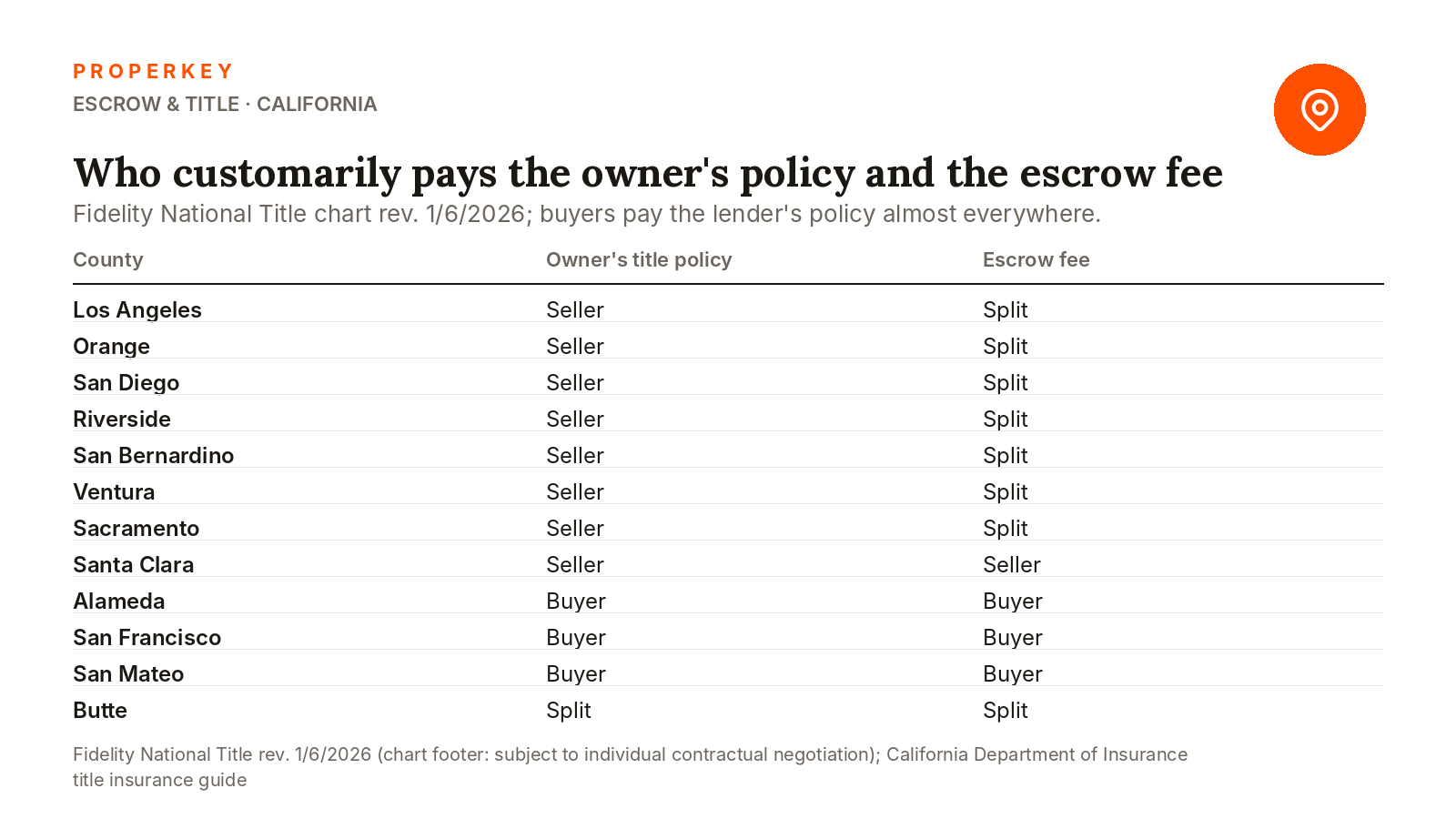
Custom, county by county, and the custom is written down. "The party that pays the title premium is a matter of local custom and practice and not set by law. … In Southern California, the seller customarily pays the premium for title insurance. It has been the practice in Northern California that the buyer customarily pays the premium for title insurance, or occasionally the premium is split between buyer and seller. In almost every county, the buyer pays the lender's policy premium" (California Department of Insurance). Fidelity National Title's chart, revised January 6, 2026, lists the seller as the customary payer of the owner's policy in Los Angeles, Orange, San Diego, Riverside, San Bernardino, Ventura, Santa Clara and Sacramento counties; the buyer in Alameda, San Francisco and San Mateo; and a split in Butte (Fidelity National Title, "Who Pays What in California"). The chart's own footer says every item "is subject to individual contractual negotiation," and the C.A.R. purchase agreement has a checkbox for it. Properkey's guide to who pays for title insurance in California goes county by county.
What does the extra 10% for the Homeowner's policy buy?
Coverage for things that happen after the policy date and for problems a records search cannot find. Chicago Title's comparison of the standard ALTA owner's policy with the Homeowner's policy lists, as Homeowner's-only coverages, post-policy forgery and impersonation, structural encroachments built by neighbors after the policy date, building-permit violations, subdivision-law violations and zoning-law violations (the permit and encroachment items "subject to deductible amounts and maximum limits of liability"), and automatic inflation protection: "The policy amount automatically increases by ten percent per year for five years, up to 150% over the original policy amount" (Chicago Title; Old Republic policy comparison). On the $900,000 example the upgrade is $231 at Old Republic, paid once. Whether the buyer or the seller pays it follows the same county custom as the base policy, so a Southern California buyer who wants the Homeowner's form usually negotiates the difference or asks the seller to order it.
The lender's policy is "usually required to get a mortgage loan" and "protects only the lender's financial interests" (CFPB; ALTA). The owner's policy is the one that protects the buyer's equity, and "for a one-time fee paid at closing, an owner's policy can protect your property rights for as long as you or your heirs own the property" (ALTA HomeClosing101). Properkey's explainer on the preliminary report versus the policy covers what the policy does and does not insure.
Why the premium is small next to the risk
The industry wrote $18.5 billion in premiums in 2025, up 13.8%, with California's $1.6 billion the third-largest state total, and paid more than $667 million in claims (ALTA, May 22, 2026). Most of the premium pays for the search and the curative work before closing, which is why premiums are paid "only once, at the close of escrow. There are no continuing premiums like other types of insurance" (California Department of Insurance). Set against a $899,720 median home and a $719,776 loan at the current 7.11% Freddie Mac rate (Freddie Mac PMMS, Nov. 12, 2026), the owner's premium is about a quarter of one percent of the price, and the buyer who is in Northern California or has negotiated to pay it should budget it alongside the escrow fee. Properkey's broker escrow, used on transactions where Properkey is the broker, orders the title work as one of its four steps; the insurance desk handles the hazard policy the lender also requires.
Questions people ask
Is title insurance required in California?
No law requires it. Lenders require a loan policy as a condition of the mortgage; the owner's policy is optional for the buyer and labeled "(optional)" on the Closing Disclosure when the buyer pays it. Buying a home for cash without an owner's policy is legal and rare.
Can you shop for title insurance?
Yes. Rates are filed and public, every insurer's schedule is posted in its offices, and the party paying picks the company. Ask the escrow holder for two quotes at the purchase price and the loan amount.
Why are there two title charges on my Closing Disclosure?
One is the lender's policy, one is the owner's. Federal rules require the lender's line to show the full stand-alone premium even when a simultaneous-issue discount applies, so the owner's line is adjusted to make the total correct.
Does the premium change with my down payment?
The owner's premium follows the purchase price; the lender's premium follows the loan amount. A larger down payment lowers only the second.
This article summarizes filed rate schedules, statutes and published customary-practice charts as of November 13, 2026; it is not legal or insurance advice. Premiums are set by each insurer's filed schedule at the actual price and loan amount.
Sources: Old Republic Title, California Partial Schedule of Title Insurance Premiums (eff. 3/17/2025) · Title Resources Guaranty Co., California Rates and Rules Manual (eff. 1/9/2026) · Stewart Title Guaranty, California Rate Manual (eff. 1/13/2025) · WFG National Title, California rate book (eff. 2/1/2024) · Ins. Code §12401.1 · Ins. Code §12401.7 · California Department of Insurance: title insurance consumer guide · CFPB TRID title insurance disclosures factsheet · CFPB: lender's title insurance · Fidelity National Title: Who Pays What in California (rev. 1/6/2026) · Chicago Title: Homeowner's Policy comparison · Old Republic: 2021 ALTA owner's vs Homeowner's policy comparison · ALTA 2025 premium volume release · ALTA title insurance FAQ · ALTA HomeClosing101 · C.A.R. September 2026 sales and price report · Freddie Mac PMMS, Nov. 12, 2026
Written by Keyro, Properkey's AI. Properkey, DRE #01979718.



