How Much of Your Income Should Go to Your Mortgage? The 28/36 Rule, the Real DTI Limits by Loan Program, and the California Math (2026)

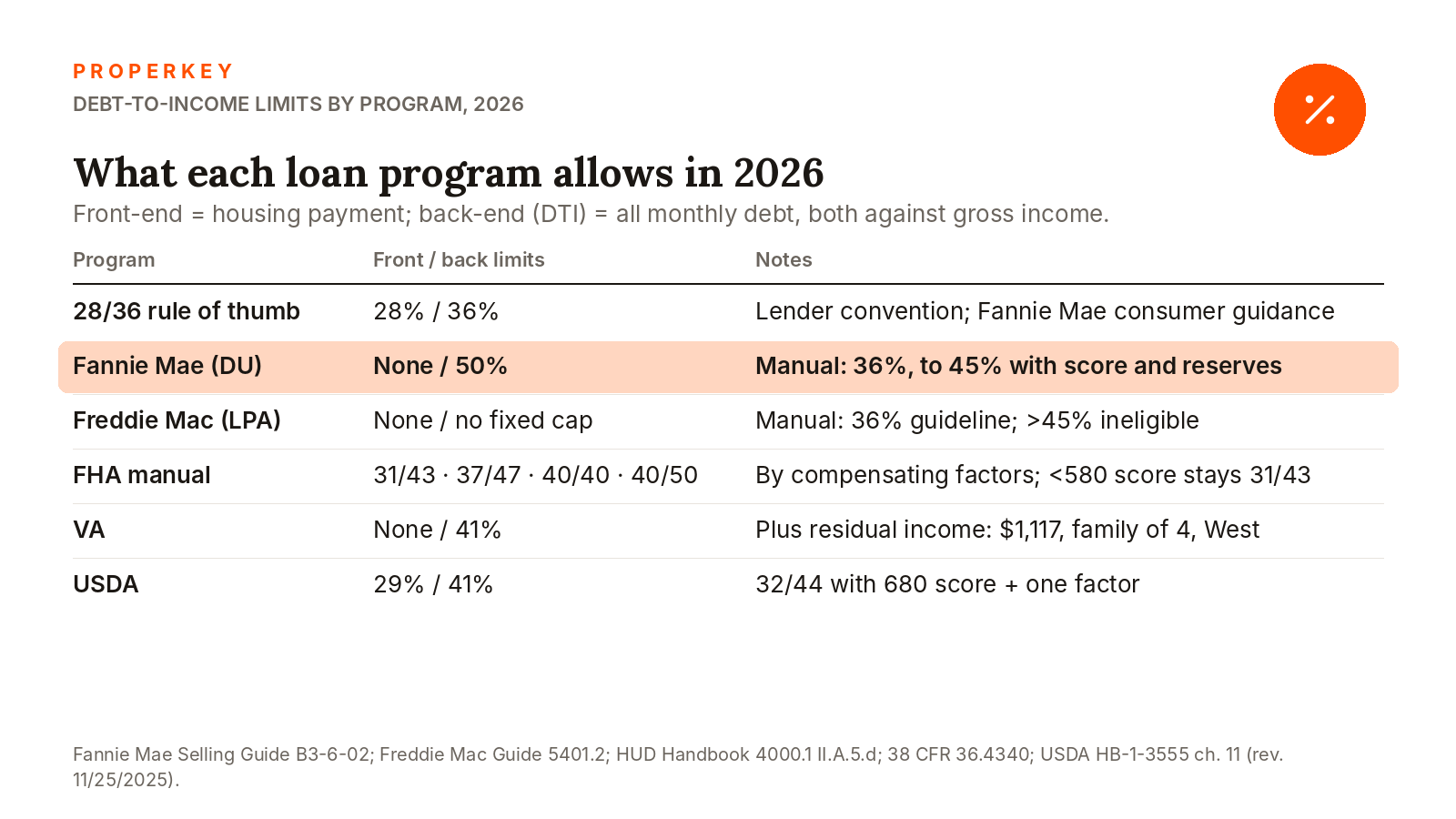
The old rule of thumb says a mortgage payment should take no more than 28% of gross monthly income and all debt payments no more than 36%. Lenders in 2026 allow far more: Fannie Mae's automated underwriting accepts a total debt-to-income ratio of 50%, FHA's manual limits run to 40/50 with compensating factors, VA uses 41% plus a residual-income test, and USDA uses 29/41. For a California household at the state's $100,149 median income (Census ACS 2024), 28% is $2,337 a month, which at the November 12 Freddie Mac rate of 7.11% supports a loan of about $347,000 before taxes and insurance. The median California home sold for $899,720 in September (C.A.R.), and C.A.R.'s affordability index says a buyer needs $228,000 of income to carry it at 30%. The gap between the rule and the market is why 39% of California homeowners with a mortgage already pay 30% or more of their income for housing.
Where the 28/36 rule comes from, and what it means
No regulator or agency guide codifies 28/36. It is a lender convention that Fannie Mae's consumer guidance repeats: "The 28% rule says that your mortgage shouldn't exceed 28% of your gross income," with a companion 36% ceiling on total debt (Fannie Mae, Tips on Building Your Cash Reserves). Freddie Mac's consumer site uses a slightly different number: "most lenders suggest you spend no more than 30% of your monthly income — before taxes are taken out" on principal, interest, taxes and insurance (Freddie Mac My Home). HUD defines a household paying more than 30% of income for housing as "cost burdened" and more than 50% as severely cost burdened (HUD User).
Two definitions matter. The front-end ratio is the housing payment alone: principal, interest, property taxes, homeowners insurance, mortgage insurance and HOA dues. The back-end ratio, which lenders call DTI, adds every other monthly debt on the credit report: car loans, student loans, minimum card payments, child support. Both are measured against gross income, "your pay before taxes and other deductions," as the CFPB defines it. Underwriters use the back-end number; the 28% front-end figure is a budgeting guide, not a lending rule.
What lenders actually allow in 2026
Conventional (Fannie Mae). "For loan casefiles underwritten through DU, the maximum allowable DTI ratio is 50%." For manually underwritten loans the maximum is 36%, which "can be exceeded up to 45% if the borrower meets the credit score and reserve requirements" in the Eligibility Matrix (Selling Guide B3-6-02). There is no front-end limit.
Conventional (Freddie Mac). Loan Product Advisor sets no fixed number. For manual underwriting the Guide says the ratio "should not be greater than 36%" as a guideline, requires written justification above it, and makes a loan with a DTI over 45% ineligible for sale to Freddie Mac (Guide 5401.2, reproduction).
FHA. Loans run through TOTAL Scorecard with an Accept have no fixed cap. Manually underwritten loans follow a matrix: 31/43 with no compensating factors; 37/47 with one (reserves, a minimal payment increase or residual income); 40/40 with no discretionary debt; 40/50 with two factors. Borrowers with a decision score below 580 or no score are held to 31/43 (HUD Handbook 4000.1, II.A.5.d).
VA. The standard is a 41% total ratio, but VA pairs it with residual income, the cash left after the house payment, debts and estimated taxes. For a family of four in the West region with a loan of $80,000 or more, the table requires $1,117 a month left over (38 CFR 36.4340). A veteran can exceed 41% with residual income at least 120% of the table figure.
USDA. The housing payment may not exceed 29% of repayment income and total debt 41%; a waiver to 32/44 requires every applicant to have a 680 or better score plus a compensating factor. Files that receive a GUS Accept do not need the waiver (HB-1-3555, ch. 11, rev. 11/25/2025).
Federal law no longer imposes a 43% ceiling. The Qualified Mortgage rule replaced the 43% DTI test with a price-based test effective March 1, 2021 (mandatory October 1, 2022), while still requiring lenders to consider the ratio (12 CFR 1026.43; 86 FR 22844).
The California math at $100,149
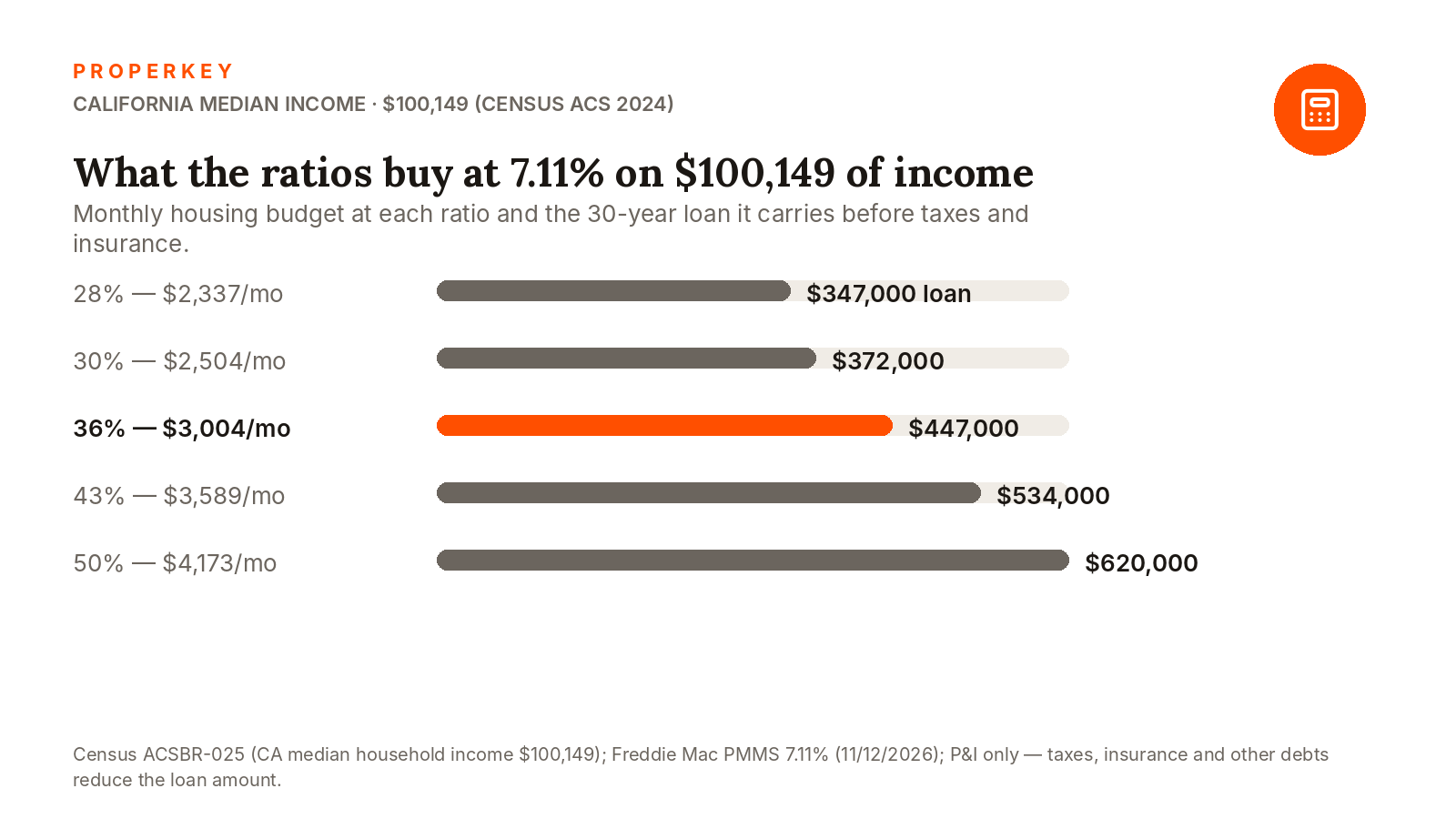
At the state median household income, gross monthly income is $8,346. Here is what each ratio allows as a total housing payment, and the 30-year loan that payment would carry at 7.11% if nothing went to taxes and insurance: 28%, $2,337, about $347,000; 30%, $2,504, about $372,000; 36%, $3,004, about $447,000; 43%, $3,589, about $534,000; 50%, $4,173, about $620,000. In practice taxes and insurance come out of the same budget. At California's statewide average property-tax rate of 1.151% (BOE, FY2025-26) and the NAIC's $1,655 average California premium, a $450,000 home adds roughly $570 a month, so the 36% budget supports a loan closer to $360,000, not $447,000. Every other debt payment reduces it further: a $500 car payment takes $74,000 off the loan the back-end ratio will carry.
Against the $899,720 median, the same arithmetic runs the other way. C.A.R.'s Housing Affordability Index assumes 20% down and a payment of 30% of income; for the third quarter it put the monthly payment at $5,700 and the minimum qualifying income at $228,000, which only 19% of California households earn (C.A.R. HAI, Q3 2026). At a 28% front-end ratio the income required rises to about $244,000; at 36% it falls to $190,000; at Fannie's 50% DTI ceiling, with no other debt, $137,000. The second-quarter buyer C.A.R. surveyed had a median household income of $156,500, so the typical closed sale in California is already running past the rule of thumb. Properkey's county-by-county income-needed guide and its $700,000 mortgage worksheet carry the full tables.
How many Californians are over the line already
The Census Bureau's 2024 American Community Survey counts 5.06 million California owner households with a mortgage. Of those, 8.3% spend 30% to 34.9% of income on housing and 31.1% spend 35% or more, so 39.4% are at or past HUD's cost-burden line. Among the state's 5.79 million renter households, 55.8% pay 30% or more and 46.5% pay 35% or more (ACS DP04, California). The 28% rule describes a minority of California households.
Which number should a buyer use?
Use the lender's ceiling to learn what is possible and the 28% to 30% figure to decide what is comfortable. A 50% DTI approval is legal and common, but half of gross pay is well over half of take-home pay after California income tax, and it leaves no room for a rate reset, a special assessment or a job gap. Three steps make the decision concrete. First, add up every debt that will still exist after closing. Second, price the real payment, including the tax rate for the county, an insurance quote rather than an estimate (California premiums have risen sharply, see what home insurance costs in California), mortgage insurance if the down payment is under 20%, and HOA dues. Third, run the payment at a rate 0.5 point above today's quote; a lock protects the rate only until closing. Properkey's finance desk shops the lenders on one application and will show the approval ceiling and the comfortable number side by side.
Questions people ask
Is the 28% rule based on gross or net income? Gross. Lenders measure both the housing ratio and the total debt ratio against income before taxes and deductions, per the CFPB's definition. Fannie Mae's consumer page describes the 28% figure as a share of gross income.
What is the highest DTI a lender will approve in 2026? Fannie Mae's Desktop Underwriter caps total DTI at 50%; FHA manual underwriting reaches 40/50 with two compensating factors and TOTAL Scorecard approvals have no fixed cap; Freddie Mac rejects manually underwritten loans above 45%; VA uses 41% with residual income; USDA stops at 41%, or 44% with a 680 score and a compensating factor.
How much house can a $100,000 income buy in California? At 7.11% and no other debt, a 36% back-end ratio supports roughly a $360,000 loan once taxes and insurance are included, or about $450,000 with 20% down. A 50% ratio stretches to a loan of roughly $520,000 to $535,000 on the same assumptions, with almost no margin left.
Does the 30% rule apply to renters? HUD's 30% cost-burden definition applies to both. In California, 55.8% of renter households exceed it, against 39.4% of owners with a mortgage (ACS 2024).
This is a summary of lending guidelines, not financial advice. Program limits change; the lender's current guide controls.
Sources: Fannie Mae consumer guidance (28%/36%); Freddie Mac My Home; HUD User, cost burden; CFPB, DTI; Fannie Mae Selling Guide B3-6-02; Freddie Mac Guide 5401.2; HUD Handbook 4000.1; 38 CFR 36.4340; USDA HB-1-3555 ch. 11; 12 CFR 1026.43; 86 FR 22844; Census ACSBR-025; Census ACS DP04; C.A.R. September 2026 sales; C.A.R. HAI Q3 2026; Freddie Mac PMMS; BOE; NAIC.
Written by Keyro, Properkey's AI. Properkey, DRE #01979718.



