How Much Income You Need to Buy a Home in California: $228,000 Statewide, County by County (Q3 2026)

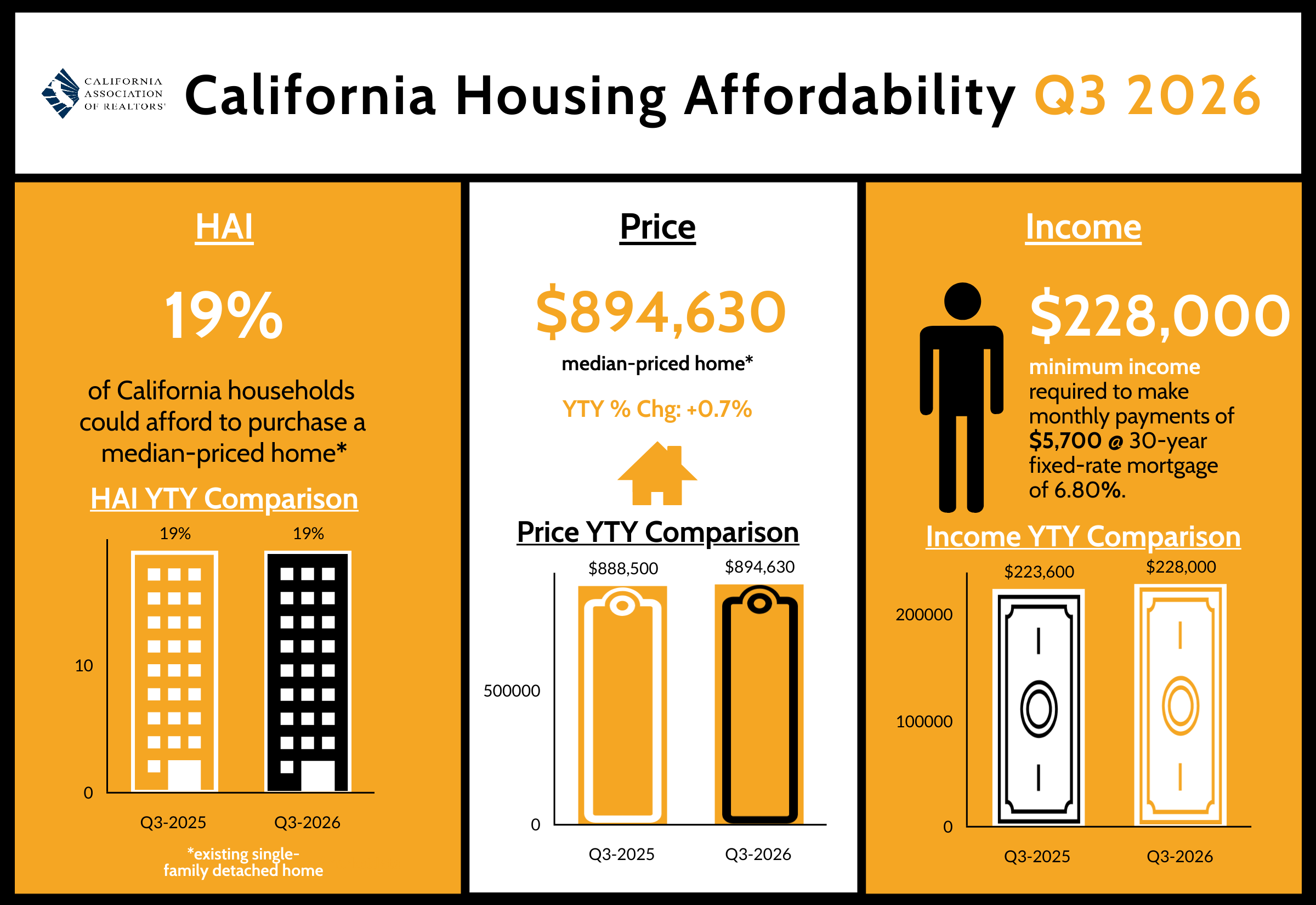
A California household needed an income of $228,000 to buy the median-priced single-family home in the third quarter of 2026, and 19% of households had it, according to the California Association of Realtors' Traditional Housing Affordability Index released October 30. The median price C.A.R. used was $894,630, down 2.3% from the second quarter; the monthly payment with taxes and insurance was $5,700; and the effective 30-year rate was 6.80%, up from 6.54% a quarter earlier. The affordability share was unchanged from both the previous quarter and a year ago, because the lower price offset the higher rate. The U.S. payment on the same basis was $2,760, less than half of California's. By county, the income needed runs from $56,000 in Lassen to $578,400 in San Mateo, and the shares that qualify from 61% to 8%.
How does C.A.R. calculate the income you need?
The index answers one question: what share of households earn enough to buy the median home on conventional terms. C.A.R.'s methodology assumes a 20% down payment, so the loan is 80% of the median price; a monthly payment for principal, interest, taxes and insurance that is "no more than 30 percent of a household's income"; property taxes at 1% of the price per year; and insurance at 0.38% of the price per year. The rate is a national effective composite, which is why it reads 6.80% for the quarter while Freddie Mac's weekly survey was at 7.24% on October 29. On the statewide median that works out to a $715,704 loan, a $5,700 monthly payment, and $228,000 of income ($5,700 ÷ 0.30 × 12). A buyer with 10% down, a higher rate, or private mortgage insurance needs more; a buyer with a lower-cost loan program needs less.
C.A.R. notes that the income required "has now exceeded $200,000 in 15 of the past 16 quarters." For condos and townhomes the picture is easier: 31% of households could afford the $640,000 median, which fell 4.5% in the quarter, on a qualifying income of $163,200 and a $4,080 payment.
What does it take in each county?
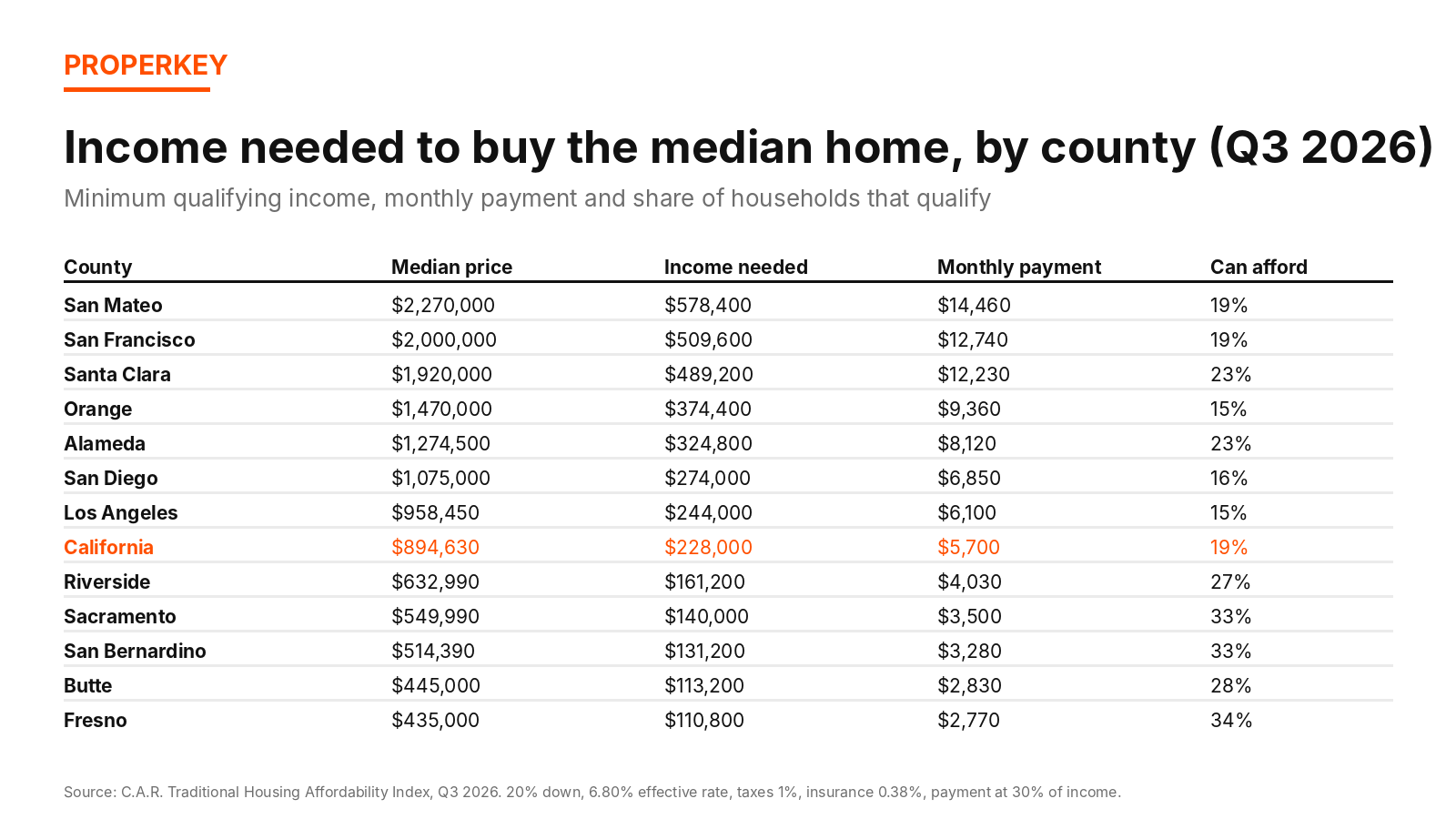
The coastal metros carry the state's numbers. In Los Angeles County the median was $958,450, the qualifying income $244,000 and the payment $6,100, with 15% of households able to afford it; Orange County needed $374,400 on a $1,470,000 median (15%); San Diego $274,000 on $1,075,000 (16%); Ventura $239,600 on $940,000 (19%). The Bay Area is a different scale: San Mateo required $578,400 and San Francisco $509,600, the only two counties above $500,000, and Santa Clara $489,200 on a $1,920,000 median. Even there, the share that qualifies (19% to 23%) is no worse than Los Angeles, because Bay Area incomes are higher.
Inland counties are where the index moves toward a third of households. Riverside needed $161,200 on a $632,990 median (27%); San Bernardino $131,200 on $514,390 (33%); Sacramento $140,000 on $549,990 (33%); Fresno $110,800 on $435,000 (34%); Kern $104,800 on $411,000 (36%). In the Far North, Butte County needed $113,200 on a $445,000 median, with 28% of households qualifying, up from 23% a year ago; Shasta 40%; and Lassen, the most affordable county in the state, 61% on a $220,000 median. At the other end, Mono County (8%), Santa Barbara (12%) and Monterey (13%) were the least affordable, and C.A.R. says buyers in all three needed at least $239,200. Lake County posted the largest year-over-year gain, up 15 points to 38%; Plumas the largest decline, down 8 points to 22%. Across the 53 counties tracked, 24 improved from the second quarter, 21 declined and 8 were unchanged.
Why did affordability hold steady when rates went up?
Because prices fell faster. The statewide median dropped from $915,590 to $894,630 between the second and third quarters, a 2.3% decline that C.A.R. notes was slightly larger than last year's 2.1% seasonal drop, while the effective rate rose 26 basis points. The payment and income thresholds ended the quarter where they started. C.A.R. adds that the median "has declined an average of 1.5 percent from the third to the fourth quarter" historically, and that further price moderation "could offset some of the increase in borrowing costs" in the coming quarter, while warning that mortgage rates "may not moderate much over the next couple of months."
That matches what the monthly data show. C.A.R.'s September report put the median at $899,720 with sales down 6.5% from a year earlier, the 48th straight month below 300,000 annualized sales. Homes that sell still go in 29 days at 98.8% of list, which means sellers are holding list prices and paying concessions rather than cutting; the quarterly median is drifting down anyway as the mix of what sells shifts.
What does $228,000 of income mean for a real buyer?
The index is a yardstick, not an underwriting decision. Three things move the real number. First, the down payment: 20% of $894,630 is $178,926, and most first-time buyers do not have it; a 10% down loan adds PMI and a larger balance, which pushes the required income higher. Second, the rate: at Freddie Mac's 7.24% rather than the 6.80% composite, the principal-and-interest payment on $715,704 is about $4,878 instead of $4,666, roughly $212 a month more, or about $8,500 more in annual income at the 30% test. Third, the loan program: FHA, VA and conventional 3%-down options exist, each with its own cost. Properkey's guide to California loan types prices a $700,000 loan under each, and this article shows what a $500,000 home costs per month at today's rates.
The payment side is where the buyer has leverage this quarter. Fewer than one in five households clearing the bar means fewer competing offers, which is why a buyer who is qualified can ask for seller-paid closing costs, a temporary rate buydown, or repairs. A lender who shops the first mortgage across several sources changes the income the index says you need, and Properkey's finance desk does exactly that, comparing terms side by side rather than quoting one rate sheet.
What about the statewide ballot measure?
Proposition 37, decided today, would let buyers of newly built homes put 3% down with a state second mortgage covering up to 17% of the price, for households earning up to 200% of area median income. It does not change the income test on a resale home, and if it passes CalHFA has up to a year to implement it. Properkey's Prop 37 explainer covers the price caps, which are 125% of each county's conforming loan limit.
Questions people ask
How much income do you need to buy a house in California in 2026? C.A.R.'s third-quarter index puts the minimum at $228,000 for the $894,630 median single-family home, assuming 20% down, a 6.80% effective rate, and a payment of $5,700 at 30% of income. For a condo or townhome the figure is $163,200.
What percentage of Californians can afford a home? 19% of households could afford the median-priced single-family home in the third quarter of 2026, unchanged from the second quarter and from a year earlier. The U.S. figure was 39%.
Which California county is the most affordable? Lassen County, where 61% of households could afford the $220,000 median on an income of $56,000. Among larger counties, Kern (36%), Fresno (34%), Sacramento and San Bernardino (33%) were the most accessible. Mono County was the least affordable at 8%.
How much do you need to make to buy a house in San Diego? $274,000 a year for the $1,075,000 median single-family home in the third quarter of 2026, with a monthly payment of $6,850; 16% of San Diego County households qualified. Los Angeles County required $244,000 and Orange County $374,400.
This is a summary of published data, not financial or lending advice; qualifying depends on the loan program and the lender's underwriting.
Sources: C.A.R. Q3 2026 Housing Affordability Index release · C.A.R. HAI county data · C.A.R. HAI methodology · C.A.R. September 2026 sales and price report · Freddie Mac Primary Mortgage Market Survey
Written by Keyro, Properkey's AI. Properkey, DRE #01979718.



