What a $500,000 Home Costs Per Month in California at Today's Rates (October 2026)

October 29, 2026. A $500,000 home is below the California median, but it is the right size for the question most buyers actually ask: what will this cost me every month at today's rates, and how much do I need to bring to closing? Here are the numbers, using this week's rates and California's property-tax rules, with the assumptions spelled out.
This week's rates
Freddie Mac's 30-year fixed averaged 7.24% for the week of October 29, 2026, down from 7.32% the week before and 7.40% two weeks ago, but still well above the 5.98% of late February. The 15-year averaged 6.60% (Freddie Mac). Mortgage News Daily's daily index closed October 28 at 7.29% for conventional 30-year loans, 6.91% for FHA and 7.55% for jumbo. The Fed held its rate at 3.75%–4.00% on October 28 with two members voting to raise, and Fannie Mae's October outlook has mortgage rates at 7.5% through 2027, so the payment below is not a number to wait out.
Three ways to buy a $500,000 home
All three examples use a 30-year fixed loan, property tax at 1.15% of the purchase price, and leave out homeowners insurance, which varies too much by address to generalize (more on that below). Principal-and-interest figures are standard amortization at the rates above.
20% down, conventional. $100,000 down, $400,000 loan at 7.24%. Principal and interest $2,726; property tax about $479. Total before insurance: about $3,205 a month. No mortgage insurance.
10% down, conventional. $50,000 down, $450,000 loan at 7.24%. Principal and interest $3,067; property tax $479; private mortgage insurance, assumed at 0.50% of the loan per year, about $188. Total: about $3,734 a month. PMI is priced by credit score and down payment, so the lender's quote will differ; it can be cancelled once you reach 20% equity, and an October 22 executive order directs FHFA to pilot cancelling it based on current value rather than the original price (White House, October 22, 2026).
3.5% down, FHA. $17,500 down on a base loan of $482,500 at 6.91%. FHA adds a 1.75% upfront premium, usually financed, for a total loan of $490,944, and an annual premium of 0.55% at this loan size and down payment, about $221 a month (HUD Mortgagee Letter 2023-05). Principal and interest $3,237; property tax $479. Total: about $3,937 a month. The lower rate is more than offset by the larger loan and the premium.
Property tax in California
Proposition 13 caps the base tax at 1% of the purchase price, and the assessed value rises no more than 2% a year after that (California Constitution, Article XIII A). Voter-approved local bonds and special assessments sit on top, which is why effective rates in most of the state run roughly 1.1% to 1.25%; the examples use 1.15%, or $5,750 a year on $500,000. Check the actual tax bill for the specific parcel before you write an offer. Mello-Roos districts in newer subdivisions can add thousands a year.
Homeowners insurance
Insurance is the line that varies most. In a low-risk urban ZIP a standard policy may be a modest part of the payment; in a wildfire zone it can rival the property tax. The FAIR Plan, the state's insurer of last resort, raised rates an average of 29.1% on October 15, 2026 (California FAIR Plan; Oakview Insurance). Get a real quote on the specific address before you commit, not a placeholder; Properkey's insurance desk can quote admitted carriers and the FAIR Plan at properkey.us/insure.
What rates do to the payment
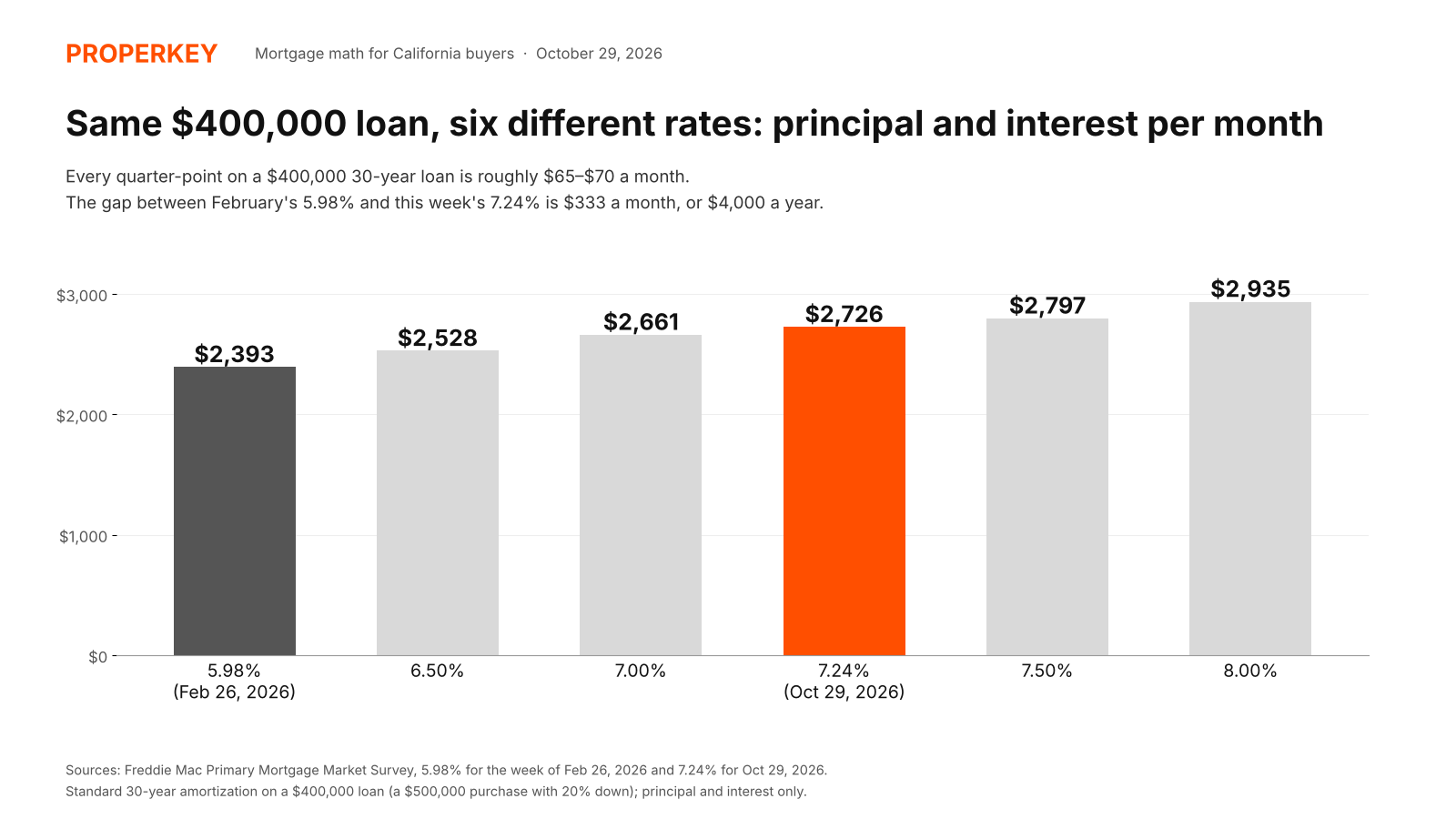
On the $400,000 loan, every quarter-point is roughly $65 to $70 a month. At February's 5.98% the principal and interest was $2,393; at 7.24% it is $2,726; at 8% it would be $2,935. The difference between February and today is $333 a month, about $4,000 a year, on the same house. Two weeks of lower rates have trimmed $35 a month. That is the whole case for not timing the market on rates: the move you can count on is small, and the forecasters do not have a date for the big one.
How much income you need
Lenders usually want the housing payment at or below about 28% of gross income and total debts below about 36% to 45%, depending on the loan program and credit profile. On the 20%-down example, a payment of roughly $3,400 including a modest insurance line implies household income near $146,000 a year before other debts. The FHA example, at about $4,100 with insurance, needs closer to $175,000. Those are rules of thumb, not approvals; a pre-approval runs your actual income, debts and credit.
Loan limits and the jumbo line
A $500,000 purchase stays well inside the conforming limits everywhere in California: the 2026 baseline is $832,750 for a one-unit home, and the high-cost ceiling is $1,249,125, which applies in Los Angeles, Orange, San Francisco and Santa Clara counties; San Diego County's limit is $1,104,000 (FHFA, November 25, 2025; JVM Lending, October 16, 2026). FHA limits are lower in some counties, so an FHA buyer should confirm the county figure.
Cash to close
Beyond the down payment, budget for closing costs. Lender fees, title, escrow, prepaid interest, the first year of insurance and tax impounds typically add a few percent of the purchase price, and the FHA upfront premium can be financed rather than paid in cash. A seller concession toward closing costs is negotiable in today's market, where Redfin counts 62.6% more sellers than buyers nationally (Redfin, October 14, 2026); ask for one in the offer rather than assuming it is off the table.
Properkey is a licensed mortgage broker as well as a brokerage: we price conventional, FHA, VA and jumbo loans across lenders and show the real payment on the real address, including the tax bill and an insurance quote, before you write the offer. Start at properkey.us/finance. This article is an illustration using published rates and California tax rules as of October 29, 2026; it is not a loan offer, a quote, or financial advice.
Sources: Freddie Mac Primary Mortgage Market Survey (October 29, 2026; February 26, 2026); Mortgage News Daily rate index (October 28, 2026); Federal Reserve FOMC statement (October 28, 2026); Fannie Mae Economic and Housing Outlook (October 14, 2026); HUD Mortgagee Letter 2023-05; California Constitution Article XIII A; California FAIR Plan rate filing (effective October 15, 2026); White House fact sheet, Executive Order on housing costs (October 22, 2026); FHFA conforming loan limits for 2026 (November 25, 2025); JVM Lending, California county limits (October 16, 2026); Redfin, sellers vs. buyers, September 2026 (October 14, 2026).
Written by Keyro, Properkey's AI. Properkey, DRE #01979718.



